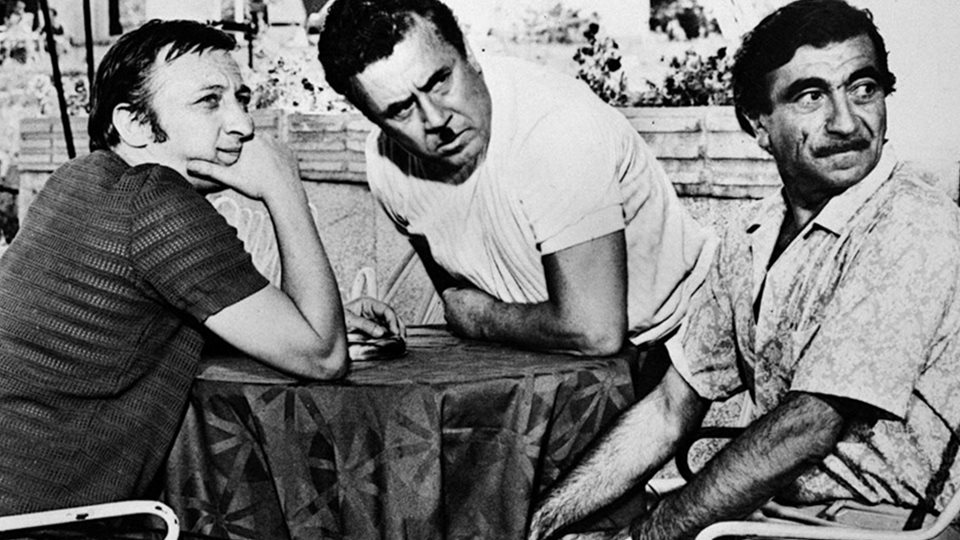
Nikola Anastasov, Georgi Kaloyanchev and Georgi Partsalev
When people talk about the great golden ages of cinema, the conversation usually drifts toward Italy, France, Japan, or perhaps Czechoslovakia and Poland if Eastern Europe enters the picture. Bulgarian cinema, by contrast, is too often treated as a footnote—mentioned briefly, vaguely, or not at all. And yet, once you truly encounter it, especially during its most fertile decades, it becomes impossible to forget.
One of the things that most captivates me about Bulgarian cinema is how abundant and prolific the comedy films and actors were during its golden age. This was not accidental, nor was it simply a matter of popular taste. Bulgarian comedy cinema became a cultural reflex, a form of collective self-recognition, and, perhaps most importantly, a way of breathing under pressure.
The golden age of Bulgarian cinema—roughly stretching from the late 1950s through the end of the 1980s—produced an astonishing gallery of actors, films, and characters that still live vividly in the public imagination. These works were not only funny; they were sharp, layered, human, and deeply observant. They laughed at power without naming it, exposed absurdity without slogans, and portrayed ordinary people with dignity even when mocking their weaknesses.
To understand why Bulgarian comedy reached such heights, one must understand the conditions under which it was made—and why laughter became one of the most reliable forms of truth.
Defining the Golden Age of Bulgarian Cinema
The golden age of Bulgarian cinema coincided with the consolidation of state-funded film production, centered largely around Boyana Film Studios. From the late 1950s onward, Bulgarian filmmakers operated within a paradoxical system: strict ideological oversight on one hand, and stable institutional support on the other. Budgets were limited but consistent. Film production was centralized, but cinema remained a mass cultural event.
Unlike today’s fragmented viewing habits, cinema during this period was communal. Films were watched together, discussed together, quoted together. Characters escaped the screen and entered daily life. Lines from comedies became part of everyday speech, gestures were imitated, faces became familiar in a way modern stardom rarely achieves.
Within this environment, comedy flourished—not because it was encouraged as escapism, but because it could do what other genres often could not: speak indirectly, metaphorically, and with emotional precision.
Comedy as Cultural Strategy
Art that feels under pressure tends to find side doors. When frontal criticism becomes impossible, metaphor sharpens. When realism risks punishment, exaggeration becomes revelation. Bulgarian comedy of the golden age understood this instinctively.
The most effective comedies of the period were never merely about laughter. They were about bureaucracy, hypocrisy, conformity, ambition, cowardice, desire, and survival. They focused obsessively on the “small man”—the clerk, the neighbor, the reservist, the repairman—because that was where truth could safely reside.
A flamboyant critique of Communism? Kit (Whale) provides one without raising its voice. Figuratively speaking, it tells the story of a tiny sprat rapidly growing into a whale within the communist bureaucracy. It is absurd, playful, and unmistakable. Everyone understood what was being said, and no one needed it spelled out.
This was the secret power of Bulgarian comedy: it trusted its audience.
A School of Faces: Actors Who Defined an Era
What truly elevates Bulgarian comedy cinema is its actors. There are cinemas with great directors, cinemas with great scripts—but few cinemas produced such an extraordinary concentration of comic performers whose faces alone could trigger laughter, recognition, or quiet sadness.
Starting with Apostol Karamitev, whose charm and intelligence made him a bridge between romantic leading man and comic observer, Bulgarian cinema quickly established a tradition of actors who felt intensely real.
Then comes Georgi Kaloyanchev—“Kalata”—truly a phenomenal actor. He is mostly remembered for his comedy films, but he was also remarkably versatile. Kaloyanchev had an instinctive understanding of timing, silence, and facial expression. He could dominate a scene without raising his voice, could suggest entire backstories with a look. Where there was chaos, Kaloyanchev was often there, grounding it, shaping it, turning it into rhythm.
It is very difficult to describe Georgi Partsalev to someone who has never seen him. Once you witness his performance, however, you can never forget it. Partsalev was not merely funny; he was fragile, anxious, deeply human. His comedy came from vulnerability rather than confidence, from hesitation rather than bravado. A film with Georgi Partsalev in it already had no chance of being bad—but in certain roles, he transcended comedy altogether.
Todor Kolev, meanwhile, is a phenomenon in himself. An ordinary, bald, short man—on paper, hardly a star. And yet his acting was nothing short of phenomenal. Kolev possessed verbal precision, physical control, and an almost musical sense of rhythm. He could charm, irritate, seduce, and expose all within a single scene. He was not just an actor; he was an event.
Then there is Georgi Rusev—one of those rare performers for whom comparisons feel inadequate. It is very, very hard to find his equal in other cinemas. Rusev had gravity. When he entered a film, the temperature changed. His presence added weight even to the lightest scenes, and when paired with actors like Kolev, the result was electric.
Grigor Vachkov was another unique force—an actor who locked you to the screen. Nikola Anastasov brought a different comic energy, while Kiril Gospodinov and Konstantin Kotsev, though less internationally known, were in no way inferior. To these, we can add Stefan Danailov, who, although mostly remembered for serious roles, also possessed a strong and often underestimated comedic side.
Together, these actors formed something like a repertory company of national memory.
Early Classics and the Formation of a Comic Language
Among the earliest milestones are Lyubimetz 13 (Favourite 13) and Spetzialist po vsichko (Jack-of-All-Trades). These films helped establish the grammar of Bulgarian screen comedy—situational humor, character-based absurdity, and a refusal to idealize authority figures.
Another early production where the funniest actors truly shine is Krivorazbranata tsivilizatsiya (The Phoney Civilization). Though it carries a musical feel, it operates as a sharp commentary on misunderstood modernity and shallow imitation. The humor is theatrical, yes, but also precise in its social observation.
These films laid the foundation for what would become a remarkably consistent comedic tradition.
Comedy, War, and Moral Absurdity
Trimata ot zapasa (Three Reservists) stands as one of the milestones of Bulgarian comedy cinema. On the surface, it is hilarious. Beneath that, it is deeply moral.
If you are a religious pacifist opposed to war and killing, what do you do on the front line? The answers—which will bring tears to your eyes—are hidden in this film. The comedy emerges not from cruelty, but from ethical tension. It laughs at war not by glorifying rebellion, but by exposing contradiction.
This balance—between laughter and conscience—is one of Bulgarian cinema’s quiet achievements.
Everyday Chaos and Collective Living
Some films are inseparable from place and atmosphere. There are Bulgarian comedies set by the sea that immediately evoke vacation, leisure, and nostalgia for supposedly simpler days—while simultaneously making you laugh until you collapse. S detza na more (Vacation with Kids) is one of those films. It smells of salt, sun, and chaos.
Then there is Toplo (The Central Warmth)—something truly unique. With an original screenplay and relentless comic energy, it turns apartment living into epic farce. If you live in an apartment building, your relationships with neighbors inevitably rise and fall. Add heating problems, incompetent repairmen who seem to be from another planet, and collective paranoia—and you have perfect chaos.
This is Bulgarian comedy at its most sociological: laughter born from proximity.
Todor Kolev at His Peak
The 1970s and 1980s contain a series of comedies starring Todor Kolev, each more legendary than the last. Dvoynikat (The Double) and Gospodin za edin den (King for a Day) are essential. The latter, with its dark humor and subtle criticism, is practically a lesson in how to smuggle philosophy into popular cinema.
But the most perfect film starring Kolev, in my opinion, is Opasen char (Dangerous Charm). You can’t help but wonder: can a film be this original and this well-acted?
The film follows the adventures of a short, bald, smooth-talking womanizer—a con artist whose power lies entirely in language, gesture, and confidence. Kolev’s delivery is astonishing. His fancy words, expressions, and rhythms create a character who is absurd, seductive, and deeply revealing.
When Georgi Rusev joins him in the second half, every second becomes top-tier humor. This is not just comedy—it is a masterclass in performance.
I truly pity cinephiles who have never even heard this film’s name.
Late-Era Energy and Ensemble Brilliance
Orkestar bez ime (A Nameless Band) captures the fertile atmosphere of the 1980s, featuring a somewhat different cast and generational tone. Music, ambition, and youth collide with reality in ways that feel both light and melancholy.
Bay Ganyo tragna po Evropa (Bai Ganyo on His Way to Europe), a television film starring Georgi Kaloyanchev in his later years, rests almost entirely on his shoulders—and he carries it effortlessly. The character becomes a mirror reflecting national insecurities, bravado, and self-delusion.
And then there is Neochakvana Vakancia (An Unexpected Vacation), the mini-series that brought together almost all the comedic geniuses of the golden age. For an entire generation of children, this series was pure joy. Kaloyanchev may stand out, but every character contributes. Individually and collectively, they bring the house down.
For me, this series represents one of the true comedic peaks of the era.
Beyond Comedy: A Living Ecosystem
While comedy was the most visible and beloved genre, it did not exist in isolation. Bulgarian cinema of the golden age also produced historical epics, psychological dramas, literary adaptations, and children’s films of remarkable sensitivity.
What makes the period remarkable is not genre dominance, but balance. Comedy absorbed the anxieties of daily life, drama explored moral interiors, and historical films negotiated national identity—all within the same institutional framework.
Bulgarian Cinema in the Eastern European Context
Compared to Czech cinema’s formal experimentation or Polish cinema’s tragic moral seriousness, Bulgarian cinema leaned toward the everyday. Its comedy was less rebellious in form, but no less subversive in effect.
Bulgarian filmmakers trusted familiarity. They believed in recognition rather than shock. And in doing so, they created a cinema that remains deeply internalized by its audience.
Why These Films Still Matter
These films are still watched. Still quoted. Still remembered. Not because they belong to a museum, but because they continue to describe human behavior with unsettling accuracy.
The laughter has aged well. The metaphors remain legible. The faces still feel familiar.
Conclusion: Laughter as Cultural Memory
The golden age of Bulgarian cinema survives not through international awards or academic canonization, but through repetition. Through memory. Through laughter passed from one generation to the next.
These comedies preserved dignity when ideology tried to erase individuality. They turned pressure into performance. And they remind us that sometimes, the most enduring truths are the ones delivered with a smile.