
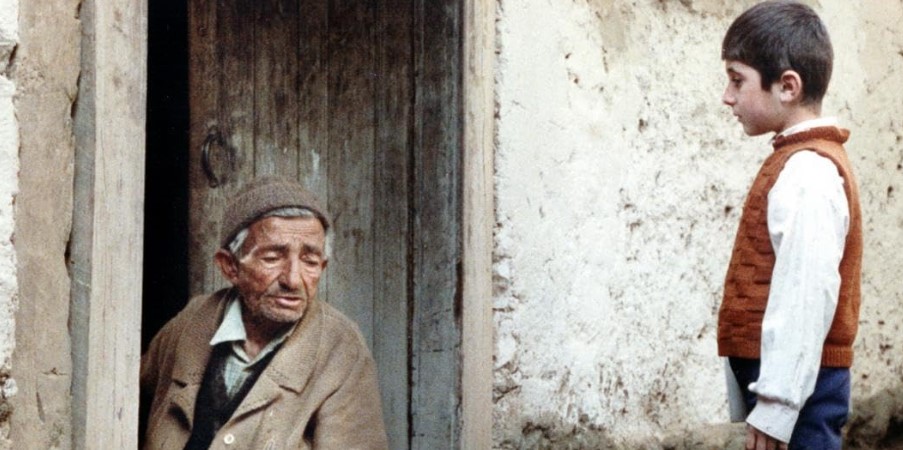
Introduction: What Is the Koker Trilogy?
The Koker Trilogy—composed of Where Is the Friend’s House? (1987), And Life Goes On (1992), and Through the Olive Trees (1994)—stands as a landmark in world cinema. Directed by Abbas Kiarostami, the trilogy takes its name from the village of Koker in northern Iran, which serves not only as the trilogy’s geographical backdrop but also as its emotional and philosophical heart. Though not a trilogy in the conventional narrative sense, these three films are deeply interconnected by their themes, location, and meta-cinematic structure.
Rather than following a single plotline or character arc, the Koker Trilogy is built on a recursive, layered exploration of life, death, art, and the resilience of ordinary people in the face of extraordinary circumstances. It is both an homage to neorealism and a radical innovation in cinematic form.
Abbas Kiarostami: A Brief Portrait of the Auteur
Before delving into the trilogy, understanding Abbas Kiarostami’s approach is crucial. A filmmaker, poet, and photographer, Kiarostami (1940–2016) is often described as one of the most significant auteurs of late 20th-century cinema. He brought Iranian cinema global acclaim while maintaining deep ties to the nation’s cultural, rural, and philosophical roots.
His style—marked by minimalism, non-professional actors, and open-ended narratives—transcends the limitations of plot. Kiarostami believed in the intelligence and creativity of the viewer. He once stated:
“The world is my imagination, and my imagination is my world.”
In the Koker Trilogy, this philosophy is fully realized.
Part I: Where Is the Friend’s House? (1987)
Plot Summary
The first film follows Ahmad, a conscientious schoolboy in the village of Koker, who mistakenly takes his classmate Mohammad’s homework notebook. Realizing that Mohammad will be punished if the notebook isn’t returned, Ahmad embarks on a quest to find his friend’s house in the neighboring village.
Style and Themes
On the surface, it’s a simple tale of childhood responsibility. But beneath this simplicity lies a profound meditation on morality, autonomy, and compassion in a rigid social structure.
- Minimalism: Long takes and static frames highlight the physical and social environment of the children.
- Non-professional actors: The performances are naturalistic, blurring the line between fiction and reality.
- Landscape as Character: The winding, hilly paths between the villages symbolize not just geography but the moral labyrinth Ahmad must navigate.
Philosophical Dimensions
“Where Is the Friend’s House?” poses its central ethical question—How far must one go for someone else’s well-being?—without moralizing. Ahmad’s journey mirrors a Sufi path toward moral clarity and spiritual obligation, aligning with Iranian mystical traditions.
Part II: And Life Goes On (1992) (a.k.a. Life, and Nothing More…)
Background: The 1990 Earthquake
Before the second film, a real-world tragedy occurred. In 1990, a devastating earthquake struck northern Iran, killing over 50,000 people and destroying large swaths of Gilan and Koker.
Kiarostami, concerned about the fate of the child actors from his earlier film, traveled to the region. This journey inspired the second installment of the trilogy.
Plot Summary
A director (played by an actor resembling Kiarostami) and his son travel from Tehran to the earthquake-stricken areas to find the child actors from Where Is the Friend’s House? As they navigate ruined villages and impassable roads, they meet various survivors who share stories of resilience and loss.
Meta-Cinema and Reflexivity
“And Life Goes On” blurs reality and fiction:
- The protagonist is a fictionalized version of Kiarostami.
- The film reflects on the making of the previous film.
- Real earthquake survivors appear in reenacted scenarios.
This recursive storytelling method forces viewers to confront the role of the filmmaker—not as a detached observer but a participant and interpreter of reality.
Central Themes
- Resilience of Ordinary People: Despite unimaginable loss, life continues—through rebuilding, soccer games, and storytelling.
- Art as Witness: The film contemplates the ethical responsibility of representing tragedy.
- Hope and Continuity: As the title suggests, the film finds life amidst ruin.
Part III: Through the Olive Trees (1994)
Plot Summary
The final film is a fictionalized account of events during the making of And Life Goes On. It follows Hossein, a young man who falls in love with Tahereh, a woman playing his wife in a scene. Off-screen, however, she refuses to speak to him. The film revolves around his persistent, respectful attempts to win her heart.
A Film Within a Film… Within a Film
This final installment reaches the trilogy’s deepest level of meta-narrative. We now watch a film about the making of a film (And Life Goes On) about the making of a film (Where Is the Friend’s House?). It’s a cinematic hall of mirrors, challenging notions of authorship, identity, and truth.
Key Elements
- Intertextuality: Viewers familiar with the earlier films gain deeper insight, but even without them, Through the Olive Trees stands alone as a love story.
- Ambiguity: The film ends on a long, distant shot of Hossein pursuing Tahereh through an olive grove. Whether she accepts him is left unresolved.
- Human Dignity: Hossein, despite his poverty and illiteracy, emerges as an emblem of determination and kindness.
Themes That Bind the Trilogy
Despite their distinct formats and increasing complexity, the three films are tied together by thematic coherence:
1. Humanism
Each film reveres the moral and emotional world of ordinary people—children, villagers, survivors. Their dignity is portrayed without sentimentality.
2. Truth and Representation
What is real, and what is constructed? Kiarostami doesn’t answer but complicates the question at each layer of the trilogy.
3. Nature and Landscape
The terrain of Koker—its hills, trees, roads, and ruins—is more than a backdrop. It acts as a philosophical and spiritual arena.
4. The Power of Cinema
Kiarostami’s trilogy is an argument for cinema as a living, breathing entity that interacts with life. Film doesn’t just reflect the world—it can shape, preserve, and even heal it.
Reception and Legacy
The Koker Trilogy received critical acclaim internationally, particularly after Iranian cinema gained recognition at festivals in the 1990s.
- Where Is the Friend’s House? won multiple awards, including at Locarno.
- And Life Goes On was lauded for its philosophical depth and screened at Cannes.
- Through the Olive Trees was a Palme d’Or contender in 1994.
Influence on Filmmakers
- Werner Herzog and Errol Morris praised Kiarostami’s blending of fiction and documentary.
- Richard Linklater acknowledged the trilogy’s influence on his Before series.
- Jafar Panahi, Kiarostami’s protégé, continued the vérité tradition with The White Balloon and The Circle.
Kiarostami’s Ethical Cinema
The Koker Trilogy exemplifies what many call “ethical cinema.” Kiarostami avoids exploiting suffering, romanticizing poverty, or editorializing moral lessons. His cinema is defined by restraint and respect.
He allows viewers to arrive at their own truths. The ambiguity in his endings is not evasive—it’s empowering.
In an era of increasingly didactic media, Kiarostami’s trust in his audience remains radical.
Cinéma Vérité and the Trilogy
While not a strict example of cinéma vérité, the Koker Trilogy shares its ethos:
- Minimal interference
- Real locations and people
- Naturalistic performances
- Blurring the boundary between observer and participant
Yet Kiarostami goes further by reflecting on the very act of filmmaking. His work is a poetic evolution of vérité—one that examines not just reality, but how we construct and perceive it.
Critical Analysis: Why It Endures
The trilogy endures not merely because it is masterfully crafted, but because it offers a profound meditation on what it means to be human in the face of adversity. It never exploits emotion; rather, it offers space for contemplation.
In a world saturated with spectacle, Kiarostami’s quiet cinema teaches us to watch slowly, to think deeply, and to feel without manipulation.
Conclusion
The Koker Trilogy is not a trilogy in the traditional sense. It is a layered meditation on life, loss, and the act of filmmaking itself. It’s an ethical, philosophical, and deeply human work of art that invites reflection, patience, and empathy.
In blending fiction with reality, simplicity with depth, and sorrow with joy, Abbas Kiarostami crafted a cinematic masterpiece that continues to inspire artists, filmmakers, and thinkers worldwide. The trilogy is a living testament to cinema’s capacity to not just depict life—but to dignify it.