
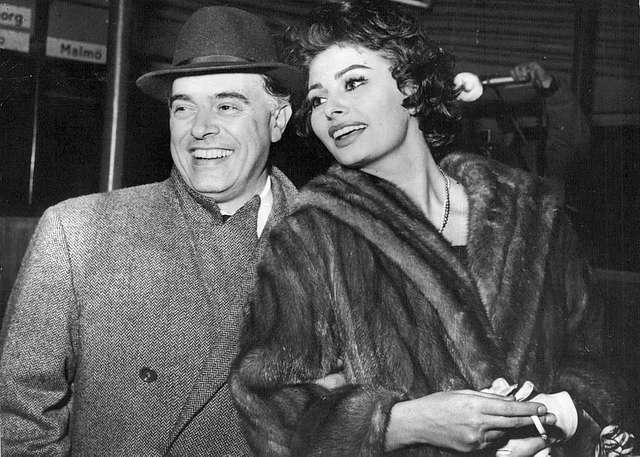
Carlo Ponti was a hugely influential figure in both Italian and international cinema. Born on December 11, 1912, in Magenta, Lombardy, he would go on to produce over 140 films, collaborate with legendary directors, define post-war Italian film, and achieve global recognition through his artistic vision and achievements.
This article explores Ponti’s life and career: his early formation, rise as a producer, his most significant collaborations, his role in Italian cinema’s “golden age,” his major awards, and his lasting legacy.
Early Life and Entry into Film
Carlo Fortunato Pietro Ponti was born into a family with a legal background and studied law at the University of Milan. After working briefly as a lawyer, Ponti transitioned into the film business—his legal and contractual expertise proving invaluable in one of Italy’s most dynamic industries.
His earliest production work dates to the early 1940s, when he contributed to films like Piccolo mondo antico (Old-Fashioned World). During this time, he worked under the Lux Film banner, navigating political restrictions of the Fascist era while helping Italian cinema maintain its creative identity.
Ponti’s ability to combine business acumen with an instinct for cinematic quality would define his future success.
Role in Italian Cinema and the Post-War Revival
Following World War II, Italian cinema underwent a remarkable rebirth. The destruction of the studio system and the realities of a war-torn nation paved the way for a new form of storytelling—one that emphasized authenticity, social truth, and human resilience. Ponti played a key role in this renaissance.
Together with his contemporary Dino De Laurentiis, Ponti helped reinvigorate post-war Italian film, producing works that balanced national identity with international appeal. His productions captured both the artistic essence of Italy and the global audience’s appetite for beauty, realism, and emotion.
This approach placed him at the center of the Italian cinema’s golden age, bridging art and commerce, local talent and global markets, neorealism and international co-production.
Key Collaborations and Unforgettable Films
Partnership with Dino De Laurentiis
In 1950, Ponti formed a partnership with Dino De Laurentiis, creating the Ponti-De Laurentiis company. Their joint venture supported some of the most significant films in post-war Italy, including early works by Federico Fellini and Vittorio De Sica.
Their collaboration brought about international successes and established Italian cinema as a major force in world film culture. Films like La Strada not only captivated audiences but also earned critical acclaim, setting the stage for Italy’s growing cinematic prestige.
Collaboration with Vittorio De Sica and Sophia Loren
Ponti’s collaboration with director Vittorio De Sica and actress Sophia Loren—his muse, partner, and eventual wife—became legendary. He discovered Loren when she was just fifteen and saw in her both beauty and rare acting talent.
Through his productions, Loren rose to international stardom, becoming a symbol of Italian grace and strength. Under Ponti’s guidance, she starred in La Ciociara (Two Women), a film that earned her the Academy Award for Best Actress—the first ever for a non-English performance.
Ponti and De Sica continued their partnership with Ieri, oggi, domani (Yesterday, Today and Tomorrow) and Matrimonio all’italiana (Marriage Italian Style), both starring Loren. These films perfectly embodied Ponti’s signature balance of emotional storytelling, realism, and international flair.
International Productions and Auteur Cinema
Ponti’s ambitions transcended Italy. He was among the first Italian producers to successfully bridge European cinema and Hollywood.
He produced Doctor Zhivago (1965), directed by David Lean—a sweeping romantic epic that became one of the most celebrated films in cinematic history. For this, Ponti received an Academy Award nomination for Best Picture.
Ponti also produced Michelangelo Antonioni’s Blow-Up (1966), a defining film of the 1960s that blurred the boundaries between art, reality, and perception. His work with Jean-Luc Godard on Contempt (Le Mépris, 1963) showcased his willingness to engage with avant-garde filmmakers and embrace cinematic experimentation.
From neorealism to auteur cinema, Ponti’s productions reflected a daring creative philosophy: cinema must evolve, take risks, and transcend borders.
Awards, Achievements, and Oscar Recognition
Carlo Ponti’s legacy is decorated with numerous achievements and honors.
He produced La Strada (1954), which won the Academy Award for Best Foreign Language Film and helped establish Italian neorealism’s international reputation.
Ieri, oggi, domani (Yesterday, Today and Tomorrow) also earned the Academy Award for Best Foreign Language Film in 1964.
His nomination for Best Picture with Doctor Zhivago cemented his status as one of the few non-American producers to attain Hollywood’s highest recognition.
In Italy, Ponti was honored with the Knight Grand Cross of the Order of Merit of the Italian Republic, acknowledging his immense contribution to the arts and culture of his country.
His motto captured his philosophy succinctly: “I make pictures, not deals.” For Ponti, the producer’s role was to create meaningful, enduring works of art—not just to manage budgets and logistics.
The Producer’s Touch: Style, Strategy, and Importance
Ponti’s influence in cinema extended beyond financial or managerial skill—he possessed an artistic vision rarely seen in producers.
- Eye for Talent: Ponti’s discovery and nurturing of Sophia Loren remain one of the most remarkable star-making stories in film history. His intuition for actors, directors, and scripts was unmatched.
- Balance of Art and Commerce: He seamlessly blended art-house sophistication with commercial success, enabling Italian films to flourish both at home and abroad.
- International Perspective: Ponti was a pioneer of the global co-production model. His ability to unite European creativity with Hollywood resources helped redefine the economics and reach of cinema.
- Genre Versatility: From neorealist dramas to sweeping historical epics and avant-garde experiments, Ponti refused to be confined by style or convention.
- Cultural Bridge: More than any other Italian producer, Ponti represented Italy’s artistic renaissance to the world. His films served as cultural ambassadors, introducing audiences to the poetry, emotion, and vitality of Italian life.
Legacy and Enduring Influence
When Carlo Ponti passed away on January 10, 2007, at the age of 94, the world of cinema mourned the loss of a visionary who helped define an era.
His films continue to inspire filmmakers and audiences alike, reminding the world that Italian cinema’s golden age was not merely a moment in time but a movement driven by ambition, collaboration, and imagination.
Ponti’s influence endures in the way modern producers approach filmmaking—with a focus on cross-cultural appeal, auteur collaboration, and artistic integrity.
He also left behind a personal legacy through his marriage to Sophia Loren, one of cinema’s most enduring icons. Together, they embodied the fusion of artistry, glamour, and authenticity that defined mid-century European cinema.
Ponti’s model of production remains instructive today: invest in art, nurture talent, bridge cultures, and never compromise quality for convenience. His success showed that a producer’s true power lies not just in raising money or assembling crews, but in believing in the transformative magic of storytelling.
Conclusion
Carlo Ponti was not simply a film producer—he was a visionary who shaped the global perception of Italian cinema. His collaborations with directors like De Sica, Antonioni, and Lean, his nurturing of Sophia Loren’s stardom, and his unrelenting pursuit of quality cinema placed him among the most important producers in film history.
He turned post-war Italian cinema into a global cultural force and helped set standards for how art and commerce can coexist. His films remain testaments to human emotion, visual beauty, and the enduring power of storytelling.
In every sense, Ponti was a true architect of modern cinema—an artist in the producer’s chair whose influence continues to illuminate the screens of the world.