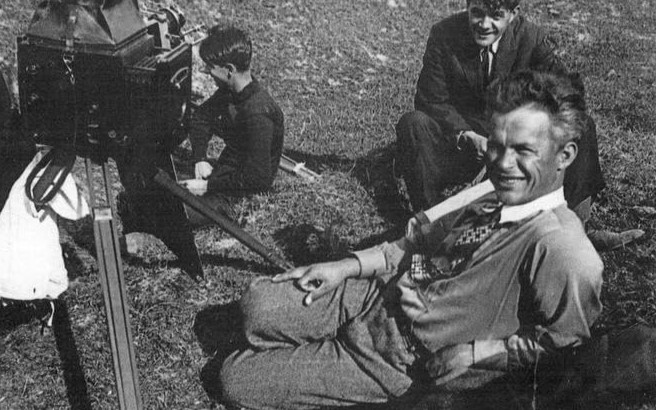
Alexander Dovzhenko is one of the most unique, visionary, and poetic filmmakers in world cinema. Often hailed as the “poet of Ukrainian cinema,” Dovzhenko transformed the visual language of early Soviet film into something uniquely lyrical — fusing avant-garde montage techniques with an almost spiritual reverence for the land, nature, and human emotion. His cinema was not simply propaganda or narrative; it was mythmaking in motion, a painter’s dream rendered on celluloid.
While contemporaries such as Sergei Eisenstein and Vsevolod Pudovkin explored dialectical montage and ideological precision, Dovzhenko spoke a different language — one of symbolism, rhythm, and visual poetry. His films — particularly Zvenigora (1928), Arsenal (1929), and Earth (1930) — transcend the boundaries of traditional storytelling. They pulse with the heartbeat of Ukrainian soil, embodying a deep spiritual connection to agrarian life and the eternal cycles of nature.
To understand Dovzhenko is to enter a world where myth and history intertwine, where images are metaphors and silence is as eloquent as speech. He was, above all, a filmmaker of emotion and essence — a man who painted with light and movement the inner life of a nation.
Early Life: From Provincial Roots to Revolutionary Art
Alexander Petrovich Dovzhenko was born in 1894 in the small Ukrainian village of Sosnytsia, then part of the Russian Empire. The son of peasants, he grew up surrounded by the rhythms of rural life — the seasons, the land, the folklore, and the unbroken continuity of family and community. These experiences would become the bedrock of his cinematic imagination.
Unlike many of his contemporaries who came from intellectual or urban backgrounds, Dovzhenko’s early years were steeped in peasant authenticity. He was not merely representing the countryside in his films; he was of it. The imagery that fills his later works — wheat fields bending under the wind, wide skies over rolling plains, faces of farmers illuminated by sunlight — all stemmed from direct, lived experience.
Before turning to cinema, Dovzhenko led a multifaceted life. He studied art and biology, worked as a teacher, served as a diplomat, and briefly entered the world of caricature and illustration. His background as a painter and visual artist would profoundly shape his filmmaking. He brought to cinema the sensibility of a painter — an acute awareness of composition, light, and texture.
When he entered the film industry in the mid-1920s, Dovzhenko was already 30 — older than most of his avant-garde peers. Yet this late start proved advantageous. He arrived with a mature worldview, steeped in cultural awareness and a sense of moral purpose.
The Birth of a Cinematic Vision
Dovzhenko’s debut feature, Love’s Berry (1926), was a modest comedy made for the Odessa Film Studio. It showed little of the poetic intensity that would define his later work, but it revealed a director experimenting with form and rhythm. His next film, Zvenigora (1928), changed everything.
With Zvenigora, Dovzhenko emerged as a major force in world cinema. The film was a kaleidoscope of Ukrainian history and mythology, spanning centuries in its attempt to capture the nation’s spirit. Its non-linear narrative, symbolic imagery, and mythic tone were radical for their time. Eisenstein reportedly called it “a poetic encyclopedia of Ukrainian soul,” recognizing in Dovzhenko’s work a new form of cinematic expression — one that was emotional rather than analytical.
What set Zvenigora apart was its fusion of myth and modernity. Dovzhenko juxtaposed ancient legends with industrial progress, peasant rituals with revolutionary fervor. The result was not propaganda, but rather a meditation on continuity — the persistence of a people’s spirit amid upheaval. The film established Dovzhenko’s hallmark style: elliptical narratives, painterly compositions, and a poetic rhythm that invited interpretation rather than dictated meaning.
Arsenal (1929): The Tragic Heroism of Revolution
Following the success of Zvenigora, Dovzhenko turned his attention to the Ukrainian civil war in Arsenal (1929). The film dramatized the Bolshevik uprising in Kiev in 1918, focusing on the moral and emotional dimensions of conflict. But as always with Dovzhenko, the historical subject was merely a vessel for something more profound: the tragic collision of life and ideology.
In Arsenal, Dovzhenko developed his visual language further, stripping away conventional plot structures in favor of symbolic tableaux. Soldiers appear like mythic figures, not individuals but embodiments of collective fate. The famous sequence of a soldier’s unbreakable body — shot but refusing to fall — encapsulates the director’s penchant for visual metaphor over realism.
Unlike Eisenstein’s dialectical editing, which sought to provoke intellectual reactions, Dovzhenko’s montage worked emotionally and rhythmically, evoking the sensations of war, exhaustion, and transcendence. The imagery of death, rebirth, and struggle feels almost biblical, elevating the revolution to a cosmic drama.
Earth (1930): The Apotheosis of Visual Poetry
If Zvenigora was a bold experiment and Arsenal a tragic meditation, Earth (Zemlya) was a revelation. Released in 1930, it is widely considered Dovzhenko’s masterpiece and one of the greatest films ever made.
Earth tells the story of collectivization in a Ukrainian village, but it transcends politics to become a universal poem about life, death, and renewal. The plot is minimal: a young peasant, Vasyl, leads his fellow villagers in adopting communal farming, but his efforts are met with violence from reactionary forces. Yet the film’s true subject is not ideology but the eternal rhythm of nature and the human connection to the land.
From its opening shots — apples falling from a tree, wheat swaying in the wind, an old man lying peacefully in a field — Earth announces itself as a work of profound visual lyricism. Every frame is composed like a painting, with Dovzhenko’s camera caressing the Ukrainian landscape as if it were sacred. The film’s pace is meditative, almost musical, emphasizing the continuity between life and death, seed and soil.
One of the most iconic sequences in Earth is the funeral of Vasyl. As his coffin is carried through the fields, the villagers move with both sorrow and pride. Their faces are radiant with light, their gestures solemn and ritualistic. The moment transcends grief; it becomes a hymn to immortality and unity.
Dovzhenko’s cinematographer, Danylo Demutsky, contributed enormously to the film’s beauty. Together, they achieved an aesthetic that merged documentary realism with dreamlike abstraction. The natural light, deep focus, and slow rhythm make Earth feel timeless — both deeply rooted in rural Ukraine and universally human.
Upon its release, Earth was met with controversy. Soviet authorities criticized it for insufficient political clarity — it was too spiritual, too humanist, too beautiful for the rigid demands of socialist realism. Yet abroad, critics hailed it as a masterpiece. In France, it was celebrated as “a symphony of life.” In the decades since, its reputation has only grown. Today, Earth is frequently cited among the greatest films of all time, and rightly so: it represents cinema at its most elemental — where image, rhythm, and emotion coalesce into art.
The Poetics of Nature and Myth
Central to Dovzhenko’s cinema is his poetic vision of nature. The earth is not merely a setting in his films; it is a living entity, a character with its own consciousness. The land gives life, receives the dead, and witnesses the perpetual cycle of creation.
This organic connection between humans and nature gives his films a pantheistic spirituality rarely found in Soviet art. Where others depicted industrial triumphs and mechanized progress, Dovzhenko returned to the soil, to fertility, to the eternal rhythms of planting and harvest. His cinema celebrates the elemental forces — sun, rain, wind, and seed — as sacred participants in the human story.
Equally vital is his use of myth and folklore. In Zvenigora, legends of hidden treasure and ancestral spirits blend seamlessly with the modern world. Dovzhenko did not treat myth as superstition but as a psychological truth — the deep structure of collective memory. By merging mythic imagery with contemporary subjects, he forged a national cinema that was both modernist and rooted in tradition.
His work embodies what might be called “poetic realism” long before the term became associated with French cinema. He was realist in that he filmed real peasants and authentic landscapes, but poetic in his presentation — elevating the mundane into the mythical through composition, rhythm, and silence.
A Painter’s Eye: Visual Composition and Rhythm
Dovzhenko’s training as a painter is evident in every frame. His use of composition was as deliberate as a brushstroke. Faces are arranged against the sky, trees frame human figures, and objects — a scythe, a loaf of bread, a droplet of water — carry symbolic weight.
He often employed low-angle shots to exalt peasants and landscapes, imbuing them with monumentality. The sky was his canvas; the horizon, his axis of eternity. Where Eisenstein fragmented motion to generate intellectual shock, Dovzhenko sought visual harmony — the sense that each image flowed organically into the next.
Equally striking is his sense of rhythm. Dovzhenko’s editing was musical rather than rhetorical. He built sequences on repetition, pauses, and visual rhymes — apples falling, wheat waving, faces turning toward light. His films feel like visual poems, where meaning arises from mood and resonance rather than dialogue or plot.
Sound, too, became part of this rhythm once he entered the sound era. In Ivan (1932) and Aerograd (1935), Dovzhenko used sound sparingly, emphasizing silence and natural ambiance over dialogue. Even in the era of synchronized sound, he remained a pictorial storyteller first and foremost.
Later Works and Shifting Tides
The 1930s and 1940s were challenging years for Dovzhenko. As Stalinist cultural policies tightened, his poetic independence came under scrutiny. His film Ivan (1932), about the construction of a hydroelectric dam, marked a shift toward official themes, but even there his lyrical style persisted. The film’s montage sequences, filled with symbolic imagery, demonstrate his inability to conform fully to socialist realism.
Later films such as Aerograd (1935) and Shchors (1939) continued this uneasy balance between state-approved subject matter and personal vision. Shchors, a biographical film about a Ukrainian revolutionary hero, won the Stalin Prize, bringing him official recognition but also artistic constraint. Dovzhenko himself reportedly viewed it with ambivalence — aware that his poetic voice had been partially subdued by political necessity.
During World War II, Dovzhenko turned to documentary filmmaking, capturing the devastation and heroism of his people. Ukraine in Flames (1943) stands out as a moving testament to his enduring humanism. Even under censorship, his empathy for ordinary lives and his reverence for the land remained undiminished.
His final years were devoted to writing and teaching. Dovzhenko’s screenplays, notably Poem of the Sea, continued his lifelong themes of nature, renewal, and the human spirit. He passed away in 1956, leaving behind a legacy of profound artistic integrity.
Influence and Legacy
Dovzhenko’s influence extends far beyond Soviet cinema. His synthesis of poetic imagery and emotional realism inspired generations of filmmakers around the world.
In the Soviet Union, his impact is visible in the works of Andrei Tarkovsky, who often cited Dovzhenko as a major influence. Tarkovsky’s meditative pacing, spiritual themes, and visual reverence for nature all echo Dovzhenko’s example. Similarly, Sergei Parajanov drew from Dovzhenko’s mythic imagery and Ukrainian folk aesthetics in films like Shadows of Forgotten Ancestors.
Outside the USSR, Dovzhenko’s approach resonated with filmmakers of poetic cinema movements — from Carl Dreyer’s visual austerity to Terrence Malick’s lyrical naturalism. His emphasis on silence, mood, and visual rhythm foreshadowed much of what we now call slow cinema.
Film theorists continue to study Dovzhenko’s work for its unique combination of avant-garde form and emotional sincerity. Unlike many modernists, he never abandoned humanity for abstraction. His films remain deeply human, rooted in compassion and the cycles of life.
Philosophy of Life and Art
Underlying Dovzhenko’s cinema is a profound philosophy of existence. He viewed humanity not as a master of nature but as part of its eternal cycle. Life, death, growth, and decay were not opposites but complementary forces in his worldview.
This organic philosophy aligns him with Tolstoyan moralism and pantheistic spirituality rather than Marxist materialism. For Dovzhenko, the revolution was not merely political — it was cosmic, a renewal of the human relationship with the earth. His heroes are not conquerors but cultivators, sowers of life.
His diaries reveal a man of deep introspection and moral conviction, often torn between his poetic ideals and political obligations. He lamented the loss of sincerity in art and the mechanization of human life. “I love the earth,” he once wrote, “and I cannot see it without tears.” This sentiment encapsulates his essence — a poet of cinema who saw beauty as sacred, and art as a form of communion.
Conclusion: The Eternal Harvest
Alexander Dovzhenko’s cinema remains one of the most luminous achievements in the history of film. His vision — born of Ukrainian soil, shaped by revolutionary fervor, and elevated by poetic imagination — transcends time and ideology.
In Earth, he gave us not a story but a universal prayer — to the sun, to the land, to the eternal cycle of life. His images continue to breathe with vitality, reminding us that cinema is not merely entertainment or politics but an art of seeing — of feeling the world’s rhythm.
More than half a century after his death, Dovzhenko stands as a bridge between the past and the timeless. His films whisper the language of wind and wheat, of birth and decay, of man and earth intertwined. In a century of noise and propaganda, his was the voice of silence — eloquent, sacred, and enduring.
Through his eyes, cinema became a form of poetry. Through his art, the earth became immortal.