
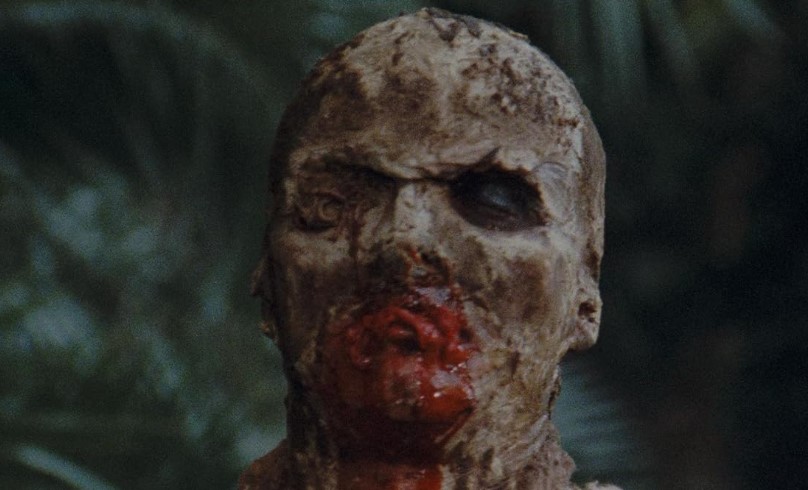
Lucio Fulci’s name carries an aura of blood-stained legend in the world of cinema. To some, he is the Italian master of horror whose films stand beside Argento’s in the pantheon of European genre cinema; to others, he is an enigmatic provocateur whose work transcended mere gore to become a feverish, surreal meditation on death, decay, and the human subconscious. Yet, before Fulci became “The Godfather of Gore,” he was something else entirely — a versatile craftsman who spent decades in the trenches of Italian cinema, moving through comedy, adventure, and westerns with the steady precision of a director learning his tools before unleashing them in their most expressive form.
Lucio Fulci’s artistic journey is not simply the story of a horror filmmaker, but of an artist whose relationship with cinema evolved from irony and laughter to existential horror and nihilism. Beneath the torn flesh and melting faces lies a complex vision of the world — one steeped in skepticism, bitterness, and dark humor, shaped by the shifting tides of Italian popular culture.
Early Life and the Genesis of a Filmmaker
Born in Rome in 1927, Lucio Fulci grew up in a society that was simultaneously rebuilding from war and redefining its artistic identity. Like many of his generation, he entered the film industry through the backdoor, studying medicine briefly before turning to art criticism and screenwriting. He began working as an assistant director and writer during Italy’s post-war cinematic boom, a period dominated by Neorealism. Yet Fulci was never quite aligned with the moral idealism of that movement. Where Rossellini or De Sica sought empathy and redemption, Fulci saw absurdity, hypocrisy, and decay — a worldview that would later infect his most nightmarish creations.
His early work as a screenwriter on films such as Un americano in vacanza and I ladri sharpened his sense for character rhythm and timing. But his directorial debut in the late 1950s, I ladri (1959) and I ragazzi del Juke-Box, placed him squarely in the realm of comedy and musical lightness. He worked with Totò, the great Italian comedian, whose elastic face and manic energy provided Fulci with a masterclass in comic rhythm and exaggeration — tools that would later mutate into something grotesque in his horror films.
Comedy was Fulci’s first school of cinematic control. Editing, timing, audience manipulation — all skills that are essential for generating laughter are equally vital for provoking fear. The young Fulci understood this instinctively: both humor and horror depend on surprise, rhythm, and the sudden rupture of expectation. His early comedies, light as they were, trained him to wield the camera like a scalpel.
From Comedy to Genre Experimentation
The 1960s were a period of restless experimentation for Fulci. He directed musicals, adventures, and spaghetti westerns, adapting his chameleonic sensibility to the commercial demands of the time. In films such as Tempo di massacro (1966), starring Franco Nero, Fulci proved himself capable of delivering hard-edged, violent action with a painterly sense of composition. The westerns taught him visual austerity and tension — long takes, barren landscapes, moral ambiguity — all of which would resurface, twisted, in his later horror work.
But even within these early genre exercises, Fulci’s signature darkness began to stir. His 1969 film Beatrice Cenci, based on the true story of a young woman executed for the murder of her abusive father, stands as a bridge between his earlier mainstream work and his later horror aesthetic. Here, Fulci’s fascination with cruelty, injustice, and religious hypocrisy takes center stage. The film’s baroque visual style — heavy shadows, candlelight, and Gothic atmosphere — anticipates the macabre worlds of The Beyond and City of the Living Dead. In Beatrice Cenci, Fulci revealed his central obsession: the corruption of institutions that claim moral authority, and the fragility of human innocence in a decaying moral order.
Fulci’s worldview was, at its core, tragicomic. Even his non-horror films possess a fatalistic humor that suggests a deep mistrust of human virtue. To watch his 1971 thriller A Lizard in a Woman’s Skin is to sense a director no longer content with mere entertainment. The film’s dream sequences — pulsating with Freudian imagery, sexual anxiety, and hallucinatory color — signal Fulci’s emergence as a visionary artist. The murder of reality itself was becoming his new subject.
The Birth of a Horror Auteur
The 1970s marked Lucio Fulci’s metamorphosis into one of the most distinctive horror auteurs in world cinema. The shift began quietly with Don’t Torture a Duckling (1972), a rural mystery that blended the giallo’s procedural framework with savage social critique. Set in a small southern Italian village, the film explores superstition, religious repression, and the hypocrisy of modern morality. Beneath its lurid murders lies a filmmaker dissecting the rot at the heart of post-Catholic Italy. The camera glides through sun-bleached hills and medieval churches, capturing beauty and corruption in the same frame. The violence, when it erupts, is shocking not because of excess, but because of its moral precision.
With Don’t Torture a Duckling, Fulci transcended the conventions of giallo and horror alike. He used genre as allegory — a means to expose the cruelty of social systems. The film’s ending, tragic and unresolved, hints at the fatalism that would soon define his worldview. Fulci’s horror was not born from monsters or ghosts, but from humanity’s own self-destructive impulses.
The Zombie Revolution
By the late 1970s, the international horror market had changed. George A. Romero’s Dawn of the Dead had reignited the zombie craze, and Italian producers were eager to capitalize on the trend. Fulci’s Zombi 2 (1979), known simply as Zombie in English-speaking countries, became his global breakthrough. Marketed as an unofficial sequel to Romero’s film, it was in fact something far stranger — a grotesque, hypnotic voyage into the heart of decay.
Shot in the Caribbean with a modest budget, Zombie turned its limitations into virtues. Fulci’s camera lingers on the texture of flesh, on the slow decomposition of bodies and civilizations alike. The infamous “eye-gouging” scene, in which a woman’s eyeball is impaled by a splintered wood shard, remains one of horror’s most unsettling images — not merely for its brutality, but for its precision. Fulci’s editing and pacing transform the act into a near-ritualistic confrontation between viewer and screen. In Fulci’s universe, the body becomes a canvas for existential dread.
Yet Zombie is more than exploitation. Beneath its tropical horror beats the pulse of apocalypse. Civilization’s collapse is portrayed not as a sudden catastrophe but as an organic process — a rot spreading from within. The film’s closing shots, of zombies marching across the Brooklyn Bridge toward Manhattan, crystallize Fulci’s poetic despair. Death is not an event; it is a contagion embedded in modern life.
The Gates of Hell Trilogy: Dreams of the Damned
In the early 1980s, Fulci entered his most creative and disturbing phase, crafting a loose trilogy of supernatural horror films that remain the cornerstone of his legacy: City of the Living Dead (1980), The Beyond (1981), and The House by the Cemetery (1981). These works defy conventional narrative logic, functioning instead as nightmares translated directly into cinematic form.
City of the Living Dead opens with a priest’s suicide in a small New England town, which inexplicably opens the gates of hell. The dead rise, and reality begins to dissolve. Fulci’s editing collapses time and space; his use of sound — distant wails, echoing screams, and silence punctuated by sudden bursts of gore — creates a sense of cosmic unease. The film’s infamous “gut-vomiting” scene and psychic imagery are not gratuitous, but expressions of a world where death and life have merged into a single grotesque continuum.
In The Beyond, often regarded as his masterpiece, Fulci attains the level of pure cinematic abstraction. Set in Louisiana, the film tells the story of a woman who inherits a hotel built over one of the seven gates of hell. The plot is secondary to mood; Fulci crafts an atmosphere of decay so thick it feels tangible. The film’s visuals — peeling walls, desolate corridors, endless fog — evoke the haunted architecture of the human mind. When the characters finally descend into hell, they find themselves wandering a barren desert landscape, trapped in an eternal loop of death. It is one of the most haunting endings in horror history: bleak, beautiful, and metaphysical.
The House by the Cemetery closes the trilogy with a domestic horror that transforms the family home into a site of ancient evil. Fulci’s fascination with space — rooms that breathe, doors that lead nowhere, basements that swallow the living — reflects his distrust of rational order. His horror operates on the logic of dreams, where meaning dissolves under the weight of atmosphere. In these films, Fulci becomes less a storyteller than a painter of dread, orchestrating images like brushstrokes of rot and mystery.
The Poetics of Decay: Fulci’s Visual and Thematic Style
To understand Lucio Fulci’s artistry, one must look beyond the gore. His films are obsessed with the physicality of decay — the crumbling of flesh, architecture, and memory. Yet this decay is not merely shocking spectacle; it is the very texture of his philosophy. Fulci’s universe is one of entropy, where time itself corrodes everything it touches.
His camera often lingers on decomposition not out of sadism, but fascination. The close-up of maggots swarming over a corpse in City of the Living Dead or the rotting landscapes of The Beyond are visual metaphors for spiritual disintegration. Fulci saw the world as a dying organism — beautiful in its corruption. His use of color, especially the pale blues and sickly yellows that dominate his later films, reinforces this sense of existential rot. Light in Fulci’s cinema is rarely natural; it is diseased, as if the air itself carries infection.
Editing is another crucial component of Fulci’s style. He often employs abrupt cuts and disjointed transitions that disorient the viewer, collapsing the boundaries between dream and reality. This fragmentation of space and time aligns him more with surrealists than traditional horror directors. Indeed, critics have compared Fulci’s work to that of Luis Buñuel and Jean Rollin — filmmakers who use shock not to repel but to awaken the subconscious. In Fulci’s case, gore becomes a form of surrealist expressionism, stripping away the illusion of cinematic safety.
Sound design in Fulci’s horror films is equally distinctive. Collaborations with composers like Fabio Frizzi produced some of the most haunting scores in genre cinema — repetitive, minimalist, and hypnotic. The music functions less as accompaniment than as an ambient presence, pulsing beneath the imagery like a dying heartbeat. Frizzi’s synthesizers and Fulci’s pacing create an auditory trance that blurs the line between horror and melancholia.
Themes of Religion, Guilt, and Nihilism
Beneath Fulci’s fascination with blood lies a moral and philosophical depth often overlooked by casual viewers. His films are haunted by religion — not in the pious sense, but as a structure of guilt, repression, and fear. Raised in Catholic Italy, Fulci internalized its imagery only to invert it. Priests become harbingers of doom; churches conceal corruption; the afterlife is not redemption but repetition. In Don’t Torture a Duckling, the supposed protectors of morality become executioners. In The Beyond, the gates of hell open beneath a building of supposed civility. For Fulci, horror is divine punishment without divine justice.
His worldview grew darker as his career progressed. Personal tragedies — including the loss of his wife — deepened his pessimism. By the early 1980s, Fulci’s films had taken on an almost metaphysical despair. Death was no longer a narrative endpoint but a cosmic condition. The Beyond’s final scene, where the protagonists realize they are trapped in an eternal void, encapsulates Fulci’s vision of existence as an unending nightmare. Unlike many of his contemporaries, Fulci offered no escape, no ironic detachment. His cinema stares directly into the abyss.
Yet his films are not devoid of empathy. There is often a mournful beauty beneath the horror — a sense that even in decay, there is poetry. His victims are rarely punished for sin; they are simply swallowed by forces beyond comprehension. Fulci’s horror is existential, not moralistic. It invites the viewer to confront the fragility of meaning itself.
The Later Years: Decline and Cult Resurrection
The mid-1980s brought both creative exhaustion and changing industry conditions. Italian horror, once a thriving export, began to falter under competition from American studios and declining budgets. Fulci continued to work prolifically, but many of his later films — Manhattan Baby (1982), The New York Ripper (1982), Aenigma (1987) — were met with controversy or dismissal. The New York Ripper in particular drew outrage for its graphic violence and misogynistic overtones, leading some critics to brand Fulci a sensationalist. Yet even in its extremity, the film displays his technical control and thematic consistency. Its New York setting becomes a modern inferno of voyeurism and moral decay — a reflection of Fulci’s belief that contemporary society itself had become a horror film.
By the 1990s, Fulci’s health declined and his career waned. Financial troubles and illness kept him from realizing several projects, including an ambitious collaboration with Dario Argento. But his legacy was already beginning to transform. Horror fans in the United States and Europe rediscovered his work through home video, elevating him from exploitation director to cult auteur. Directors like Quentin Tarantino, Eli Roth, and Guillermo del Toro have since acknowledged his influence. Fulci’s name, once whispered in grindhouse theaters, now echoes in film schools and retrospectives.
The Fulci Effect: Influence and Legacy
Lucio Fulci’s influence extends far beyond the boundaries of Italian horror. His work helped redefine the relationship between beauty and brutality in cinema, paving the way for generations of filmmakers who treat horror as a form of visual poetry. The dream logic of The Beyond can be traced in the works of David Lynch; the grotesque surrealism of City of the Living Dead resonates in modern films by Panos Cosmatos and Gaspar Noé. Even contemporary arthouse horror — from Ari Aster’s ritualized violence to Robert Eggers’s historical dread — carries traces of Fulci’s atmospheric nihilism.
More importantly, Fulci’s films challenge the hierarchy of cinematic art. He proved that horror, long dismissed as low culture, could embody philosophical and aesthetic sophistication. Through meticulous composition and fearless imagery, he expanded the possibilities of what horror could express — not just fear, but awe, sorrow, and metaphysical inquiry.
Fulci’s artistry also lies in his refusal to conform. Unlike Argento, whose films often celebrate beauty and control, Fulci embraced chaos. His editing fractures space and logic; his worlds are governed by decay, not order. In doing so, he captured something profoundly modern: the sense that reality itself is unstable. Watching a Fulci film is like staring into a mirror that refuses to reflect coherently — it shows us the fragmentation of contemporary existence.
Rediscovering the Humanity Beneath the Horror
To understand Fulci solely through the lens of gore is to miss his essential humanity. Beneath the viscera lies a profound melancholy — a lament for a world where reason has collapsed, where the sacred has become grotesque. His characters are not villains or heroes, but wanderers lost in a universe that no longer obeys human logic. In The Beyond, the protagonists’ journey from ignorance to damnation mirrors humanity’s eternal search for meaning in the face of cosmic indifference.
Even in his most violent moments, Fulci maintains an artist’s eye for composition. The lighting, framing, and rhythm of his gore scenes are choreographed with painterly care. This attention to aesthetics transforms violence into a form of tragic art — one that mirrors Caravaggio’s fascination with beauty in suffering. In this sense, Fulci is a descendant of Italian baroque — his horror not merely sensational but spiritual, an exploration of suffering as revelation.
Lucio Fulci and the Art of Fear
Fulci’s cinema operates on a sensory and philosophical level that few horror directors have matched. He transforms fear into an existential state — a recognition that beneath the skin of reality lies chaos. His films evoke the primal terror of losing coherence, of confronting a universe that no longer makes sense. Yet they also offer a strange comfort: in the shared experience of horror, we glimpse our own vulnerability, our own fleeting mortality.
This duality — horror as both destruction and revelation — defines Fulci’s art. His zombies, ghosts, and mutilated bodies are not merely monsters; they are metaphors for the erosion of certainty in the modern age. The gates of hell in City of the Living Dead are not just portals to another world; they are cracks in the illusion of order that society clings to. Fulci invites us to peer through those cracks, to confront the void — and perhaps to find a grim form of beauty there.
A Final Vision
Lucio Fulci passed away in 1996, leaving behind a body of work as uneven as it is unforgettable. Yet his cinematic signature endures — the slow tracking shots through fog, the diseased light, the rhythmic pulse of Fabio Frizzi’s music, the relentless fascination with decay. He remains one of cinema’s great iconoclasts: a director who transformed low-budget horror into metaphysical art, who saw in the grotesque a reflection of human truth.
To watch a Fulci film today is to enter a dream that refuses to end — a dream of death, but also of defiance. In his universe, the gates of hell are always open, not to punish but to remind us that beneath our illusions of control lies an abyss we can never fully escape. Fulci’s genius was to face that abyss — and to make it beautiful.