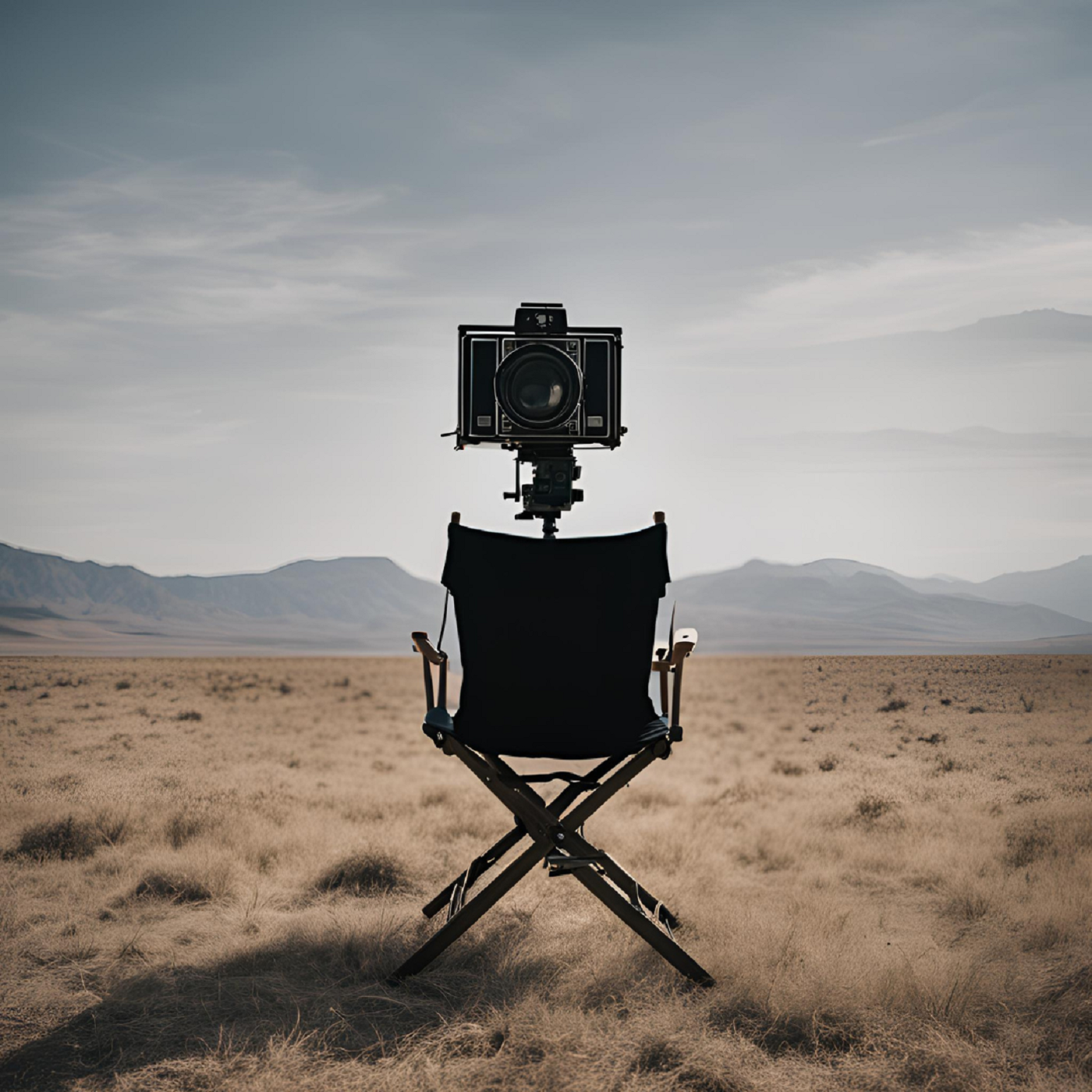
Cinema has always been more than light projected on a screen. Long before it earned the prestige of an art form, film was recognized as something even more potent: a machine for shaping emotion, reinforcing ideology, and manufacturing consent. What makes cinema uniquely seductive is not merely its ability to tell stories, but its ability to make those stories feel natural, inevitable, even true. A regime can build monuments, march armies, rewrite textbooks, but to reshape the imagination—that is the realm of cinema. And every government that sensed that power tried to harness it.
In this essay, we will explore the wide political geography of propaganda cinema: Nazi Germany, the Soviet Union, Fascist Italy, Imperial Japan, East Germany’s DEFA studios, Hollywood’s soft-power machinery, Middle Eastern state cinemas, revolutionary movements in Latin America and Africa, and the new digital landscape. The aim is not to reduce film to political usefulness, but to understand propaganda as an inherent potential within the medium itself — a potential that filmmakers, regimes, and audiences have always negotiated in complex and fascinating ways.
What follows is not a simplistic overview but a cinephile-minded journey into the aesthetics, psychology, and contradictions of propaganda cinema — how images instruct, seduce, distort, and sometimes even liberate.
I. Cinema’s Earliest Discovery: The State Realizes the Power of Moving Images
The invention of cinema in the late 19th century coincided with the rise of mass politics, nationalism, and industrial modernity. What newspapers and pamphlets had done in the 18th century, the camera could now do with unrivaled emotional power. Moving images were instantaneous, accessible to the illiterate, and capable of turning abstract ideas into deeply personal experiences.
The First World War accelerated this realization. Newsreels, patriotic shorts, and battlefield footage began to shape public morale. It was the first time governments understood how cinema could “visualize” the nation and “humanize” political causes. After 1918, the question was no longer whether cinema could be used as propaganda — but who would use it most effectively.
II. Hollywood: Soft Power Wrapped in Entertainment
While authoritarian regimes engineered propaganda with visible ideological precision, the United States discovered a different mode: soft power. Unlike explicit political cinema, Hollywood’s influence operated subtly. Its propaganda was not a dictation of belief but a shaping of aspiration.
1. The American Dream as Cultural Export
Hollywood films exported mythologies of freedom, success, rugged individualism, and heroism. Through glamorous narratives, foreign audiences absorbed American consumer culture, gender ideals, and political optimism. The U.S. government did not always need to intervene; the industry naturally produced stories that supported national identity.
2. Collaboration with the Military
From WWII onward, the Pentagon cooperated with film studios by providing equipment, locations, and advisors — in exchange for script approval. The result was a mutually beneficial ecosystem: the military received positive portrayals, and studios gained access to otherwise impossible scenes.
3. Noir and Cold War Anxiety
Even genres not explicitly commissioned by the state reflected ideological climates. The paranoia in Film Noir mirrored postwar disillusionment, while 1950s science fiction allegorized fears of communism, nuclear disaster, and infiltration. These films shaped American—and global—perceptions of threat and security, even when audiences consumed them as escapism.
Hollywood’s propaganda was never monolithic; at times, filmmakers rebelled against it. Yet its global reach made it the most effective ideological exporter in cinematic history.
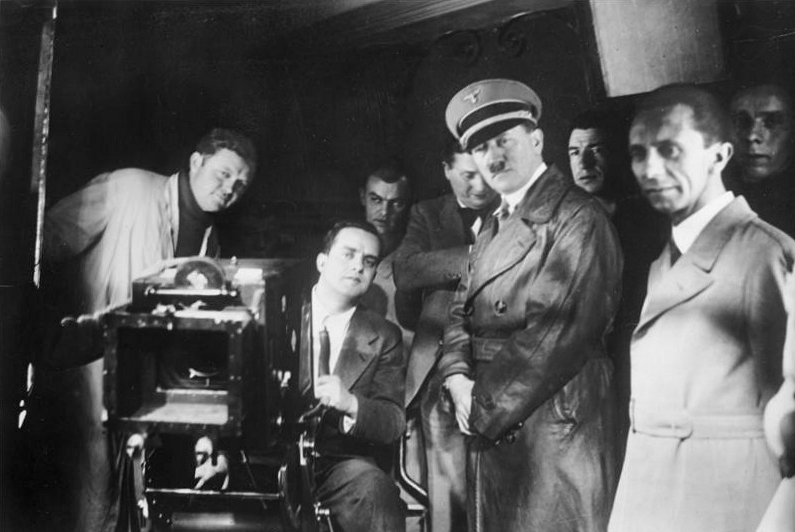
III. Nazi Germany: Aestheticized Power and the Machinery of Control
No study of propaganda cinema can avoid confronting the chilling sophistication of film under the Third Reich. Here, the medium was weaponized with near-total coordination between state ideology, aesthetics, and industrial production.
1. Leni Riefenstahl and the Seduction of Form
With Triumph of the Will and Olympia, Riefenstahl did not simply document events—she transformed them into myth. She engineered a cinematic vocabulary of power: symmetrical compositions, monumental scale, choreographed crowds, and the deification of political leaders. These films were propaganda by beauty. The more aesthetically overwhelming the image, the more persuasive the ideology it carried.
2. UFA Studios and Narrative Propaganda
Beyond the notorious documentaries, the regime produced comedies, romances, melodramas, and historical epics with ideological undertones. Even genres marketed as “apolitical” were designed to normalize hierarchy, nationalism, obedience, and purity through narrative structure.
3. The Strategy of Emotional Manipulation
Rather than relying solely on slogans, Nazi cinema focused on emotional resonance — fear, belonging, desire, envy, and catharsis. It demonstrated a truth that extends far beyond Germany: propaganda is most effective when it feels like entertainment.
IV. Soviet Montage: Revolutionary Art as Revolutionary Message
If Nazi cinema represented propaganda through authoritarian spectacle, Soviet cinema developed a more intellectual, aesthetically experimental form — one that still influences film language today.
1. Sergei Eisenstein and the Politics of Editing
Eisenstein believed that montage—placing images in sequence—could train viewers to think dialectically. The viewer wouldn’t merely watch revolution; they would mentally partake in it. Battleship Potemkin, with its rhythmic editing and unforgettable Odessa Steps sequence, remains a masterclass in how emotion and ideology can merge.
2. Dziga Vertov and the Kino-Eye
Vertov proposed a cinema free from bourgeois narrative, championing documentary truth as revolutionary power. In Man with a Movie Camera, he used cinematic experimentation to illustrate a society in motion — a utopian vision of labor, progress, and modernity.
3. Cinema as Public Education
The Soviet state recognized film as a classroom. It produced newsreels, agit-trains (mobile propaganda units), and films that celebrated collective labor. Unlike Nazi cinema, which idolized leaders, Soviet films glorified the masses.
V. Fascist Italy: The Dream of Cultural Empire
Mussolini famously declared that cinema was the “strongest weapon” of the regime. In Italy, propaganda intertwined with national romanticism, spectacle, and state-sponsored infrastructure.
1. The Construction of Cinecittà
Founded in 1937, Cinecittà was more than a studio — it was a symbol of Italy’s cinematic ambitions. The regime sought to rival Hollywood by producing epic spectacles, historical dramas, and patriotic films.
2. Aestheticizing the Nation
Italian propaganda cinema emphasized unity, discipline, rural purity, and the glory of ancient Rome. These themes persisted even after the regime collapsed, influencing neorealism’s rejection of cinematic artificiality.
VI. Imperial Japan: Cinema as Militaristic Mobilization
Japanese cinema before and during WWII served as both entertainment and social engineering.
1. Nationhood, Sacrifice, and Duty
Films reinforced loyalty to the emperor, the virtue of sacrifice, and the moral superiority of Japanese civilization. Martial values were presented not as imposed but as inherent to Japanese identity.
2. The Censorship Apparatus
The state controlled scripts, themes, and casting. Directors were encouraged to elevate national myths through narratives of tradition, self-discipline, and collective harmony.
3. Propaganda Through Emotion
Rather than focusing solely on battle, Japanese wartime cinema emphasized families, village life, and moral dilemmas — grounding militarism in intimate, relatable terms.
VII. East Germany (DEFA): Cinema Behind the Iron Curtain
East Germany’s DEFA studios represent one of the most fascinating and under-discussed propaganda ecosystems in world cinema — blending ideology, artistry, surveillance, and subtle resistance.
1. DEFA as a State Machine
Founded in 1946, DEFA was a fully state-owned studio complex. The government controlled film production, distribution, and exhibition. Cinema was meant to demonstrate the superiority of socialism, the failures of the West, and the necessity of communist unity.
2. Antifascist Narratives
Early DEFA films portrayed East Germany as the morally legitimate heir to antifascism. Nazi pasts were explored from a socialist perspective, emphasizing worker resistance, class struggle, and moral renewal. These films were used to distinguish East Germany from West Germany, which was depicted as compromised by capitalism and American influence.
3. Everyday Propaganda and Social Realism
DEFA dramas often depicted model workers, cooperative farming, and moral citizens resisting the corruption of Western consumerism. But these films were often surprisingly nuanced, touching on themes of alienation, bureaucracy, and personal conflict — propaganda softened by genuine artistry.
4. The Subversive Undercurrents
The more talented the filmmaker, the more complex the propaganda became. Directors such as Konrad Wolf pushed the boundaries of what could be said about war trauma, memory, and individual conscience. Many films smuggled existential or critical themes beneath officially acceptable narratives.
5. The Legacy of DEFA
Even after the fall of the Berlin Wall, DEFA’s films offer invaluable insight into how a socialist state sought to control culture while also encouraging artistic expression within limits. They remain essential viewing for cinephiles interested in propaganda’s subtler forms.
VIII. The Middle East: Film as Identity, Control, and Nation-Building
The Middle East presents diverse cinematic ecologies — authoritarianism, revolution, censorship, and cultural transformation.
1. Egypt: The Arab World’s Hollywood
Nasser’s Egypt produced films that promoted pan-Arab unity, modernization, and social reform. Even melodramas reinforced moral values aligned with state ideology.
2. Iran: Before and After the Revolution
Under the Shah, cinema balanced Western influence with nationalism; after 1979, it became a tool for promoting religious virtue, martyrdom, and social discipline. Yet filmmakers developed highly artistic ways to challenge or reinterpret official narratives.
3. Turkey: From State Nationalism to Political Polarization
Historical epics, military films, and patriotic dramas often reflected the ideological tides of the state. Even when not overtly propagandistic, Turkish cinema frequently reinforced narratives of national identity.
IX. Latin America and Africa: Revolutionary Cinema as Counter-Propaganda
Unlike authoritarian regimes seeking obedience, revolutionary cinemas often used film to liberate, decolonize, and awaken political consciousness.
1. Cuba: The Revolutionary Camera
Post-1959 Cuba invested heavily in film as a cultural weapon. Documentaries, newsreels, and narrative films celebrated anti-imperialism, literacy, and solidarity among oppressed peoples.
2. Latin American Third Cinema
Directors like Fernando Solanas and Octavio Getino argued that cinema should be anti-colonial, collective, and aligned with popular struggle. Their films rejected Hollywood aesthetics in favor of confrontational, politically urgent imagery.
3. African Liberation Movements
In countries emerging from colonial rule, film became a way to reclaim history, revive indigenous identity, and critique lingering imperial structures. Directors like Ousmane Sembène used cinema to expose inequality and articulate new national visions.
X. Censorship as Negative Propaganda: Power Through Absence
One of the most effective forms of propaganda is simply banning what contradicts the state’s narrative. Whether in authoritarian regimes or democracies, censorship constructs a biased worldview by limiting exposure to alternatives.
What the audience cannot see becomes as important as what they can.
XI. Propaganda in Democratic Societies: Subtle, Cultural, and Normalized
Propaganda in democracies is rarely labeled as such. It emerges through market forces, media consolidation, military cooperation, and narrative habits. Genres like superhero movies, disaster films, and patriotic dramas often reinforce specific political values without explicit direction.
Even documentaries, which claim objectivity, can frame issues in ways that reflect ideological assumptions.
The challenge is not to condemn such films but to critically understand how power shapes what becomes mainstream.
XII. The Digital Era: When Propaganda Escapes the Cinema and Invades the Feed
Today, propaganda no longer requires a state-sponsored studio. Social media algorithms, viral videos, micro-targeted ads, and AI-generated content have produced a new landscape in which propaganda is fragmented, decentralized, and ubiquitous.
Cinema’s monopoly over visual persuasion is over — but its lessons remain essential for understanding modern influence.
XIII. Conclusion: Cinema as Influence, Art, and Responsibility
Cinema has always existed at the crossroads of art and power. It can inspire empathy or enforce obedience; it can liberate minds or narrow them. The medium’s essence — immersive, emotional, narrative — makes it uniquely capable of shaping worldview. That power is neither inherently good nor evil; it depends on who wields it, and how audiences perceive it.
For cinephiles, understanding propaganda is not an act of cynicism but a deepening of appreciation. To love cinema is to understand its complexity — its beauty, its danger, its potential to move masses or manipulate them. The more we examine propaganda, the more we become aware of the ideological forces at play behind every frame.
Cinema will always be a battleground of imagination. And as long as images matter, the question remains: Who controls the screen, and to what end?