
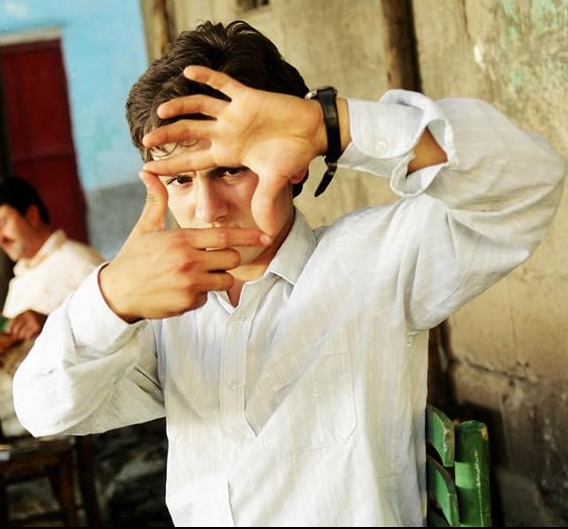
There are filmmakers who enter cinema through institutions, and there are filmmakers who discover it the way one discovers fire: by accident, curiosity, and obsession. Ahmet Uluçay belongs firmly to the second group. His cinema was not born in film schools, urban studios, or industrial sets, but in a small Anatolian village where imagination had to compensate for everything that was missing. What makes Uluçay essential is not only the beauty of his films, but the life behind them: a life shaped by scarcity, patience, and an unshakable belief that cinema could exist anywhere, even far from the cultural centers that usually define it.
Uluçay’s story matters because it speaks directly to filmmakers who work with limited means, especially those growing up in rural environments. He did not merely overcome obstacles; he transformed them into the very substance of his cinema. His films do not ask for pity or admiration for their modest conditions. Instead, they quietly assert that sincerity, observation, and memory can be stronger than budgets, equipment, or institutional approval.
At the heart of his legacy stands Boats Out of Watermelon Rinds (Karpuz Kabuğundan Gemiler Yapmak), one of the most tender and autobiographical films in Turkish cinema. But to understand its emotional force, we must first understand the man who made it.
A childhood where cinema arrived like a wonder
Ahmet Uluçay was born in 1954 in Tepecik, a village near Tavşanlı in Kütahya. Like many rural children of his generation, his early life was shaped by agricultural rhythms, communal labor, and a strong sense of place. Cinema did not belong to this world naturally. It arrived from the outside, carried by traveling projectionists who set up makeshift screenings in village squares, coffeehouses, or schoolyards. For a child like Uluçay, these screenings were not just entertainment; they were revelations.
The flickering images, the mechanical hum of the projector, the way light transformed a wall into another world — all of this imprinted itself deeply on him. Unlike children in cities, he could not take cinema for granted. Its rarity gave it a sacred quality. The distance between his village and the images he saw only intensified his desire to understand how they worked.
This fascination soon turned into experimentation. With friends, he tried to build improvised projectors, reenacted scenes, and dreamed of creating moving images himself. These early attempts were clumsy and fragile, much like the watermelon-rind boats of his later film, but they contained the essential impulse that would define his life: the need to make cinema rather than merely consume it.
The burden and gift of being far from the center
For Uluçay, geography was both a burden and a gift. Living far from major cities meant limited access to film culture, professional networks, and financial support. There were no studios nearby, no producers casually dropping by, no systematic funding mechanisms designed for someone like him. In many ways, his background placed him outside the traditional pathways of Turkish cinema.
Yet this same distance protected his imagination. He was not pressured to imitate dominant styles or market trends. Instead, he developed a cinematic language rooted in observation and memory. His understanding of cinema grew organically, shaped by lived experience rather than theory. When he eventually made films, they felt unforced and unpretentious because they were not trying to compete with metropolitan aesthetics.
Uluçay’s struggle was not only economic but psychological. Continuing to believe in cinema while surrounded by people who saw it as impractical, unrealistic, or irrelevant required quiet stubbornness. He worked various jobs, lived modestly, and pursued filmmaking without the assurance that it would ever bring recognition. His persistence itself became an act of faith.
Learning cinema by doing, failing, and trying again
Uluçay was largely self-taught. His early short films were experiments in form and storytelling, often made with minimal equipment and non-professional actors. These works did not aim for polish; they aimed for discovery. Each film was a step toward understanding how images, sound, and time could work together.
This process of learning through making is central to his significance. Unlike directors who arrive fully formed, Uluçay’s cinema bears visible traces of growth. His films feel handmade, not because of technical roughness, but because they carry the marks of trial and error. He embraced imperfection as part of the creative process.
For young filmmakers today, especially those outside major production centers, this approach is profoundly encouraging. Uluçay’s career suggests that cinema is not something one waits to be “ready” for. It is something one practices, imperfectly and persistently, until a voice begins to emerge.
Boats Out of Watermelon Rinds: memory as cinema
When Boats Out of Watermelon Rinds finally appeared, it felt less like a debut and more like the culmination of a lifetime of looking. The film is openly autobiographical, yet it avoids nostalgia in the conventional sense. It does not romanticize poverty or rural life. Instead, it focuses on the inner world of two boys whose fascination with cinema offers a form of escape, creativity, and meaning.
The title itself is deeply symbolic. Boats made from watermelon rinds are temporary, fragile, and destined to sink. Yet they float long enough to carry imagination. This image perfectly captures Uluçay’s understanding of cinema: not as a permanent monument, but as a fleeting miracle that exists precisely because someone dared to build it from inadequate materials.
Visually, the film is restrained. The camera observes rather than imposes. The village is not exoticized; it is lived in. Natural light, long takes, and simple compositions create a rhythm that mirrors everyday life. Silence is allowed to speak. Children are not forced into dramatic arcs; they drift, observe, and dream.
Emotionally, the film is devastating in its gentleness. It understands that childhood is not a separate realm from hardship but a way of navigating it. Cinema, for these boys, is not a career aspiration but a promise that the world might be larger than the village that defines them.
Cinema without spectacle, meaning without noise
What distinguishes Uluçay from many directors working with limited means is that his films never feel defensive. They do not apologize for their modest scale, nor do they attempt to compensate with exaggerated symbolism or forced drama. His confidence lies in observation.
In Boats Out of Watermelon Rinds, every object seems to carry memory: a projector lens, a hand-painted poster, a dirt road at dusk. These details do not shout for attention; they accumulate meaning quietly. Uluçay trusts the audience to feel rather than be instructed.
This trust is an ethical position as much as an aesthetic one. It suggests respect — for the characters, for the environment, and for the viewer. In an era where cinema often overwhelms through speed and excess, Uluçay’s restraint feels radical.
Inspiration for filmmakers with limited resources
Ahmet Uluçay’s importance today may be greater than it was during his lifetime. As digital tools become more accessible, many young filmmakers face a paradox: technical possibility without institutional support. Uluçay offers a model for navigating this tension.
First, he demonstrates the power of local storytelling. His films prove that one does not need universal settings to reach universal emotions. Specificity, when treated honestly, travels far.
Second, he shows how limitations can shape style. Instead of seeing budget constraints as obstacles, Uluçay allowed them to define his aesthetic. This approach encourages filmmakers to ask not “What do I lack?” but “What kind of cinema does what I have allow me to make?”
Third, his work emphasizes community. Non-professional actors, real locations, and collaborative production methods rooted his films in lived experience. Cinema, for Uluçay, was not an extractive process but a shared act.
Finally, his life reminds us that recognition is not always immediate. Persistence matters. Cinema can be a long conversation with oneself before it becomes a conversation with the world.
A legacy built on humility and devotion
Ahmet Uluçay passed away in 2009, leaving behind a small but profoundly influential body of work. His legacy does not rest on a long filmography or commercial success. It rests on integrity.
He proved that cinema could emerge from places the industry often ignores. He showed that love for film is not measured by access to resources but by willingness to keep creating despite their absence. His films continue to be rediscovered, taught, and cherished because they carry something rare: sincerity without sentimentality.
For young filmmakers in villages, small towns, or overlooked regions, Uluçay remains a quiet companion. His cinema says: you are not alone, your world is enough, and your stories matter.
In a medium increasingly dominated by scale, speed, and spectacle, Ahmet Uluçay reminds us that sometimes the most enduring cinematic journeys begin with nothing more than a dream, a few friends, and a boat made from watermelon rinds.