
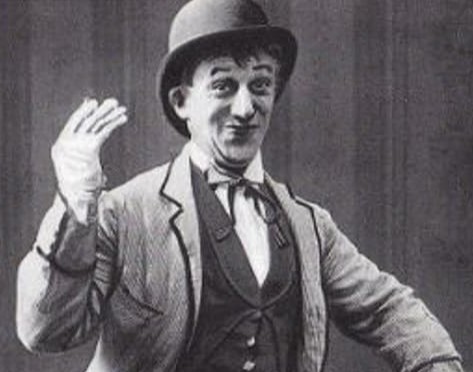
There is a particular moment that arrives when one seriously begins to explore early cinema. It happens quietly, without announcement. You start watching films not for plot, not for characters, not even for “quality” as we understand it today, but for movement, gesture, accident, and survival. Somewhere in that moment—often unexpectedly—you meet André Deed.
He does not arrive as a monument. There are no solemn introductions, no reverent framing. Instead, he crashes through doors, tumbles down staircases, explodes into fragments, and reassembles himself as if the human body were nothing more than a cinematic toy. And yet, the longer one stays with his work, the clearer it becomes: André Deed is not a marginal figure in film history. He is one of its structural foundations.
To learn about André Deed is not simply to learn about a performer. It is to learn how cinema learned to use the body, how laughter shaped film language, and how chaos preceded order in the evolution of moving images.
Cinema Before Identity: The World That Formed André Deed
André Deed was born in 1879, at a time when cinema did not yet exist as a cultural category. By the time he entered film in the early 1900s, moving images were still suspended between invention and entertainment, between science and spectacle.
Early cinema did not know what it wanted to be. It borrowed freely from wherever it could:
from circus routines, from fairground attractions, from vaudeville sketches, from magic shows, from pantomime. There was no “film grammar” yet—only experiments in duration, framing, and repetition.
This context is essential to understanding Deed. He did not choose cinema as a medium with defined rules; he stepped into something unfinished, something unstable. He was not adapting his art to film—he was helping invent what film could do.
Unlike later stars who would be shaped by cinema, Deed belonged to a generation of performers who shaped cinema in return.
From Stage to Screen: Physical Training as Cinematic Destiny
Before the camera, Deed was a performer trained in physical comedy and acrobatics. This background cannot be overstated. Early cinema did not favor subtle facial expression or psychological nuance. Cameras were static. Shots were wide. Editing was rudimentary.
What translated best to film was the body in motion.
Deed understood this instinctively. His performances are not about emotion; they are about trajectory. Where is the body going? What is it colliding with? How can it be broken apart and restored? How long can a gag be extended before it becomes surreal?
In this sense, Deed is less an actor in the modern sense than a kinetic designer. He composes sequences of destruction and recovery, turning the human form into a visual mechanism.
Watching his films today, one begins to recognize how much early cinema depended not on storytelling, but on trust in the performer’s body. The audience laughed not because a joke was clever, but because a human being had risked himself for the image.
Pathé Frères and Industrial Freedom
Deed’s rise is inseparable from Pathé Frères, the most powerful film company of its era. Pathé was an industrial giant, producing films at a staggering rate and distributing them across Europe and beyond.
What makes Pathé remarkable, especially from a modern perspective, is how much freedom it allowed certain performers. Quantity mattered more than uniformity. If something worked, it was repeated. If it failed, it was discarded.
Within this environment, Deed thrived.
He became the face of a series of short comedies that revolved around a single principle: total disruption. Under the character names Boireau in France and later Cretinetti in Italy, Deed developed a screen persona that was instantly recognizable.
Cretinetti is not psychologically motivated. He does not “want” anything in the narrative sense. His purpose is purely kinetic. He enters a space, and that space collapses.
Cretinetti: A Body Without Limits
The genius of Cretinetti lies in his elasticity. He is endlessly punished, endlessly destroyed, endlessly revived. Heads are removed and replaced. Bodies are flattened and inflated. Limbs detach and reattach.
This was not realism—it was pre-animated logic performed by a real human being.
Through substitution splices, jump cuts, and stop-motion effects, Deed’s body becomes modular. The audience learns that nothing is permanent. Cause and effect exist only to be violated.
This approach to physical comedy did something radical: it freed cinema from theatrical continuity. On stage, destruction has consequences. In Deed’s cinema, destruction is a reset button.
This is one of his most important contributions to film language. He helped establish cinema as a medium where reality could be broken without explanation.
Trick Effects and the Fusion of Body and Technology
While Georges Méliès is rightly celebrated for his pioneering use of cinematic trickery, André Deed deserves recognition for integrating those tricks directly into performance.
In Deed’s films, special effects do not exist separately from the actor. They exist to extend the body’s possibilities. The camera does not merely record action—it collaborates with it.
Cuts become punches. Splices become wounds. Edits become resurrections.
This fusion of body and technology laid the groundwork for much of what followed in visual comedy. Later silent comedians would refine it. Animators would abstract it. But Deed was among the first to realize that cinema could treat the human figure as material, not symbol.
Violence Without Trauma: The Comic Body
One of the most striking aspects of Deed’s work is its relationship to violence. His films are filled with beatings, falls, explosions, and bodily harm—yet they are never cruel.
Pain exists only momentarily. The body absorbs it, transforms it, laughs it off.
This comic violence served a crucial function in early cinema. It reassured audiences that the dangers they saw were illusory, that cinema was a safe space for excess.
At the same time, it allowed filmmakers to explore limits without moral consequence. How far can the body be pushed? How much can it endure? What happens if we treat it as indestructible?
These questions echo through the history of screen comedy, from silent slapstick to modern action cinema. André Deed was asking them first.
Authority in Ruins: Anarchic Energy
Deed’s films consistently undermine authority. Police officers fail. Judges panic. Military figures collapse into chaos. Institutions appear fragile, easily dismantled by a single irrational presence.
This anarchic energy was not ideological in the modern sense, but it was deeply resonant. Early film audiences lived in societies undergoing rapid industrialization, urbanization, and social change. Authority was visible everywhere—and so was its absurdity.
Cretinetti did not argue against authority; he tripped over it, knocked it down, and walked away laughing.
This instinctive subversion would later become central to screen comedy. Chaplin’s Tramp humiliates authority through empathy. The Marx Brothers annihilate it through language. Deed destroys it through movement alone.
Italy and International Stardom
Deed’s move to Italy marks an important phase in his career and in early cinema history. Italian studios recognized the commercial power of his persona and embraced him enthusiastically.
Under the name Cretinetti, Deed became one of the earliest examples of a transnational film star. His films circulated widely across Europe, demonstrating cinema’s ability to transcend language through physical expression.
This international success challenges modern assumptions about early cinema being nationally isolated. In reality, early film culture was fluid, interconnected, and surprisingly global.
Deed was part of that circulation. His body traveled where words could not.
The Limits of Evolution: Cinema Changes
As cinema evolved, it began to favor longer narratives, more coherent characters, and emotional continuity. By the mid-1910s, film language was stabilizing.
For performers like Deed, this posed a challenge.
His genius was rooted in short-form chaos. Feature-length structure demanded different skills—psychological consistency, narrative pacing, emotional development. Deed’s cinema was about disruption, not continuity.
Unlike Chaplin or Keaton, who adapted and refined their personas within longer narratives, Deed remained tied to an earlier cinematic logic. Gradually, his prominence faded.
This decline should not be read as failure. It is a reminder that cinema’s evolution is not linear. Some pioneers belong to specific moments. Their value lies in what they make possible, not in how long they remain visible.
Legacy Without Recognition
André Deed does not enjoy the posthumous recognition he deserves. He is rarely discussed outside specialist circles. His films are often treated as curiosities rather than foundations.
Yet his influence is undeniable.
Without Deed, slapstick would not look the same. Without his experiments, the comic body would not have been freed from realism so early. Without his reckless commitment, cinema might have taken longer to understand its own physicality.
He is present in the DNA of screen comedy—even when unnamed.