
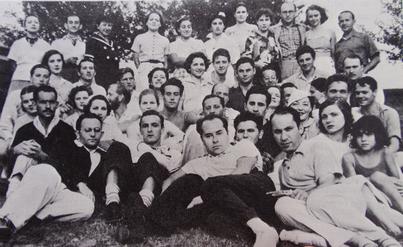
When cinephiles speak about revolutions in cinema, the conversation often begins with cameras, editing, or visual grammar. Yet one of the most radical transformations in film history did not originate on a set or in a cutting room, but in rehearsal halls, cramped apartments, and collective discussions among struggling actors in Depression-era New York. The Group Theatre, founded in 1931, did not make films. It did something far more enduring: it changed how performers inhabit characters, how directors listen to actors, and how cinema learned to trust silence, inner conflict, and psychological truth.
For anyone interested in American cinema of the 1940s through the 1970s — from On the Waterfront to Taxi Driver — the Group Theatre is not a footnote. It is a subterranean force. Its members carried its ideals into Hollywood, into acting studios, into directing styles, and into the moral and emotional texture of American film. The Group Theatre’s influence over filmmaking is indirect but profound, shaping generations of actors, writers, and directors who redefined realism on screen.
This is not merely a story about Method Acting. It is a story about how cinema learned to breathe.
I. The Birth of the Group Theatre: A Rebellion Against Artifice
The Group Theatre emerged during one of the most turbulent periods in American history. The Great Depression was not only an economic catastrophe; it was a spiritual one. Broadway theatre at the time largely functioned as escapism — star-driven, commercial, and emotionally distant. Against this backdrop, Harold Clurman, Cheryl Crawford, and Lee Strasberg imagined something radically different: a permanent ensemble devoted to serious art, social truth, and collective creation.
Their goal was not success but authenticity. They wanted theatre that spoke about real people in real conditions — workers, families, moral conflicts — performed by actors who lived and trained together, forming emotional continuity across productions. This ensemble idea, borrowed in spirit from the Moscow Art Theatre, stood in opposition to the Broadway system of interchangeable casts and commercial calculation.
From the beginning, the Group Theatre positioned itself as an ethical project as much as an artistic one. Their work carried political undertones, shaped by leftist thought, social realism, and a belief that art should confront reality rather than anesthetize it.
Cinema would later inherit this ethic — especially during Hollywood’s postwar crisis of identity.
II. Stanislavski’s System: The Invisible Engine Behind Modern Film Acting
To understand the Group Theatre’s influence on film, one must first understand its relationship with Konstantin Stanislavski. The Group did not simply borrow his ideas; they translated them into an American psychological language that would later become central to screen acting.
Stanislavski’s system emphasized:
- Psychological motivation
- Emotional memory
- Given circumstances
- Objectives and obstacles
- Inner truth over external gesture
For cinema, this was revolutionary. Early film acting, still influenced by stage traditions and silent-era exaggeration, relied heavily on visible expression. Stanislavski’s approach, by contrast, was interior, perfectly suited to the close-up.
Under Lee Strasberg’s guidance, the Group Theatre focused intensely on affective memory — the actor’s ability to draw from personal emotional experiences to fuel performance. This internalization aligned naturally with film’s capacity to capture micro-expressions, hesitation, and thought processes without dialogue.
When Method-trained actors later entered Hollywood, the camera discovered something new: performances that did not “play” emotions but contained them.
III. The Group Theatre as a Training Ground for Cinema
Although the Group Theatre disbanded in 1941, its real life began afterward. Its alumni did not vanish — they colonized American cinema.
Many of its actors and directors moved to Hollywood, bringing with them an approach that clashed with the studio system’s polished surfaces. They believed characters should feel lived-in, contradictory, and morally ambiguous. This tension between studio polish and Group realism created some of the most powerful films of mid-century American cinema.
The Group Theatre was, in retrospect, a proto-film school — not in technique, but in sensibility.
IV. Elia Kazan: The Bridge Between the Group and Hollywood Cinema
No figure embodies the Group Theatre’s cinematic legacy more than Elia Kazan. A former Group actor and director, Kazan carried its principles directly into American film.
Kazan’s directing style prioritized:
- Actor psychology over visual flourish
- Moral conflict embedded in performance
- Ensemble tension rather than individual heroism
Films like A Streetcar Named Desire, East of Eden, and On the Waterfront are inconceivable without the Group Theatre’s ethos. Kazan did not impose performances; he excavated them.
His collaboration with actors trained in Method techniques created a feedback loop between performance and direction. Kazan’s camera often lingers, allowing actors’ internal struggles to unfold in real time — a radical departure from the brisk, plot-driven pacing of classical Hollywood.
For cinephiles, Kazan represents the moment when American cinema began trusting actors as co-authors of meaning.
V. Method Acting and the Transformation of Film Performance
The most visible legacy of the Group Theatre is, of course, Method Acting — though this term oversimplifies a complex evolution.
After the Group disbanded, its ideological fractures produced three major pedagogical branches:
- Lee Strasberg: emotional memory and inner life
- Stella Adler: imagination, text, and social context
- Sanford Meisner: truthful behavior and reactive presence
All three shaped film acting in different ways, but collectively they ended the era of purely technical performance. The camera now encountered actors who thought, hesitated, resisted.
Actors influenced by this lineage include:
- Marlon Brando
- Montgomery Clift
- James Dean
- Rod Steiger
- Karl Malden
- Lee J. Cobb
Their performances introduced vulnerability, anger, sensuality, and moral confusion into American cinema — elements previously suppressed or stylized.
The Group Theatre taught actors not to represent emotion, but to experience it under fictional circumstances — a distinction that cinema absorbed deeply.
VI. Cinema Learns Silence: Why the Group Theatre Changed Film Rhythm
One overlooked aspect of the Group Theatre’s influence is its effect on cinematic rhythm. Method-influenced performances slowed films down — not structurally, but emotionally.
Scenes lingered. Pauses mattered. Silence became expressive.
This shift aligned perfectly with postwar cinema’s growing interest in alienation, trauma, and identity. Film noir, social dramas, and later New Hollywood cinema all benefited from actors capable of communicating conflict without dialogue.
For cinephiles, this marks a crucial transition: American cinema began to resemble European art cinema in its attention to inner states — but rooted in distinctly American psychological and social tensions.
VII. Writers, Realism, and the Group Theatre’s Narrative Legacy
The Group Theatre did not only influence actors and directors. Its commitment to social realism reshaped American screenwriting.
Many playwrights associated with the Group, including Clifford Odets, infused American storytelling with:
- Working-class perspectives
- Political urgency
- Moral ambiguity
This sensibility migrated to film narratives that rejected simple resolutions. Characters were no longer symbols; they were products of environment, history, and inner conflict.
Cinema absorbed this worldview, particularly in postwar dramas and later in New Hollywood’s antiheroes.
VIII. The Group Theatre and New Hollywood
Though separated by decades, the Group Theatre’s DNA is visible in New Hollywood cinema of the 1960s and 1970s.
Actors like Al Pacino, Robert De Niro, Dustin Hoffman, and Ellen Burstyn inherited a performance tradition shaped by Group Theatre ideology — even if indirectly.
Films like The Godfather, Mean Streets, and Taxi Driver rely on performances rooted in psychological continuity rather than plot mechanics. The camera observes rather than commands.
This lineage — Group Theatre → Actors Studio → New Hollywood — forms one of the most important continuities in American film history.
IX. Beyond America: Global Influence on Film Acting
While the Group Theatre was an American phenomenon, its influence extended globally. Method-based acting approaches spread to European and world cinema, intersecting with neorealism, British kitchen-sink drama, and later independent film movements.
The idea that cinema should capture inner truth rather than theatrical display became a shared language across borders.
X. Why the Group Theatre Still Matters to Cinephiles
For cinephiles, the Group Theatre represents a reminder that cinema is not only visual — it is psychological and ethical.
Its legacy can be felt whenever:
- An actor allows discomfort to remain unresolved
- A director trusts performance over montage
- A film prioritizes emotional truth over narrative efficiency
The Group Theatre taught cinema how to look at people — not as types or symbols, but as contradictions in motion.
Conclusion: An Invisible Revolution
The Group Theatre did not make films. It made film acting possible in its modern form.
Its influence is invisible because it is embedded — in technique, in rhythm, in expectation. Every time a close-up reveals thought rather than expression, every time silence carries meaning, every time a character feels painfully real rather than dramatically neat, the Group Theatre is present.
For cinephiles tracing the hidden currents of film history, the Group Theatre is not an origin myth — it is a living legacy, still unfolding in the faces captured by the camera.