
Introduction: Why Stanislavski Still Matters to Cinephiles
For anyone who takes cinema seriously—not merely as entertainment but as an art shaped by history, philosophy, and human behavior—Konstantin Stanislavski remains unavoidable. His name appears whenever realism, psychological depth, or “truthful acting” is discussed, yet it is also one of the most misunderstood references in film culture. Too often, Stanislavski is reduced to a buzzword, flattened into “Method acting,” or dismissed as a theatrical relic irrelevant to a medium defined by cameras, lenses, and editing.
This article is written from the perspective of a filmmakers’ website that treats cinema as a continuum rather than a rupture: a living art that absorbs literature, theatre, painting, music, and philosophy. From that vantage point, Stanislavski is not merely a theatre reformer but a foundational figure in film history—someone whose ideas quietly reshaped how actors behave in front of the camera, how directors rehearse, and how audiences learned to read faces on screen.
Rather than offering a technical manual, this flagship essay connects the dots between Russian theatre, early cinema, Hollywood’s transformation in the mid‑20th century, and global realist traditions. It treats Stanislavski’s system as a historical process, a set of evolving ideas responding to artistic crises, and a bridge between stage and screen at the precise moment cinema was discovering its own language.
1. Acting Before Stanislavski: Convention, Gesture, and Display
Before Stanislavski, acting in Europe was largely governed by convention. Performers were trained to project emotions outward, using codified gestures, rhetorical delivery, and clearly readable poses. This tradition, inherited from classical theatre and refined in the 18th and 19th centuries, valued clarity and virtuosity over psychological depth.
Actors demonstrated emotion rather than experienced it. Grief was shown through posture, anger through declamation, love through poetic emphasis. The audience was meant to understand, not necessarily believe. While this approach produced charismatic stars and impressive technique, it struggled to adapt to the changing artistic climate of the late 19th century.
Realism was reshaping literature and painting. Novelists like Tolstoy and Dostoevsky explored inner conflict, moral ambiguity, and fragmented consciousness. Theatre, however, often lagged behind, especially when confronted with plays that resisted melodrama and demanded silence, hesitation, and subtext.
Early cinema inherited many of these habits. Silent film acting initially relied on exaggerated gesture to compensate for the absence of sound. Yet as film grammar evolved—through editing, close-ups, and narrative continuity—the limitations of theatrical excess became increasingly apparent. Cinema would soon require a different kind of acting, one rooted in inner life rather than external display.
2. Stanislavski’s Personal Crisis and the Search for Truth
Konstantin Stanislavski was not born a revolutionary. Raised in a wealthy Moscow family, he entered theatre through privilege and enthusiasm rather than rebellion. Yet despite early success, he was haunted by inconsistency. Some performances felt alive and truthful; others felt hollow, mechanical, and false.
This inconsistency became his obsession. Stanislavski asked questions that few actors of his time dared to articulate: Why does inspiration come and go? Can artistic truth be achieved reliably? Is acting merely imitation, or can it become a disciplined exploration of human behavior?
These questions coincided with broader intellectual movements. Psychology was emerging as a field, with thinkers exploring memory, consciousness, and emotion. Realism in the arts was demanding authenticity rather than ornamentation. Stanislavski absorbed these influences not academically, but practically, through rehearsal rooms and failed performances.
His dissatisfaction was not with theatre itself, but with acting as it was practiced. He sought a process that could replace imitation with lived experience, technique with understanding.
3. The Moscow Art Theatre: A Laboratory for Modern Performance
The founding of the Moscow Art Theatre in 1898, alongside Vladimir Nemirovich‑Danchenko, marked a decisive turning point. The MAT rejected star culture, emphasizing ensemble work, long rehearsals, and artistic unity. Performance was no longer about individual brilliance but collective truth.
Anton Chekhov’s plays became the ultimate testing ground. Works like The Seagull and Uncle Vanya demanded an unprecedented sensitivity to rhythm, silence, and psychological contradiction. Characters spoke past one another, concealed desires, and revealed themselves indirectly.
Traditional acting methods failed these plays. Stanislavski’s evolving ideas—focused on motivation, inner logic, and believable behavior—allowed actors to inhabit Chekhov’s world rather than decorate it. The success of these productions reverberated far beyond Russia, influencing European theatre and laying conceptual groundwork for cinematic realism.
4. The System Explained: Not a Formula, but a Way of Thinking
Stanislavski’s “system” was never intended as a rigid doctrine. It was an open framework designed to help actors achieve truthful behavior under imaginary circumstances.
Given Circumstances
Understanding the factual reality of the play—historical context, relationships, social pressures—grounds performance in logic rather than impulse.
The Magic If
By asking “What would I do if I were in this situation?”, actors connect imagination to personal experience without collapsing into self-indulgence.
Objectives and Actions
Stanislavski shifted emphasis from emotion to action. Characters pursue goals, and emotions emerge organically from these pursuits.
Super‑Objective
Across the entire work, each character follows an overarching desire that unifies smaller actions into a coherent psychological journey.
This approach transformed acting from display into behavior. Importantly, Stanislavski continually revised these ideas, resisting dogma.
5. Emotional Memory: Experiment, Misreading, and Retreat
Emotional memory remains the most controversial aspect of Stanislavski’s legacy. Early experiments explored whether personal memories could stimulate authentic emotion. While occasionally effective, the technique proved risky.
Stanislavski himself grew wary, later emphasizing physical actions and imagination instead. However, American practitioners would elevate emotional memory into a central pillar, creating a divergence that shaped Method acting.
6. From Russia to America: The Group Theatre and Transformation
Stanislavski’s ideas reached the United States through émigré teachers and the Group Theatre. In a culture shaped by individualism and psychology, his system was adapted rather than adopted.
Lee Strasberg, Stella Adler, and Sanford Meisner each emphasized different elements. The result was not a single Method, but competing interpretations sharing a common ancestor.
7. Method Acting and Cinema: A New Screen Presence
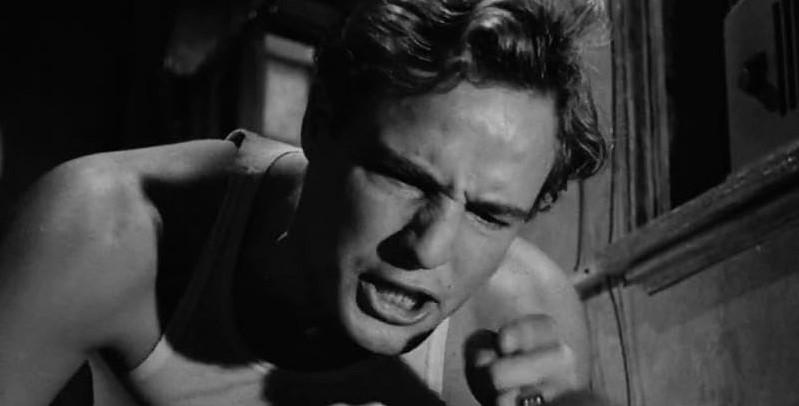
Cinema proved fertile ground for these ideas. The camera rewarded restraint, inner conflict, and psychological continuity. Performers like Marlon Brando and Montgomery Clift embodied a new masculinity—vulnerable, fractured, inward.
This was not simply better acting; it was a transformation of cinematic language. Close‑ups became sites of thought rather than expression. Silence gained narrative weight.
8. Directors, Rehearsal, and Stanislavskian Cinema
Directors such as Elia Kazan integrated Stanislavskian principles into blocking, camera placement, and rehearsal methods. Performance was no longer isolated from form; it shaped cinematic structure itself.
9. Beyond Hollywood: Global Realism and Quiet Performance
Italian Neorealism, Iranian cinema, and contemporary European realism reflect Stanislavski’s influence indirectly. Non‑professional actors, everyday behavior, and moral ambiguity echo his emphasis on truthful action.
10. Stanislavski vs. Brecht: Two Paths for Cinema
Brecht’s alienation contrasts sharply with Stanislavski’s immersion. Cinema has drawn from both traditions, producing everything from political modernism to intimate realism.
11. Critiques and Misuses in Contemporary Cinema
Over‑psychologized performances and self‑absorbed acting often misuse Stanislavski’s ideas. He sought discipline, not indulgence.
Conclusion: Stanislavski as the Hidden Architect of Screen Acting
Stanislavski did not invent realism, nor did he define a single correct way to act. What he offered was a method of inquiry—one that allowed acting to evolve alongside cinema.
For filmmakers and cinephiles, understanding Stanislavski means understanding why modern screen acting looks the way it does. His influence is not always visible, but it is foundational—embedded in the way cinema learned to capture inner life.
In that sense, Stanislavski belongs not only to theatre history, but to the deep structure of film itself.