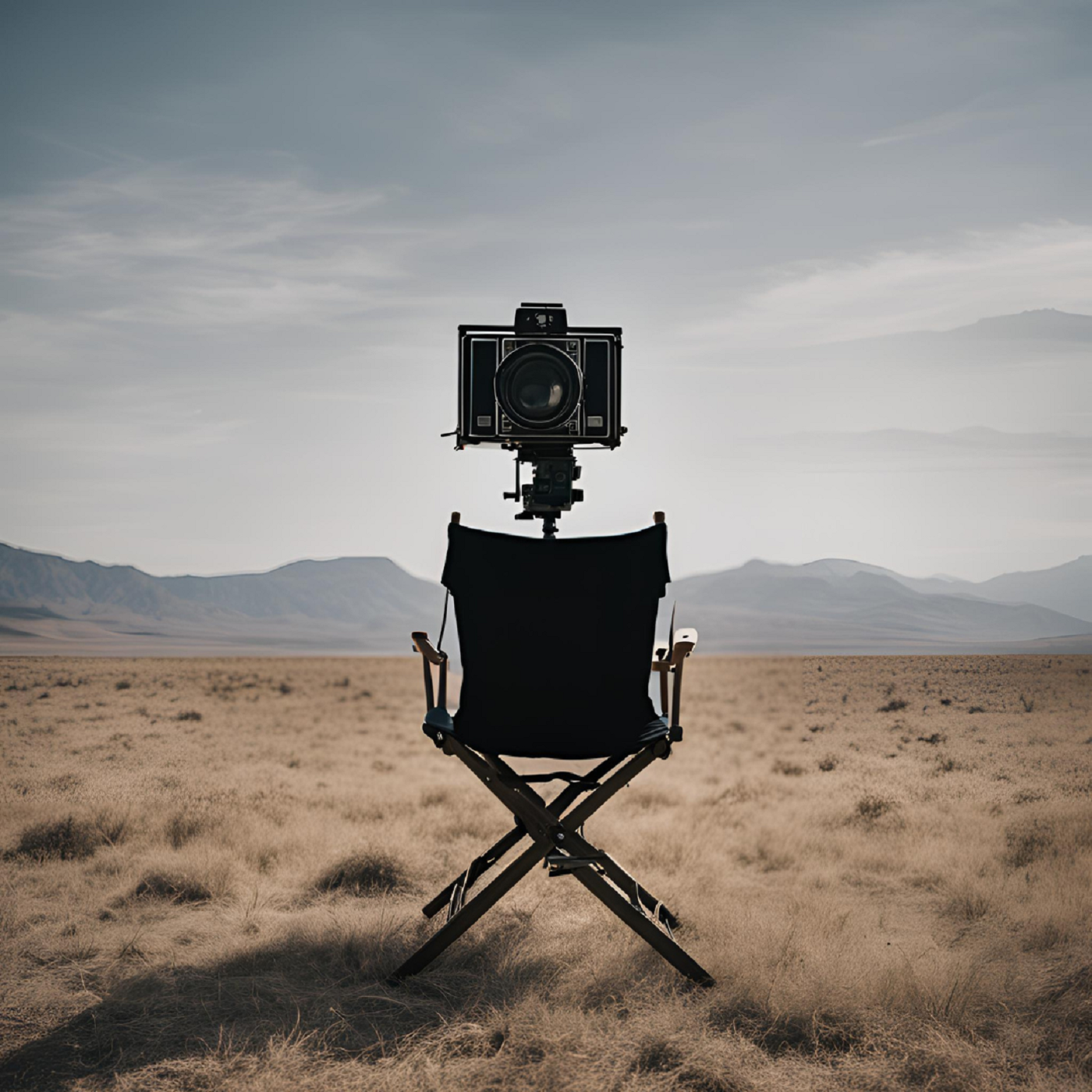
There is a moment in Andrei Tarkovsky’s Stalker — somewhere around the long, almost unbearable tracking shot through the waterlogged soil, the camera drifting over scattered syringes and soaked pages and a ruined mosaic — where time stops being something that happens to you and becomes something you are inside of. The shot lasts nearly three minutes. Nothing, by the metrics of contemporary cinema, happens. And yet everything that cinema is capable of is present in those four minutes: dread, wonder, the sacred, the broken.
I think about that shot a great deal. Partly because of its beauty, and partly because I cannot imagine it being made today — not in the industrial sense, but in the deeper sense. I am not sure the audience for it still exists in quite the way it once did. Or rather, I wonder whether the audience has been changed, gradually and without anyone announcing it, by decades of acceleration that have fundamentally altered our relationship with screen time.
This is not an elegy for a lost golden age, and it is not an indictment of TikTok or the algorithmically optimized attention economy. It is something more complicated and, I think, more interesting: an attempt to understand how cinema’s relationship with time has transformed across a century, what was gained and lost along each turn, and what it means that some of the most devoted filmmakers working today are still — stubbornly, magnificently — sculpting time the way Tarkovsky did, in a world that has largely stopped valuing the act.
I. The Monastery of the Long Take
Tarkovsky did not arrive in a vacuum. By the time he was making Andrei Rublev in 1966 and Solaris in 1972, there was already a tradition of filmmakers who understood that cinema’s unique relationship with time was not a bug but the central feature — the thing that separated it from theatre, from literature, from painting. Cinema could capture duration. It could make you feel time passing, not represent it, not abbreviate it, but actually deliver you into it.
Carl Theodor Dreyer understood this. La Passion de Jeanne d’Arc, made in 1928, uses close-ups and temporal extension not to entertain but to expose — to peel the face of a person under pressure until there is nothing left between the viewer and the raw fact of another consciousness. Dreyer’s faces take time. They ask you to stay. There are no cuts for relief, no musical cues to tell you how to feel. You are deposited into an experience and left there.
Roberto Rossellini‘s postwar films — Rome, Open City; Paisà; Germany Year Zero — introduced something else: the ethics of duration. For Rossellini, cutting away from suffering before it had run its course was a moral failure. The camera had a responsibility to stay. If a child walked to the end of a street and sat down on the rubble, you showed it. The time that the world spent being destroyed, cinema had an obligation to account for. This is where slow cinema first acquires its moral dimension — not as aestheticism but as witness.
“Cinema is the art of sculpting in time.” — Andrei Tarkovsky, Sculpting in Time (1986)
Tarkovsky made this explicit, as only he could. In his extraordinary book Sculpting in Time, written toward the end of his life, he argued that the director’s fundamental material was time itself — not narrative, not image, not performance, but the quality of time impressed upon the celluloid. A long take was not a stylistic choice; it was the substance of the work. The rhythm of cuts was not editing in the conventional sense; it was the shaping of a temporal organism. Every film he made — from Ivan’s Childhood to The Sacrifice — is evidence for this theory. You do not watch a Tarkovsky film. You inhabit it.
What made this possible? The question is partly technical — the long take requires patience from a crew, a budget that can absorb it, a lab that will not ask why so little of the negative has been used — but it is also cultural. Tarkovsky’s audience had not yet been trained out of patience. They went to the cinema expecting duration. They sat in the dark and surrendered to whatever tempo the film imposed. Television was present but not omnivorous. Advertising existed but had not yet colonized every waking second. Distraction was available; it simply had not yet become the default mode of consciousness.
This context is not incidental. It is crucial. The slow cinema of the mid-twentieth century was made by artists who lived in a world where stillness was still a natural condition — where you could sit in a field or a kitchen or a theatre and simply be present without a device pulsing in your pocket, drawing you elsewhere. The speed of their editing reflects, in part, the speed of their inner lives. Or rather, the speed of inner life that their culture had not yet made impossible.
II. The Grammar of Patience — Contemporaries of Tarkovsky
Tarkovsky was the most articulate apostle of temporal cinema, but he was far from alone. The postwar decades produced a remarkable constellation of filmmakers for whom duration, stillness, and the long take were primary tools of expression — and what is fascinating, looking back, is how different their reasons were.
Michelangelo Antonioni and the Emptiness That Speaks
Michelangelo Antonioni‘s L’Avventura (1960) famously begins with a woman disappearing — and then does not resolve her disappearance. The film simply moves on, as though loss is not something that gets solved but something that settles into the air and stays there. Antonioni’s camera lingers on landscapes, on architecture, on characters after they have stopped doing anything. What he is filming, always, is the residue of experience — the shape that feeling leaves in a room after the feeling has passed.
In Red Desert (1964), Monica Vitti’s neurotic restlessness is communicated not primarily through dialogue or plot but through the color of walls, the sound of industrial machinery, the way she moves through spaces that seem indifferent to her presence. Antonioni gives us time precisely so we can feel the texture of alienation — not understand it intellectually, but feel it in the body, the way you feel a temperature drop. This is something no accelerated editing can accomplish. You cannot cut your way into that kind of awareness.
Yasujirō Ozu and the Pillow Shot
Yasujirō Ozu, working in Japan across the 1940s and 1950s, developed one of cinema’s most quietly radical techniques: the pillow shot. Between scenes of human drama, Ozu would insert shots of empty spaces — a hallway, a rooftop, a row of laundry on a line — that had no direct narrative function. They were pauses. They were the film breathing. They gave the viewer a moment not to process information but simply to be — to exist in the space between stories.
Late Spring (1949), Tokyo Story (1953), An Autumn Afternoon (1962) — these films operate at a tempo that many Western viewers initially experience as slowness and gradually come to experience as something else: depth. Ozu’s pace mimics the actual rhythm of Japanese middle-class life in the postwar period, its rituals and meals and seasons, and by doing so it makes those ordinary moments monumental. When the parents in Tokyo Story sit by the sea while their children have sent them away, the long duration of that shot is the meaning of the shot. There is no shortcut to what it says.
Robert Bresson and the Economy of Time
Robert Bresson is perhaps the most austere figure in this tradition. His films — Pickpocket (1959), Au Hasard Balthazar (1966), Mouchette (1967) — are not slow in the conventional sense but operate by a principle of radical reduction. Bresson believed that cinema had been contaminated by theatre, by performance, by the habits of literary storytelling. He wanted to strip away everything redundant until only what was essential remained.
His models (his word for actors, deliberately chosen to strip away connotations of performance) are instructed not to express. The emotional content of a scene lives not in a face but in the arrangement of elements — a hand, a latch, footsteps on a floor, the timing of a cut. Bresson’s films are brief in duration but feel long in experience, because they demand total attention. Every frame carries weight. You cannot zone out during a Bresson film without losing the entire thread.
What is remarkable about Bresson, Ozu, Antonioni, and Tarkovsky, regarded together, is the implicit agreement they share: that the viewer’s time is sacred. That making someone sit with an image, a scene, a silence, is not a burden but a form of respect — a refusal to treat the audience as a passive recipient of stimulation and instead treating them as a consciousness capable of depth, capable of meeting the film halfway.
III. The World Without Pockets
It is worth pausing to consider, carefully and without romanticization, what the world of these filmmakers actually looked like in terms of attention and distraction. Because the temptation is to paint a golden age of contemplation that never quite existed — and that would be dishonest.
The audiences of the 1950s and 1960s were not monks. They were distracted by newspapers, by gossip, by radio, by the anxieties of the Cold War and economic precarity and the thousand ordinary pressures of human life. They were not, by nature, more patient than we are. Human attention has not changed in any biological sense.
But the architecture of distraction was different. Crucially, distraction was largely not portable. When you sat in a cinema in 1962, you could not pull a device from your pocket and disappear into it. The darkness of the theatre was a genuine threshold — a physical separation from the world outside. The film held you not because you had chosen to let it hold you (though you had, in some sense) but because the alternative was simply staring at the back of the person in front of you.
This architectural fact had profound consequences for what filmmakers could attempt. Tarkovsky could impose a four-minute tracking shot on an audience because that audience, having paid their admission and sat in the dark, had implicitly agreed to submit to whatever tempo the film required. They had, in effect, given themselves over. The film could ask things of them that would now feel like impositions — because now there is always somewhere else to go.
Television was the first major disruption of this arrangement, and it is worth noting that the greatest slow cinema flourished in the decades when television existed but before it became all-consuming. The arthouse cinema of the 1960s and 1970s — the New Waves of France, Italy, Germany, Japan, Czechoslovakia — was in part a response to television’s speed and shallowness. If the small box in the corner of the living room offered efficiency and entertainment, the cinema could offer the opposite: an immersive, demanding, temporally expansive experience that the television set could never replicate. The long take was partly a defence of territory.
Then came the 1980s, the MTV edit, the action movie, and the progressive acceleration of mainstream cinema’s cutting rate. Studies of average shot length in Hollywood films reveal a sustained, decades-long compression: from roughly 10-12 seconds in the 1960s to 4-6 seconds in the 2000s, to films today — particularly in the action, superhero, and thriller genres — where individual shots can last less than two seconds. The grammar of cinema has been rewritten, and it has been rewritten at the speed of a heartbeat.
IV. Speed as Language — The Other Tradition
It would be wrong, and intellectually dishonest, to treat fast editing as simply a degradation of the cinematic form. Before going further into the collapse of time, it is worth acknowledging the other tradition — the one that found its poetry in speed, in collision, in the charged space between images.
Sergei Eisenstein, who was in many ways Tarkovsky’s direct ancestor and greatest antagonist, believed that the meaning of cinema lived not in the single shot but in the collision between shots — in what he called the dialectical montage. The cut was not a seam but an explosion. When in Battleship Potemkin (1925) the stone lions appear to rise in three successive cuts, that is not a trick or an effect; it is cinema thinking — ideas generated by the clash of images the way sparks are generated by the clash of flints.
Eisenstein’s heirs are everywhere in contemporary cinema, and in contemporary media more broadly. The music video, which perfected the grammar of rapid cutting in the 1980s; the advertising industry, which has spent decades refining the emotional impact of two-second images; the action blockbuster, which discovered that cutting at the frequency of a nervous system under stress could produce something that felt like being in a fight — all of these descend, however distantly and unconsciously, from Eisenstein’s insight that time could be weaponized.
There is genuine artistry in this tradition. The Coen Brothers edit with a rhythm so precise it functions almost as music. Edgar Wright’s rapid cutting in films like Hot Fuzz and Baby Driver is not acceleration for its own sake but a comic and kinetic language with its own internal logic. Even Christopher Nolan’s fragmented chronologies — in Memento, in Dunkirk — use temporal dislocation not to confuse but to force the viewer into an experiential relationship with the film’s subject matter.
The point is not that fast cinema is bad and slow cinema is good. The point is that they are different temporal philosophies, different propositions about what cinema is for and what it can do to a person sitting in the dark. The collapse that concerns us is not the existence of speed but the point at which speed stops being a choice and becomes the only available option — the moment when the accelerated image is no longer one voice in a conversation but the only voice anyone is still willing to hear.
V. The TikTok Condition
TikTok did not invent the short attention span. It was built for one that already existed, and having been built for it, it proceeded to deepen it, algorithmically and without remorse. This is worth saying clearly without blame: the platform did exactly what platforms are designed to do, which is to maximize the time a user spends on the platform. The fact that this requires fragmenting content into dopamine-optimized units lasting between fifteen seconds and three minutes is simply the logical outcome of that optimization.
What is genuinely new about TikTok, and about the broader short-video ecosystem it has spawned, is not the brevity — brevity has always existed — but the infinite scroll: the removal of any threshold, any pause, any gap between one piece of content and the next. Traditional television, even at its most accelerated, had commercial breaks, transitions, the pause between channel changes. The VHS tape rewound. Even YouTube required you to search, to click a link, to make a choice. The infinite scroll requires nothing. It is a media environment engineered to make stopping actively difficult and starting effortlessly automatic.
The neurological and psychological consequences of this are only beginning to be understood, and the honest position is one of uncertainty rather than alarm. But what seems clear, anecdotally and from the experience of educators, therapists, and filmmakers, is that extended exposure to infinite-scroll media alters the experience of duration. Ten minutes begins to feel long. Thirty minutes feels like a commitment. Two hours, the length of a standard feature film, begins to feel — to a generation that has consumed content at TikTok speed since early adolescence — like a genuine endurance test.
“I have students now who cannot watch a film for more than twenty minutes without checking their phones. Not because they are bored — they are often genuinely engaged. It is as if the body needs to reset, to confirm that the world outside the screen still exists.” — an anonymous film studies professor, 2023
This is the TikTok condition: not that people cannot appreciate long films, but that the experience of duration has been recalibrated so thoroughly that the body registers stillness and length as discomfort before the mind has had a chance to decide whether it is meaningful discomfort.
And yet. The same platform that produces this condition also regularly surfaces the exact films it seems designed to destroy. On TikTok, in the communities of cinephiles who have gathered there, you will find passionate seven-minute essays about the color palette in In the Mood for Love, frame-by-frame analyses of Kubrick’s one-point perspective, arguments about which of Bergman’s films to watch first. The cinephile impulse does not die in the attention economy; it finds new corridors to run down. What is uncertain is whether the films themselves can survive the transit — whether a person who encountered Tarkovsky on TikTok can then actually sit with Tarkovsky for three hours without the habit of the scroll reasserting itself.
VI. The Inheritors — Keeping the Long Gaze Alive
While mainstream cinema accelerated and social media fragmented, a lineage of filmmakers continued — quietly, stubbornly, internationally — the tradition of temporal cinema. They are Tarkovsky’s heirs not by direct influence (though often that too) but by philosophical conviction: by the belief that duration is not a problem to be solved but a gift to be given.
Béla Tarr and the Hypnotic Real
The Hungarian filmmaker Béla Tarr is perhaps the most extreme practitioner of long-take cinema working in the late twentieth and early twenty-first century. Sátántangó (1994), his seven-and-a-half-hour masterwork, contains shots that last ten, fifteen, even twenty minutes. There is a shot of a man walking across a muddy courtyard, his coat blown by the wind, that seems to last long enough to actually experience the weather. Tarr is not testing the audience’s patience; he is attempting something specific and almost mystical: to make the viewer feel that they are not watching a representation of reality but actually present within it.
What is striking about Tarr’s approach — and why it matters to this discussion — is that it feels not like a return to an older cinema but like a radicalization of it. His films are not nostalgic. They are made in full awareness of a world that has been speeding up, and they push back against that speed with a force that feels almost confrontational. To watch Sátántangó in our current moment is to understand that its length is not incidental — it is the argument. The film is saying: this is how long reality takes. This is the actual duration of despair.
Abbas Kiarostami and the Ethics of Looking
The Iranian filmmaker Abbas Kiarostami, whose films from Khane-ye doust kodjast? (Where Is the Friend’s Home?, 1987) through Certified Copy (2010) and beyond represent one of cinema’s most sustained meditations on the act of looking, developed a practice rooted in what might be called the ethics of duration. Kiarostami’s long takes are inseparable from his humanism. When he holds on a face, he is not aestheticizing — he is insisting that this person deserves the time.
His road movies — And Life Goes On (1991), Through the Olive Trees (1994) — find their meaning almost entirely in their duration. A car winds up a mountain road. Again. And again. The landscape changes subtly. Something accumulates that cannot be named precisely but is felt absolutely. Kiarostami is perhaps the best argument against the idea that slow cinema is difficult or alienating. His films are profoundly humane, often gently funny, and accessible to anyone willing to grant them their time.
Apichatpong Weerasethakul and the Cinema of Waking Dreams
The Thai filmmaker Apichatpong Weerasethakul — who won the Palme d’Or at Cannes for Uncle Boonmee Who Can Recall His Past Lives (2010) — represents perhaps the most radical extension of temporal cinema in the current era. His films do not merely use long takes; they dissolve the boundary between watching and dreaming. Sequences in Tropical Malady (2004) and Cemetery of Splendour (2015) move at a pace so close to the tempo of half-sleep that they induce something not unlike a trance state in receptive viewers.
Weerasethakul has spoken about cinema as a place of rest — a counter to the constant stimulation of modern media — and his films enact this literally. People sleep in them. Characters drift between consciousness and unconsciousness. The long take becomes not a display of patience but an act of care: the filmmaker allowing you, insisting that you, put down the armor of constant alertness and simply be in a space for a while.
That this cinema still exists and is still being made and shown and celebrated at the highest levels of the art form is not a small thing. It represents a genuine refusal — not angry, not nostalgic, not reactionary, but firm — to accept that acceleration is the only direction available.
Chantal Akerman’s Radical Ordinariness
To discuss slow cinema without Chantal Akerman is to miss its most politically charged dimension. Jeanne Dielman, 23, quai du Commerce, 1080 Bruxelles (1975) — recently named the greatest film ever made by the Sight & Sound poll of 2022, a verdict that sent certain corners of the internet into predictable fury — is a three-and-a-half-hour film about a woman doing housework. It shows, in real time, the peeling of potatoes, the washing of dishes, the making of beds.
The politics of Akerman’s duration are explicit and radical: she is saying that the time of women’s domestic labor — historically invisible, unmarked, compressed out of existence by a cinema that only showed what it considered significant — deserves to be seen in full. The length is the argument. Every minute you sit watching Jeanne Dielman peel potatoes is a minute in which you are being forced to acknowledge that this labor takes this long, that this life takes this form, that this time exists and matters. No faster film could make this argument, because the argument is the time itself.
VII. The Philosophical Divide — Two Theories of What Cinema Is For
We arrive at last at the deeper question that all of this circling has been approaching: not what happened to cinema’s relationship with time, but what our two temporal extremes — the long take and the TikTok scroll — say about fundamentally different theories of what a screen experience is for.
The slow cinema tradition, from Dreyer to Weerasethakul, operates on a philosophical assumption that might be called the theory of the gift. The filmmaker gives the viewer time — not information, not entertainment, not stimulation, but time itself: expanded, heightened, made precious. The long take says: this moment is worth your full attention. Stay here. What is present in this image will not arrive quickly; it requires duration to manifest. This is a fundamentally generous act, and it asks for generosity in return.
The accelerated cinema of the blockbuster, and more radically the infinite-scroll environment of TikTok, operates on a different philosophy: what we might call the theory of the service. The content is a service performed for the viewer. It delivers stimulation efficiently, it respects the viewer’s time by not wasting it on moments that do not carry narrative or emotional payload, it acknowledges that the audience has choices and competes for their attention rather than commanding it.
Neither of these philosophies is simply wrong. The theory of the gift can become arrogance — there are films that use slowness as a form of prestige signaling rather than genuine temporal exploration, films that are long because their directors believe length equals depth. The theory of the service can become contempt — there is a strand of commercial cinema that does not so much respect the viewer’s time as exploit their neurological reflexes, mistaking stimulation for experience.
What is genuinely philosophical about the divide is the question of what cinema does to consciousness. The slow cinema tradition believes — and there is phenomenological support for this — that the sustained encounter with a long take changes the viewer. That sitting with an image long enough to exhaust your initial response and move through it into something else is a kind of transformation that has no equivalent in accelerated media. Tarkovsky spoke of cinema as a form of prayer; Bresson spoke of it as a kind of grace. These are not casual metaphors. They describe a specific quality of attention that only duration can produce.
The accelerated tradition, by contrast, trusts the accumulated effect: that the rapid succession of images, each one charged with meaning, produces an emotional whole greater than the sum of its two-second parts. The montage of a well-cut action sequence can produce genuine awe — a sense of scale and momentum and collective force that no single long take could replicate. This is not nothing. It is a different kind of truth.
The question that our current historical moment makes urgent is whether these traditions can coexist — or whether the infrastructure of attention built by the digital economy is systematically destroying the conditions under which the first tradition can be experienced as intended. You can preserve a film in a digital archive. What you cannot so easily preserve is the quality of attention that the film requires.
VIII. The Cinema of the Future — Resistance, Adaptation, Reinvention
There is a younger generation of filmmakers — some working in features, some in installation art, some in forms that do not yet have names — who are engaging directly and consciously with this divide. They are not simply continuing the slow cinema tradition; they are responding to the specific conditions of post-TikTok spectatorship with a range of strategies that range from radical resistance to curious hybridization.
The Argentinian filmmaker Lucrecia Martel, whose films La Ciénaga (2001), The Holy Girl (2004), and Zama (2017) are as demanding as any in contemporary cinema, has spoken about the experience of time in her work as explicitly ecological — a response to a world in which everything is moving too fast to be perceived. Her films resist not through slowness alone but through a refusal to tell the viewer where to look, what is important, what the narrative is. Attention is not guided; it is released into the image and allowed to find its own path. In an era of algorithmic curation, this is itself a political act.
The South Korean filmmaker Hong Sangsoo works in the opposite key — his films are brief, conversational, deceptively simple — but his relationship to time is just as considered. By repeating scenes with variations, by returning to the same restaurants and the same conversations, he creates a temporal structure that is neither the long take nor the rapid cut but something closer to memory itself: looping, incomplete, returning always to what has not been fully understood.
And then there are the installation artists — figures like Sharon Lockhart, James Benning, and Tacita Dean — who have taken the logic of slow cinema out of the theatre entirely and into the gallery, where a film can play for ten hours and a viewer can enter and leave at any point, experiencing fragments of duration rather than submitting to a fixed temporal structure. This is not a compromise; it is a rethinking of the frame itself. If the cinema cannot guarantee an audience’s sustained attention, perhaps the work must be designed for a different mode of encounter.
What is striking about all of these practitioners is the absence of despair. None of them behave as though the battle is lost. They work with the full knowledge that their films will be seen, in most cases, by relatively small audiences — that the economics of contemporary cinema do not favor them, that the attention economy is not their friend. And they make the films anyway, with the same conviction that Tarkovsky brought to his work: the conviction that the act of sculpting time is not peripheral to human experience but essential to it.
IX. What We Lose, What We Keep
I want to be careful, as this essay moves toward its conclusion, not to resolve into a simple lament. The situation is genuinely complex, and the complexity is worth preserving.
We have lost something. This seems to me simply true, and worth saying without qualification. The collective experience of surrendering to a long, demanding film in a darkened theatre — the experience that produced the audience for which Tarkovsky, Bergman, and Akerman made their work — is no longer a default mode of cultural participation. It requires now a specific intention, a specific seeking-out, a degree of deliberate resistance to the default conditions of attention that is available only to people with a certain kind of cultural access and a certain kind of developed patience. That this experience has become, in some sense, a form of cultural capital — a luxury of the educated and the economically comfortable — is a genuine diminishment of something that was once more widely available.
We have also gained something, and this too seems true and worth saying without embarrassment. The democratization of the moving image — the fact that a teenager in a provincial town anywhere in the world can now access the complete films of Tarkovsky, Bergman, Ozu, Kiarostami, on a device in their pocket — is not nothing. The cinephile communities that have formed on TikTok, YouTube, Letterboxd, and forums across the internet have produced levels of critical engagement with film history that no previous generation could have assembled. The question of what cinema is, what it has been, what it could be, is being asked by more people, in more places, with more passion, than at any previous moment.
The TikTok essay-filmmaker who makes a seven-minute video about the use of silence in Tati’s Playtime is, in some sense, a direct descendant of the Cahiers du Cinéma critics who made their arguments in printed form in 1950s Paris. The form has accelerated, the depth has sometimes (not always) diminished, but the impulse — to take cinema seriously as an art, to look at it carefully, to argue about it with genuine feeling — is unchanged.
What seems most important, in the end, is not the preservation of any particular temporal form but the preservation of the capacity for temporal depth: the ability to be held by an image, to let duration work on you, to sit with a sequence long enough to discover what it contains. This is a capacity that can atrophy with disuse, and our current media environment is, in many ways, a perfect instrument for atrophying it. But it can also be cultivated, recovered, shared.
The filmmakers who continue to practice slow cinema in an accelerated world are not making a nostalgic argument for the past. They are making a present-tense argument for a kind of attention that the human being is still capable of, that still produces experiences unavailable by any other means — experiences of the kind that Tarkovsky described when he talked about cinema as a place where time could be saved, held, given back. They are saying: this is still possible. You are still capable of it. Come and see.
Coda: The Tunnel
I return, finally, to that shot in Stalker. Three minutes. The camera moving slowly over ruins and water and the wreckage of a civilization. Nothing happening, by one definition of the word. Everything happening, by another.
What Tarkovsky understood — and what the best of his inheritors have continued to understand — is that the cinema screen is not primarily a delivery mechanism. It is not there to give you information or stimulation or product. It is there to open a space in which time can be experienced differently: more slowly, more fully, more honestly than the ordinary pressures of conscious life allow. This is not a luxury. It is, if you accept Tarkovsky’s argument, a necessity — one of the ways in which art maintains the health of the inner life against the incessant demands of the outer one.
TikTok offers something real and something pleasurable and something that serves genuine human needs for connection, humor, and the rapid metabolism of a complicated world. I do not want to pretend otherwise. But it does not offer the tunnel. It cannot offer the tunnel. The tunnel requires time, and time is the one thing the scroll is designed to abolish.
Whether we preserve the conditions under which the tunnel is still possible — whether we sustain the theatres, the festivals, the educational structures, and above all the habits of attention that make the long take a viable artistic form — is not a question about cinema alone. It is a question about what kind of inner life we want to be capable of. About whether we still believe, as Tarkovsky and Dreyer and Ozu and Akerman believed, that sitting quietly in the dark with something difficult and beautiful is worth the time it takes.
I think it is. I think it always will be. But I also think that belief requires tending, like any other thing that the world is trying, in its cheerful and accelerating way, to make unnecessary.