For those of us who have spent years navigating the dust-choked, frantic energy of the Balkans—the loud, brass-heavy celebrations of Kusturica or the bleak, post-war silence of Tanović—approaching František Vláčil (1924–1999) is a jarring experience. If Balkan cinema is a shout, Vláčil is a low, resonant hum from the back of a cathedral. He is often called the “Czech Tarkovsky,” a label that is both high praise and a bit of a lazy reduction. While they shared a preoccupation with the spiritual and the elemental, Vláčil was far more concerned with the physical weight of history. He didn’t just want to film a story set in the 13th century; he wanted to exhume the 13th century and make it breathe.
I. The Formative Eye: Aesthetics over Industry
Vláčil’s journey is unique because he was an “accidental” filmmaker. He didn’t graduate from the prestigious FAMU (the Prague film school that birthed the New Wave). Instead, he studied Art History and Aesthetics. This academic foundation is the “Skeleton Key” to his work.
When you watch a Vláčil film, you aren’t seeing a director who learned how to block a scene from a textbook; you are seeing a man who spent his youth analyzing the composition of Gothic altarpieces and the play of light in Baroque cathedrals. This gave him a “Compositional Rigor” that is almost unmatched in European cinema. He saw the frame not as a window, but as a canvas where every shadow had a moral weight.
The Military Training Ground
In an ironic twist, Vláčil’s technical mastery was forged in the Czechoslovak Army Film studio. During the 1950s, while he was making instructional films about tank maneuvers and military discipline, he was secretly honing his ability to move the camera through difficult terrain. This “Military Precision” allowed him later to execute the massive, sprawling shots of Marketa Lazarová—shots that would have broken a less disciplined director.
II. The Vláčil-Liška Synthesis: A New Grammar of Sound
One cannot speak of Vláčil without speaking of Zdeněk Liška. If you are a cinephile who values the sonic textures of Morricone or the haunting minimalism of Arvo Pärt, Liška will be a revelation.
In most cinema, sound follows the image. In Vláčil’s work, sound leads the soul. Liška’s scores for Vláčil are not “background music”; they are psychological architectures.
- The Choral Wall: In his medieval epics, Liška uses Gregorian-style chanting that is often manipulated—echoed, distorted, or layered—to create a sense of religious dread.
- The Subjective Ear: Vláčil and Liška pioneered a technique where the audio focus shifts independently of the visual. You might see a wide shot of a valley, but hear the intimate, wet breathing of a character as if they were standing right in your ear.
- Electronic Ancestry: Despite the historical settings, Liška used early electronic synthesizers and tape loops. This creates a “Temporal Dissonance”—you are looking at the 1200s, but you are hearing the futuristic hum of the human psyche.
III. The Masterworks: A Detailed Examination
To understand Vláčil’s place in the “Czech New Wave,” we have to recognize that he was an outlier. While his peers (Forman, Menzel, Chytilová) were using “Verité” styles to critique modern socialist life, Vláčil was using “Formalism” to explore the eternal human condition.
1. The White Dove (Holubice, 1960)
This was Vláčil’s breakthrough, and for a cinephile, it’s a masterclass in visual storytelling. The plot is deceptively simple: a paralyzed boy in a Prague apartment and a lost racing pigeon.
- The Style: It is nearly dialogue-free. Vláčil uses the architecture of the city and the flight paths of the bird to create a “visual poem.”
- The Impact: This film proved that the “New Wave” didn’t just have to be about gritty realism; it could be about pure, transcendent beauty.
2. Marketa Lazarová (1967): The “Impossible” Epic
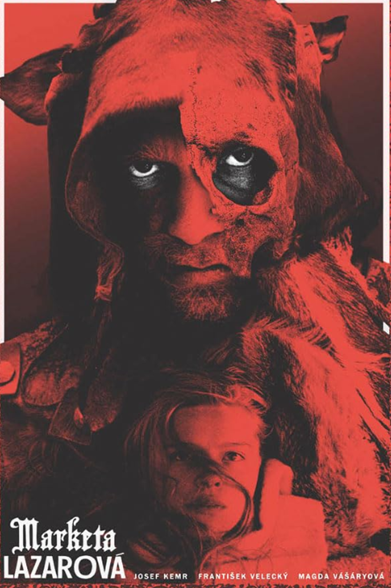
If you only ever see one Czech film, it must be this one. Voted by Czech critics as the greatest film in their history, it is a 165-minute descent into the medieval subconscious.
- The Narrative Labyrinth: The film follows the clash between two pagan clans and the encroaching Christian authorities. However, Vláčil rejects linear storytelling. He uses “stream-of-consciousness” editing. We jump through time, dreams, and memories.
- The Physicality: Vláčil famously made his actors live in the woods for two years. They didn’t wear “costumes”; they wore rags that had been dragged through real mud. When you see the steam rising from a horse’s flank or the frost on a knight’s beard, it is real. This isn’t the “Sanitized Middle Ages” of Hollywood; it is a world of bone, fur, and cold iron.
- The Lens: Cinematographer Bedřich Baťka used wide-angle lenses that slightly distort the periphery, making the forest feel like a living, claustrophobic monster.
3. The Valley of the Bees (Údolí včel, 1968)
If Marketa is a wild, sprawling forest, The Valley of the Bees is a cold, geometric stone cell.
- The Conflict: It tells the story of a man trying to escape the Teutonic Knights (a religious order of warrior-monks) to return to his human roots.
- The Philosophy: The film is a devastating critique of Fanaticism. The “Order” demands the total erasure of the self in favor of a “Higher Idea.” In the context of 1968, audiences immediately saw this as a metaphor for the rigid Communist Party structures.
- The Visuals: Every shot is composed with a “Baroque Symmetry.” The stark white robes of the knights against the black stone walls create a binary visual language of “Purity vs. Corruption.”
IV. The Legacy: A Cinema of “Tactile Memory”
Vláčil’s films are not “watched”—they are endured. For a lover of European cinema, his legacy is found in the way he influenced the “Slow Cinema” movement.
Comparison with Contemporary Masters
- Vláčil vs. Tarkovsky: Tarkovsky is interested in the Metaphysical (the spirit). Vláčil is interested in the Material (the mud). Vláčil believes that you find the spirit through the mud, not by escaping it.
- Vláčil vs. Angelopoulos: Both use the landscape as a primary character. However, while Angelopoulos uses the “Long Take” to show the passage of time, Vláčil uses “Rapid, Impressionistic Montage” to show the intensity of the moment.
- Vláčil vs. Béla Tarr: You can see Vláčil’s fingerprints all over Sátántangó or The Turin Horse. The obsession with texture, the indifference of nature, and the weight of the “Long History” are all Vláčil-esque traits.
The “Normalization” Years
After the Soviet invasion in 1968, Vláčil was marginalized. He was a man of “Big Ideas” in a time that demanded “Small Compliance.” He was forced to make films for children or historical biographies of obscure artists. Yet, even in these “lesser” works like Shadows of a Hot Summer (1978), his genius for tension and landscape remained. Shadows is essentially a “Chamber Western” set in the aftermath of WWII, showcasing his ability to build Hitchcockian dread with minimal resources.
V. Why Vláčil Matters to the Modern Cinephile
We live in an era of “Clean Cinema”—digital, sharp, and often sterile. Vláčil is the antidote. His work reminds us that cinema can be a sensory assault. To explore Czech cinema through Vláčil is to realize that the “New Wave” was much broader than the witty satires of the 60s. It was a movement that reached back into the deep, dark roots of European identity.
The Essential Watchlist for the Explorer:
- Marketa Lazarová (1967): The summit.
- The Valley of the Bees (1968): The intellectual core.
- The White Dove (1960): The poetic debut.
- Shadows of a Hot Summer (1978): The late-career thriller.
- Serpent’s Poison (Hadí jed, 1981): A rare contemporary drama about alcoholism, showing his darker, modern side.
VI. Conclusion: The Final Frame
František Vláčil died in 1999, just as the digital revolution was beginning. He remains a “Director’s Director.” When you watch his films, you feel the hand of a craftsman—a man who understood that a film is built frame by frame, like a cathedral is built stone by stone.
For those of us coming from the Balkan tradition, where history is always a wound and the landscape is always a witness, Vláčil is a kindred spirit. He didn’t just document the past; he captured the echoes it leaves behind.
If you are ready to venture beyond the familiar names of European cinema, let Vláčil be your guide. Put on your headphones, turn off the lights, and let the 13th century swallow you whole. You won’t come back the same.
Technical Breakdown: The Vláčil Aesthetic
| Element | Technique | Effect on the Viewer |
| Lensing | Ultra-wide (18mm-25mm) | Distorts reality; creates a “subjective vertigo.” |
| Editing | Associative/Non-linear | Mimics the way memory and dreams function. |
| Sound | Non-diegetic choral loops | Disconnects the viewer from a “safe” reality. |
| Color | High-contrast Monochrome | Strips away sentimentality; highlights texture. |
Final Thought
The greatness of Vláčil lies in his refusal to simplify. He knew that history is messy, that faith is terrifying, and that nature is indifferent. In a world of “content,” his films remain “Art”—stubborn, difficult, and immortal.
Pingback: The Czechoslovak New Wave: A Burst of Cinematic Rebellion and Reflection - deepkino.com