A Cinephile’s Confession: Arriving Late to an Early Phenomenon
Every cinephile has a silent map in their head. Mine, like many others, was drawn early: the Lumière brothers opening the factory gates, Georges Méliès turning cinema into magic, and D.W. Griffith teaching the world how to cut, scale, and emotionally manipulate images. This triangle—France, fantasy, and formal grammar—felt complete enough to explain the birth of cinema. Or so I thought.
Then, almost accidentally, Italy entered the frame.
Not the Italy of neorealism, not Rossellini’s shattered streets or Visconti’s aristocratic decay. Not Fellini’s carnivals or Antonioni’s existential silences. I am speaking of an Italy that existed before Hollywood knew what it wanted to be, before cinema decided whether it was art or attraction, novelty or narrative. An Italy that approached the moving image with an audacity that feels almost shocking even today.
What I discovered was not a footnote to early film history, but a missing pillar. Italian cinema, astonishingly early on, was already classy, prestigious, internationally dominant, and unapologetically ambitious. In many ways, it was the first national cinema—after France—to truly believe cinema could rival the established arts.
This article is written from the perspective of that discovery: a cinephile who knows the canon, respects the pioneers, but suddenly realizes that the early history of cinema looks incomplete without Italy standing tall among its founders.
After France, Who Took Cinema Seriously?
It is almost instinctive to place France at the beginning of everything—and rightly so. The Lumière brothers gave cinema its documentary impulse, Méliès gave it imagination, and companies like Pathé and Gaumont gave it industrial structure. France did not just invent cinema; it understood it.
But invention is not the same as expansion.
The question that fascinates me now is this: Which country was the first to treat cinema as a cultural equal to literature, theatre, opera, and painting? Which nation looked at this new medium and said, this deserves grandeur?
Italy’s answer was immediate and decisive.
By the late 1900s and early 1910s, Italian filmmakers were not content with one‑reel novelties or filmed stage acts. They aimed higher. They aimed for history, myth, tragedy, and spectacle—subjects traditionally reserved for the most “serious” of arts.
In doing so, Italian cinema became one of the earliest examples of a national film culture that was not merely productive, but aspirational.
Cinema as Cultural Inheritance: Why Italy Was Uniquely Prepared
To understand why Italy embraced cinematic grandeur so early, one must look beyond technology and toward cultural psychology.
Italy did not see cinema as a threat to tradition. It saw it as a continuation of it.
This was a country shaped by:
- Roman imperial history
- Renaissance painting and architecture
- Opera as mass spectacle
- Theatre as a moral and emotional forum
Early Italian filmmakers instinctively understood that cinema could absorb all of these influences. The moving image could reanimate ruins, resurrect emperors, and stage collective memory.
Where Méliès built artificial worlds, Italy rebuilt ancient ones.
Where early American cinema searched for immediacy, Italy searched for permanence.
Cinema, in Italy, was not born in fairgrounds alone—it was born in museums, libraries, and opera houses.
The Italian Historical Epic: Cinema Learns to Breathe
If one had to identify the moment Italian cinema announced itself to the world, it would be through the historical epic.
Films such as:
- Gli ultimi giorni di Pompei (1908, 1913)
- Quo Vadis? (1913)
- Cabiria (1914)
were not just longer films. They were conceptual revolutions.
Scale as Meaning
These films expanded cinema’s physical and psychological scale. Massive sets, thousands of extras, carefully composed tableaux, and narratives that unfolded with operatic rhythm—all of this suggested that cinema was capable of epic thought.
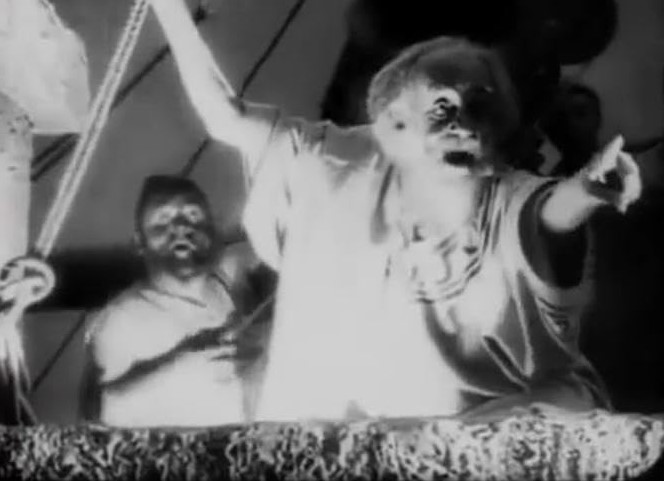
Watching Cabiria today, one does not merely see an early film. One sees a declaration: cinema belongs among the grand narratives of civilization.
Movement Within Monumentality
Italian filmmakers were also experimenting with camera movement at a time when many films remained static. The famous tracking shots of Cabiria do not simply display technical bravado—they create a sense of historical depth, as if the camera itself is wandering through time.
This is where Italian cinema quietly taught the world a lesson that Griffith would later expand upon: movement is emotion.
Cabiria and the Invisible Dialogue with Griffith
No discussion of early Italian cinema can avoid Cabiria. It stands not merely as an Italian triumph, but as a global turning point.
What fascinates me as a cinephile already familiar with Griffith is not the competition between them, but the conversation.
Cabiria did not invent narrative cinema, but it redefined its scale, pacing, and ambition. Griffith’s Intolerance feels unthinkable without the Italian precedent. The idea that cinema could juggle multiple historical epochs, monumental sets, and moral allegory owes an undeniable debt to Italy.
In this sense, Italian cinema was not following cinema’s grammar—it was co‑authoring it.
“Classy” Cinema Before Art Cinema Had a Name
The word classy is often avoided in academic writing, but it is precisely the right word here.
Early Italian cinema deliberately positioned itself as:
- Literate
- Cultured
- Prestigious
- Serious
These films adapted canonical texts, referenced classical sculpture and Renaissance composition, and framed human drama against historical inevitability.
This was cinema that wanted respect—not in the future, but immediately.
In an era when cinema was still fighting for legitimacy, Italian filmmakers behaved as if the battle had already been won.
Italy vs. Its Contemporaries: A Necessary Comparison
To say that Italian cinema was among the first after France is not to deny others their place.
- Denmark offered psychological realism and moral restraint.
- Germany, slightly later, would explore expressionism and inner states.
- The United States would industrialize storytelling and editing.
Yet Italy’s uniqueness lies in how early it achieved prestige cinema.
While others refined form or efficiency, Italy pursued cultural authority.
It did not ask what cinema could do cheaply or quickly. It asked what cinema could do greatly.
A Fragile Empire: The Decline of Early Italian Dominance
Ironically, Italian cinema’s early dominance was also fragile.
World War I, economic instability, and the rise of Hollywood’s industrial model shifted the balance. Italy, which had once led the world, found itself struggling to compete with American efficiency and global distribution.
Yet influence does not vanish simply because dominance fades.
The DNA of early Italian cinema survived:
- In Hollywood epics
- In historical spectacle
- In cinema’s ongoing desire to legitimize itself as art
Rediscovering Early Italy as a Modern Cinephile
What makes this discovery so moving today is not nostalgia—it is relevance.
In an era where cinema again struggles between content and art, algorithm and ambition, early Italian cinema feels strangely contemporary. It reminds us that cinema did not begin humbly and grow proud. In some places, it began proud from the start.
Italy looked at cinema and did not ask whether it deserved grandeur. It assumed it did.
Conclusion: Italy as Cinema’s First Aristocrat
So, is it fair to say that Italian cinema was one of the first in the world after France to be classy and prominent in its earliest productions?
Not only is it fair—it is necessary.
Italian cinema was not an appendix to early film history. It was one of its foundations. It demonstrated that cinema could carry history, culture, and spectacle without apology. It taught the world that the moving image could aspire to permanence.
As a cinephile who thought he knew the origins of cinema, discovering early Italian film feels like discovering a missing chapter—one written in marble, fire, and silent grandeur.
Cinema did not learn ambition from Hollywood.
It learned it from Italy.