
Introduction
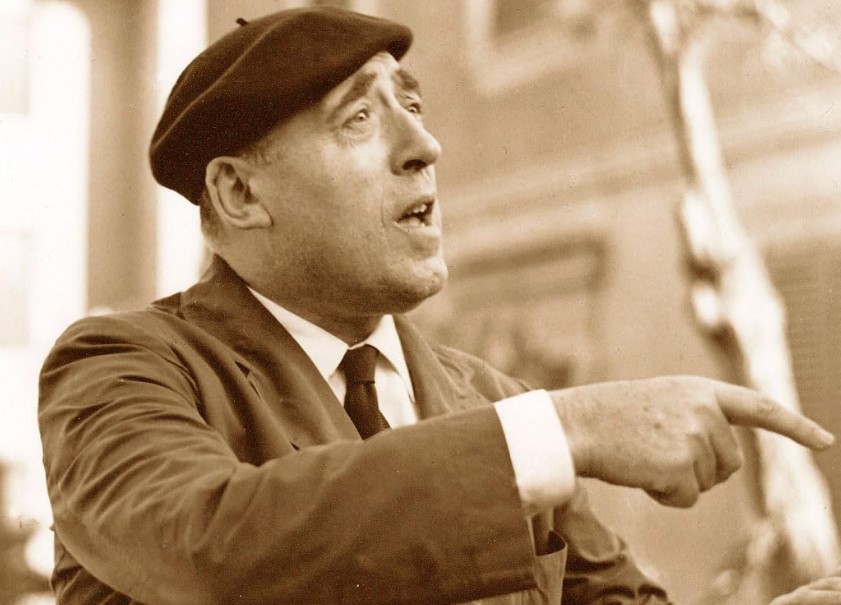
Cesare Zavattini was more than a screenwriter — he was the conscience of Italian Neorealism. Born in Luzzara, Italy, in 1902, and active across literature, journalism, and film, Zavattini revolutionized the way stories could be told on screen. His collaborations with Vittorio De Sica produced some of cinema’s most powerful masterpieces — Ladri di biciclette (Bicycle Thieves, 1948), Sciuscià (Shoeshine, 1946), and Umberto D. (1952). Each work embodied the very heart of Neorealism: simplicity, human truth, and compassion for ordinary lives.
Zavattini was not only a writer of stories but also a theorist of cinema. He gave voice and shape to the philosophical foundations of a movement that redefined postwar Italian identity and influenced world cinema for decades to come. Through his screenwriting and essays, Zavattini became one of the first thinkers to articulate how cinema could mirror the daily struggles of real people — the poor, the forgotten, and the invisible.
This article explores Zavattini’s crucial role in Neorealism, his key collaborations, his most celebrated works, his Oscar nominations, and his enduring legacy.
Early Life and Intellectual Formation
Cesare Zavattini was born on September 20, 1902, in Luzzara, a small town in the Emilia-Romagna region of Italy. He initially studied law at the University of Parma, but his passion for writing led him toward literature and journalism. During the 1930s, he began publishing novels and essays marked by humor, irony, and a deep empathy for the human condition. His early works such as Parliamo tanto di me (1931) and I poveri sono matti (1937) revealed an author fascinated by the psychology of ordinary people — a theme that would later dominate his films.
By the late 1930s, Zavattini had moved into screenwriting, working with directors such as Mario Camerini and Alessandro Blasetti. In 1935, he wrote the story for Darò un milione, a light comedy featuring Vittorio De Sica as an actor. This collaboration would mark the beginning of one of the most fruitful partnerships in film history.
As Italy entered the turmoil of World War II, Zavattini’s writing evolved toward more socially conscious themes. He believed cinema could serve as a moral instrument — a tool for understanding society rather than escaping from it. When he and De Sica reunited in the 1940s, the convergence of Zavattini’s social vision and De Sica’s compassionate direction became the foundation of Italian Neorealism.
The Birth of Italian Neorealism
Italian Neorealism was born from the ashes of war. The fascist era’s artificial studio productions — full of glamour, escapism, and propaganda — gave way to a new hunger for truth. The country was devastated: bombed cities, poverty, unemployment, disillusionment. In that context, filmmakers began to point their cameras toward real people and real streets.
Zavattini was one of the earliest thinkers to define the aesthetic and moral goals of this new cinema. He argued that film should reject artificial stories and instead document life as it was lived. He called for films that replaced spectacle with sincerity, stars with non-professionals, studios with real locations, and melodrama with authenticity.
For Zavattini, the everyday was the true source of drama. A man searching for a job, an old man losing his dignity, a child facing hunger — these, he believed, were stories powerful enough to move audiences more deeply than any fantasy. “The cinema,” he once said, “should tell the stories that happen every day, in every street, in every home. Reality is enough.”
This idea would not remain theoretical. It became the creative engine behind the films he co-wrote with Vittorio De Sica — films that defined Neorealism and reshaped global cinema.
Collaboration with Vittorio De Sica
The Zavattini–De Sica partnership was one of the most extraordinary collaborations in the history of film. De Sica brought to the table his refined sense of acting, composition, and emotional clarity, while Zavattini provided the narrative skeleton, human insight, and philosophical depth. Together, they produced a string of masterpieces that combined social observation with deep compassion.
Their first major success came with Sciuscià (Shoeshine, 1946), a film about two poor boys in postwar Rome whose dream of owning a horse ends in tragedy. The film won an Honorary Academy Award in 1947 and introduced international audiences to the raw emotional power of Italian Neorealism. But this was only the beginning.
Zavattini’s true breakthrough came two years later, with Ladri di biciclette (Bicycle Thieves, 1948).
Ladri di biciclette — The Perfect Expression of Neorealism
Few films in cinema history have captured human suffering and dignity as powerfully as Bicycle Thieves. Zavattini adapted the story from Luigi Bartolini’s novel, but he stripped away melodrama and moral judgment. What remained was an almost biblical simplicity — a father and son searching for a stolen bicycle through the streets of postwar Rome.
The film follows Antonio Ricci, an unemployed man who finally gets a job putting up movie posters, a symbol of postwar hope. But his job depends on having a bicycle — which is stolen on his first day. The rest of the film is a desperate, tragic search through a broken city. In the final moments, when Antonio tries to steal a bicycle himself, only to be caught and humiliated in front of his son, Zavattini’s humanism shines with devastating clarity.
The bicycle is not just a prop; it is a symbol of survival, pride, and dignity. Its theft represents the theft of humanity itself in a world consumed by hardship. Zavattini once said he wanted to make “a film about a man who loses a bicycle and is transformed into a thief.” That simplicity was revolutionary. There were no villains, no clear resolutions — only the harsh poetry of real life.
Bicycle Thieves won the 1949 Academy Honorary Award for Best Foreign Film and remains one of the most celebrated films ever made. Zavattini received an Oscar nomination for Best Screenplay, marking one of his first major recognitions in Hollywood.
Umberto D. — Humanism at Its Purest
If Bicycle Thieves was the social heart of Neorealism, Umberto D. was its soul. Released in 1952, it is one of Zavattini’s most personal works and a film that transcends politics to become a profound study of loneliness, age, and human dignity.
The film tells the story of Umberto Domenico Ferrari, an elderly pensioner in Rome struggling to survive on a meager income. He faces eviction from his room, abandonment by friends, and the indifference of society. His only companion is his small dog, Flike. The film moves with a quiet intensity, portraying Umberto’s daily humiliations — counting coins for rent, begging on the street, and facing the abyss of loneliness.
Zavattini’s script, brought to life through De Sica’s restrained direction, avoids sentimentality. Instead, it creates empathy through understatement. Every small gesture — Umberto’s trembling hand, the shadow of his dog — becomes a moment of emotional truth. The final sequence, where Umberto contemplates suicide and Flike runs back to him, remains one of the most moving scenes in cinema history.
Umberto D. earned Zavattini another Academy Award nomination for Best Story and cemented his reputation as a writer who could turn the smallest human moments into universal experiences.
Other Significant Works
While Bicycle Thieves and Umberto D. are his best-known achievements, Zavattini’s influence extends through many other important films.
Sciuscià (Shoeshine, 1946)
This early De Sica–Zavattini collaboration tells the story of two boys caught in the machinery of poverty and injustice. Its focus on children as victims of social neglect became a recurring motif in Neorealism. The film received an Honorary Oscar and is often seen as the movement’s prototype.
Miracolo a Milano (Miracle in Milan, 1951)
A surprising fusion of Neorealism and fantasy, this film tells of an orphan who brings magic to the poor inhabitants of a shantytown. Though lighter in tone, it reveals Zavattini’s continuing compassion for the marginalized. The film won the Grand Prize at Cannes and demonstrated that realism and imagination could coexist within the same moral universe.
La Ciociara (Two Women, 1960)
Although the strict Neorealist period was over, Zavattini continued writing humanist dramas. This film, starring Sophia Loren, tells the story of a mother and daughter’s suffering during wartime. Loren’s performance, guided by Zavattini’s deep understanding of trauma, earned her an Academy Award for Best Actress.
Il giardino dei Finzi-Contini (The Garden of the Finzi-Continis, 1970)
Late in his career, Zavattini contributed to this adaptation of Giorgio Bassani’s novel about Jewish life under Fascism. The film won the Academy Award for Best Foreign Language Film and showed that Zavattini’s moral sensibility could adapt to different times and styles.
Zavattini’s Theory of Cinema
Zavattini’s contribution to cinema was not limited to writing scripts. He articulated a coherent vision of what film should be. His essays, interviews, and notes outlined the principles of a new kind of storytelling — one built on truth, observation, and humility.
He believed that cinema should abolish the distance between art and life. The role of the filmmaker, in his view, was to witness, not to manipulate. He often spoke of “the duty to record reality, to show life as it is, without adornment.” For Zavattini, the world itself was dramatic enough; invention only diminished it.
Among his key ideas were:
- The everyday as subject matter: Stories could and should arise from daily life.
- The moral responsibility of the artist: Filmmakers had an ethical obligation to represent the truth of their society.
- The abolition of artificial plots: Life’s randomness was more truthful than fictional contrivance.
- Empathy through simplicity: The smaller the gesture, the more universal the meaning.
This philosophy made Zavattini a moral guide for generations of filmmakers — from the French New Wave to British social realists and even Iranian cinema. Abbas Kiarostami, Ken Loach, and the Dardenne brothers have all carried forward aspects of Zavattini’s spirit.
Oscar Nominations and International Recognition
Despite working largely outside the Hollywood system, Zavattini’s work received major recognition from the American Academy and global critics. His three Academy Award nominations reflect both the quality and universality of his storytelling.
- 1948: Nominated for Best Story (Sciuscià)
- 1950: Nominated for Best Screenplay (Bicycle Thieves)
- 1957: Nominated for Best Story (Umberto D.)
Additionally, Bicycle Thieves won an Honorary Oscar for Best Foreign Film, while Miracle in Milan and Two Women received international acclaim at Cannes and the Academy Awards. These honors established Zavattini as one of the few screenwriters whose name became synonymous with moral cinema.
In 1977, he was awarded the Writers Guild of America Medallion for his contribution to the art of screenwriting, and throughout his later life, he continued to publish essays, stories, and philosophical reflections on art, society, and ethics.
Legacy and Influence
Cesare Zavattini’s legacy is immense. Few screenwriters have had such lasting influence on both the aesthetics and ethics of filmmaking.
A Humanist Vision
Zavattini’s central belief — that every human life is worthy of attention — continues to resonate. His films turned the poor, the elderly, and the forgotten into protagonists, granting them dignity on screen. This humanism transformed the moral horizon of cinema.
A Global Impact
His ideas spread far beyond Italy. The French New Wave directors, such as François Truffaut and Jean-Luc Godard, admired his rejection of artifice. British directors like Ken Loach, and later filmmakers such as Satyajit Ray and Kiarostami, embraced his faith in everyday realism. Even contemporary cinema’s turn toward social narratives — from Roma (2018) to Parasite (2019) — carries echoes of Zavattini’s approach.
A Theorist of Reality
More than a writer, Zavattini was a philosopher of film. His essays proposed that cinema should move from “re-creating life” to “recording life.” This radical simplicity, though often misunderstood, inspired documentary styles and realist fiction alike. It also laid the groundwork for what we now call “slow cinema,” where observation replaces drama.
Cultural Legacy
Zavattini’s hometown of Luzzara honors his memory with museums and cultural projects. His writings and paintings are preserved as part of Italy’s cultural heritage. Even decades after his death in 1989, retrospectives and scholarly studies continue to reinterpret his work and reaffirm his place as the soul of Italian Neorealism.
Conclusion
Cesare Zavattini’s contribution to cinema cannot be overstated. He was not merely a screenwriter but a moral architect of film history. Through his collaboration with De Sica, he shaped a cinema that refused escapism, confronted social truth, and restored dignity to the everyday human being.
In Bicycle Thieves, Shoeshine, and Umberto D., Zavattini captured life as it is lived — fragile, humble, full of struggle yet filled with meaning. His work stands as a reminder that film, at its best, is not about spectacle but about empathy. It is about seeing others, understanding them, and recognizing our shared humanity.
Zavattini’s Neorealism remains not a movement frozen in history but a living ideal — one that continues to inspire filmmakers, critics, and audiences who believe that cinema’s highest calling is truth.