
A Cinephile Encounters Cinema’s First Act of Self-Destruction
Coming to Italian Futurist cinema after the Lumière brothers, Georges Méliès, and D.W. Griffith feels like walking into a familiar house only to discover that someone has set it on fire—not by accident, but by conviction. As a cinephile, I thought I understood early cinema’s deepest desire: to be taken seriously, to gain legitimacy, to evolve from novelty into art.
Italian Futurist cinema wanted none of that patience.
It wanted cinema to accelerate beyond itself, to abandon coherence, continuity, memory, and even pleasure. Where early Italian historical epics reached backward toward Rome and the Renaissance to justify cinema’s cultural status, Futurism declared those very traditions toxic. Museums were graveyards. Libraries were prisons. The past was ballast slowing the machine of modern life.
To study Italian Futurist cinema is therefore to confront the first moment in film history when cinema did not ask what it could become, but rather what it must destroy in order to exist.
This essay is written in that spirit of confrontation: not as a detached academic survey, but as a cinephile’s attempt to understand how Futurist cinema—despite its limited surviving films—became one of the most radical foundations of avant-garde cinema worldwide.
Futurism Before Film: An Ideology of Rupture
Italian Futurist cinema cannot be separated from Futurism itself. Founded in 1909 by Filippo Tommaso Marinetti, Futurism was less an art movement than a declaration of war—against tradition, restraint, and historical continuity.
The Futurist manifesto celebrated:
- Speed, machinery, and industrial power
- Youth, aggression, and violent renewal
- War as a cleansing force
- The rejection of moral and aesthetic limits
- The annihilation of the past
Unlike Symbolism or Decadence, which mourned decline, Futurism exalted destruction. Its language was deliberately excessive, provocative, and confrontational. Art was no longer meant to contemplate the world, but to attack it.
Cinema, still young and unburdened by centuries of tradition, appeared to Futurists as the ideal weapon. It was mechanical, reproducible, collective, and fast. Most importantly, it had no ancestors demanding respect.
Why Cinema Became Futurism’s Ideal Medium
Painting and literature, for all their radical potential, remained tethered to history. Cinema did not. It arrived without classical lineage, born of machines and electricity. For Futurists, this made film uniquely suited to their ideology.
Cinema could:
- Fragment time and space
- Multiply movement
- Assault perception
- Destroy linear logic
- Reach mass audiences simultaneously
Film could move faster than human thought, overwhelming rational interpretation with sensation. Futurism’s obsession with simultaneity, acceleration, and sensory shock found its most natural home in the moving image.
Yet a central paradox defines Futurist cinema: it was theorized far more than it was practiced. The movement produced manifestos with revolutionary clarity, but only a handful of films—many now lost.
What survives, however, is enough to permanently alter cinema’s imagination.
The Futurist Cinema Manifesto (1916): Toward Anti-Cinema
Published in 1916, The Futurist Cinema manifesto stands among the earliest explicit theories of avant-garde film. Its demands remain startling even today.
The Futurists rejected:
- Narrative continuity
- Psychological realism
- Literary adaptation
- Naturalism
- Sentimental identification
In their place, they proposed a cinema of:
- Fragmentation
- Abstract sensation
- Visual aggression
- Illogical juxtapositions
- Deliberate incoherence
Cinema, they argued, must not imitate theatre or literature. It must obliterate them. Film should not explain the world; it should destabilize perception itself.
This manifesto predates Dada, Surrealist film theory, and Soviet montage writings. It establishes Futurism as one of the earliest movements to demand a fully autonomous, non-representational cinema.
Loss, Ephemerality, and the Futurist Attitude Toward Film
One reason Futurist cinema is often marginalized is the scarcity of surviving works. Many films were lost to poor preservation, wartime destruction, or deliberate disregard by their creators.
This was not accidental.
Futurists distrusted permanence. They valued impact over legacy, explosion over preservation. Film was not meant to be archived—it was meant to strike and vanish.
Judging Futurist cinema by quantity misses the point. Its importance lies in its ideas, its provocations, and its influence across avant-garde movements that followed.
Vita Futurista (1916): Cinema as Assault
The best-known Futurist film, Vita Futurista, embodies the movement’s anti-cinematic impulse. Created collaboratively by Marinetti, Arnaldo Ginna, Bruno Corra, and others, it defies conventional classification.
Vita Futurista is not a narrative film but a collage of visual disruptions, absurdist gestures, and self-reflexive attacks on cinema itself. Scenes begin and end abruptly. Logic is mocked. Meaning dissolves.
Its importance lies not in what it depicts, but in what it refuses:
- Coherence
- Emotional identification
- Narrative causality
Watching it today, one recognizes a proto-Dada sensibility—a cinema that exists to provoke confusion rather than understanding. It is a manifesto in motion, designed to destabilize spectatorship.
Thaïs (1917): Futurism Enters Narrative Cinema
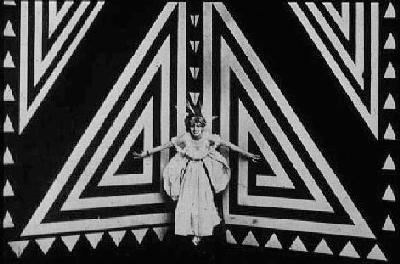
If Vita Futurista represents Futurism’s rejection of narrative, Thaïs (1917) reveals its most intriguing contradiction. Directed by Anton Giulio Bragaglia, Thaïs is the most important surviving Futurist-influenced narrative film—and a crucial bridge between Futurist theory and cinematic practice.
On the surface, Thaïs tells a melodramatic story of jealousy, obsession, and psychological manipulation. Yet its true radicalism lies in its visual design. The film replaces realistic environments with abstract, geometric sets designed by Futurist artists Enrico Prampolini and Giacomo Balla.
Spirals, diagonals, and stark contrasts dominate the frame. Space becomes hostile, oppressive, unreal. Characters appear trapped inside visual systems that externalize mental collapse.
Thaïs demonstrates that Futurism did not only seek chaos—it sought to infect narrative cinema with abstraction. In doing so, it anticipates later Surrealist strategies, where set design replaces psychological realism and architecture becomes emotion.
Few films better illustrate Futurism’s ambition to remake cinema from within.
Arnaldo Ginna and Bruno Corra: Toward Abstract Cinema
Among Futurism’s most visionary figures were brothers Arnaldo Ginna and Bruno Corra, whose experiments moved cinema toward pure abstraction.
Their hand-painted film strips—now lost—are frequently cited as among the earliest examples of abstract cinema. Long before Eggeling, Ruttmann, or Fischinger, Ginna and Corra imagined film as visual music, composed of rhythm, color, and movement rather than representation.
Though these works no longer exist, their conceptual importance is immense. They position Futurism as a precursor not only to narrative disruption, but to non-figurative film itself.
Futurist Performance and Expanded Cinema
Futurist cinema rarely existed alone. Screenings were often accompanied by live performances, provocations, and confrontations with audiences.
This collapse of boundaries between film, performance, and spectatorship anticipates later expanded cinema practices, where the viewing situation becomes part of the artwork.
Futurism understood cinema as an event rather than an object—a temporary shock rather than a preserved artifact.
Futurism’s Influence on Other Avant-Garde Movements
Though few Futurist films survived, their influence spread widely.
Dada
Futurism’s embrace of absurdity, fragmentation, and anti-logic prefigures Dadaist cinema. Where Dada mocked meaning, Futurism assaulted it—but both shared a desire to destroy cinematic expectation.
Surrealism
Thaïs anticipates Surrealism’s use of abstract space to externalize mental states. Futurism taught cinema how to visualize non-realist psychology without narrative explanation.
Soviet Montage
While ideologically opposed, Futurism and Soviet cinema shared a belief in cinema’s autonomy. Both rejected theatrical imitation and demanded a new visual language.
Abstract and Structural Film
The Futurist pursuit of pure visual rhythm foreshadows later abstract and structural cinema, where film becomes material, duration, and movement rather than story.
Futurism, Fascism, and Ethical Reckoning
Any serious engagement with Futurist cinema must confront its political entanglements. Futurism’s glorification of violence and destruction aligned disturbingly with Italian Fascism, and Marinetti’s political involvement cannot be ignored.
This does not negate Futurist cinema’s artistic importance—but it demands critical distance. Innovation and danger can coexist, and Futurism embodies that tension.
Why Italian Futurist Cinema Still Matters
Italian Futurist cinema matters not because of its volume, but because of its audacity. It was the first movement to imagine cinema as pure rupture.
It taught later avant-gardes that cinema could:
- Reject narrative entirely
- Attack perception
- Exist as manifesto rather than story
Without Futurism, the history of experimental cinema is incomplete.
Conclusion: Cinema at Maximum Speed
Italian Futurist cinema was never meant to endure. It was meant to explode.
In the broader history of avant-garde cinema, it stands as one of the earliest and most extreme attempts to free film from tradition, psychology, and continuity. It reminds us that cinema’s origins were not only about invention and mastery—but also about destruction.
Encountered today, Futurist cinema feels both exhilarating and unsettling. It reveals that from its earliest days, cinema carried within it a desire not only to represent the world—but to annihilate it and rebuild it at maximum speed.