
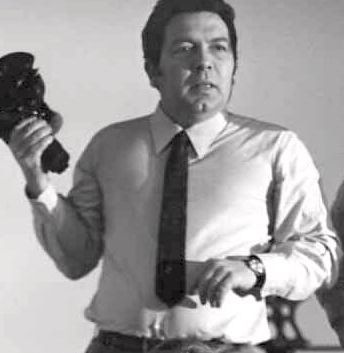
As someone who has spent decades chasing the ghosts of Italian cinema through smoky repertory theaters and late-night VHS marathons, I hold a special reverence for directors who refused to play nice. Fellini had his dreams, Antonioni his silences, Pasolini his sacred fury, but Elio Petri? Petri had a scalpel. He cut straight into the nerves of post-war Italy: the hypocrisy of power, the madness of work, the obscene intimacy between money and death. He never courted the art-house priesthood or the popular audience in the way his contemporaries did. Instead, he made films that felt like manifestos disguised as thrillers, comedies that left you choking on your own laughter, tragedies that dared you to look away. In the landscape of 1960s and 1970s Italian cinema, where every frame seemed charged with ideology, Petri was the one who never pretended neutrality was possible.
Born Eraclio Petri in Rome on January 29, 1929, he grew up in a working-class household split down the middle by belief. His father was a metalworker and devout communist; his mother a Catholic waitress. The boy shuttled between Marxist pamphlets and catechism classes, an only child absorbing contradictions like oxygen. World War II and the collapse of fascism hit when he was barely a teenager. By fifteen he had discovered Marx, the cinema, and the Italian Communist Party all at once. He started writing film criticism for L’Unità, the party newspaper, with the fervor of someone who believed movies could change the world. That conviction never left him, even when the world—and the party—disappointed him profoundly.
The Soviet invasion of Hungary in 1956 broke something in Petri. Like many intellectuals of his generation, he walked away from the PCI, but he did not walk away from politics. If anything, the betrayal sharpened his gaze. He refused the comforts of dogma and the seductions of pure aesthetics. “I’m not a poet,” he liked to say. “I’m closer to a sociologist or a psychiatrist.” Cinema, for him, was a diagnostic tool, a way to X-ray a sick society.
His apprenticeship came under Giuseppe De Santis, one of the great neorealist directors. Petri worked as assistant, researcher, and co-writer on films like Rome 11:00 and Days of Love. Neorealism gave him rigor, a hatred of ornament, and an abiding respect for the lived texture of ordinary lives. But by the late 1950s the movement was exhausted, and Petri had no interest in nostalgia. He wanted to push further, to dissect the new Italy that was rising from the rubble: consumerist, bureaucratic, increasingly Americanized, and still haunted by fascist ghosts wearing democratic clothing.
His debut feature, L’assassino (1961), announced that a new voice had arrived. Marcello Mastroianni, fresh from La dolce vita, plays a small-time antique dealer accused of murdering his wealthy mistress. On the surface it’s a police procedural, but Petri turns it into a merciless portrait of class resentment and institutional sadism. The police don’t care about truth; they care about producing a guilty man who fits their narrative. The film’s editing is nervous, almost cubist, leaping between past and present, accusation and memory. Italian censors demanded ninety cuts and forced the dubbing of Roman accents into neutral Italian to avoid implicating real institutions. Petri swallowed the insult and kept working.
The follow-up, I giorni contati (1962), is quieter but no less devastating. An aging plumber witnesses a man drop dead on a tram and suddenly realizes his own life has been an endless, meaningless repetition of labor. He quits his job and wanders Rome like a ghost. Salvo Randone’s performance is one of the great unnoticed miracles of Italian cinema: a man watching the meaning drain out of everything he once took for granted. The film won prizes at Mar del Plata and was hailed by critics who recognized that Petri had taken the neorealist concern with poverty and given it an existential twist. Work wasn’t just exploitation; it was slow spiritual suicide.
Petri spent the next few years experimenting. Il maestro di Vigevano (1963) is a bitter comedy about a schoolteacher destroyed by get-rich-quick schemes in the boom years. La decima vittima (1965) is a pop-art science-fiction satire in which murder has been legalized and turned into a televised game show. Ursula Andress in futuristic costumes hunts Marcello Mastroianni through a Rome of brutalist architecture and comic-book colors. It’s funny, sexy, and ice-cold: a prophecy of reality television and the society of the spectacle.
But it was in 1967, with A ciascuno il suo, that Petri found his mature voice and the two collaborators who would define his greatest period: the screenwriter Ugo Pirro and the actor Gian Maria Volonté. Adapted from a Leonardo Sciascia novel, the film is set in a small Sicilian town where two men are murdered during a hunting trip. A leftist professor (Volonté) tries to solve the crime and discovers a web of Mafia, Church, and political complicity so dense that truth itself becomes impossible. Shot in stark black and white, it feels like a cross between Antonioni and a political pamphlet. The final image—of the professor realizing he has been manipulated into silence—is one of the most chilling indictments of intellectual cowardice ever put on screen.
The partnership reached its peak with the trilogy that Italian critics later dubbed “the neurosis trilogy”: Indagine su un cittadino al di sopra di ogni sospetto (1970), La classe operaia va in paradiso (1971), and La proprietà non è più un furto (1973). These three films, all starring Volonté and scored by Ennio Morricone, are among the most ferocious political artworks of the 1970s.
Investigation of a Citizen Above Suspicion is the one everyone remembers, and for good reason. Volonté plays a high-ranking police official who murders his mistress and then deliberately leaves clues pointing to himself, just to prove that his position makes him untouchable. The film is a screaming nightmare of authority, a black comedy that keeps tightening the screws until you can barely breathe. Morricone’s score—those mocking children’s instruments under the main theme—turns the whole thing into a carnival of power. It won the Oscar for Best Foreign Film, the Grand Prix at Cannes, and became an international cause célèbre. In Italy it was both celebrated and reviled; police unions tried to have it banned. Petri just smiled. He had made the perfect film about the impunity of the powerful, and the powerful hated being seen so clearly.
La classe operaia va in paradiso is, for my money, even better. Set in a Turin factory during the explosive strikes of 1969–70, it follows Lulu Massa (Volonté again), a Stakhanovite piece-work champion who prides himself on outproducing everyone else. When he loses a finger in an accident, something snaps. He begins listening to the student radicals who call for “less work, more pay,” gets fired, rehired, driven half-mad, and finally institutionalized. The film is loud, chaotic, deliberately ugly. Close-ups of sweating faces, machines pounding like migraines, Morricone’s score using factory noises as percussion. It shared the Palme d’Or at Cannes (tied with The Mattei Affair) and provoked fistfights in Italian cinemas between workers who felt seen and party officials who felt betrayed. Petri didn’t care whose side anyone thought he was on. He wanted the audience to feel the contradiction in their own bodies.
Property Is No Longer a Theft completes the trilogy by moving from the factory to the bank. A young clerk (Flavio Bucci) develops a psychosomatic allergy to money and begins stalking a vulgar butcher-entrepreneur (Ugo Tognazzi), stealing not for profit but for revenge against the very idea of possession. It’s the strangest and most theoretically dense of the three films, full of monologues about capital as a vampire and objects that take on obscene life. Some found it excessive. I find it prophetic.
Petri kept working through the darkening 1970s. Todo modo (1976) is a savage adaptation of another Sciascia novel, a claustrophobic allegory of Christian Democratic corruption starring Volonté and Mastroianni as politicians attending a spiritual retreat that turns into a ritual of mutual annihilation. Released two years before Aldo Moro’s kidnapping and murder, it felt like a prophecy no one wanted to hear. After Moro’s death, the film was quietly withdrawn from circulation for years.
His final films are lesser known but still remarkable. Le buone notizie (1979) is a bleak comedy about a man trapped in a marriage deformed by television and bourgeois despair. He also directed for television (a superb adaptation of Sartre’s Dirty Hands with Mastroianni) and theater (Arthur Miller’s The American Clock). Cancer took him quickly. He died in Rome on November 10, 1982, at the age of fifty-three.
Petri never achieved the international canonization of Fellini or the cult status of Argento or Leone. In Italy he was often dismissed as “just” political, as if politics were a lesser concern than style or psychology. But that’s the point: for Petri there was no separation. Power, desire, madness, money—these were not themes; they were the material of everyday life. He used genre the way a guerrilla uses the jungle: giallo tension, science-fiction estrangement, comedy’s permission to say the unsayable. He worked with the best—Volonté’s volcanic intensity, Morricone’s wicked ear, Pirro’s surgical screenplays—and never let technical brilliance overshadow the idea.
Today his films feel more necessary than ever. Watch Investigation in an age of police impunity. Watch Working Class when algorithms measure every second of your labor. Watch Property when billionaires are treated as secular saints. The surfaces have changed—fewer cigarettes, more screens—but the structures Petri diagnosed are still standing, grinning at us from positions above suspicion.
Elio Petri didn’t just make political cinema. He made cinema that understood politics as the secret heartbeat of private life. That’s why, forty years after his death, his best work still stings, still provokes, still refuses to let us look away.