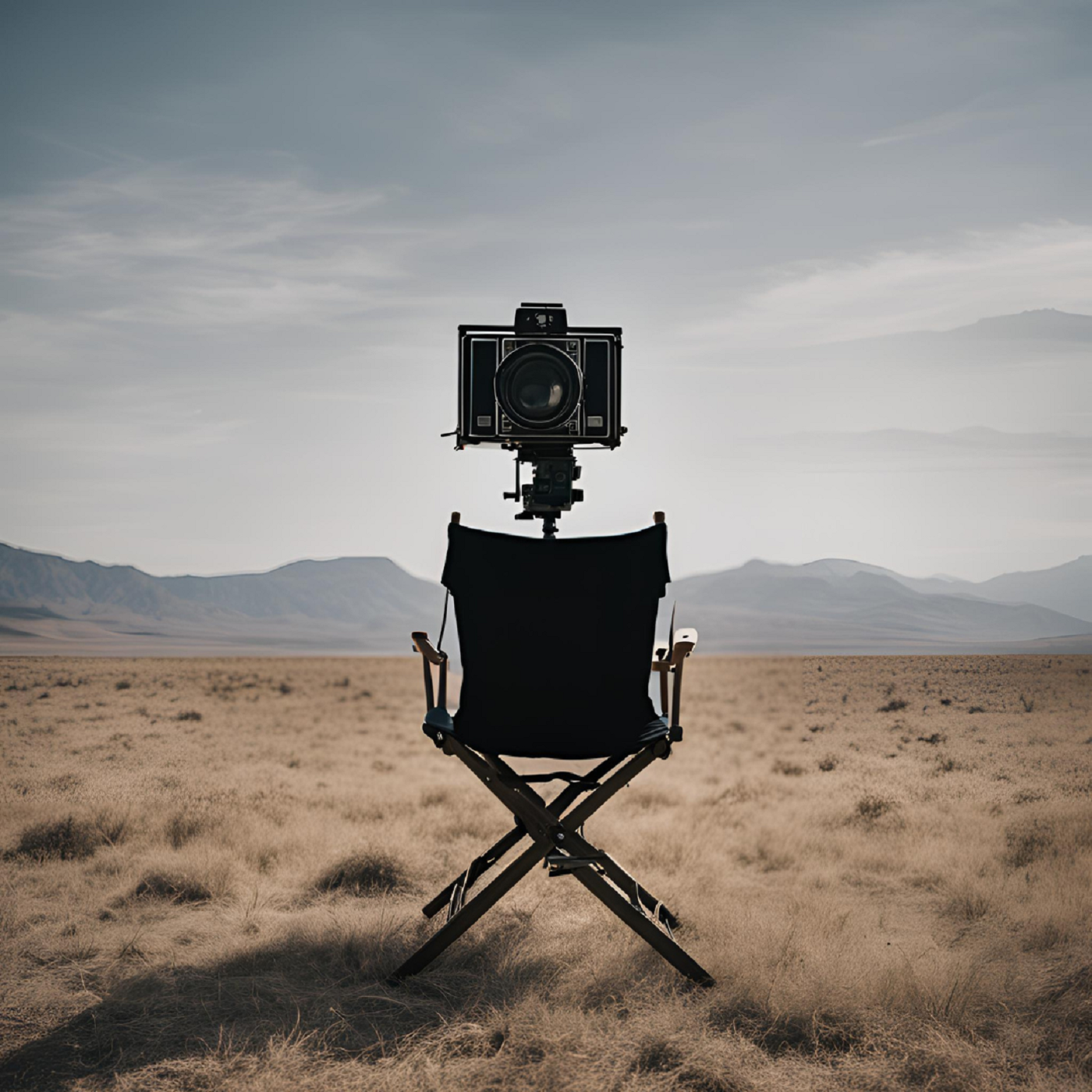
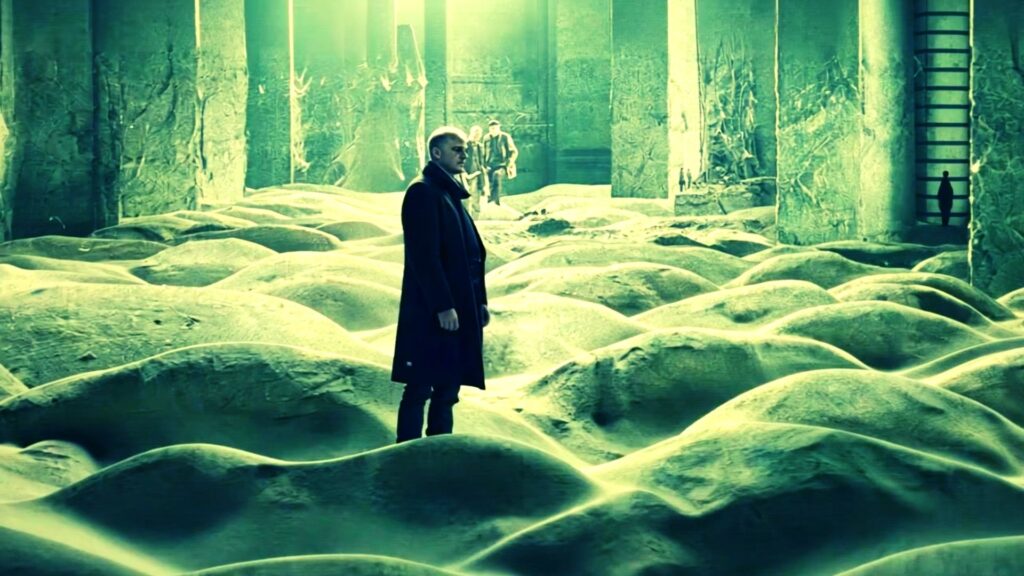
There are moments in life when something enters quietly, almost unnoticed, and then — without warning — rearranges the entire interior of your world. For some people, it’s a book, a place, a poetic line overheard at the right moment. For me, it was a film. Or rather, one filmmaker. And one long, slow, meditative journey into the Zone.
I was twenty-three when I first saw Andrei Tarkovsky’s Stalker.
Not in a cinema, not in the kind of temple the film deserves — but on a modest screen, alone, after midnight, while the pressure of daily life pressed in from all sides. I pressed play thinking I’d watch twenty minutes and fall asleep.
Instead: three hours passed like a whispered prayer.
That night was the beginning of something I didn’t have a name for yet — a new form of seeing, a new way of feeling, a new kind of listening. It was the beginning of my cinephile self awakening.
It didn’t happen suddenly. It didn’t happen loudly. But it happened with absolute certainty.
For the first time in my life, I realized that cinema could be more than entertainment, more than a means of escape from routine or stress. It could be a philosophy. A lens. A slow-burning illumination of the soul.
This is the story of that journey — a personal, wandering, unfinished pilgrimage through slow cinema, world cinema, and the vast constellation of filmmakers who shaped not only my taste but my way of being in the world.
This is for the young cinephile who senses there is something “more” behind the moving images — but doesn’t yet know how to reach it.
1. When the World Slowed Down: My First Encounter With Tarkovsky
Stalker didn’t sweep me up with plot.
It didn’t intoxicate me with explosive emotions.
It didn’t seduce me with speed.
Instead, it pulled me into its currents like a quiet river that looks shallow but carries unimaginable depth.
At twenty-three, I didn’t have the tools to “analyze” Tarkovsky.
But I felt him.
The rhythm of long shots, the devotion to the material world (rusty metal, dripping water, ruins half-swallowed by nature), the sense that time itself was a character — these elements rearranged my understanding of what cinema could be.
A year later, I found Solyaris.
Where Stalker taught me that film could be metaphysical, Solyaris taught me that film could be intimate and metaphysical at the same time — that science fiction didn’t need spectacle to explore the deepest questions of memory, regret, and human longing.
Watching Hari appear and reappear felt like watching grief materialize.
Watching Kris Kelvin tremble with love and guilt felt like a wound being reopened.
I realized then: Tarkovsky’s power lies not in “slowness” but in presence.
He doesn’t show you the world — he holds you inside it.
At that moment, something shifted inside me.
Commercial cinema, which I still enjoy and always will, suddenly felt like a necessary warm-up — not the destination.
The real journey had just begun.
2. The Long Walk Toward Slowness
After Tarkovsky, I didn’t immediately jump into world cinema.
In fact, for a while, I hovered between two worlds: the world of entertainment — and the world of truth.
I still rewatched Heat again and again.
Something about Michael Mann’s atmosphere — the cool blue nights, the existential loneliness of Neil McCauley — comforted me. It was stylish, yes, but also emotional. That scene where De Niro watches the ocean in silence? That was my gateway drug to meditativeness.
I also dove into fantasy worlds for escapism — Jeunet’s dreamlike universes, with their quirky characters and warm colors, gave me joy and protection. Reality felt lighter when I exited a Jeunet film. Escape is not weakness; escape is fuel.
Dark comedies, absurd worlds, post-apocalyptic films, survival stories — they all fed a different part of me. The part that wanted distance. The part that wanted intensity. The part that wanted fun with my family, laughter, adrenaline.
But gradually, quietly, another current pulled me.
Slowness.
Minimalism.
Silence that meant something.
This was the moment I started seeking not “movies,” but experiences.
3. Falling in Love With Slow Cinema
Slow cinema is not simply about long takes or minimal action.
It’s about respect — respect for time, for silence, for the viewer.
After Tarkovsky, I found myself slowly drifting toward other masters of the quiet:
Ozu — The Poet of Everyday Life
The stillness of Tokyo Story hit me harder than any Hollywood climax.
A teapot, a corridor, a quiet sigh — they carried more emotional weight than a hundred screaming arguments.
Béla Tarr — The Collapse of Time
Watching Sátántangó was like walking through a haunted landscape where every step echoed. At first I resisted its length; then I surrendered. Tarr’s slowness is not style; it is the architecture of despair.
Theo Angelopoulos — History as Memory
His long tracking shots felt like historical wounds moving across the screen. He doesn’t show events — he shows the ghosts of events.
Sokurov — The Softness of Sorrow
His films felt like paintings dissolving into emotions.
And then came two filmmakers who became deeply personal for me:
4. Wong Kar-wai, Kiarostami, and the Geography of Emotion
Wong Kar-wai: The Cinema of Loneliness and Color
Discovering Wong Kar-wai felt like discovering a secret room inside myself.
No one films time like he does — as something that slips through fingers.
No one films desire like a passing shadow.
No one uses color as a form of memory.
When I watched In the Mood for Love, I felt like I was intruding on two people who couldn’t speak their truths. Wong Kar-wai taught me that emotional tension can be more powerful than emotional release.
He also taught me that style is not decoration — style is emotion.
Abbas Kiarostami: The Cinema of Honesty
Kiarostami was a revelation.
A filmmaker who proved that simplicity can be transcendent.
In Taste of Cherry, the silence of the hills felt like the silence inside a man contemplating death.
In Where Is the Friend’s House?, a child’s journey became a spiritual quest.
In Close-Up, the boundary between fiction and truth dissolved so gently I barely noticed.
Kiarostami taught me how to look — really look — at life’s smallest gestures.
He taught me humility.
He taught me that cinema doesn’t need to elevate life — it only needs to notice it.
Together, Wong Kar-wai and Kiarostami formed a kind of emotional compass for me: one pointing toward longing, the other toward truth.
5. The Shock of Haneke
Then came Michael Haneke.
His films were not slow in the gentle, meditative way I had come to love.
His slowness was a blade — clinical, cold, merciless.
The White Ribbon felt like watching the birth of European cruelty.
Cache felt like being complicit in silence.
Funny Games exposed the viewer’s addiction to violence.
Haneke doesn’t comfort.
He confronts.
If Tarkovsky opened my soul, Haneke opened my eyes — sometimes painfully.
He made me question my relationship with images, with violence, with guilt, with responsibility.
He is the filmmaker who taught me that cinema can be ethical, not just aesthetic.
6. World Cinema: Entering the Map of Humanity
After Haneke, my curiosity exploded outward.
Japan
- Ozu showed me acceptance.
- Kurosawa showed me dignity.
- Mizoguchi showed me suffering.
- Kore-eda later showed me tenderness.
South Korea
There is nothing like the emotional elasticity of Korean cinema.
Tragedy, comedy, violence, melodrama — all in the same breath.
From Bong Joon-ho’s social rage to Park Chan-wook’s operatic darkness, from Lee Chang-dong’s human fragility to Kim Ki-duk’s symbolic minimalism — Korean cinema expanded my emotional vocabulary.
Eastern Europe
The realism here hit like a cold wind.
The Romanian New Wave taught me that minimalism can be brutal.
Polish cinema taught me that absurdity and tragedy are siblings.
Hungarian cinema (Tarr, Jancsó) taught me that history is a long, exhausting walk.
Middle East and Iran
Iranian cinema — from Kiarostami to Panahi, Majidi to Farhadi — showed me how censorship can create creativity, how metaphor becomes survival.
Every silence feels like rebellion.
Every child’s gaze feels like truth.
Soviet Filmmakers Beyond Tarkovsky
Parajanov, Kalatozov, Dovzhenko — each offered a different form of poetry, imagery, and myth.
Their films felt like ancient texts rewritten as dreams.
7. Filmmakers Working Under Censorship: Metaphor as Resistance
I became fascinated with filmmakers who had to speak in metaphor because they weren’t allowed to speak openly.
- Iranian filmmakers turning daily life into allegory.
- Chinese independent filmmakers hiding realism inside digital cameras.
- Turkish filmmakers using landscapes and silence to express political tension.
- Soviet-era filmmakers who encoded meaning into symbols, colors, even shadows.
Their courage taught me that cinema can be an act of rebellion — a way to say what cannot be said.
This opened my eyes to the political dimensions of slowness:
sometimes silence is not a technique; it is a necessity.
8. Avant-Garde Detours: Embracing the Strange
At a certain point in my journey, I became drawn to the eccentric, the strange, the avant-garde:
- Maya Deren’s dreamlike rituals
- David Lynch’s subconscious labyrinths
- Apichatpong Weerasethakul’s spiritual forests
- Guy Maddin’s surreal nostalgia
- Tsai Ming-liang’s long, aching urban loneliness
- Chantal Akerman’s domestic radicalism
- Béla Tarr’s cosmic despair
- Experimental shorts from Japan, Eastern Europe, Latin America
These films didn’t “entertain” — they unsettled, confused, hypnotized, transformed.
Avant-garde cinema taught me that the rules are not fixed.
You don’t need to “understand.”
You only need to feel, to surrender, to inhabit the images.
9. How Cinema Changed the Way I See Life
Somewhere along this path, I realized that cinema wasn’t just shaping my taste — it was shaping how I moved through the world.
Slowness became a virtue.
I learned to appreciate waiting, listening, observing.
Silence became meaningful.
I started noticing small sounds — the hum of a fridge, the rhythm of footsteps, the quiet between conversations.
Faces became landscapes.
Ozu and Kiarostami taught me to read emotions in micro-movements.
Nature became spiritual.
Tarkovsky made me see water, fire, wind as cinematic characters.
Time itself felt different.
Angelopoulos stretched history.
Tarr made it heavy.
Wong Kar-wai made it melancholic.
Haneke made it moral.
Cinema gave me patience.
Cinema gave me compassion.
Cinema gave me memory.
And most importantly:
Cinema gave me a way to understand myself.
10. A Message to the Young Cinephile
If you are young and standing at the threshold of world cinema, unsure where to go, unsure which door to open first — know this:
You don’t need to rush.
Cinema is not a race.
It is a lifelong companion.
Start with the films that call you — even if they are commercial, fantastical, action-packed, bizarre, or absurd. Your early loves matter. They shape your emotional compass.
When the time comes, the “slow” films will find you.
You will know the moment when a long shot stops feeling “boring” and begins feeling like oxygen.
You will know the moment when silence says more than dialogue.
You will know the moment when cinema stops being escape — and becomes revelation.
And when that moment arrives, your life will change quietly, permanently.
11. Where I Am Now
I still love survival films.
I still enjoy post-apocalyptic stories.
I still revisit Heat with admiration.
I still dive into fantasy worlds when I need comfort.
I still laugh with my family at eccentric comedies.
But now I also carry the slow, gentle, painful, profound films inside me like a second heartbeat.
Tarkovsky opened the door.
Wong Kar-wai painted its interior.
Kiarostami cleared a space for honesty.
Haneke sharpened my awareness.
The world’s filmmakers filled in the rest.
Cinema shaped my way of seeing — and continues to shape it.
Every film adds a new layer.
Every director adds a new emotion.
Every long shot teaches me something about patience, beauty, or time.
This journey is not over.
It never will be.
And that is the greatest gift cinema has offered me.