A personal and philosophical reflection on time, modern life, and the healing power of slow cinema
I. A World Without Stillness: The Opening Question
There is a question that has haunted me for years — a question that feels less hypothetical and more like a warning:
If slow cinema had never existed, what would cinema — and its audience — look like today?
Try to imagine a world where Tarkovsky never carved stillness into time, where Béla Tarr never stretched a moment until it broke open, where Tsai Ming-liang never taught us to sit with silence, where Chantal Akerman never revealed the quiet violence of daily routine. Imagine film evolving only toward speed — toward shorter cuts, louder soundtracks, faster arcs, instant gratification. Imagine an art form shaped entirely by the momentum of consumerism, designed to entertain rather than transform.
Would we still consider cinema an instrument of inner life?
Would we still have the patience to understand an image instead of consuming it?
Would the screen still be a mirror, or merely another distraction?
This thought experiment leads to an uncomfortable realization: much of modern life already leans toward this reality. Our attention spans shrink, our tolerance for silence evaporates, and the constant pressure to “keep up” makes introspection feel like a luxury. We binge-watch shows while looking at our phones; we scroll through TikTok as if time were an enemy to be defeated; even our emotions are consumed quickly, without digestion.
In this atmosphere, slow cinema is not just a genre — it is a rebellion.
A form of resistance.
A way back to ourselves.
This is the story of how slow cinema taught me to slow down — not only as a viewer, but as a person living in a world that no longer knows how to breathe.
II. The Age of Acceleration: How Modern Life Lost Its Rhythm
We live in a time defined by velocity. The speed of the world is no longer measured in hours or days but in notifications, reactions, and micro-impressions. Everything moves quickly — not because it must, but because slowness has become a threat to modern economic logic.
The signs are everywhere:
- We scroll faster than we think.
- We skim instead of reading.
- We react instead of reflecting.
- We consume emotions like disposable products.
- We replace experiences with impressions.
Modern life has not only accelerated — it has become fragmented. Our attention is shattered into seconds, our sense of continuity constantly disrupted by the digital pulse of updates and alerts. Time itself feels thinner, stretched and strained.
This pressure to “keep moving” is not merely psychological; it’s moral and existential. When everything is fast, reflection becomes a luxury. When everything is instant, depth becomes obsolete. And when life becomes a race, we forget to live inside our own experiences.
Cinema, too, has mirrored this acceleration. The rise of hyper-edited blockbusters, binge-worthy streaming formulas, and algorithm-driven storytelling reflects the same cultural anxiety: the fear that an unstimulated audience will vanish. Modern entertainment assumes that viewers cannot sit still, cannot contemplate, cannot endure silence.
But then there is slow cinema — the counter-movement that refuses this logic. It stands apart not because of its length, but because of its courage to protect attention, protect silence, protect the integrity of time.
Slow cinema does not fight speed by offering less; it fights speed by offering truth.
III. My First Encounter with Slowness: Discovering a New Way of Seeing
I discovered slow cinema at a time when I didn’t know how to slow down myself. I was in my early twenties, moving through life with the same restless urgency that defines so many modern young adults. Every day felt like a sprint; every hour demanded productivity; every moment of boredom felt like failure.
Then I encountered Andrei Tarkovsky — specifically Stalker.
I was twenty-three.
I remember the exact scene that altered something inside me: the long, silent tracking shot on the rail cart as the three men slowly travel into the Zone. Nothing “happens” in the conventional sense. The shot unfolds like a meditation — a prolonged breath that refuses to be shortened, refuses to be interpreted prematurely. The camera doesn’t chase action; it bears witness.
At first I resisted it. My body was impatient, conditioned by a lifetime of fast pacing. But gradually, something shifted — not on the screen, but inside me. The slowness became a space. A pause. A moment where time stopped demanding something from me and simply was.
I realized I had never actually watched time before.
Only used it.
Measured it.
Raced against it.
Tarkovsky forced me to see it — to recognize time not as a resource to be spent but as a dimension to be inhabited.
This realization changed how I watched films. More importantly, it changed how I understood life.
IV. What Slow Cinema Asks from Us
Slow cinema is often misunderstood as “boring” or “empty.” But what it asks from the viewer is profound and challenging:
1. Patience
Not passivity, but active patience — the willingness to remain with a moment beyond its immediate meaning.
2. Surrender
You cannot dominate or predict a slow film; you must submit to its rhythm.
3. Attention
Not the scattered attention of multitasking, but a singular, meditative focus.
4. Vulnerability
Slowness reveals emotions we usually hide under activity and noise.
5. Presence
Slow cinema brings you back to the physicality of the moment — the sound of wind, the weight of silence, the texture of a room.
In an age that demands endless acceleration, slow cinema teaches us to reclaim the fundamental human ability to experience. Watching a slow film is an act of defiance: you allow your mind to settle, your breathing to soften, your awareness to deepen.
It feels radical because in today’s world, it is.
V. The Healing Power of Looking: How Slow Cinema Rebuilds Inner Life
The deeper I went into slow cinema, the more it reshaped not just my viewing habits, but my internal world. These films taught me to look again — to really look.
1. Learning to observe without judgment
Slow cinema emphasizes the act of observation. A long static shot is not merely visual; it trains the mind to sit with what is in front of it without rushing to interpret or categorize. This patience extends into life, allowing you to engage with people and situations without immediate reaction.
2. Reconnecting with silence
Silence is one of the rarest experiences in modern life. Slow cinema restores silence as a meaningful space — a space where emotions can surface, where memory can breathe.
3. Confronting emotions instead of numbing them
Fast entertainment numbs. Slow cinema unveils.
You cannot escape yourself during a 7-minute shot of a character staring out a window — you begin to feel the weight of your own quiet moments.
4. Reclaiming depth in an age of superficiality
Slow films demand emotional depth because they trust the viewer. They assume you are capable of thinking, feeling, and reflecting — something modern entertainment often forgets.
5. Restoring a sense of moral and spiritual grounding
Slowness is fundamentally ethical.
It values life.
It rejects the industrial logic that everything must be efficient, entertaining, profitable.
Slow cinema, in its essence, is a reminder that human life is not meant to be lived at the speed of algorithms.
VI. Textbook Examples of Slow Cinema and What They Teach About Time
Here are some of the essential works and scenes that embody the philosophy of slowness.
1. Tarkovsky’s Candle in Nostalghia
The famous final sequence — the protagonist carrying a candle across an empty pool — is a lesson in endurance. The entire scene is a metaphor for how fragile meaning is, how difficult it is to protect something sacred in a chaotic world.
2. Béla Tarr’s Opening Shot in Sátántangó
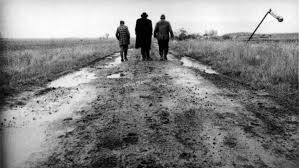
The legendary seven-minute shot of cows slowly walking across muddy ground is more than a stylistic choice — it’s a worldview. Life moves at its own pace; meaning emerges only when we allow ourselves to see the world without decoration.
3. The Turin Horse — Repetition as Philosophy
Béla Tarr again: the routine of the father and daughter, repeated daily, without variation, is a spiritual confrontation with existential decay. It teaches that slowness is not always peaceful — sometimes it reveals the truth we avoid.
4. Chantal Akerman’s Jeanne Dielman
A masterclass in domestic time. Akerman reveals the hidden labor, monotony, and psychological weight of routine. Time becomes a silent force shaping a woman’s entire existence.
5. Apichatpong Weerasethakul’s Mystical Durations
In films like Tropical Malady and Uncle Boonmee Who Can Recall His Past Lives, slowness becomes an entry into the metaphysical. Time here is porous, dreamlike, spiritual.
These examples are not about length; they are about courage — the courage to let time breathe.
VII. A World Without Slow Cinema: A Philosophical Warning
If slow cinema had never existed, what would happen?
1. The collapse of cinematic patience
We would accept speed as the natural state of film, forgetting that images can breathe.
2. A fully accelerated audience
Viewers would expect constant stimulation, losing the capacity to endure silence or ambiguity.
3. The loss of cinema’s spiritual dimension
Without slow cinema, film becomes entertainment only — not contemplation, not art, not philosophy.
4. A moral and emotional shallowness
Speed creates superficiality. Slowness creates meaning.
5. The disappearance of time as a subject
Without slow cinema, time becomes invisible — not explored, not felt, not questioned.
The absence of slow cinema would mean the absence of a cinematic counterbalance to modern acceleration. It would leave us with images designed only to distract, never to transform.
VIII. How Slow Cinema Teaches Us to Live Differently Today
This is where slow cinema becomes more than an aesthetic movement — it becomes a life philosophy.
1. The art of single-tasking
In a world of distractions, slow films train the mind to focus on one thing at a time.
2. The practice of stillness
Stillness becomes a skill — the ability to remain with yourself without anxiety.
3. The rediscovery of emotional honesty
Slowness enables depth: deeper empathy, deeper sensitivity, deeper perception.
4. A form of meditation
Many slow films are experienced not as stories but as meditations. The screen becomes a space for introspection.
5. The rebirth of moral awareness
Slowness restores the ethical dimension of perception: you see more, you feel more, you understand more.
Slow cinema, in this sense, is not a retreat from the world but a way of re-entering it with clarity and softness.
IX. Conclusion: Slowing Down as an Act of Resistance
Slow cinema taught me that slowing down is not a withdrawal — it is a resistance. In a world that demands constant acceleration, slowing down becomes a way to protect your inner life, your attention, your humanity.
Cinema showed me that life is not meant to be consumed but experienced.
That silence is not emptiness but space for meaning.
That time is not an enemy but the medium of existence.
That slowness is not weakness but depth.
And perhaps most importantly:
Slow cinema reminded me that the world becomes beautiful only when we give it time.