
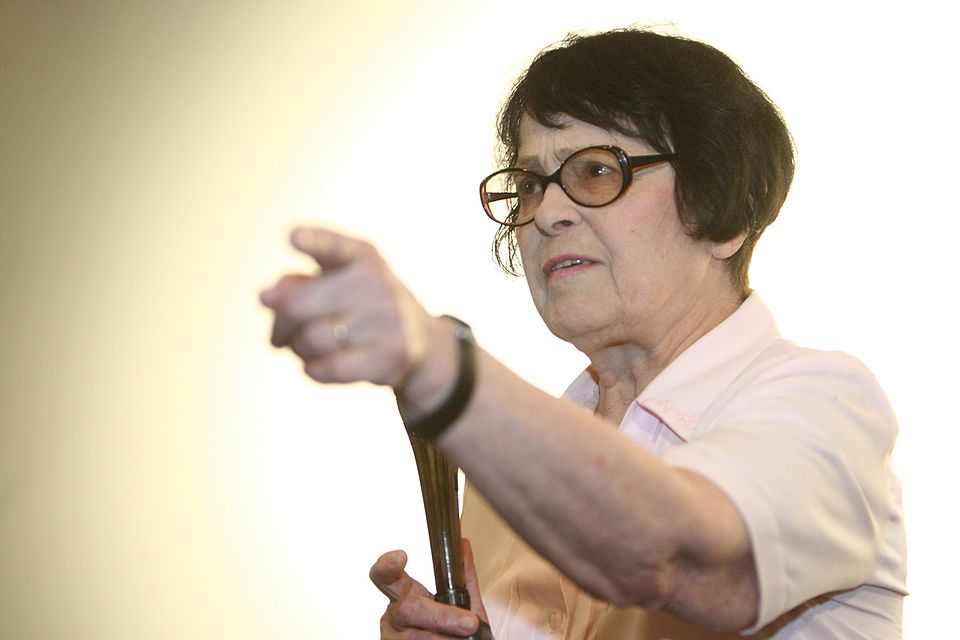
There are filmmakers who challenge institutions, filmmakers who challenge audiences, and then there is Kira Muratova — a director who, throughout her career, seemed determined to challenge cinema itself. Born in 1934 in Soroca (present-day Moldova) and active mainly in Odessa, Muratova forged one of the most uncompromising, idiosyncratic voices in Eastern European cinema. Her films are jagged, dissonant, darkly comic, abrasive, and strangely lyrical. They occupy a space between poetry and chaos, between theatricality and realism, between empathy and cynicism. Watching a Muratova film is not a passive experience; it is an encounter — sometimes bewildering, sometimes hypnotic, often uncomfortable, and always unforgettable.
For cinephiles who gravitate toward filmmakers unafraid of ugliness, contradiction, or emotional messiness — directors like Béla Tarr, Radu Jude, Sharunas Bartas, Chantal Akerman, or Aleksei German — Muratova stands as one of the most radical voices of the last fifty years. But unlike some of her high-modernist contemporaries, she never seemed interested in grand metaphysical statements or tidy structural designs. Her cinema is more like a fractured mirror: sharply reflective in places, opaque in others, shattered but deliberate. Human behavior — especially in its most excessive or absurd forms — is her raw material.
This article examines Muratova’s career in depth: her early struggles with censorship, the evolution of her cinematic language, the thematic obsessions that repeat across her films, and the stylistic features that have made her one of the most daring auteurs in post-Soviet cinema. It is written from the perspective of a cinephile who has spent years absorbing the rhythm, dissonance, and strange beauty of her films — someone who recognises that Muratova is not merely a director, but an entire cinematic ecosystem unto herself.
The Early Years: A Filmmaker Born Into Disorder
Kira Muratova’s upbringing foreshadowed the fractured sensibility that would define her films. Her mother was a doctor, her father a communist activist executed during Stalinist purges. She witnessed political cruelty firsthand. She grew up in multiple cultures — Romanian, Russian, Ukrainian — without fully belonging to any of them. Later she studied at VGIK (the prestigious Soviet film school) under Sergei Gerasimov, a mentor to many major Soviet directors.
But Muratova did not share the traditional socialist-realist optimism of her mentors. From the start, she distrusted ideology. She distrusted narratives that promised solutions. She distrusted the Soviet taste for tidy moral endings. Her cinema would instead become a catalogue of human dissonance and confusion — not to denounce society in a didactic way, but to show that confusion is part of human nature. Her films were censored so frequently not because they were overtly political but because they were ambiguous, and ambiguity itself was considered threatening in a system obsessed with clarity.
The 1960s and 1970s: The Struggle to Be Heard
Muratova’s early films, starting with Brief Encounters (1967) and Long Farewells (1971), reveal a director already playing with fragmented narration and emotional discontinuity. Both films were suppressed to varying degrees; Long Farewells was shelved for nearly two decades. Soviet officials did not quite know what to make of her: she was not attacking socialism, but her characters behaved in ways that felt too interior, too contradictory, too psychologically complex, too unheroic.
Brief Encounters (1967)
Starring the legendary Vladimir Vysotsky and Muratova herself, Brief Encounters is ostensibly a love triangle, but its narrative dissolves into elliptical memory, spatial fragmentation, and unconventional character rhythms. Even in this early film, Muratova’s fascination with uncomfortable pauses, psychological opacity, and emotional déjà-vu is evident. She was already breaking Soviet narrative norms.
Long Farewells (1971)
Perhaps the most psychologically delicate film of her early period, Long Farewells examines a mother-son relationship through small gestures, fractured emotional beats, and disorienting time jumps. It is not a story of conflict but a story of dissonance — characters failing to communicate despite deep emotional bonds. The actress Zinaida Sharko gives one of the best performances in Soviet cinema: fragile, neurotic, loving, irritating, and authentically human.
These early films already show Muratova’s resistance to the idea that characters must be likeable or coherent. Her protagonists often behave in ways that feel contradictory or repetitive — not because of poor writing but because she understood human beings as inherently repetitive and contradictory creatures. Soviet censors mistook this for narrative incompetence; in reality, it was a kind of radical psychological honesty.
The 1980s Explosion: Muratova Unbound
Although Muratova directed films throughout the Brezhnev and stagnation years, it was with The Asthenic Syndrome (1989) — one of the last major works of the Soviet era — that she fully unleashed her cinematic force. The film is a delirious, furious masterpiece, a howl from within the collapsing Soviet psyche.
The Asthenic Syndrome
Often cited as one of the greatest Eastern European films ever made, The Asthenic Syndrome is a work of artistic rebellion. It attacks apathy, despair, and post-traumatic social illness, but it does so with an unconventional structure: the first part is a black-and-white film within the film; the second part is in color. It is chaotic, abrasive, and deliberately exhausting. Muratova forces the viewer to feel the psychic collapse she is portraying.
What makes The Asthenic Syndrome remarkable is not merely its anger but its compassion: beneath the cynicism lies a profound sorrow for human beings trapped in a society that no longer provides meaning. It is a film about people too exhausted to scream and yet screaming anyway.
With this film, Muratova became internationally recognized. She was suddenly grouped with auteurs like Tarkovsky and Parajanov, but she never fit neatly into the same category. If Tarkovsky sought transcendence, Muratova sought the grotesque; if Parajanov sought beauty, Muratova sought dissonance.
The Muratova Style: Fragmentation, Dissonance, Excess
To understand Muratova is to understand that her films do not treat humans as stable agents. People in her films talk too much or too little, repeat actions compulsively, interrupt each other, drift into monologues, or behave like caricatures that somehow remain deeply human.
Her style has several recognizable components:
1. Fragmented Narrative and Emotional Discontinuity
Muratova rarely allows scenes to progress linearly. She jump-cuts emotional beats, inserts seemingly irrelevant details, and disrupts temporal flow. This fragmentation is not alienating for its own sake; it reflects the way emotions accumulate inconsistently in real life.
2. Repetition and Excess
Characters repeat phrases, gestures, or entire monologues. Sometimes it feels like absurd comedy; sometimes it feels like madness. Muratova understood repetition as a core element of human behavior — a way to reveal emotional desperation or psychological blockage.
3. Abrasive, Non-Naturalistic Performances
Actors in Muratova’s films often speak in unusual rhythms, frequently overlapping dialogue. She encouraged non-theatrical cadences, unexpected pauses, and exaggerations. The result is a strange blend of realism and anti-realism — a world where human beings feel both hyper-authentic and hyper-constructed.
4. Obsession with the Grotesque and the Marginal
She loved characters on the fringes of society: drunks, eccentrics, petty criminals, loners, obsessive talkers, failed dreamers. Not because she wanted to mock them, but because she saw in them a more honest portrait of humanity than in conventional protagonists.
5. Collision of High Art and Low Life
Muratova was fascinated by how lofty ideals crash against banal reality. Poetic monologues coexist with degraded environments. Elegance and squalor cohabit the same frame.
6. Theatricality as a Tool of Truth
Many scenes feel staged, even artificial, but this artificiality reveals emotional truth. She used theatricality to expose the absurdity of social rituals and relationships.
7. Humor — Dark, Dry, and Anarchic
Though frequently described as bleak or harsh, Muratova’s films are extremely funny — but in a way that makes you uncomfortable to laugh. Her comedy emerges from repetition, social awkwardness, human incompetence, and emotional breakdowns.
Her cinema is not “weird for weirdness’ sake,” nor is it experimental in a self-conscious way. It is simply the cinematic equivalent of someone who refuses to lie about the absurdity of existence.
The 1990s and 2000s: A Late-Career Renaissance
After the collapse of the Soviet Union, Muratova became surprisingly prolific. Her films in this period are bolder, stranger, and more stylistically refined. Themes of cruelty, absurdity, and emotional chaos intensify.
Three Stories (1997)
A triptych that shows Muratova at her most unsettling. Each story revolves around a murder — but not in a genre sense. Murders here are mundane, impulsive, or disturbingly casual. The film examines violence without sensationalizing it, treating cruelty almost as a psychological symptom of post-Soviet disillusionment.
The Turn of the Century (2000)
A mosaic-like work with a sprawling cast, capturing a society adrift in fragmentation. Characters drift through absurd scenarios, engaging in circular conversations and expressing emotional confusion. It is Muratova’s portrait of the new millennium: anxious, uncertain, disoriented.
Chekhov’s Motifs (2002)
A brilliant fusion of Anton Chekhov’s texts with Muratova’s signature style. She takes Chekhovian absurd humor and injects her own formal chaos. The result is a deeply intelligent film that respects Chekhov while transforming him.
The Tuner (2004)
One of her most accessible films, though still filled with emotional perversity. It follows a piano tuner who manipulates wealthy women. It is partly a con-artist story, partly a social satire, partly a meditation on loneliness.
Two in One (2007)
Combining two separate screenplays, the film explores sexuality, betrayal, and the performative nature of relationships. It features some of Muratova’s most beautiful and dangerous emotional moments.
Melody for a Street Organ (2009)
Among her most heartbreaking works. Two orphaned children wander through a cold, indifferent city in a film that echoes De Sica yet remains unmistakably Muratova. The film is bleak, but its emotional force is undeniable.
Eternal Homecoming (2012)
Her final film is a meta-cinematic reflection on performance, repetition, and the impossibility of emotional resolution. It is almost a summation of her entire philosophy: life as endless rehearsal, endless repetition, endless failed communication.
Recurring Themes in Muratova’s Work
1. Human Incoherence
Muratova rejected the idea of coherent personality. People in her films contradict themselves constantly. They say one thing and do another. They repeat their thoughts compulsively. She understood that psychology is not stable — it is a kaleidoscope.
2. Breakdown of Communication
Conversation in her films is rarely meaningful. People talk past each other. They answer questions that were not asked. They monologue instead of dialogue. Speech becomes noise — an expression of loneliness rather than connection.
3. Cruelty and Indifference
Violence in Muratova’s cinema is rarely dramatic. It is casual, almost accidental. She reveals the banality of cruelty in daily life — the small betrayals, the humiliations, the emotional negligence.
4. Obsession and Compulsion
Characters become fixated on trivial tasks: repeating a phrase, writing a letter, following a stranger, counting money. These compulsions reveal inner voids, cracks in the psyche.
5. Borders Between Comedy and Tragedy
Muratova erases the line between genres. Tragedy is funny because it is absurd; comedy is painful because it reveals human fragility. Her films produce laughter mixed with discomfort.
6. Social Chaos and Emotional Disorder
She captures the chaotic atmosphere of late-Soviet and post-Soviet life: bureaucracy, poverty, apathy, and existential exhaustion. Her films are sociological without being didactic.
7. Women as Complex, Non-Idealized Beings
Muratova brewed some of the most nuanced female characters in Eastern European cinema. They are difficult, contradictory, emotionally raw, sometimes cruel, sometimes fragile. She never reduced them to symbols.
The Muratova Universe: Actors, Odessa, and the Power of Ensemble
Just as Fellini had his troupe, Muratova cultivated an ensemble of regular performers: Zinaida Sharko, Renata Litvinova, Nina Ruslanova, and others. These actors understood how to deliver her peculiar rhythms — the broken sentences, the overlapping dialogue, the theatrical deadpan.
Odessa, her home base, also became a recurring character: a city by the sea, filled with eccentrics, dreamers, and contradictions. Its mixture of beauty and decay matched Muratova’s sensibility perfectly.
Why Muratova’s Films Feel So Difficult — and Why They Are Worth It
Many viewers find Muratova challenging. Her films do not follow traditional emotional cues. They do not offer clear narrative arcs. They resist identification. But for cinephiles willing to embrace discomfort, her films provide an experience unmatched in world cinema.
Here’s why:
1. They portray emotional truth in its rawest form.
Human beings are messy, contradictory, and irrational — and Muratova shows precisely that.
2. They dismantle cinematic clichés.
She refuses sentimentality, moral clarity, and narrative comfort.
3. They blend high art with the grotesque.
The films are both brutal and poetic.
4. They demand active engagement.
You cannot watch a Muratova film passively; you have to enter its rhythm.
5. They feel completely original.
Her voice is instantly recognizable and utterly unrepeatable.
Kira Muratova and the Politics of Ambiguity
Although she never considered herself a political filmmaker, Muratova’s work is filled with political implications. Her refusal to simplify human nature challenged Soviet ideological expectations. Her portraits of apathy and emotional exhaustion reflected social malaise. Her dissection of cruelty exposed underlying structural violence.
But Muratova rejected labels — she insisted she was simply portraying life as she saw it. Her politics are embedded in her form, not in slogans. When she shows the grotesque, she is not mocking people; she is exposing the conditions that produce such grotesqueness.
Legacy: The Last Great Rebel of Eastern European Cinema
Kira Muratova died in 2018, leaving behind a body of work that remains one of the most radical and under-appreciated in world cinema. Her films do not have the mainstream recognition of Tarkovsky or the cult following of Parajanov. Part of this is due to distribution challenges; part is due to the demanding nature of her style. But among filmmakers, scholars, and adventurous cinephiles, she is revered.
Her influence can be seen in the stylized cruelty of Sergei Loznitsa, the absurdist humor of Radu Jude, the emotional chaos of Khrzhanovsky, and the fractured narratives of many modern Eastern European auteurs.
Yet no one has truly replicated her voice. Her films remain singular, fiercely autonomous, resistant to categorization.
Why Cinephiles Should Rediscover Her Today
In an era where cinema increasingly gravitates toward clarity, accessibility, and emotional “relatability,” Muratova’s films feel like a last stand for artistic risk. They remind us that cinema can still be strange, dissonant, and frighteningly honest.
She invites us to see humans without filters. Not as heroes or villains. Not as symbols. Not as narrative functions.
But as living contradictions.
As chaos.
As beauty fractured into pieces.
As beings trying — and often failing — to communicate.
In this sense, Muratova’s cinema is not only important — it is necessary. It restores cinema’s capacity to disturb, to challenge, and to confront us with the uncomfortable truth that human behavior rarely fits into tidy stories.
Conclusion: Entering the Muratova Labyrinth
To love Kira Muratova’s films is to love contradiction. It is to embrace discomfort, emotional fragmentation, grotesque humor, and narrative chaos. It is to accept that films do not need to guide you gently — they can push, pull, confuse, provoke, and still be profoundly honest.
Her cinema is a labyrinth, not a map.
A provocation, not a lesson.
A dissonant symphony, not a melody.
But for those willing to explore it, the labyrinth leads to a deeper, darker, more authentic vision of humanity — one that few filmmakers have had the courage to reveal.
Kira Muratova did reveal it.
And she revealed it fearlessly.
In doing so, she carved out one of the boldest bodies of work in world cinema — a cinematic universe where chaos becomes art, where excess becomes meaning, and where the grotesque becomes a mirror held up to our own fragmented souls.