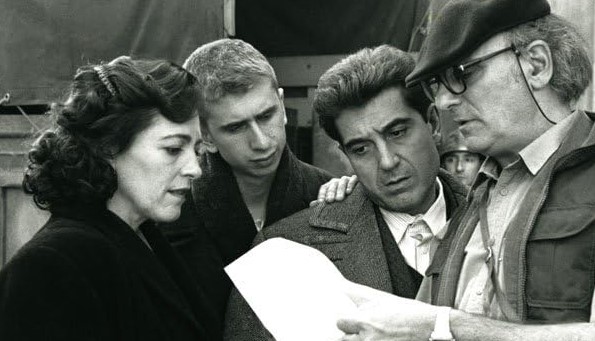
When Carlos Saura died in February 2023, cinema lost one of its most sophisticated architects of temporal space. For those of us who have spent decades immersed in his work—from the suffocating psychological chambers of The Hunt (1966) to the kaleidoscopic memory palaces of his flamenco trilogy—Saura’s passing felt like the closing of a particular chapter in film history, one defined by an almost architectural approach to the fluidity of time and consciousness.
The Saura Aesthetic: Where Memory Becomes Space
What distinguishes Saura from his contemporaries, even from other masters of European art cinema, is his unique method of spatializing time itself. This isn’t the Proustian meditation on memory we find in Resnais, nor is it the Bergmanesque psychological excavation. Saura’s innovation lies in his ability to construct physical spaces—often theatrical, often confined—where past and present, reality and fantasy, memory and hallucination exist simultaneously, without hierarchy, without clear demarcation.
Watch Cría Cuervos (1976) and you witness this methodology in its purest form. The Francoist-era Madrid household becomes a literal stage where the dead mother (Geraldine Chaplin) moves through rooms occupied by the living, where the adult Ana narrates from a future that bleeds into her childhood self’s present. Saura doesn’t use flashbacks in any conventional sense—there are no dissolves signaling temporal transition, no sepia tones marking “the past.” Instead, time pools in the same architectural space, characters from different temporal planes sharing the same frame, the same staircase, the same dining table.
The Franco Years: Metaphor as Survival
Those of us who came to Saura through his 1960s and 70s work understand that his aesthetic wasn’t merely stylistic preference—it was born of necessity. Under Franco’s censorship, direct political statement was impossible. But Saura discovered something profound: that the collapse of temporal boundaries could serve as political metaphor. The past doesn’t stay past in Saura’s Spain; it haunts, it infects, it literally occupies the same space as the present.
The Hunt remains one of cinema’s most claustrophobic experiences precisely because Saura traps his middle-aged men in a landscape that is simultaneously the Spanish countryside of 1965 and the Civil War battleground of their youth. The rabbit hunt becomes a ritual re-enactment, memory made carnally present. The violence that erupts isn’t psychological breakdown—it’s the past asserting its material reality, refusing to remain memory.
Cousin Angelica (1974) takes this further, casting the same actor (José Luis López Vázquez) as both the middle-aged Luis and his childhood self. When adult Luis returns to his childhood home, he doesn’t remember being a boy—he becomes the boy again, adult consciousness trapped in a child’s perspective and vice versa. It’s disorienting, deliberately so, because Saura understands that memory doesn’t work through neat temporal segregation. We don’t visit the past; we inhabit multiple temporalities simultaneously.
The Dance (Flamenco) Trilogy: Reality as Performance, Performance as Reality
By the time Saura made Blood Wedding (1981), Carmen (1983), and El Amor Brujo (1986), he had perfected his method of temporal-spatial fusion to the point where he could apply it to the heightened reality of flamenco. These films—often misunderstood as mere filmed dance performances—represent Saura at his most sophisticated.
What Saura discovered in flamenco was a form that already operated in his preferred mode: flamenco collapses past and present through duende, that ineffable quality where the performer channels centuries of accumulated emotion and history into the immediate present. In Carmen, Saura layers the rehearsal of Bizet’s opera with the “real” relationships of the dancers, which in turn mirror the mythic narrative of Carmen herself. Which is the performance? Which is reality? Saura refuses to answer because the question itself is false. All of it is both performance and reality simultaneously.
The brilliance lies in how Saura films these works. The camera often pulls back to reveal the theatrical space—the mirrors, the studio floor, the watching dancers—breaking any conventional illusion. But then, within the same shot, without cut, the performance takes over and the theatrical frame dissolves. We’re no longer watching a rehearsal in Madrid but witnessing Carmen’s story as if it were unfolding before us for the first time. Then, just as smoothly, we’re back in the studio. Saura makes us experience the permeability of these boundaries, the way performance and life, myth and reality, occupy the same existential space.
The Goya Films: History Painting in Motion
Goya in Bordeaux (1999) might be Saura’s ultimate statement on his career-long obsession. Here is a film about a painter whose later work dissolved the boundaries between reality and nightmare, who painted his demons directly onto his walls. Saura finds in Goya a kindred spirit—another Spanish artist forced to navigate political oppression, who discovered that the fantastic could express truth more directly than realism.
The film’s structure mirrors Goya’s own techniques: scenes from the painter’s life blend seamlessly with his paintings coming to life, with his memories, with his hallucinations in old age. The Spanish War of Independence, the terrors of the Inquisition, the personal tragedies—all exist simultaneously in Goya’s consciousness and in Saura’s frame. We see Goya’s younger self watching his older self, paintings bleeding into life bleeding back into paint.
Technical Mastery: How Saura Builds His Temporal Architecture
For those of us who study Saura’s technique, certain patterns emerge. He favors long takes that allow multiple temporal planes to coexist within a single shot. He uses mirrors obsessively—not as symbolic devices but as literal tools for showing multiple realities simultaneously. The camera in a Saura film often pulls back to reveal the theatrical frame, then slowly moves in until that frame dissolves and we’re inside the memory or fantasy or performance.
His collaboration with cinematographer Teo Escamilla (from Cría Cuervos through much of the 1980s) was crucial. They developed a visual language where lighting could shift within a shot from naturalistic to theatrical without feeling jarring, where the camera could glide from documentary observation to subjective immersion. Watch how often Saura uses doorways and windows not as mere compositional elements but as literal thresholds between temporal states—characters step through a door and move from present to past, or we see both times through a window simultaneously.
His use of music, particularly in his dance films, operates similarly. The music doesn’t underscore the action; it creates the space where different temporal realities can merge. When the palmas (hand clapping) begins in a Saura film, we’re entering a temporal-spatial zone where different rules apply, where the performer is simultaneously themselves, the character they’re dancing, and every dancer who has ever performed that piece.
Legacy and Influence: The Post-Saura Generation
Watching contemporary Spanish cinema, you can trace Saura’s influence even when it’s not explicitly acknowledged. Isabel Coixet’s fluid approach to memory, Alejandro Amenábar’s ghost stories where past and present cohabit, even Almodóvar’s use of performance and reality as interchangeable—all of these carry forward something Saura pioneered.
But his influence extends beyond Spain. You see it in the temporal complexities of Apichatpong Weerasethakul’s cinema, in the way Bruno Dumont stages his films as both historical reconstruction and contemporary parable, in how Christian Petzold’s ghosts walk among the living. These filmmakers, whether they’ve acknowledged Saura or not, work in a cinema where his fundamental insight—that film can construct spaces where multiple temporalities exist without hierarchy—has become possible.
The Intimate Political: Saura’s Enduring Relevance
What makes Saura’s work feel particularly urgent now is his understanding that the political and the personal, the historical and the intimate, occupy the same space. He doesn’t make films about how history affects individuals; he makes films where historical trauma is personal memory, where collective experience and individual consciousness are indistinguishable.
This is why Cría Cuervos remains so powerful. The dying Franco lies in his bed, and simultaneously Ana’s mother lies dying in hers, and both deaths mean the same thing and different things, and Saura refuses to separate them. The political allegory and the family drama aren’t parallel tracks—they’re the same track, the same space, the same architecture.
Conclusion: Cinema as Memory Palace
Carlos Saura gave us a cinema of sophisticated spatial and temporal fusion that refuses easy categorization. His films don’t depict memory; they construct memory palaces where we can wander between past and present, reality and fantasy, witnessing how these supposedly distinct categories are, in fact, permeable, simultaneous, inseparable.
For those of us who have spent years studying his work, returning to his films again and again, what remains most striking is their fundamental generosity. Saura never patronizes his audience with clear temporal markers or heavy-handed symbolism. He trusts us to navigate these complex temporal architectures, to accept that a dead mother can sit at the table with her living children, that a rehearsal can be more real than reality, that the past is never past but always present, always pressing against the now, always inhabiting the same rooms we walk through.
In an era of cinema increasingly dominated by either rigid narrative clarity or empty stylistic experimentation, Saura’s work reminds us that formal innovation can serve profound emotional and political truths. His temporal architectures weren’t intellectual exercises—they were the only way to honestly depict consciousness under dictatorship, memory in the aftermath of trauma, the Spanish experience of living in multiple temporalities simultaneously.
This is what mastery looks like: a filmmaker who developed a completely personal formal language that was simultaneously innovative technique, political necessity, and the most honest way to depict human consciousness he could find. Saura didn’t collapse boundaries between time periods because it looked cool. He did it because that’s how memory actually works, how trauma operates, how we actually experience being alive in history.
That’s the lesson for anyone who wants to understand cinema as an art form: style isn’t decoration. In Saura’s hands, the dissolution of temporal boundaries was content, was meaning, was the only way to tell these particular truths about Spain, about memory, about consciousness itself. That’s what makes him a master—not just that he could do it, but that he understood why it had to be done this way and no other.
Pingback: Listening With the Eyes: Carlos Saura’s Flamenco Trilogy and the Discovery of Cinema as Ritual - deepkino.com