
There are filmmakers whose names become shorthand for entire eras—Bergman for existential introspection, Fellini for carnivalesque memory, Tarkovsky for poetic metaphysics. And then there is Juraj Jakubisko, a director so wildly imaginative, so rooted in folklore yet unbound by realism, that one struggles to find anyone else quite like him. Critics often call him “the Fellini of the East,” but the comparison, while flattering, never fully captures the singularity of Jakubisko’s cinematic touch. He was, in every sense, a sorcerer: a filmmaker who transformed Slovak history, magic, tragedy, and absurdity into a visual language entirely his own.
For audiences discovering him today, Jakubisko stands as one of the most visionary figures of the Czechoslovak New Wave, yet also as someone who reached beyond its boundaries. While Miloš Forman, Jiří Menzel, and Věra Chytilová carved paths through sly satire and experimentation, Jakubisko immersed himself in something more primal—something closer to fairy tale logic, pagan symbolism, and the deep, often haunted folklore of Central Europe.
This article explores his biography, the aesthetic foundations of his cinema, his major films, thematic concerns, political struggles, artistic partnerships, and ultimately, the legacy that places him among Europe’s great auteurs.
I. Early Life: A Childhood Shaped by Myth and Memory
Juraj Jakubisko was born in 1938 in Kojšov, a small village nestled in the mountainous region of eastern Slovakia. This landscape—rugged, folkloric, and steeped in oral tradition—would later form the spiritual backbone of his cinematic language. Unlike his Czech contemporaries, many of whom grew up in cities and gravitated naturally toward urban satire or documentary realism, Jakubisko absorbed a worldview more mystical than materialist.
He grew up surrounded by:
- superstitions told by elders at night,
- rituals marking the seasons,
- a Catholic world infused with pagan survivals,
- and the remnants of a rural life untouched by modernity.
These early impressions did not simply inform his work—they became his work. Every Jakubisko film vibrates with the tension between the earthly and the otherworldly, between history and dream, between the joy of community and the trauma of war. He once said that “fairy tales are truer than reality,” and in many ways this became the unconscious thesis of his oeuvre.
His route into filmmaking followed the path of many Eastern European auteurs: he studied at FAMU, the famed film school in Prague. There, he encountered a generation of young artists pushing against the constraints of socialist realism. FAMU in the 1960s was a crucible of rebellion, intellectual exchange, and experimentation, and Jakubisko quickly distinguished himself as one of the movement’s most visually daring voices.
II. The Czechoslovak New Wave: A Movement and a Rebellion
The Czech New Wave was not a monolith but a constellation—sharing a common spirit but branching into wildly different styles. Whereas Menzel crafted gentle humanist comedies, Chytilová wielded avant-garde provocation, Forman chased the absurdities of everyday life, and Švankmajer explored the surreal through animation, Jakubisko entered the cinematic conversation with an almost mythopoetic sensibility.
What made his presence unique within the New Wave?
1. A visionary eye for baroque imagery
Jakubisko’s films often burst with:
- handheld dynamism,
- chaotic crowd scenes,
- layered compositions,
- swiftly changing emotional registers.
He brought to the movement an energy far more expressionistic than his peers.
2. A deep connection to Slovak identity
The New Wave, dominated by Czech filmmakers, leaned heavily on Prague’s intellectual culture. Jakubisko provided the counterpoint: a cinema rooted in Slovakia’s mountains, folklore, and village rituals.
3. A spiritual and mystical vocabulary
While others critiqued socialism through everyday absurdities, Jakubisko refracted political discomfort through surreal visions, magical symbolism, and historical allegory.
4. A boldness that often attracted censorship
His imaginative freedom was inspiring to audiences but deeply frustrating to authorities. His work would be suppressed after the 1968 invasion, shaping the rhythms of his career.
III. “Crucial Years” of a Visionary: Early Masterpieces
The Prime of Life (Kristove roky) – 1967
Jakubisko’s first feature already shows the maturity that would characterize his entire career. The film follows a young artist wrestling with existential uncertainty—a theme common among New Wave directors—but Jakubisko’s execution is different. Instead of naturalistic observation, he presents a fragmented, poetic, visually restless exploration of youth and creativity.
Handheld camera movements, overlapping dialogues, abrupt tonal shifts, and dreamlike interludes give the film a kinetic rhythm. The protagonist’s inner life is not explained but felt. Already, Jakubisko was rejecting cinematic realism in favor of emotional truth.
Deserters and Pilgrims (Zbehovia a pútnici) – 1968
If his debut brought him attention, Deserters and Pilgrims made his reputation. It is one of the most astonishing films of the New Wave—a chaotic, absurd, and deeply philosophical meditation on war. The story, set during World War I, follows deserters wandering through a landscape of brutality, superstition, and grotesque humor.
This film encapsulates many Jakubisko signatures:
- war treated not as heroism but as existential madness,
- recurring motifs of death and resurrection,
- myth merging with history,
- dark comedy intertwined with tragedy,
- surreal tableaux that feel like living paintings.
It is also the film that first revealed him as a “painter of chaos,” a director capable of choreographing disorder into poetry.
With the Soviet invasion of 1968, however, Jakubisko’s freedom was abruptly cut short.
IV. The Years of Silence: Art Under Watch
After the Prague Spring was crushed, the regime implemented “Normalization,” a political and cultural crackdown on artists deemed undesirable. Jakubisko, with his rebellious formal experimentation and anti-authoritarian allegories, was placed on an unofficial blacklist.
For nearly a decade, he was largely forbidden from making the kinds of films he envisioned. Some projects were halted midway; others never left the page. The silence was painful but formative. It deepened his reliance on metaphor, symbolism, and folk imagery. When he finally returned, his works became even richer in meaning.
V. The Great Return: The 1970s and 1980s
Three Wishes for Cinderella (Tri oríšky pro Popelku)?
(Important note: Though often mistakenly associated with Jakubisko because of his fairy-tale style, this classic was directed by Václav Vorlíček. Jakubisko’s actual fairy-tale sensibility appears later with Perinbaba.)
Build a House, Plant a Tree (Postav dom, zasaď strom) – 1979
Jakubisko’s return to narrative filmmaking came through a film that, while more grounded, still carried his signature themes: moral fragility, suppressed guilt, and the shadow of the past. It tells the story of a man who rises socially through deceit, an allegory that resonated deeply in Czechoslovakia.
The Polish Bride of the Devil (Nevesta hôľ) – 1971, released later
Another project delayed by censorship, it carries the mythic and folkloric tones of a pagan fable. The mountains, forests, and rituals speak not just of Slovakia but of a timeless human drama.
Signum Laudis – 1980
A grim, harrowing film about the absurd cruelty of war. Jakubisko once again frames conflict as madness rather than heroism. The starkness of the film, its intense focus on power and obedience, and its bleak ending fit seamlessly into the broader anti-war tradition of Eastern European cinema.
VI. The Magical Films: Jakubisko Fully Unleashed
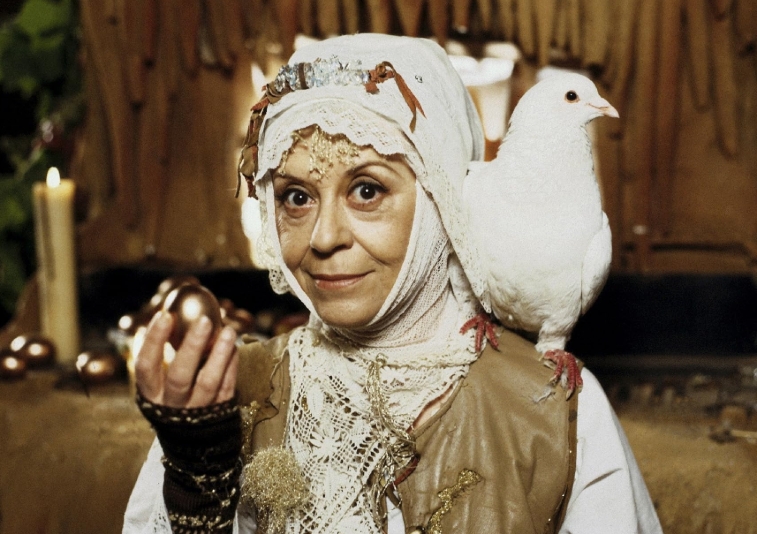
The Feather Fairy (Perinbaba) – 1985
For many Europeans—especially in Slovakia, Czechia, and Germany—Perinbaba remains a beloved childhood memory. Yet cinephiles recognize it as one of the greatest fantasy films of the late 20th century. Adapted from the Brothers Grimm but reimagined through Central European folklore, the film epitomizes Jakubisko’s gift for mixing innocence with cosmic depth.
What makes Perinbaba unique?
- Visual extravagance: Dreamlike snowscapes, oversized props, puppet-like characters, and fluid camerawork create a world that feels handcrafted.
- A tonal duality: It balances childlike wonder with the darker themes of mortality, destiny, and the cycle of life.
- A powerful female presence: The Feather Fairy, portrayed with ethereal gravitas, is one of Jakubisko’s iconic creations.
- A mythic view of nature: Seasons are living forces; snow and wind are characters; death and rebirth form the film’s backbone.
Jakubisko’s imagination here is boundless, but never random. Every image feels intentional, symbolic, part of a spiritual fabric.
Sitting on a Branch, Enjoying Myself (Sedím na konári a je mi dobre) – 1989
A late-socialist tragicomedy, it shows two men navigating the chaos of post-war Czechoslovakia. Jakubisko blends:
- slapstick humor,
- philosophical musings,
- surreal encounters,
- and a deep longing for meaning.
It is one of his most accessible works, beloved for its warmth and absurdity.
VII. Post-Communist Era and International Recognition
With the fall of communism in 1989, Jakubisko experienced a new creative renaissance. Freed from censorship, he was able to explore larger budgets and international co-productions.
An Ambitious Epic: Bathory (2008)
One of the most expensive films in Central European history, Bathory retells the legend of Countess Elizabeth Báthory through a revisionist lens. Instead of portraying her as the infamous “Blood Countess,” Jakubisko presents a more nuanced perspective, blending politics, myth, and historical reinterpretation.
The film was visually lush, dynamic, and filled with Jakubisko’s energetic staging. While divisive among critics, it was an enormous commercial success, proving that Jakubisko could bridge arthouse sensibilities with mainstream appeal.
VIII. Aesthetic and Narrative Signatures
To understand Jakubisko deeply, one must examine the patterns that define his artistic identity.
1. Chaos as a form of truth
Jakubisko’s films often feel chaotic—crowded frames, overlapping voices, sudden emotional jumps. Yet this chaos mirrors the unpredictability of life in Central Europe, shaped by war, shifting borders, and political repression.
2. Folklore as philosophy
He treats folklore not as quaint tradition, but as a repository of existential wisdom. Folk songs, rituals, village myths, and rural landscapes carry profound truths in his cinema.
3. Death as a recurring companion
Death is not a shock in Jakubisko’s films—it is a character. It dances, sings, jokes, seduces, and watches over the living. This worldview, rooted in Slovak folk beliefs, gives his films an unusually mature relationship with mortality.
4. Surrealism intertwined with realism
Jakubisko’s surrealism is never alienating. It emerges organically from environment, character psychology, or cultural memory. His surreal images feel less like stylistic experiments and more like natural extensions of his worldview.
5. Circular narratives
Time loops, history repeats, and destiny circles back. This structure reflects both mythic storytelling and the cyclical trauma of Central European history.
6. Visual maximalism
His frames are rich, colorful, and multilayered. Jakubisko treats cinema like a painting—every shot textured, dense, emotionally alive.
IX. Political Allegory and Resistance
Like many filmmakers of the New Wave, Jakubisko used metaphor to critique the political systems around him. But unlike Forman’s gentle satire or Chytilová’s confrontational absurdism, Jakubisko’s approach was allegorical, almost mystical.
War as madness
Both World War I and World War II recur throughout his films, not as historical events but as psychological climates of chaos, trauma, and dislocation.
Authority as corruption
Jakubisko’s power figures—officers, bureaucrats, petty leaders—are often depicted as foolish, tyrannical, or morally hollow.
The individual vs. destiny
His heroes rarely triumph through strength. Instead, they navigate a world larger than themselves, driven by forces beyond their control—fate, history, myth, or cosmic cycles.
Censorship and creativity
Paradoxically, the pressures of censorship strengthened his symbolic language. What he could not say plainly, he expressed through image, metaphor, and dream logic.
X. Collaborations and Artistic Partnerships
One cannot discuss Jakubisko without acknowledging the collaborators who enriched his films.
1. Dežo Ursiny – Composer
The Slovak rock legend infused Jakubisko’s films with musical depth. Ursiny’s scores blend melancholy with transcendence.
2. His cinematographers
Jakubisko often worked with gifted cinematographers who understood his love for handheld dynamism and painterly frames. Their collaborations produced some of Central European cinema’s most iconic images.
3. Family collaborations
His wife, Deana Jakubisková, played a central role in his later work, especially during the production of Bathory.
XI. Influence on Slovak and International Cinema
Juraj Jakubisko’s influence extends far beyond the borders of Slovakia.
1. A pioneer of Slovak national cinema
Before him, Slovakia lacked a globally recognized auteur tradition. Jakubisko changed that, becoming the voice of Slovak cinema on the world stage.
2. Inspiration for younger generations
Contemporary Slovak filmmakers—those exploring folklore, magical realism, or historical trauma—owe an aesthetic debt to Jakubisko.
3. A bridge between art cinema and popular culture
Films like Perinbaba achieved cult status, shaping childhood memories while also attracting scholarly attention.
4. International cult following
Among cinephiles worldwide, Jakubisko remains a treasured discovery—a director whispered about, recommended in film schools, and admired by lovers of surrealism and mythic storytelling.
XII. Later Years and Final Projects
One of Jakubisko’s long-dreamed projects was Perinbaba 2, a continuation of his beloved fantasy world. He worked on the film for years, seeking to return to the magical realism that defined his reputation. His health in later life made production challenging, but the project symbolized his enduring passion for cinema even in his final decade.
He passed away in 2023, leaving behind a filmography that continues to surprise, challenge, and enchant.
XIII. The Legacy of a Cinematic Sorcerer
Juraj Jakubisko does not fit into neat categories. He was not simply a New Wave rebel, a folkloric storyteller, a surrealist, or a fantasist. He was all of these at once—and more.
His cinema embodies:
- the tumultuous history of Central Europe,
- the dreams and nightmares of Slovakia,
- the ancient rhythms of folk culture,
- and the imaginative freedom of an artist unbound by convention.
In every Jakubisko film, whether tragic or playful, grounded or fantastical, there is an unmistakable heartbeat—a belief that cinema can capture the irrational, the mystical, the poetic, and the impossible. His films remind us that reality is never just what we see; it is what we feel, remember, imagine, and fear.
Jakubisko’s legacy is not merely in his masterpieces but in the worlds he created—worlds where magic and history walk hand in hand, where death laughs, where love survives catastrophe, where fate dances in circles, and where the human soul is always seeking meaning amid chaos.
For cinephiles, discovering Jakubisko is like entering a forest of dreams: mysterious, a little dark, wildly beautiful, and filled with the sense that something ancient and true is waiting behind every tree.
He was, and will remain, the sorcerer of Slovak cinema