
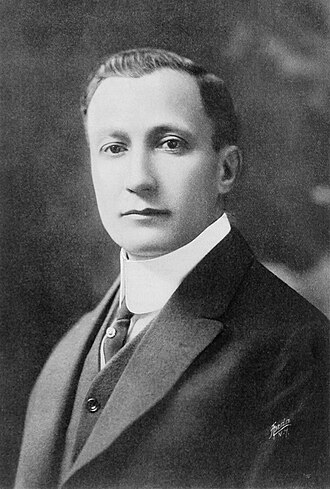
There is a particular kind of ambition that doesn’t announce itself loudly. It doesn’t arrive draped in the theatrical flamboyance of a Méliès, constructing moonscapes out of cardboard and magic-lantern dreams, nor does it carry the visionary moral weight of a Griffith, convinced that the camera is his pulpit. It arrives quietly, in a fur coat, with an eye for what people want before they know they want it — and it reshapes the world around it so completely that what comes after is simply called normal.
Adolph Zukor was that kind of ambition. By the time most film historians remember to mention him, the structures he built are already so embedded in how we understand movies — the star system, the feature-length film, the vertically integrated studio, the idea that cinema is above all else a business conducted at scale — that crediting him feels almost redundant, like crediting someone for inventing the air we breathe inside a theater. But credit him we must. Because before Zukor, the American film industry was a carnival. After Zukor, it was an empire.
A Hungarian in New York: The Formation of a Mind
Adolph Zukor was born on January 7, 1873, in Ricse, a small village in northeastern Hungary. He was orphaned early — his father died when he was an infant, his mother when he was seven — and raised by his uncle, a rabbi. There is something almost mythically American about what came next: the young Zukor, with roughly forty dollars sewn into the lining of his coat, sailed for New York in 1888, aged fifteen, and landed in a city that was still figuring out what it was going to be.
He worked in a fur shop. Then he worked in another fur shop. Then he opened his own. By the early 1900s, Zukor was a successful furrier with enough capital and enough restlessness to look around for the next thing. What he found, almost by accident, was the nickelodeon.
In 1903, Zukor invested in a penny arcade in New York — one of those raucous, dimly lit halls where men in shirtsleeves fed coins into machines to watch brief loops of boxers, acrobats, and bathing beauties. He quickly saw that the moving pictures showing in the back rooms drew more sustained attention than anything else. He partnered with Marcus Loew — who would go on to found his own considerable empire — and began acquiring and operating nickelodeon theaters across the eastern seaboard. Zukor was already doing what he would do for the rest of his career: not inventing the form, but understanding its commercial logic better than almost anyone else around him.
This is worth pausing on. In the great genealogy of early cinema — the family tree that runs from the Lumière brothers through Méliès, from the trick-film fantasists of Paris to the narrative pioneers of Brighton, from Giovanni Pastrone‘s Cabiria to the American chase films that preceded Griffith — Zukor belongs to a slightly different branch. He was not, in any conventional sense, an artist. He never held a camera. He never composed a shot. What he possessed instead was something rarer in the early film world: a systematic understanding of what cinema could become if it were taken seriously as a cultural product rather than treated as a fairground curiosity.
The Queen’s Gambit: Famous Players Film Company
The move that defined Zukor’s career — and, it is not an overstatement to say, defined the trajectory of American cinema — came in 1912, and it began in Paris.
Zukor had become aware of a French film that was causing a sensation wherever it screened: Queen Elizabeth (1912), a four-reel production starring the great Sarah Bernhardt, the most famous actress on the Western stage, in a filmed record of her theatrical performance as the aging English queen. The film had been produced by Hiram Abrams and distributed in France, but Zukor saw in it something that the American film industry had not yet dared to pursue: a feature-length motion picture that could be sold not as a novelty or a diversion, but as an event.
He paid $18,000 for the American distribution rights — an enormous sum at the time — and booked the film into legitimate theaters rather than the nickelodeons where movies were still largely confined. He charged a dollar a ticket, at a time when a nickelodeon admission cost five cents. The industry thought he had lost his mind.
Queen Elizabeth was a massive success.
What Zukor had grasped, with an intuition that seems obvious only in retrospect, was that the resistance to cinema among educated, middle-class Americans was not a resistance to the medium itself but to the environment and the company in which it was experienced. Nickelodeons were working-class spaces, associated in the cultural imagination with immigrants, darkness, and dubious moral influence. Legitimate theater was respectable. If you put a famous theatrical star on a screen, in a respectable venue, at a respectable price, you could reach an audience that had never set foot in a nickelodeon and never intended to.
This insight became the founding logic of the Famous Players Film Company, which Zukor incorporated in 1912 with the motto — still among the most revealing slogans in film history — “Famous Players in Famous Plays.”
The concept was elegant in its simplicity and revolutionary in its implications. Zukor would recruit the most celebrated stage actors of the day, adapt the most celebrated theatrical productions of the day, film them at a quality and length that matched the ambitions of legitimate theater, and thereby elevate cinema into a cultural form worthy of serious attention. The borrowing of prestige from the stage was, of course, not unique to Zukor — the Italian film industry had been doing something similar with its grand historical epics, films like Quo Vadis? (1913) and the aforementioned Cabiria (1914), which had traveled to America and demonstrated that audiences would sit still for two hours if the spectacle was grand enough. But where the Italians were thinking in terms of classical antiquity and operatic sweep, Zukor was thinking in terms of the American theatrical star system and its existing audience.
The early Famous Players productions were uneven by any artistic measure. They were often stiff, theatrical, and poorly integrated with the possibilities of the medium — a criticism that applies to much of the filmed-theater tradition across Europe and America in this period. The camera tended to sit at a respectful distance, as if it were a polite audience member, watching actors do essentially what they did on stage. Griffith, who was simultaneously developing a cinematic grammar of close-ups, cross-cutting, and compositional rhythm, was doing something technically more adventurous. The Italian masters, particularly Pastrone, were pioneering camera movement and scale that Famous Players could not yet match. Zukor was not, in these years, producing the most artistically interesting films being made. But he was producing the most commercially sophisticated ones, and laying infrastructure that would eventually make the art possible at scale.
The Star System and the Business of Fame
Here is where Zukor’s role in cinema history becomes genuinely singular, and where his legacy diverges most sharply from the pioneers I have been writing about in this series.
Méliès built a world of illusions and lost everything when the world moved on. Griffith built a grammar of cinema and died broke, his reputation complicated by the racial catastrophe of The Birth of a Nation. The Italian studios — Cines, Ambrosio, Itala Film — scaled their ambitions magnificently, then collapsed under the weight of the First World War and their own internal contradictions. These were artists and craftsmen grappling with a new form, often brilliantly, often tragically.
Zukor grappled with a different question: how do you build something that lasts? And his answer, worked out over the decade between 1912 and 1922, was the star system — not as we sometimes lazily describe it, as a simple celebration of glamour and personality, but as a rigorous economic mechanism for managing risk and generating reliable returns.
The logic ran as follows. A film, in isolation, is an unknown quantity. Audiences cannot evaluate it before they see it. What they can evaluate is the person in it. If you build a star whose image, persona, and appeal are so established and so beloved that audiences will attend any film in which that star appears, you have converted an uncertain commodity into a predictable one. The star becomes the guarantee.
Zukor understood this before almost anyone else in America, and he pursued it with a systematic ferocity that the early film industry had never seen. His greatest star acquisition — and the one that makes all subsequent arguments about the star system concrete — was Mary Pickford.
Mary Pickford was already famous when Zukor came for her, famous from her work with Griffith at Biograph, famous from her subsequent independent productions, famous across America and increasingly across the world as “America’s Sweetheart,” the curly-haired, indomitable girl who overcame adversity with pluck and charm and a smile that somehow managed to be simultaneously innocent and knowing. She was, by any measure, the most commercially powerful performer in the world in the mid-1910s. She was also extraordinarily shrewd about her own value — perhaps the only person in American cinema in this period who understood the economics of stardom as well as Zukor did.
The negotiation between them is one of the great business dramas of early Hollywood. Zukor brought Pickford to Famous Players in 1913 for $500 a week. By 1916, she had renegotiated her contract to give her $10,000 a week plus fifty percent of her films’ profits and her own production unit. Zukor agreed to every term, because the alternative — losing Pickford to a competitor — was unthinkable. She was not simply an actress. She was a franchise, an industry, a one-woman content platform, to use anachronistic but not inaccurate language.
The dynamic Zukor established with Pickford was repeated, in variant forms, with virtually every major star of the era. He brought in John Barrymore, Pauline Frederick, Marguerite Clark, Marie Dressler, and a roster of theatrical names that gave Famous Players exactly the cultural legitimacy its motto promised. He later acquired the contracts of Douglas Fairbanks, Rudolph Valentino (briefly), and dozens of others who would define American stardom in the silent era. Each acquisition followed the same underlying logic: the star’s commercial value was inseparable from the system that promoted, protected, and deployed them.
But — and this is crucial to understanding Zukor’s particular genius and his particular ruthlessness — he was never content to simply employ stars. He wanted to own the system that produced and sustained their value. A star under contract to Famous Players could not simply walk across the street to a competitor. The long-term exclusive contract, with its iron-clad provisions and its carefully graduated compensation designed to make defection financially catastrophic, was Zukor’s instrument of control. When stars pushed back — when Pickford eventually departed to co-found United Artists in 1919, along with Chaplin, Fairbanks, and Griffith — it was in explicit rebellion against the control that Zukor and his model represented.
The Merger and the Making of Paramount
By 1916, the American film industry was consolidating rapidly, and Zukor was at the center of the consolidation. In that year, Famous Players merged with the Jesse L. Lasky Feature Play Company — itself a significant production entity, home to Cecil B. DeMille and a roster of strong productions — and with several other companies, under the corporate umbrella that would eventually become Paramount Pictures.
The Paramount story is, in many ways, the story of how the American film industry grew up. The studio had been founded in 1912 as a distribution company by W.W. Hodkinson, who had developed the national distribution network that any studio needed to get its films into theaters across America. Zukor recognized that distribution was the choke point of the industry — the place where power actually resided — and he systematically worked to control it.
The merger of 1916 created Paramount Famous Lasky Corporation, with Zukor as president. He held the position for years, and the corporation he ran became the model for the integrated studio system that would define Hollywood for the next four decades. Zukor understood, earlier than almost anyone, that a film studio was not simply a factory for making films. It was a vertically integrated system in which production, distribution, and exhibition were linked — and in which controlling all three gave you leverage that controlling only one never could.
This was the logic that drove Zukor’s most aggressive and controversial maneuver: the campaign to acquire or control movie theaters. Through the late 1910s and into the 1920s, Paramount systematically purchased theaters across America, building a chain that eventually numbered in the thousands. This was not simply a real estate play. It was a strategic seizure of the one point in the system that could not be bypassed. A competitor could build a studio. A competitor could sign stars. But if Paramount owned the theaters, a competitor’s films might never reach an audience at all.
The practice Zukor pioneered — or at least perfected — was called block booking. Under this system, a theater owner who wanted access to Paramount’s biggest pictures, its Pickfords and its DeMilles, had to agree to take the studio’s entire output, the prestige pictures and the programmers alike. The theater owner had no choice but to play films they hadn’t seen, might not want, and had no ability to evaluate in advance. It was a coercive arrangement by any honest description, and it would eventually be ruled illegal by the United States Supreme Court in the landmark Paramount Decree of 1948. But in the 1910s and 1920s, it was simply how Zukor did business, and it was devastatingly effective.
Zukor as Producer: The Architecture Behind the Films
It would be a mistake to think of Zukor purely as a business strategist who happened to operate in the film industry rather than in steel or railroads. He was also, in a meaningful sense, a producer — and understanding his role as producer helps us understand how Hollywood actually worked in the studio era.
Zukor was not a producer in the hands-on, creative sense that we sometimes romanticize: he was not on set adjusting performances, not in the editing room shaping rhythm, not in conversation with cinematographers about light. The directors who worked within the Paramount system — DeMille, above all, but also Allan Dwan, Herbert Brenon, Sidney Olcott, and eventually more overtly commercial directors who understood the Paramount style — maintained a working relationship with the studio that was governed more by commercial parameters than by artistic collaboration.
But Zukor as producer meant something real. He set the conditions within which films were made: the budgets, the stars, the genres, the release strategies. He had an almost infallible instinct for what audiences wanted to see, developed over two decades of watching them respond to what he put in front of them. When he greenlit a production, he was making a bet about audience desire, and he was usually right.
His most important creative partnership was with Cecil B. DeMille, who became Paramount’s most profitable and most characteristic director in the late silent and early sound era. DeMille’s taste for spectacle, for biblical grandeur, for stories that combined moral seriousness with elaborate displays of flesh and luxury — this was not accidental. It was, in part, a response to the commercial environment that Zukor had built, an environment in which scale was a virtue, in which the biggest picture was the best advertisement for the system that produced it, in which cinema was not a modest art form but a monumental one.
The great Paramount productions of the 1920s — DeMille’s The Ten Commandments (1923), the elaborate romantic vehicles built around Gloria Swanson, the genre pictures that defined American popular taste in the decade before sound — all bear Zukor’s fingerprints, even when his name appears nowhere near them. He was the invisible architect, the man who had decided what the building would be used for and then hired others to design the rooms.
Power, Control, and the Limits of Empire
No account of Zukor is complete without reckoning with the darker dimensions of the system he built. The star system was not simply a mechanism for producing entertainment; it was also a mechanism for controlling people. The long-term contracts that Zukor pioneered treated actors less as artists than as proprietary assets, bound to studios that could loan them to competitors, suspend them without pay for refusing roles, and manage their public images with an intrusiveness that would be unrecognizable by contemporary standards.
The system also concentrated economic power in ways that strangled competition. Independent producers found it almost impossible to get their films into theaters dominated by Paramount’s block-booking arrangements. Smaller studios were squeezed, acquired, or simply driven out of existence by a distribution system that Zukor and his successors had designed specifically to exclude them. The creative diversity of the early film industry — the nickelodeons, the fly-by-night production companies, the independent directors who worked outside the studio system — gave way to an oligopoly of a handful of major studios of which Paramount was the archetype.
And yet. It is too easy, and ultimately too reductive, to frame Zukor simply as a monopolist who happened to choose cinema as his field of operations. The system he built also made possible the great films of the classical Hollywood era. The integrated studio, for all its coercive dimensions, created the conditions for a kind of sustained, high-quality popular filmmaking that had not existed before and has arguably not existed since. The stars it produced were not simply commercial properties; they were cultural figures whose performances accumulated meaning over careers of decades, whose faces became as familiar to audiences as the faces of their own families, whose art — and it was art, even inside the machine — shaped how millions of people understood love, loss, courage, and comedy.
Zukor lived long enough to see nearly all of it. He stepped back from day-to-day management of Paramount in the 1930s, though he remained associated with the studio for the rest of his extraordinary life. He saw the transition from silence to sound, which destroyed some careers and made others. He saw the Depression, which reshaped what audiences wanted from movies. He saw television, which the studios first dismissed and then were forced to accommodate. He saw the Paramount Decree of 1948 dismantle the theater ownership that had been central to his strategy. He saw the collapse of the studio system he had helped build and the rise of the independent cinema that, in some ways, represented a return to the conditions of the nickelodeon era he had once transcended.
He died in 1976, at the age of 103. He had been in the film industry for seventy years.
Legacy: The Invisible Pioneer
Writing this piece, I am aware of a tension that runs through all the profiles in this series. The figures I have been drawn to — Méliès for his wonder, Griffith for his tragic complexity, the Italians for their audacious scale — are all, in some fundamental sense, artists struggling with a new form. Zukor was something different. He was a builder of systems, and systems, almost by definition, make themselves invisible. We see the films. We do not see the contracts, the distribution networks, the theater acquisitions, the block-booking arrangements, the long-term star deals. We see Mary Pickford’s face on the screen; we do not see the $18,000 Zukor paid for a French film about a dead English queen that convinced him the future of cinema was the feature-length prestige production.
But I think the invisibility is precisely what makes Zukor worth seeing. He understood something about cinema that the artists often didn’t: that a medium can only sustain its art if it first sustains its economics. The nickelodeon era produced genuine creativity, genuine excitement, genuine innovation — and it also produced an industry too chaotic and too cash-poor to realize most of its possibilities. What Zukor built, for all its faults and coercions, was a machine capable of making big, expensive, ambitious films reliably and distributing them widely. The great directors who worked within that machine — not just DeMille but Lubitsch, Von Sternberg, and eventually Wilder and Hitchcock at Paramount — made some of the greatest films in cinema history partly because of the resources and stability the machine provided.
There is a line from Zukor’s nickelodeon investments in 1903 to the Paramount mountain logo that still opens films today. It is not a straight line, and it is not a clean one. It passes through coercion and consolidation and the suppression of competition. But it also passes through the creation of a film culture that reached more people, more consistently, with more craft and more ambition, than anything that had come before.
In the great pantheon of early cinema, Adolph Zukor stands apart. Not as the dreamer — that was Méliès. Not as the grammarian — that was Griffith. Not as the epic poet — that was Pastrone. Zukor was the architect. And we are still, a century later, living inside the building he designed.