
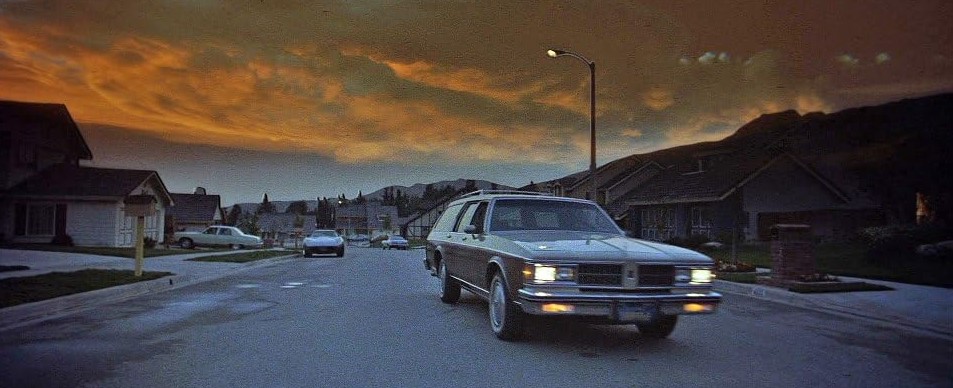
1. The Opening Scene as a Manifesto
There is a peculiar experience that millions of viewers in the developing world share, one that transcends language barriers, cultural differences, and generational gaps. It is the experience of watching the first ten minutes of Poltergeist — directed by Tobe Hooper and produced by Steven Spielberg in 1982 — and feeling a deep, almost inexplicable pang of longing. Not for the supernatural events that are about to unfold. Not for the horror, the levitating furniture, the static-filled television sets, or the malevolent spirits that will soon terrorize the Freeling family. The longing arrives earlier, much earlier, before a single ghost makes its appearance. It arrives with the image of a wide, sun-drenched suburban street. It arrives with the sight of a generous, neatly trimmed front lawn. It announces itself through an automatic garage door swinging open to reveal a spotless station wagon, and it deepens with every subsequent detail of a life that seems, from the outside, almost impossibly comfortable.
This essay argues that Poltergeist functions on two simultaneous registers. On one level, it is a ghost story about the dark underside of American suburban prosperity. On another — and this is the register that matters most to the billions of people who watched it outside the United States — it is an extraordinarily effective advertisement for the American way of life. Its opening acts as a manifesto, a lavish, unironic catalogue of middle-class material culture so densely packed with aspirational detail that it operates independently of the horror narrative that follows. For viewers in developing and emerging economies across Latin America, Africa, South Asia, Southeast Asia, Eastern Europe, and the Middle East, the truly terrifying thing about Poltergeist is not what happens to the Freelings. It is that the Freelings exist at all.
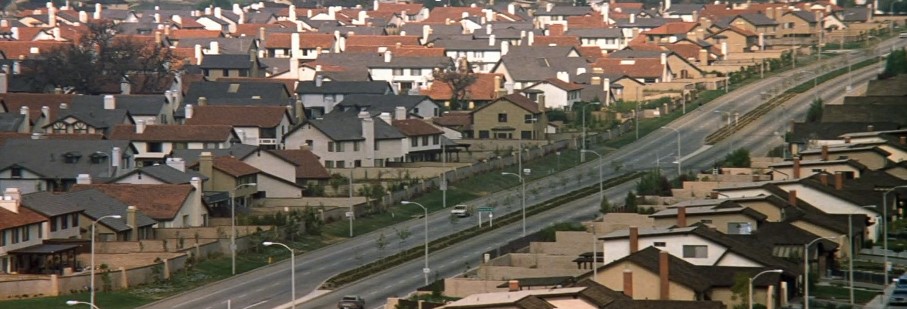
2. The Suburban Utopia: Architecture as Aspiration
The Cuesta Verde development in which the Freelings reside is, from an architectural standpoint, entirely unremarkable by American standards. It is a planned suburban community of the kind that had been spreading across the American landscape since the postwar Levittown developments of the late 1940s. Horizontal in its layout, generous in its spacing, and anchored by a network of wide, smooth roads designed primarily around the automobile, it represents the default setting of American middle-class aspiration rather than its pinnacle.
Yet for viewers in countries where the dominant housing typology involves multi-story apartment blocks, cramped urban neighborhoods, shared walls, and limited private outdoor space, this architectural ordinariness reads as extraordinary. The detached single-family home — the house that stands alone on its own plot, surrounded by its own grass, with its own driveway and its own backyard — is not a universal norm. It is, in most of the world, either a mark of significant affluence or an entirely inaccessible dream. The camera in Poltergeist lingers on these houses with the practiced eye of a real estate photographer, presenting wide, unobstructed facades bathed in California light. The message is architectural and deeply ideological: space is abundant here, and it belongs to ordinary people.
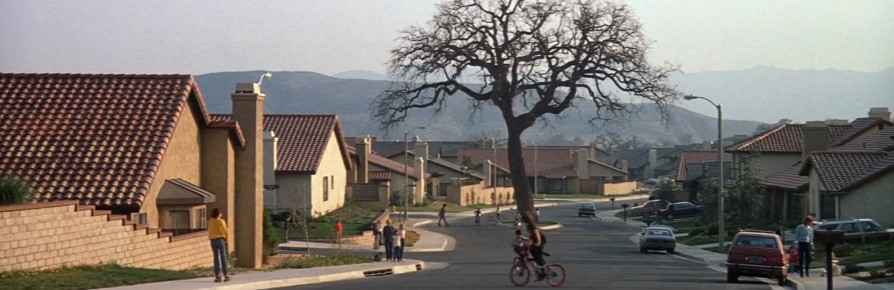
The streets of Cuesta Verde deserve particular attention. They are wide enough for cars to park on both sides while still allowing easy traffic flow, lined with mature trees, and populated by children on BMX bicycles who ride with a freedom and casualness that implies both safety and space. In many parts of the world, a child riding a bicycle outside involves a complex negotiation with traffic, narrow sidewalks, and anxious parents. The children of Cuesta Verde, by contrast, drift through their neighborhood like it is an extension of their own living rooms — because, in the logic of American suburban planning, it essentially is.
3. Objects of Desire: Consumer Goods as Storytelling
Poltergeist is, among its many other qualities, a masterclass in product placement as world-building. The consumer objects that populate the Freeling household are not incidental props. They are load-bearing narrative elements, communicating character, social status, and way of life with an efficiency that dialogue could never match. For international audiences watching the film in the 1980s and 1990s — often on VHS cassettes, in countries where many of these objects were still prohibitively expensive or simply unavailable — these goods carried an almost talismanic weight.
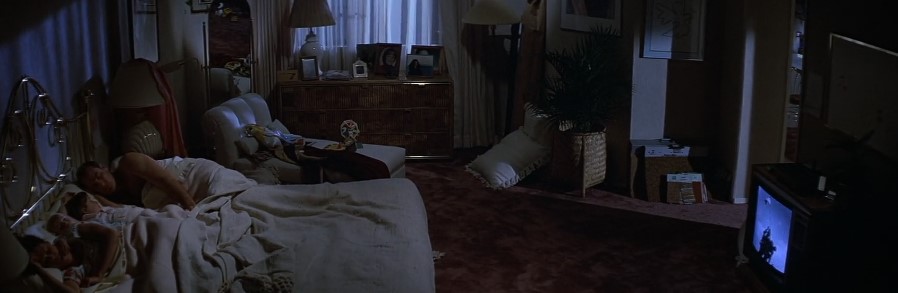
Consider the television sets. The Freeling home does not have a television. It has televisions — plural, positioned in multiple rooms including the master bedroom. Television ownership was still aspirational in many parts of the world when Poltergeist was released. The idea of having a personal set in the bedroom, available for private viewing after the children had gone to sleep, was the kind of luxury that signaled not extreme wealth but something perhaps more unsettling: a surplus of consumer goods so complete that the living room television was simply insufficient for all the television-watching that needed to happen. The remote control, meanwhile — already standard in American households — was still a novelty or an absurdity in much of the world.
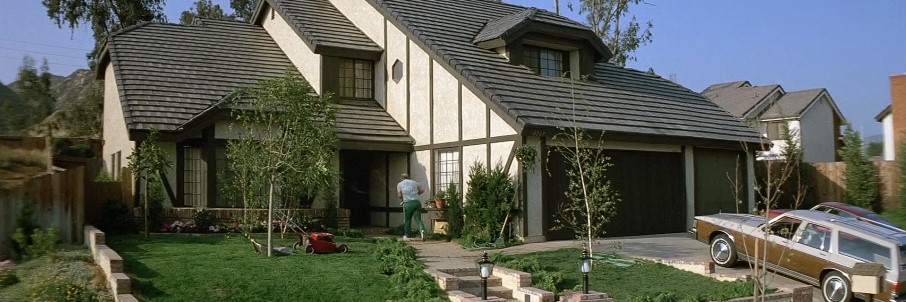
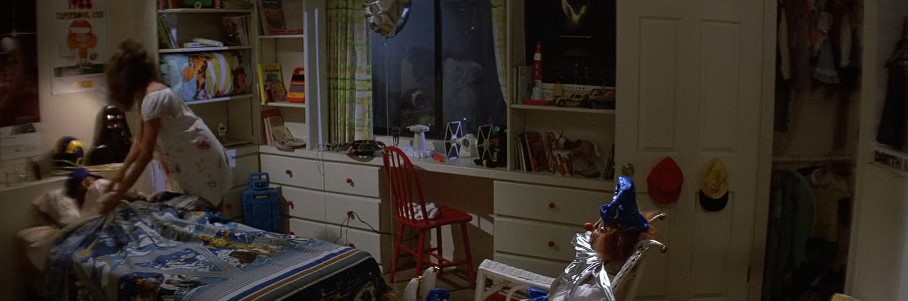
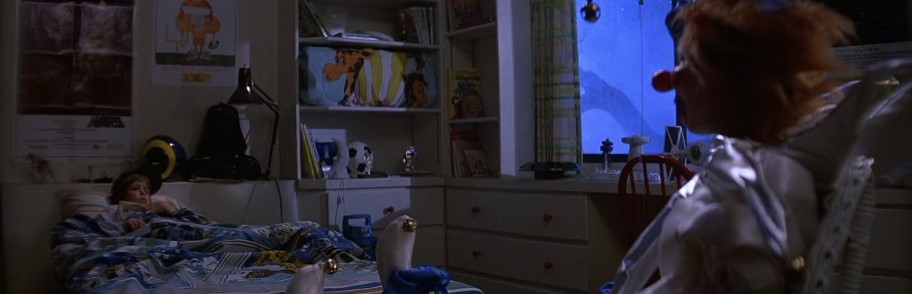
The toy situation in the Freeling household deserves its own analysis. The children possess remote-controlled vehicles, elaborate battery-powered gadgets, and the kind of clown doll that has since become iconic precisely because it so perfectly represents excess: a toy so large and elaborate that it qualifies as furniture. In the film’s context, this clown is the source of horror. But before it becomes horrifying, it is simply astonishing — a monument to the proposition that American children were the recipients of consumer goods on a scale that children elsewhere could barely imagine. The lawn mower, visible in the garage and the yard, completes this inventory of domestic equipment. In many parts of the world, lawns themselves were rare. A machine dedicated solely to their maintenance was almost comically specific in its luxury.
Then there are the cars. The enormous, automatic-transmission automobiles parked in every driveway and along every street of Cuesta Verde represent a vision of personal mobility that remained out of reach for the majority of the world’s population throughout the 1980s. These are not luxury vehicles — they are practical family cars, the kind of transportation a middle manager might drive. Their size, their automatic gearboxes, their apparent abundance communicate a relationship with the automobile entirely different from that of most of the world, where cars were either expensive status symbols or simply absent from daily life.
4. The Middle-Class Magic: Wealth Without Elite Status
Of all the elements in Poltergeist that produce this complex mixture of wonder and anguish in the international viewer, none is more powerful than the occupational status of Steve Freeling. He is not a doctor, a lawyer, or an executive in any traditional sense. He is a real estate salesman — a moderately successful one, apparently the best in his company’s district, but a salesman nonetheless. He sells houses in a planned development. This is not, by any recognizable global standard, a position of extraordinary economic privilege. It is solidly, comfortably, unremarkably middle class.
And yet his family lives in a four-bedroom detached house with multiple televisions, a yard large enough for a swimming pool, two cars, enough money for regular pizza deliveries when no one feels like cooking, and a lifestyle that involves beer, cigars, sports betting with neighbors, and children surrounded by an abundance of consumer goods. The gap between Steve Freeling’s occupational status and his material standard of living is, for viewers in developing economies, one of the most disorienting and affecting aspects of the entire film.
In most of the world, the lifestyle depicted in Poltergeist requires significant wealth. It requires family money, or professional success at a high level, or some fortunate combination of circumstances that places a household well above the national median. The notion that a salesman — not even a sales director, not even a regional manager, just a man who sells houses in a suburb — could sustain this standard of living does not merely represent aspiration. It represents a fundamentally different social contract, one in which ordinary labor yields extraordinary comfort. This is the core of the American Dream as exported by Hollywood, and Poltergeist illustrates it with more unconscious fidelity than almost any other film of its era.
5. Childhood as Freedom: The Spatial Politics of Growing Up
The spatial arrangements of childhood in Poltergeist carry their own powerful ideological charge. The Freeling children sleep in their own rooms, separated from their parents not just by doors but by meaningful physical distance. The teenage daughter Dana has a room that functions as a private apartment — decorated according to her own tastes, hung with the posters of her own choosing, and providing a space in which she can lead a life substantially independent of family supervision.
This model of childhood and adolescence — children as sovereign occupants of their own domestic territories — is culturally specific to a degree that is rarely acknowledged within American media. In the multigenerational, high-density households that characterize much of the world’s population, children and teenagers share rooms with siblings, sleep in proximity to parents, and inhabit spaces that are collective by necessity. Privacy, in these contexts, is not a right of childhood but a luxury of adult life. The sight of young Carol Anne Freeling alone in her spacious room, conversing with the television in the small hours of the night, represents a vision of solitary childhood freedom that is simultaneously enchanting and alienating to viewers from more communal domestic cultures.
6. The Grammar of Ordinary Life: Food, Leisure, and Spontaneity
Food occupies a surprisingly prominent role in establishing the Freeling household’s cultural identity. The breakfast scene — cereal poured from a box into a bowl, consumed quickly and without ceremony before the day begins — is a small but telling detail. Breakfast cereal was itself an American invention, and its global spread through the latter decades of the twentieth century tracks closely with the spread of American soft power through film and television. The casual, industrialized quality of the Freeling breakfast speaks to a relationship with food characterized by convenience and abundance: there is always enough, preparation requires minimal effort, and the meal is subordinate to the rhythm of the day rather than central to it.
The pizza scene is perhaps more resonant still. When the Freeling household finds itself without a prepared meal, the response is not concern, improvisation, or a reorganization of the evening’s plans. It is simply a phone call. Pizza arrives. The ease of this transaction — the infrastructure of delivery services, the cultural normalization of paying for someone else to prepare and bring your food on a weekday evening — communicates something profound about disposable income, urban services, and the relationship between time and money. In many parts of the world at the time of the film’s release, and in many parts of the world still, eating outside the home or having food delivered represents either a significant expense or an unavailable option. For the Freelings, it is a casual solution to a minor inconvenience.
The scenes of Steve and his neighbors watching football together — drinking beer freely, smoking cigars, placing casual bets on the game’s outcome — construct a vision of male leisure that combines accessibility, comfort, and permissiveness in a way that registers as deeply desirable across cultural boundaries. The beer flows without anxiety about cost. The cigars are lit without ceremony. The gambling is conducted not as a vice but as a social lubricant. The dog wanders freely through the house and yard, fully integrated into the family’s life. Every element of this leisure landscape speaks of abundance and ease.
7. The Hollywood Export Machine: A Pattern Across Genres
Poltergeist is not an isolated case. It is an exceptionally clear example of a pattern that runs through American popular cinema from the late 1970s through the 1990s — a golden age of suburban aspiration on screen. The films of Steven Spielberg and his collaborators are particularly dense with this material. E.T. the Extra-Terrestrial (1982) is set in a household remarkably similar to the Freelings’, complete with a divorced mother managing a comfortable suburban home, children with impressive toy collections, and the same grammar of American domestic life. The Goonies (1985) takes place in houses whose interiors communicate wealth as ordinary background. Home Alone (1990) is, in its first act, essentially a feature-length catalogue of upper-middle-class American domestic life, complete with a house so large that a child can be forgotten in it.
Back to the Future (1985) gives us a slightly more modest suburban setting but compensates with an inventory of 1980s consumer technology that reads, from outside the United States, as a museum of desire: the DeLorean, the skateboard, the rock guitar amplifier, the video camera, the mall. Jurassic Park (1993) opens with a trailer home in Montana that is, by global standards, spacious and well-equipped. Even the villains in these films live comfortably: the Wet Bandits in Home Alone target houses whose contents alone would represent a lifetime of earnings for a working-class family in most of the world.
What unites these films is a technique that might be called the luxury of the unremarked. The consumer goods, the spaces, the services, and the freedoms on display are never flagged as remarkable within the narrative. No character pauses to express gratitude for the four-car garage, the swimming pool, or the ability to order food by telephone at nine in the evening. These things are simply the water these characters swim in — the invisible background against which the actual story unfolds. And this invisibility is precisely what makes them so effective as aspirational imagery. They communicate a world in which abundance is the default condition, not an achievement or a privilege.

8. The Psychological Mechanism: Aspiration, Inadequacy, and Longing
The emotional response produced in viewers from developing and emerging economies by these images is rarely simple or unidirectional. It is not pure admiration, nor is it pure resentment. It is something more complex and more painful: a compound of wonder, longing, and a creeping sense of inadequacy that operates below the threshold of conscious analysis. The viewer does not think, while watching Poltergeist, “I am being subjected to soft power propaganda.” The viewer thinks — feels, more precisely — something like: “Why does this not exist where I live? What would it mean to live like this?”
Cultural theorists have identified this mechanism under various names: comparative deprivation, relative poverty, the demonstration effect. The economist James Duesenberry described in the 1940s how exposure to higher consumption standards leads individuals to feel dissatisfied with their own, regardless of their objective material conditions. What Hollywood added to this mechanism was scale, narrative embedding, and emotional seduction. It is one thing to read about American consumer culture in a newspaper article. It is another to spend two hours immersed in it, emotionally invested in the characters who inhabit it, watching it function as the natural and unquestioned backdrop of a story that is actually about something else entirely.
The particular sting is the ordinariness of it all. Had these films depicted billionaires and their mansions, the response would have been simple: admiration at a distance, the kind of desire that knows itself to be unrealistic. But the Freelings are not billionaires. They are not even particularly successful professionals by American standards. They are simply middle class. And it is precisely this middle-classness — this comfortable, spacious, well-equipped, spontaneous, beer-drinking, pizza-ordering, BMX-riding, lawn-mowing middle-classness — that proves so devastating to viewers who understand, instinctively and without being told, that in their own countries, this lifestyle is available only to the genuinely wealthy.
9. The Irony of Horror: When the Dream Becomes a Nightmare
There is a formal irony embedded in Poltergeist that deserves acknowledgment, even if it does not ultimately undermine the film’s aspirational power. The very home that represents the apex of American suburban comfort is the site of supernatural invasion. The house that is so desirable — so perfectly representative of everything a middle-class American family could want — turns out to have been built on disturbed ground, on a site whose history was concealed by the development corporation that employed Steve Freeling. The horror, in other words, is native to the dream itself.
Hooper and Spielberg were, whether consciously or not, engaging with a well-established tradition of American cultural critique through the suburban horror genre. The perfectly manicured lawn conceals something rotten. The spacious house harbors invisible threats. The community built on prosperity is also built on erasure — of indigenous burial grounds in the film’s literal plot, and of social inequity, environmental cost, and historical violence in its metaphorical resonance. Poltergeist belongs to a lineage that includes Shirley Jackson’s The Haunting of Hill House, Richard Yates’s Revolutionary Road, and later Sam Mendes’s American Beauty — works that treat the suburban dream not as a utopia but as a site of profound unease.
Yet this critique is largely inaccessible to the international viewer arriving at the film without deep familiarity with American cultural anxieties about suburban conformity and middle-class ennui. The internal critique requires a prior immersion in the thing being critiqued. For viewers who never had the suburban dream to begin with, the horror does not function as an indictment of a way of life they know too well. It functions, paradoxically, as an intensification of desire: even with the ghosts, they would take the house.
10. The Screen as a One-Way Mirror
In the decades since Poltergeist’s release, the mechanism it exemplifies has evolved and intensified rather than diminished. The VHS cassette that carried Poltergeist to living rooms in Cairo and Jakarta and Lagos and Caracas has been replaced by streaming platforms that offer instantaneous access to the full catalogue of American aspirational imagery. But more significantly, the technology has become participatory. Social media has democratized the production and distribution of aspirational content, meaning that the gap between the lives depicted on screen and the lives of viewers can now be measured not just against fictional characters but against real people — or the carefully curated, aspirationally constructed public personas of real people.
The one-way mirror that cinema erected between the American Dream and its global audience has, in the age of Instagram and TikTok, become something more like a two-way window — except that the glass is still heavily tinted, the lighting on one side is always better, and the images on display are still subject to the same processes of selection, idealization, and unconscious influence that characterized Hollywood at its mid-century peak. The suburban house, the spacious kitchen, the casual abundance — these have migrated from the cinema screen to the social media feed, and their psychological effect on viewers in developing economies remains substantially unchanged.
What has changed is the awareness. The generation that grew up watching Poltergeist on blurry VHS tapes often absorbed its aspirational content uncritically, simply because the critical vocabulary for analyzing soft power and cultural influence through entertainment was not widely available. The generation watching its streaming equivalents today is more likely to have encountered, at least in abbreviated form, some version of the argument this essay has been making: that American popular culture systematically presents a standard of living as normal and universal that is, in global terms, exceptional and geographically specific.
Yet awareness does not dissolve desire. The longing produced by the opening minutes of Poltergeist does not require ignorance to function. It operates at a level below argument, in the register of visceral wanting that bypasses critical reflection. The wide street, the green lawn, the automatic garage door, the remote control, the pizza arriving at the door — these images speak directly to something in the human animal that responds to abundance, to ease, to space, and to the freedom from daily economic anxiety. They spoke to it in 1982. They speak to it now. And they will continue to speak to it as long as the gap between what most of the world’s population has and what the screen casually presents as ordinary remains as vast as it is.
Conclusion: The Most Effective Horror Is the One Before the Horror
Poltergeist endures as a landmark of American horror cinema, and its supernatural set pieces — the tree, the clown, the static-filled television, the light at the end of the tunnel — have entered the permanent vocabulary of the genre. But its deepest and most lasting achievement may be something its makers never intended as an achievement at all: its first act, those luminous opening minutes in which nothing frightening happens, in which the Freeling family goes about the business of its ordinary American life, constitutes one of the most effective pieces of cultural soft power ever committed to film.
For the hundreds of millions of viewers who encountered it outside the country that produced it, the horror of Poltergeist is not the Beast or the malevolent spirits or the disappearance of Carol Anne. The horror is simpler and more durable than any of these. It is the horror of recognition: the recognition that somewhere, this life exists. That a salesman lives in that house. That his children have those toys. That on a Tuesday evening, when nobody wants to cook, the pizza simply arrives. The ghosts, when they finally appear, are almost a relief. At least they explain why someone would ever want to leave.