
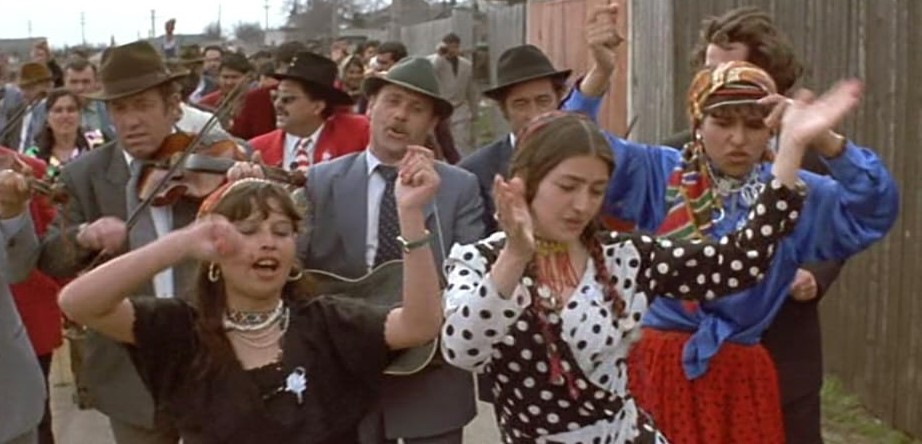
Tony Gatlif’s films are among the clearest, most insistent cinematic invitations to feel Romani life — its music, its migrations, its intimate communal rituals, and its political injuries. Across three decades he has produced a body of work that sits uneasily between documentary and fiction, ethnography and lyricism, activist representation and contested romanticism. That uneasy tension is precisely what makes his cinema rich and important: Gatlif insists on representing Roma as a living sensory world — songs, dances, argot, food, gestures — while also placing that world in relation to exile, racism, and the modern European nation-state.
1. A brief biography — origins that travel
Tony Gatlif was born Michel Dahmani in 1948 in Algiers, Algeria, into a family with mixed North African and Romani heritage; later he moved to France and adopted the name Tony Gatlif as he entered the world of cinema and the arts. His biography — North African birth, Mediterranean itinerancy, and a re-grounding in France — is a meaningful backdrop for the recurrent themes of exile, displacement, and cross-border cultural continuity in his films. Gatlif studied art in Paris and began his creative life in film and music at a time when Europe was slowly waking to post-colonial migratory realities and the deep marginalization of Romani peoples. His personal and cultural origins help explain his persistent interest in Romani music and language, and his refusal to let Roma be reduced to mere background decoration. RomArchiveRomea
2. Filmography and a thematic map
Gatlif’s filmography can be read as a set of recurring preoccupations rather than a neat chronology of genre experiments. Key titles to know (not exhaustive):
- La Terre au Ventre (early short/feature work — Gatlif’s beginnings in French cinema)
- Latcho Drom (1993) — a landmark, music-centered travelogue through Romani musical traditions.
- Gadjo Dilo (1997) — a narrative feature about a French outsider and a Romanian Roma village.
- Exils (2004) — a road film that is partly autobiographical.
- Vengo (2000) — Andalusian-set film that connects flamenco to Romani honor and vendetta.
- Transylvania (2006), Djam (2017), Swing (2002) and other titles that explore music, borders and identity.
Across these works we find consistent elements: a privileging of music as both narrative engine and epistemology; a tendency to blur documentary and fiction; a focus on mobility, exile and return; and casting choices that often mix non-professional Roma actors, musicians, and performers with trained actors. These formal decisions are not aesthetic “gimmicks” but are central to how Gatlif understands representation: cinema, for him, is a space where communal knowledge — particularly musical — can be preserved, amplified and transmitted.
3. The musical sensibility: Latcho Drom and the anthropology of sound
If Gatlif’s cinema has a manifesto, Latcho Drom (1993) is it. The film is structured as a journey — “safe journey” — through Romani music, beginning in India (the putative origin of Roma) and passing through Egypt, Turkey, Romania, Hungary, Slovakia and into Spain. Rather than explaining, Gatlif stages encounters: sequences of musicians playing, singers improvising, dancers moving, local rituals unfolding. There is almost no explanatory voiceover; the film privileges the sensory and says: attend, listen, and you will learn.
This methodological choice — music as method — does two things. First, it reframes Romani identity as creolized and mobile rather than homogeneous and static. Second, it resists the clinical gaze of the ethnographic voice that studies “objects.” Instead, Gatlif creates a filmic space where Roma speak and sing for themselves, and where music becomes the archive. Scholars have rightly noted that Latcho Drom functions as a kind of cinematic ethnography — but one that is poetic rather than textual, and deliberately partial rather than totalizing. The film’s archival value — recordings of musicians and songs that might otherwise be lost or remain marginal — is considerable.
4. Gadjo Dilo (1997): narrative, intimacy, and ethical contact
Gadjo Dilo is often treated as Gatlif’s most internationally visible fiction. The film tells the story of Stéphane (played by Romain Duris), a young Frenchman who arrives in Romania searching for a singer whose recordings his deceased father loved. He becomes embedded in a Roma village and experiences initiation into that community’s music, humor and codes. The narrative affords a double frame: an outsider’s discovery and a community’s life. Gatlif deliberately stages Stéphane’s absorption into the village as a learning process mediated by music, touch and food.
Two important claims about Gadjo Dilo:
- It is a film about empathy and the politics of witnessing. Stéphane’s status as a “gadjo” (non-Roma outsider) tracks how power and ignorance can be negotiated. The film repeatedly refuses simple exoticization: moments of laughter and tenderness coexist with humiliations and intercultural misunderstanding. Stéphane is not a savior; he learns, he blunders, he is sometimes the object of the village’s humor. The narrative thus foregrounds mutual translation — cultural, musical and emotional.
- It has had political resonance beyond film festivals. Gadjo Dilo came at a moment when Roma communities were gaining more visibility in Europe because of migrations after 1989 and because of rising anti-Roma policies in countries like France. The film helped popularize a sympathetic view of Roma among cinephile publics and human-rights advocates, and it has been the subject of advocacy writing and debate about representing Roma in popular culture. The film’s impact has been both cultural (shaping perceptions) and political (stimulating debate about discrimination).
5. Vengo (2000): flamenco, vendetta, and a Southern Spain that rhymes with Roma struggles
Vengo transposes Gatlif’s interest in music and honor to Andalusia. The film revolves around Caco, whose family has an honor conflict with a local boss; the narrative unfolds as a flamenco-infused chorus of communal memory and present conflict. Gatlif here connects gypsy identity with flamenco — a relationship that is arguably one of the most explosive and historically layered in European cultural studies, because flamenco has itself been racialized, exoticized, and also celebrated.
Formally, Vengo is closer to melodrama than Latcho Drom; it contains a clearer plot skeleton with revenge and family honor driving the action. Yet music remains the crucial expressive medium — trance, ritualized singing, and the communal performance of grieving and defiance. Critics have praised Vengo for its energetic performances and musical direction, while some have found its narrative conventions less subtle than Gatlif’s purely musical experiments. Still, as a film that insists on communicating through flamenco’s embodied language, Vengo is central to understanding how Gatlif reworks local music cultures into cinematic politics.
6. Style and recurrent methods
Across Gatlif’s films some stylistic trademarks recur:
- Music as primary narrator. Many of Gatlif’s emotional beats are delivered through musical performance rather than expository dialogue. Songs do the work of plot and interiority.
- Blurring documentary/fiction. Gatlif often casts real musicians and Roma non-actors; scenes are frequently shot in naturalistic settings and allow improvisation. This decision complicates the viewer’s categories and invites a reading of his films as hybrid documents.
- Close attention to language and argot. Gatlif frequently includes Romani dialects, localized slang and multilingual spaces; the use of Romani language asserts cultural presence and resists linguistic erasure.
- Rhythmic editing and long takes on performance. When music plays, Gatlif lets it breathe: extended takes, handheld cameras in the middle of dancing bodies, close-ups on hands and faces during singing.
- Mobility and travel. Road narratives, journeys, and crossings are recurring motifs; movement becomes a structural organizing principle, echoing historical Roma migrations.
These methods are not merely stylistic flourish; they encode ethical commitments. Casting Roma musicians as performers rather than as mere subject-matter enables what Gatlif sees as a reparative politics: giving voice and screen-time to cultural producers who have long been marginalized. But this same approach raises important debates about representation and the “celluloid gypsy.”
7. E-E-A-T: expertise, lived experience, and the ethics of representation
From an E-E-A-T perspective, Gatlif’s work raises crucial questions: who has the authority to represent Roma? How do lived experience and cultural proximity factor into cinematic authority? Gatlif claims Romani roots and often situates himself as an insider-ally; this positionality affords him certain permissions in representation but does not immunize his work from critique.
What Gatlif brings in terms of expertise:
- Cultural embeddedness. His films demonstrate sustained, long-term engagement with Romani musicians and communities across Europe. That relationship produces access to songs, rituals and performances that outsiders rarely capture on film. Latcho Drom alone is an audiovisual repository of recordings and practices.
- A politics of accompaniment. Gatlif’s films often accompany Romani performers and let music circulate in cinematic space rather than reframe it for non-Roma consumption. This accompaniment is a form of cultural labor: making visible that which has been erased.
- A provocation of mainstream audiences. By refusing neat explanatory scaffolding, his films force non-Roma viewers into affective engagement, disrupting comfortable distance.
But the expertise claim must also address critique: scholars and Romani activists have sometimes argued that Gatlif’s films reproduce certain tropes — the “noble gypsy,” the ecstatic musician, the mystical wanderer — that can essentialize Romani identity for non-Roma audiences. Such critiques do not negate Gatlif’s achievements but instead remind us that representation is double-edged: visibility can be empowering but also reductive when it becomes the sole image available to the majority. The academic debate about the “celluloid gypsy” is relevant here: Gatlif’s films are central to that debate precisely because they offer so much material for interpretation and contestation.
8. Reception, impact, and cultural politics
Gatlif’s impact is plural:
- Cultural archiving. Films such as Latcho Drom serve as archives of musical forms that are otherwise underrecorded in mainstream media. For musicians and scholars, these films are resources that preserve songs and styles.
- Public perception and advocacy. Gadjo Dilo and other films helped shape sympathetic public imaginaries about Roma in the 1990s and 2000s, during a period of intensified debate about Roma rights in Europe. Human-rights organizations and cultural critics pointed to Gatlif’s films as counter-narratives to the xenophobic discourses that circulated in some national politics.
- Academic conversation. Film studies and Romani studies scholars frequently use Gatlif’s films as case studies to discuss cinematic representation, postcolonial mobility, and the ethics of ethnographic filmmaking. Gatlif appears centrally in comparative studies with directors like Emir Kusturica, where debates revolve around authenticity, romanticization and the politics of spectacle.
- Controversy and critique. As noted, some critics accuse Gatlif of romanticizing Roma, reducing complex socio-economic realities to a picturesque set of customs. Others defend him, arguing that his films are political acts against erasure, bringing Romani voices into European cultural spaces.
Ultimately, Gatlif’s impact must be measured along two axes: the films’ capacity to preserve and amplify musical and social practices, and their capacity to influence how non-Roma publics imagine the Roma. On both axes the effect is significant — but contested.
9. Close readings — three moments worth unpacking
To illustrate Gatlif’s method concretely, we close-read three representative moments across his oeuvre.
A. The campfire sequence in Gadjo Dilo
A late-night campfire scene where the village performs for Stéphane is a masterclass in communal pedagogy. The camera lingers on faces, on the way hands move across strings, on the small gestures exchanged between performers and listeners. Gatlif’s editing privileges the sonic build, and he allows songs to tell the history of the village’s grief and joy. The outsider’s presence functions as an aperture through which the audience receives the community’s interiority — but the camera never privileges Stéphane as primary; instead, rhythm, song and the elders’ laughter remain central.
B. The road passages in Latcho Drom
Rather than cutting to voiceover exposition, Gatlif stages caravan scenes, trains and road crossings as sensory thresholds: the change of landscape signals a change in musical language and social practice. The film’s cartography is auditory as much as visual. The effect is to remind viewers that Roma identity is historically mobile and composed of layered musical genealogies.
C. Flamenco fury in Vengo
Vengo uses flamenco not as background color but as the engine of moral and social logic. When a clan’s honor is affronted, flamenco’s intensities not only narrate emotion but sanction social response. The camera’s proximity in dance scenes produces an embodied ethics: we understand the stakes of honor not by hearing exposition but by feeling the music’s pulse. This is Gatlif’s cinematic pedagogy: the body and the song teach us what words would struggle to convey.
10. Collaboration, casting and the question of voice
Gatlif’s frequent use of non-actors (musicians, elders, local singers) is both aesthetic and political. By placing actual Romani performers at the center, he opens screen-time to those historically excluded from filmic subjectivity. At times his casting choices consciously privilege community members’ agency: many sequences are improvisational and formed in dialogue with local performers. But this practice raises ethical questions about editorial control and authorship. Who decides what remains in the final cut? How are performers credited, remunerated, and represented off-screen? These questions matter ethically. Gatlif’s record suggests a long-term collaborative ethic, but that ethic is necessarily filtered through the unequal power relations inherent to film production.
11. Debates: romanticization vs. recuperation
Two opposing critiques often structure debates about Gatlif:
- Romanticization: Critics argue that Gatlif’s cinema sometimes freezes Roma in an exotic archetype — the musician as the emblematic Romani subject — and thereby risks ossifying identity into performance. This critique reminds us that representation is rarely neutral: the imagery that travels most easily can become the dominant public idea, overshadowing the complexity and heterogeneity of Romani life.
- Cultural recuperation and activism: Supporters argue that Gatlif recuperates traditions violently erased or ignored by nation-states; his films restore dignity by showing richness, resilience and artistry. In social contexts where Roma are structurally marginalized, such representations can function as restitution — a public record against erasure.
Both positions capture truths: Gatlif’s images are both recuperative and susceptible to simplified readings by non-Roma audiences. The responsible viewer and scholar must therefore read his films within a broader media ecology, acknowledging both their archival value and the risks of essentializing representation.
12. Gatlif and contemporary Romani cultural politics
Since the 1990s Roma rights movements have evolved in law, activism and cultural production. Gatlif’s films intersect with these movements: they have been used by activists to argue against marginalization, and they have been sites where Romani performers have gained visibility. But the films also predate and sometimes outpace formal political representation: cultural recognition does not necessarily translate into material political gains.
In the European public sphere, Gatlif’s films have mattered symbolically. They have been screened in festival circuits, taught in film schools, cited in policy reports, and used in cultural education. At the same time, the structural problems confronting Roma — poverty, discrimination, deportation — persist. Films like Gadjo Dilo can raise awareness, but cinema alone cannot redress structural injustice. What Gatlif’s films do well is humanize and complexify public perceptions; the work of turning that complexity into policy and social change requires activism, law and sustained institutional work.
13. Where Gatlif’s work sits in European and world cinema
Gatlif is part of a broader constellation of filmmakers who explore nomadism, exile and cultural survival (from Emir Kusturica to filmmakers in postcolonial cinemas). What distinguishes him is the centrality of music and his lifelong engagement with Romani cultural producers. His cinema belongs to world cinema’s tradition of ethnographic lyricism: films that avoid didacticism and insist on sensory immersion. This places him in the company of filmmakers who trust music and embodied performance to convey knowledge that words cannot. At the same time, his films are unapologetically European in orientation: they interrogate European nation-states, their borders and their histories of exclusion.
14. Criticism, reflection and open questions
An honest appraisal must admit Gatlif’s limits alongside his strengths. Important questions remain open:
- To what extent do Gatlif’s films create a fixed image of Romani identity for non-Roma audiences? The repetition of certain tropes (music, wandering, honor) risks creating a “brand” that eclipses other Romani experiences, such as urban labor, political organizing or contemporary youth cultures.
- How do Romani audiences perceive Gatlif’s work? While many Romani people and activists celebrate his visibility, others have expressed concern about simplification and about how his films are marketed to non-Roma publics.
- What are the ethical standards for collaborations between filmmakers and marginalized communities? Gatlif’s long-term relationships with musicians suggest respectful collaboration, but the film industry’s structural inequities make any such relationship precarious.
These questions do not invalidate the films; they demand continued critical engagement and responsible contextualization when screening or teaching Gatlif’s cinema.
15. Conclusion — the responsibility of witnessing through film
Tony Gatlif’s cinema insists that we feel before we categorize. His method — privileging music, foregrounding lived performance, blurring fiction and documentary — creates a mode of cinematic witnessing that is at once aesthetically powerful and politically implicated. Latcho Drom archives, Gadjo Dilo humanizes, and Vengo electrifies; together they form a corpus that has helped bring Romani music and subjectivity into European cultural consciousness. At the same time, the debates his films provoke — about romanticization, authorship and representation — are healthy and necessary. They remind us that representation can be an act of solidarity only when accompanied by structural change and by giving voice and power to the communities represented.
For anyone approaching Gatlif’s films now, the responsible stance is twofold: watch as a close listener (attend to music, gestures, language) and read as a critical interlocutor (contextualize, ask who benefits from certain images, and seek out Romani voices in conversation about the films). Doing so honors the very impulse that motivates much of Gatlif’s work: to let Romani songs and lives be known in a European public that has too often refused to hear them.