The Forgotten Father of Modern Cinema
In the pantheon of film pioneers, certain names echo loudly—Chaplin, Griffith, Eisenstein—but few embody the quiet poetry of cinema like Victor Sjöström. Born in 1879 in Silbodal, Sweden, Sjöström emerged as one of the most innovative filmmakers of the silent era. His works combined human depth, natural landscapes, and visual symbolism long before these became staples of world cinema.
For cinephiles today, Sjöström is often remembered through Ingmar Bergman’s tribute—his haunting performance as the old professor in Wild Strawberries (1957). Yet before his collaboration with Bergman, Sjöström had already transformed cinema itself. He helped turn film from a mechanical novelty into an art of emotion, constructing visual stories that spoke to conscience, destiny, and the mysteries of the soul.
This article explores the evolution of Victor Sjöström as a filmmaker—his early mastery in Swedish silent cinema, his technical innovations, his years in Hollywood, his later collaboration with Bergman, and his enduring legacy in global film history.
Early Life and the Birth of Swedish Cinema
Victor David Sjöström’s upbringing was marked by hardship and introspection. After losing his mother at a young age and living briefly in New York, he returned to Sweden to pursue acting in the theatre. This early experience on stage laid the foundation for his cinematic sense of dramatic composition and expressive performance.
In 1912, Sjöström joined Svenska Biografteatern, the studio that became the center of Swedish silent film. The Swedish cinema of the 1910s was uniquely poetic—its directors sought not the spectacle of Hollywood but a union between man and nature, moral reflection, and a search for spiritual truth.
Under producer Charles Magnusson, Sjöström began directing films that broke away from theatrical conventions. His first significant work, Ingeborg Holm (1913), is often cited as one of the first realist social dramas in film history. The story of a woman’s tragic fall into poverty, it displayed an emotional subtlety rarely seen in early cinema.
Ingeborg Holm is considered a milestone because of its psychological realism—Sjöström moved the camera closer to the human face, using body language and light to convey emotion rather than exaggerated gestures. This attention to human suffering would become a defining mark of his career.
The Aesthetic of Nature and Morality
By the mid-1910s, Sjöström had developed a distinctive cinematic style that merged moral narrative with the Scandinavian landscape. His use of natural settings was not merely decorative; forests, lakes, and snowfields became metaphors for fate and conscience.
Films like Terje Vigen (1917) and The Outlaw and His Wife (1918) exemplify this synthesis. Both are adaptations of Nordic literary works, capturing the loneliness and grandeur of human struggle against natural and moral forces.
In The Outlaw and His Wife, Sjöström portrayed a man and woman fleeing into the mountains after a crime of passion. Shot in the wilds of Icelandic-style terrain, the film turned nature into a spiritual mirror—an early form of cinematic existentialism. Long before Bergman or Tarkovsky, Sjöström saw film as a medium for exploring guilt, redemption, and the human condition.
The Phantom Carriage (Körkarlen, 1921): The Crown of Swedish Silent Cinema
No discussion of Victor Sjöström can avoid his undisputed masterpiece: Körkarlen (The Phantom Carriage, 1921). Often hailed as the greatest Swedish silent film, it embodies everything that made Sjöström a visionary—moral allegory, technical daring, and profound emotion.
The Story and Themes
Based on Selma Lagerlöf’s novel, Körkarlen tells the story of David Holm, a drunkard confronted by the spectral driver of Death’s carriage on New Year’s Eve. The film unfolds in nested flashbacks, revealing how Holm’s cruelty and despair destroyed his family and faith.
The central motif—the legend that the last person to die each year must drive Death’s carriage for the next twelve months—serves as a powerful metaphor for redemption through suffering. Sjöström, who also plays David Holm himself, imbues the narrative with tragic realism.
Technical Brilliance
For its time, Körkarlen was a technical marvel. Sjöström and cinematographer Julius Jaenzon pioneered double exposure techniques that allowed ghostly figures to appear translucent yet tangible. The spectral imagery—Death’s carriage gliding over misty graveyards—remains chillingly beautiful even a century later.
More importantly, these effects served emotional truth rather than spectacle. The film’s atmosphere of remorse, the interplay of shadows and fog, and the rhythmic editing create a haunting meditation on morality.
Influence on Bergman and Beyond
Ingmar Bergman often cited Körkarlen as a revelation that made him believe cinema could be spiritual art. In The Seventh Seal (1957), Bergman’s iconic scene of a knight playing chess with Death echoes Sjöström’s imagery of mortality as a presence both terrifying and compassionate.
Internationally, Körkarlen influenced directors from Dreyer to Murnau, shaping the European Expressionist movement while maintaining Nordic restraint. It remains a cornerstone of early 20th-century cinema and a testament to the power of film as moral vision.
The Silent Craftsman: Sjöström’s Directing Style
Victor Sjöström’s directing style can be defined by three key qualities: psychological realism, visual symbolism, and moral gravitas.
1. The Face as Landscape
Sjöström treated the human face as a terrain of emotion. His camera often lingered on silent expressions—eyes reflecting guilt or hope—allowing viewers to infer meaning rather than be told. This subtlety distinguished him from American melodrama and aligned him with later directors like Dreyer and Bergman.
2. Nature as Character
In Sjöström’s films, nature is never neutral. The sea in Terje Vigen or the snow in Körkarlen act as forces shaping destiny. The natural world mirrors human turmoil, creating an aesthetic of spiritual geography—a vision that would later influence poetic realism and Nordic cinema.
3. Narrative as Redemption
Sjöström’s stories often revolve around sin, repentance, and moral awakening. He was drawn to characters on the brink of salvation or despair, finding grace in human frailty. This moral dimension—delivered through visual restraint—gave his films emotional resonance that transcended words.
Crossing the Atlantic: Sjöström in Hollywood
By the early 1920s, Hollywood had taken notice of the Scandinavian masters. After the international acclaim of Körkarlen, Sjöström was invited to the United States by Louis B. Mayer and Irving Thalberg. In 1923 he arrived in California, joining MGM at a time when silent cinema was reaching artistic maturity.
Adapting to the Hollywood System
In America, Sjöström (often billed as Victor Seastrom) had to adapt his contemplative European sensibility to the demands of the studio system. Yet he retained his integrity, crafting films that balanced psychological realism with narrative accessibility.
Key Hollywood Films
- He Who Gets Slapped (1924) – Starring Lon Chaney and Norma Shearer, this tragic tale of a scientist-turned-clown remains one of MGM’s earliest artistic triumphs. Sjöström’s direction turns the circus setting into a metaphor for humiliation and human cruelty.
- The Wind (1928) – Perhaps his most famous American film, starring Lillian Gish. It tells of a woman isolated in the harsh Texas plains, besieged by literal and emotional storms. The relentless wind becomes a psychological force, echoing Sjöström’s use of nature as destiny.
- The Scarlet Letter (1926) – An adaptation of Hawthorne’s novel, with Lillian Gish as Hester Prynne, captures the moral austerity and repression that fascinated Sjöström throughout his career.
A Master of Atmosphere
In Hollywood, Sjöström perfected his ability to blend environment with emotion. His films stood apart for their sincerity and lack of sentimentality. While others chased glamour, Sjöström explored internal suffering and redemption, making him a precursor to the modern auteur.
Decline and Return to Sweden
The transition to sound cinema in the early 1930s marked a painful turning point. Sjöström, whose artistry thrived on visual expression, found himself alienated by dialogue-heavy films. After directing a few minor talkies, he returned to Sweden in 1930 and largely withdrew from filmmaking.
However, he remained active in Swedish theatre and served as the director of the Royal Dramatic Theatre. Although his directorial output dwindled, his influence on the next generation was immense.
The Mentor: Collaboration with Ingmar Bergman
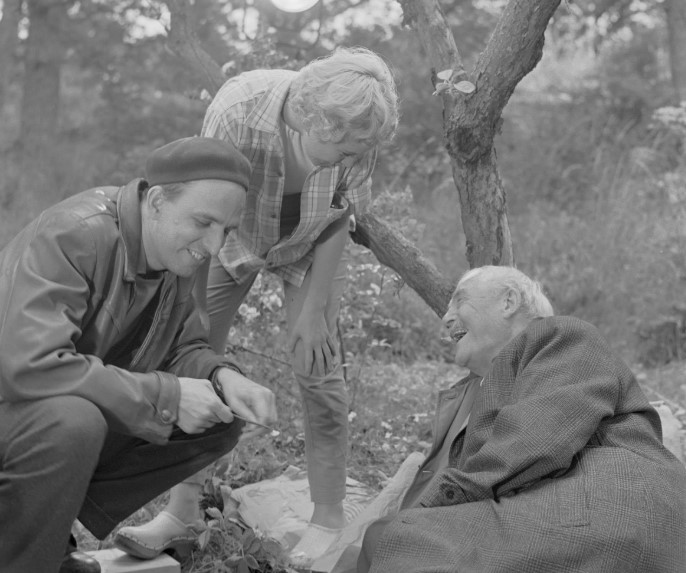
Victor Sjöström’s later life brought him into close contact with a young Ingmar Bergman, who regarded him as a spiritual father. Bergman, then a scriptwriter at Svensk Filmindustri, admired Sjöström’s moral intensity and command of visual storytelling.
Their bond culminated in one of cinema’s most moving collaborations: Wild Strawberries (1957). Bergman cast the aging Sjöström as Professor Isak Borg, an elderly doctor confronting his mortality through dreams and memories.
Sjöström’s Performance
At 78, Sjöström delivered a performance of profound restraint and grace. His weary eyes, fragile movements, and silent regrets brought authenticity to Bergman’s introspective narrative. It was as if the ghostly driver of Körkarlen had returned, now embodied in a man facing his final reckoning.
Mutual Respect
Bergman described Sjöström as “a monument of integrity and wisdom.” During filming, he adjusted his schedule so that the elderly actor could return home early each day. Their relationship symbolized the passing of the cinematic torch—from Sweden’s silent pioneer to its modern existential master.
Cinematic Continuity
Through Wild Strawberries, the moral and spiritual preoccupations of Sjöström’s silent films found new life. The dream sequences, the confrontation with death, the search for forgiveness—all echo Körkarlen. In this sense, Bergman’s cinema can be seen as an extension of Sjöström’s vision, translated into mid-century modernism.
Legacy and Global Influence
Victor Sjöström’s influence extends far beyond his filmography. Though he directed fewer than forty films, his innovations shaped the grammar of narrative cinema.
1. Human Realism and Emotional Subtlety
Before Sjöström, film acting was often exaggerated and theatrical. His commitment to psychological realism paved the way for naturalistic performance styles that later defined world cinema. Directors such as Dreyer, Ozu, and Bergman inherited this belief in emotional authenticity.
2. Integration of Landscape and Emotion
Sjöström’s visual philosophy—using nature as a moral and psychological mirror—influenced countless filmmakers. From John Ford’s Monument Valley to Tarkovsky’s rain-soaked fields, the fusion of environment and inner life owes much to Sjöström’s Nordic sensibility.
3. The Morality of Image
Sjöström treated cinema as an ethical art form. His films invite audiences not only to feel but to reflect on the consequences of human action. This moral seriousness distinguishes him from many contemporaries and aligns him with later auteurs like Robert Bresson and Terrence Malick.
4. Technical Innovation
His pioneering use of multiple exposure and layered imagery in Körkarlen anticipated modern special effects while retaining poetic integrity. These visual experiments proved that cinematic technique could serve spiritual storytelling rather than distract from it.
5. Bridging Eras
Sjöström stands as a bridge between silent expressionism and modern psychological cinema. His journey from Sweden to Hollywood and back embodies the globalization of film language in the early 20th century.
The Rediscovery of Victor Sjöström
For decades, Sjöström’s name faded from public consciousness, overshadowed by the talkies and Hollywood glamour. It wasn’t until the film renaissance of the 1950s and 60s, spurred by Bergman’s success, that critics revisited his legacy.
Film historians like Peter Cowie and Jean Mitry hailed him as a founding father of cinematic humanism. The restoration of Körkarlen and The Outlaw and His Wife by the Swedish Film Institute brought renewed attention to his artistry.
Today, retrospectives at film festivals and archives (such as the Criterion Collection’s releases) continue to highlight his contribution to the birth of modern cinema. For young filmmakers, studying Sjöström is a reminder that silence can speak volumes—that emotion, light, and rhythm can express truths beyond dialogue.
Why Victor Sjöström Matters Today
In an age dominated by visual overload and digital spectacle, Sjöström’s work offers a different model of filmmaking—one rooted in empathy, patience, and moral inquiry. His films remind us that cinema began as a spiritual art, a medium capable of touching conscience as much as the eye.
From his early Swedish dramas to his Hollywood masterpieces, Sjöström never lost sight of the human heart. His characters seek redemption, his landscapes echo sorrow, and his camera captures the tremor between sin and grace.
Modern filmmakers—from Lars von Trier to Béla Tarr—owe an unspoken debt to his legacy. Even Bergman’s dreamscapes and Tarkovsky’s temporal meditations can be traced back to Sjöström’s vision: that film is not about movement, but about memory and soul.
Conclusion: The Eternal Carriage Rolls On
Victor Sjöström’s life reads like the story of cinema itself—born in silence, matured through image, and immortalized through influence. From the raw humanism of Ingeborg Holm to the metaphysical grandeur of Körkarlen and the Hollywood winds that shaped The Wind, his artistry bridged continents and generations.
His collaboration with Bergman in Wild Strawberries completed a perfect circle: the old master of silent cinema becoming the vessel for a new era’s introspection. It was not only a passing of the torch but a cinematic resurrection.
To study Victor Sjöström is to encounter the essence of filmmaking—the union of image and soul, where every frame is a moral choice and every silence speaks. His films continue to remind audiences that true cinema is not merely seen but felt, deeply and eternally.