Discovering a Master Hidden in Plain Sight
There’s a particular thrill that comes with discovering a filmmaker whose work feels both revelatory and mysteriously absent from the broader cinephile conversation. In my years of exploring Japanese cinema—from the contemplative genius of Ozu to the anarchic energy of Suzuki, from Kurosawa’s humanism to Mizoguchi’s flowing camera—I thought I had mapped the terrain. Then I encountered Shinji Sōmai (相米慎二), and suddenly the landscape shifted beneath my feet.
Sōmai passed away in 2001 at the criminally young age of 53, leaving behind only thirteen features. Yet within this compact filmography lies some of the most audacious, formally inventive, and emotionally lacerating cinema Japan—or anywhere—has produced. That he remains relatively unknown in the West, even among dedicated cinephiles, speaks less to the quality of his work than to the vagaries of international distribution and the unfortunate timing of his death just as global interest in contemporary Japanese cinema was cresting.
What strikes me most forcefully about Sōmai is how he defies easy categorization. In 1990, readers of the influential Kinema Junpō magazine voted him the best Japanese director of the 1980s. Film critic Yomota Inuhiko described him as having “the most aggressive and radical style of any of the new directors.” Aaron Gerow’s phenomenological analysis positions Sōmai’s cinema as exploring fundamental tensions between frame and off-screen space, between conscious staging and unbridled adolescent drives, ultimately between life and death itself. These aren’t idle academic observations—they speak to something visceral and immediate in the work.
The Sōmai Style: Long Takes That Breathe and Wound
To discuss Sōmai is to discuss the long take. But this requires immediate qualification, because Sōmai’s relationship with extended shots differs fundamentally from his predecessors and contemporaries. Unlike Mizoguchi’s flowing découpage that creates spatial depth and grace, or the more recent contemplative long takes of filmmakers like Tsai Ming-liang or Béla Tarr, Sōmai’s camera movements create what I can only describe as organized chaos—a controlled delirium where the formal rigor of staging collides with the unpredictable spontaneity of performance.
Consider the opening of Lost Chapter of Snow: Passion (雪の断章 -情熱-, 1985), which features a fourteen-minute apparently unbroken take that encompasses events spanning days, even years. The camera surveys an elaborate miniaturized set representing different stages in a young orphan’s life—from abuse in a foster home to rescue by an unlikely father figure. Years are skipped with nothing more than a pan. The set itself shifts and transforms around the actors. When the shot finally, abruptly cuts, we smash into close-up on the same character, now a teenager on a moped, in a real exterior location. The shock of that cut—after such sustained artifice—jolts you into a new relationship with the film. Reality and constructed space, time compressed and time extended, studio craft and location immediacy: all these oppositions collide in that sequence.
But Sōmai’s long takes can also be “short”—if longer than classical continuity editing would typically allow. As Bingham Ray noted in The Brooklyn Rail, a Sōmai shot is “full of choreography, planning, and meticulous mise-en-scène, but he goes to great lengths to ensure that his actors are never rendered passive automatons.” This is crucial. Sōmai’s assistant director Enokido Koji speculated that the director initially adopted long takes to maintain concentration in his teenage actors, but soon became fascinated by how these shots captured changes in performance and physicality over time.
The camera in a Sōmai film is in perpetual tension with its subject. Actors are given problems to solve, games to play, terrain to navigate. Their solutions surprise us, surprise Sōmai himself, surprise even the performers. This is not the detached observation of a Hou Hsiao-hsien long take, nor the Baroque choreography of Ophüls or Max Ophüls. It’s something uniquely aggressive—the camera pursuing, retreating, circling, always actively engaged in discovering what the actors will do next.
The Nikkatsu Years and the Roman Porno Crucible
Understanding Sōmai requires understanding where he learned his craft. After dropping out of Chuo University (where he’d been involved in left-wing political activism and the Sanrizuka struggle as part of the Fourth International), Sōmai joined Nikkatsu in 1972 as an assistant director. Nikkatsu, once a major studio, had pivoted to producing Roman Porno—softcore theatrical pornography that somehow became a laboratory for formal experimentation.
Here’s what’s remarkable about the Roman Porno system: despite the mandatory sex scenes, filmmakers enjoyed enormous artistic freedom. They could experiment with style and content. Budgets were tight, but shooting on glorious 35mm remained standard. Sōmai apprenticed under Sone Chūsei, one of the line’s prominent directors, and later worked with Hasegawa Kazuhiko (who had himself assisted Imamura Shohei). These weren’t hacks churning out exploitation—they were craftsmen making what Hasegawa insisted were “cinematographic masterpieces, not sordid back-alley pulp.”
When Sōmai returned to direct his own Roman Porno entry, Love Hotel (ラブホテル, 1985), he created something unsettling and magnificent. The film opens with two scenes of sexual assault—a man forced to witness his wife’s rape as punishment for debt, leading to his mental breakdown, followed by his own failed attempt to rape and murder a call girl. Two years later, these two damaged souls meet again. For a film ostensibly meant to arouse, Love Hotel is oppressively gloomy, its characters trapped in compulsory rituals, unable to control their own desires. The mandatory sex scenes feel precisely that—mandatory, reinforcing the sense of fatalistic inevitability. Momoe Yamaguchi’s jazz ballad “Into The Night” plays during key sequences, its incantatory lyrics deepening the atmosphere of entrapment.
Love Hotel might represent the apotheosis of Sōmai’s long-take style—not despite being a pink film but perhaps because of the constraints, which forced him to find ways to transcend the genre’s limitations through pure formal invention.
Typhoon Club: The Masterpiece That Captured Lightning
If one film encapsulates Sōmai’s genius, it’s Typhoon Club (台風クラブ, 1985). I’m aware that different Sōmai devotees champion different films as his masterwork—Moving (お引越し, 1993) has fervent admirers, as does Wait and See (あ、春, 1998). But Typhoon Club holds a unique position in his oeuvre and in Japanese cinema more broadly.
The premise is deceptively simple: over several days, as a typhoon approaches, passes through, and departs a Tokyo suburb, we follow a group of middle school students whose barely contained adolescent energies erupt in increasingly chaotic ways. There’s no clear protagonist. The narrative is deliberately fragmented. Events occur that seem inexplicable, or at least resistant to conventional interpretation.
The film opens in darkness—a figure swimming in a school pool, surfacing and diving, surfacing and diving. Water, silence, the title card appearing over still water. Then, suddenly, explosively: BARBEE BOYS’ “Dance in the Dark” (暗闇でDANCE) blasts from a boombox, and girls in swimsuits dance wildly on the pool deck. It’s jarring, disorienting, ecstatic. Already we’re in Sōmai’s world—a space where the everyday can pivot without warning into the surreal, where teenage energy exists at such intensity that it borders on violence.
What follows over the next 115 minutes feels less like a conventional narrative than an anthropological study of adolescence at its most volatile. Thursday night: the girls harass a boy in the pool, stripping his swimsuit, accidentally nearly drowning him. Friday: the homeroom teacher’s (played by Miura Tomokazu) personal life explosively intrudes into the classroom when his girlfriend’s family arrives to publicly shame him. Saturday: the typhoon arrives, and students trapped in the school as the storm rages outside begin to shed social conventions like snakeskin.
The centerpiece—the sequence that has burned itself into film history—comes during the storm. Outside, in torrential rain and howling wind, the students strip and dance. Sōmai films this in an extended, mesmerizing long take. Bodies drenched, clothes discarded, the teenagers move through the water-logged landscape singing warabe’s “Moshimo Ashita ga…” (もしも明日が…。). It’s one of the most powerful depictions of adolescent transformation I’ve encountered on film—not a metaphor for puberty but puberty itself, made visible through the dissolution of boundaries between inside and outside, clothed and naked, restraint and abandon.
The Japanese critical response understood the film’s significance immediately. At the inaugural Tokyo International Film Festival, Typhoon Club won the Young Cinema Grand Prix. Bernardo Bertolucci, serving as a juror, called it “one of the most beautiful and touching teenage films I’ve ever seen.” Kinema Junpō initially ranked it 55th in their 1999 all-time best Japanese films list; by 2009, it had climbed to 12th. These weren’t empty accolades—they represented recognition that Sōmai had achieved something genuinely new.
What makes Typhoon Club so powerful? Partly it’s the fearless performances from the young cast—工藤夕貴 (Kudo Yuki), 大西結花 (Onishi Yuka), and others who had never appeared in films before. Sōmai’s direction of young performers was legendary and somewhat controversial. He was notoriously demanding, refusing to explain what he wanted, instead forcing actors to discover their performances through endless rehearsals and multiple takes. Many young actresses cried on his sets. But as actor Terada Minori observed, when these same actresses saw the completed films, they invariably wanted to work with Sōmai again—because performances discovered through this process had a vitality, a lived authenticity that no amount of technical polish could replicate.
薬師丸ひろ子 (Yakushimaru Hiroko), who worked with Sōmai on his early films, reflected that he taught her that standing before a camera required the courage to expose one’s naked self to public view—that acting meant understanding both its severity and its terror. Even decades later, she credited that difficult period with allowing her to continue as an actress.
斉藤由貴 (Saito Yuki), who starred in Lost Chapter of Snow: Passion and later returned for Wait and See, recalled initially hating the experience—even contemplating deliberate injury to escape the production. The physical demands were extreme (including extensive motorcycle sequences). Yet when Sōmai told her during filming that he wanted to work with her again in ten years, after she’d matured as a performer, she knew she would accept. When that call came for Wait and See, she agreed without hesitation. She described standing before Sōmai as an experience where lying became impossible—he forced you to discover accumulated falsities, to encounter yourself without protective layers.
Form and Feeling: The Sōmai Paradox
What consistently strikes me about Sōmai’s films is how they balance—or refuse to balance—seemingly contradictory impulses. They’re formally rigorous yet emotionally volcanic. They feature meticulous staging yet feel spontaneous, even dangerous. They take adolescence seriously while refusing to sentimentalize it.
In Typhoon Club, this manifests in scenes that feel almost documentary-like in their capture of teenage behavior, yet are clearly carefully constructed. The classroom chaos when the teacher’s personal crisis erupts—students climbing on furniture, shouting, the spatial organization dissolving into pandemonium—this feels captured rather than staged. Yet it couldn’t possibly be entirely spontaneous. Sōmai choreographs chaos, engineers spontaneity. This is the central paradox of his method.
He also refuses to moralize. The students in Typhoon Club do things that would, in most films, mark them as troubled, even disturbed. They engage in bullying, voyeurism, potentially criminal behavior. One boy (played by 三上祐一, Mikami Yuichi) discusses death with his older brother (鶴見辰吾, Tsurumi Shingo), philosophical conversations about “the individual” versus “the species,” before eventually jumping from a third-floor window into a puddle—an act that may or may not result in his death; the film deliberately leaves this ambiguous.
But Sōmai doesn’t judge these actions. He simply observes them with unflinching attention. As critic 相田冬二 (Aida Toji) notes in a fascinating piece of close analysis, the film can be interpreted almost as a fantasy—a liminal space where normal rules are suspended during the typhoon, where adolescents work through psychic material that cannot be processed through conventional social channels. The film’s refusal to explain, to provide reassuring adult perspective, to resolve its tensions into neat narrative closure, is precisely what gives it such disturbing power.
This approach links Sōmai to other radical filmmakers—not necessarily in style, but in attitude. There’s something of the anarchic spirit of Koji Wakamatsu, the unflinching observation of Imamura Shohei, even echoes of the Japanese New Wave’s political urgency, despite Sōmai working a decade or more after that movement’s dissolution. Yet he’s also distinctly his own filmmaker, impossible to reduce to influences or parallels.
Beyond Adolescence: The Later Films
While Sōmai is primarily celebrated for his adolescent coming-of-age films, his range extended far beyond this territory. Moving (1993), which many consider his masterpiece, follows a sixth-grader named Renko (田畑智子, Tabata Tomoko, in an astonishing debut) struggling with her parents’ divorce. The film starts as seemingly straightforward domestic drama—if one directed with Sōmai’s characteristic formal intensity—before transforming in its final third into something far stranger and more mythical.
After attending a lakeside fireworks festival, Renko encounters a landscape of burning hay bales, trickling streams, and mist-shrouded hills. Eventually she witnesses a lonely dragon boat emerging from fog. The film shifts registers completely, from realism into something dreamlike, primordial. Renko embraces a physical manifestation of her younger self—one of cinema’s most moving images of childhood confronting its own passing.
Moving premiered at Cannes (Un Certain Regard section) and won the Minister of Education Award for Fine Arts. It’s now recognized as a precursor to Kore-eda Hirokazu’s empathetic explorations of childhood and family crisis. The influence is direct—Kore-eda and other contemporary Japanese directors including Hamaguchi Ryusuke and Kurosawa Kiyoshi have acknowledged Sōmai’s profound impact on their work.
Wait and See (1998) represents another departure—a road movie following an elite bureaucrat with catastrophic drinking problems (played by Satō Kōichi) and a wounded sex worker (Saito Yuki, returning to Sōmai after more than a decade). The Kinema Junpō critics poll voted it the best film of 1999, and it won the FIPRESCI Prize at the Berlin Film Festival. It’s Sōmai at his most formally restrained yet emotionally devastating—Hamaguchi’s Drive My Car (2021) owes an obvious debt to its road-movie structure and quiet intensity.
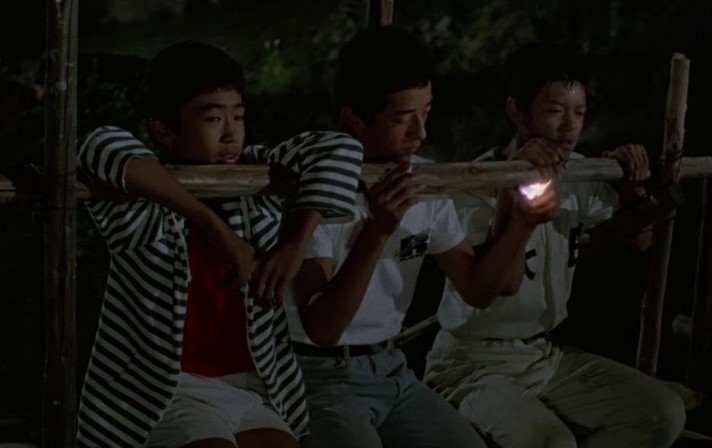
The Friends (夏の庭, 1994), adapted from Yumoto Kazumi’s novel (which Sōmai himself encouraged her to write), follows three boys who become fascinated with death and stake out an elderly man’s house waiting for him to die—only to form an unexpected friendship with him. It’s one of Sōmai’s most accessible films, though no less formally rigorous. The great 三國連太郎 (Mikuni Rentarō) brings tremendous dignity and pathos to the role of the lonely old man, while戸田菜穂 (Toda Naho) appears in her film debut as the boys’ teacher.
The International Rediscovery
For years, Sōmai remained frustratingly difficult to see outside Japan. Despite the critical acclaim, despite the festival prizes, almost none of his films received proper Western distribution. The occasional festival screening or repertory showing was the best one could hope for. Even during the early 2000s J-horror boom, when international interest in contemporary Japanese cinema peaked, Sōmai’s final films remained inaccessible.
This has begun changing dramatically in recent years. The 2012 Edinburgh International Film Festival mounted a full retrospective. A 2015 screening at Germany’s Deutsches Filminstitut & Filmmuseum introduced many European cinephiles to his work. In 2021, Tokyo’s Eurospace theater screened all thirteen features over two weeks—during the COVID-19 pandemic, no less—and the audience response was extraordinary, particularly among younger viewers encountering Sōmai for the first time.
The real breakthrough came in 2023. Japan Society in New York presented “Rites of Passage: The Films of Shinji Somai”—his first-ever North American retrospective, including the world premiere of a 4K restoration of Typhoon Club. The restoration subsequently played theatrical runs across the United States. That same year, Moving received a 4K restoration that premiered at the Venice Film Festival, winning the Best Restored Film Award. These restorations have been theatrical events, with audiences encountering Sōmai as a revelation.
In 2024, Arrow Video released the first Western home video of any Sōmai film—Sailor Suit and Machine Gun—a landmark moment for accessibility. More releases will hopefully follow, but the digital restorations and festival screenings have already begun shifting Sōmai’s reputation from cult obscurity toward something approaching his proper place in cinema history.
The Asian cinephile community never forgot Sōmai. The 2005 Jeonju Film Festival in South Korea held a major retrospective that shocked attendees with its intensity. Korean filmmaker Yoon Dan-bi, whose House of Hummingbird (2018) became a surprise hit, has spoken about Sōmai’s influence. Taiwanese and Hong Kong critics have long recognized his importance. As the organizers of the recent Japanese retrospectives have noted, there’s a sense of Asian cinema rediscovering Sōmai as a crucial link between the classical studio period and contemporary independent filmmaking.
The Technique and the Truth
What separates Sōmai from other technically accomplished filmmakers? After all, plenty of directors use long takes, work with non-professional actors, focus on adolescence, employ elaborate staging. What makes his work so uniquely powerful?
I think it comes down to what film scholar Shigehiko Hasumi identified: Sōmai represents “the missing link between the end of the studio system of Japan and the rise of independent filmmaking.” He worked in both worlds, understood both systems, and refused to be constrained by either. His early films for major studios like Toho and Kadokawa (including the massively successful Sailor Suit and Machine Gun) exist alongside independently financed work with the Directors Company collective he co-founded with Kurosawa Kiyoshi and others.
This dual practice allowed Sōmai to combine studio-system craft—the kind of technical excellence that can only emerge from decades of institutional knowledge—with independent cinema’s freedom to take risks, to fail, to pursue visions that might not find commercial justification. The result is cinema that feels simultaneously classical and avant-garde, accessible and uncompromising.
There’s also his absolute commitment to truth—not realism, which is different, but truth. Ryusuke Hamaguchi wrote in his notes for the Japan Society retrospective that Sōmai’s camera “ventured out into a time and space that only existed then and there.” This gets at something essential. Sōmai’s long takes aren’t about showing off technical prowess (though the technical achievement is undeniable). They’re about creating conditions where truth can emerge—where actors can discover authentic moments, where the gap between performance and being collapses.
As critic Aaron Gerow argues, Sōmai’s aesthetics explore fundamental tensions: between frame and off-screen space, between conscious control and unconscious drives, between the concrete and the mythic, between life and death. These aren’t abstract formal concerns—they’re the actual tensions his characters live within. The form embodies the content. The technique serves the truth.
Style as Substance: The Choreography of Chaos
Let me be more specific about what a Sōmai long take actually looks and feels like, because the experience defies easy description. Take the famous sequence from P.P. Rider (ションベン・ライダー, 1983) where actress Kawai Michiko rides a motorcycle in an extended take that pushes past anything resembling normal screen time for such an action. The shot is famous, justly so—but what makes it remarkable isn’t its length but what happens during that length.
The camera follows Kawai through urban spaces, the motorcycle’s movement creating a kind of kinetic energy that builds and builds. But Sōmai doesn’t just follow—the camera has its own intelligence, its own relationship to the actor and the space. Sometimes it pulls back, sometimes it pushes in. The framing constantly adjusts, not mechanically but organically, as if discovering the correct composition moment by moment. By the time the shot ends, you’ve been through something—not just watched something, but experienced a duration that has transformed how you understand the character, the space, the film itself.
Or consider the climactic long take in Typhoon Club when the students strip and dance in the rain. On paper, this could sound like chaos impossible to choreograph. And yet when you watch it, you see both the chaos and the choreography—the careful positioning of bodies, the way the camera navigates between them, the rhythm of the sequence building toward something ecstatic and terrifying. Sōmai trusts his young performers to move through this space genuinely, not as pieces in a preset pattern, while simultaneously sculpting their movements into cinema through camera placement and movement.
This is why comparisons to other long-take masters ultimately fall short. Orson Welles’ deep-focus compositions in Citizen Kane serve different purposes—they’re about power, about revealing character through spatial relationships. Kenji Mizoguchi’s flowing camera movements in films like Ugetsu create a kind of temporal continuity that serves his narratives of suffering and transcendence. Theo Angelopoulos’ long takes in films like The Travelling Players function as historical meditation, allowing time itself to become visible.
Sōmai’s long takes do something else: they capture human beings in the process of becoming, of discovering who they are through action and performance. They create space for actors to surprise themselves. They refuse to settle into stasis, instead maintaining a kind of productive tension throughout their duration. They’re aggressive, alive, dangerous.
The Price of Vision
Sōmai’s demanding methods exacted costs. His relationships with actors could be difficult, occasionally crossing lines that would likely be unacceptable today. The stories of young actresses crying during filming, of endless rehearsals pushing performers past exhaustion, of Sōmai’s own intensity and perfectionism—these aren’t comfortable aspects of his legacy.
Yet nearly every actor who worked with him, even those who found the experience grueling, speaks of it as transformative. They describe Sōmai as someone who demanded truth, who would accept nothing less than genuine emotion and authentic performance. This could be brutal. It could also result in career-defining work. Yakushimaru Hiroko became a major star; Tabata Tomoko’s debut in Moving remains one of the most remarkable child performances in cinema history; even actors in smaller roles found themselves challenged and elevated.
This raises difficult questions about artistic ambition and human cost, about the ethics of direction and performance. I don’t have easy answers. I can only observe that Sōmai created conditions where extraordinary cinema became possible, where young performers discovered capabilities they didn’t know they possessed, where the distance between acting and being dissolved into something approaching truth.
Why Sōmai Matters Now
Watching Sōmai in 2026, I’m struck by how urgently contemporary his films feel. The formal boldness, yes—but more than that, the emotional honesty, the refusal to condescend to young people, the willingness to sit with ambiguity and discomfort, the commitment to cinema as art rather than product. These feel like necessary correctives to so much contemporary filmmaking, which often mistakes technique for substance, or worse, sentimentality for feeling.
His influence on contemporary Japanese cinema is undeniable. Hamaguchi Ryusuke has stated that no Japanese filmmaker makes a film without being conscious of Sōmai’s existence—this from an Oscar-winning director speaking in 2021, two decades after Sōmai’s death. Kore-eda Hirokazu’s films about childhood clearly learned from Sōmai’s example. Kurosawa Kiyoshi, who worked alongside Sōmai in the Directors Company, has acknowledged the debt. The lineage extends even to younger filmmakers discovering his work through recent retrospectives.
But Sōmai’s relevance extends beyond direct influence. In an era of franchises and prequels, of algorithmically optimized content designed for maximum engagement, of cinema reduced to intellectual property exploitation, Sōmai represents an alternative model: cinema as personal expression, as formal experimentation, as emotional excavation. His films were never easy, never comfortable, never designed to please everyone. They were uncompromising visions, realized with absolute technical mastery in service of emotional and philosophical truth.
Typhoon Club remains his most perfect achievement—a film that captures adolescence with unprecedented intensity while also functioning as formal tour de force. But the entire filmography rewards engagement. From early works like The Terrible Couple through late masterpieces like Wait and See, Sōmai never made a boring film, never repeated himself, never settled for anything less than absolute commitment.
Conclusion: An Incomplete Legacy
Shinji Sōmai died on September 9, 2001, at 53 years old. He left thirteen features, a handful of television work and commercials, and two opera productions. It’s not a large output—a director with another decade or two could have made thirty or forty films. We’ll never know what his 2000s work might have looked like, how he might have responded to digital cinematography, what new directions his formal investigations might have taken.
What we have, though, is extraordinary. Thirteen films that push cinema toward its limits, that refuse easy categorization, that demand engagement on their own terms. Films that have influenced an entire generation of filmmakers while remaining largely unknown outside Japan and specialized cinephile circles. Films that are finally, blessedly, becoming accessible through digital restorations and home video releases.
If you consider yourself a serious student of cinema, you need to engage with Sōmai. Not because he’s a completist’s obligation, not to check a box, but because his films will change how you think about what cinema can do, what it can capture, what it can mean. Start with Typhoon Club if you can find it, or Moving which is somewhat more accessible. Watch how Sōmai uses duration, how he works with performers, how he refuses to provide easy answers or comfortable resolutions.
Pay attention to the long takes, yes, but also to the cuts—because Sōmai understands that the power of the long take depends on knowing when to cut, when to shift perspective, when to allow the sustained duration to give way to fragmentation. Notice how he lights dark spaces, how he uses water and weather as both atmosphere and metaphor, how he captures bodies in motion with a kind of kinetic energy that feels almost dangerous.
Most importantly, allow yourself to be challenged, confused, even frustrated. Sōmai doesn’t make it easy. His films require patience, attention, a willingness to sit with discomfort. They reward that investment with cinema of extraordinary power and beauty, cinema that expands what the medium can express about human experience, about adolescence, about time and memory and the gap between who we are and who we might become.
In an era where so much filmmaking feels safe, calculated, designed to avoid offense or discomfort, Sōmai’s uncompromising vision feels like oxygen. His films are alive in ways that most cinema isn’t—messy, dangerous, unpredictable, true. They deserve to be seen, studied, celebrated. The fact that we’re only now, a quarter-century after his death, beginning to properly recognize his achievement is one of cinema’s great injustices—but at least that recognition is finally, belatedly, arriving.
Watch Shinji Sōmai. Let his films challenge you, shake you, transform how you think about cinema. You won’t be the same afterward. That’s the point.