
There are certain filmmakers whose names feel inseparable from a mood. When we say Hitchcock, we think of suspense. When we say Ozu, we think of stillness and domestic space. And when we say Marcel Carné, we enter fog. We enter damp cobblestones, shadow-cut alleyways, working-class rooms lit like cathedrals, and lovers who seem to recognize, almost immediately, that their happiness is already slipping away.
Carné is often introduced as the leading director of French Poetic Realism, the filmmaker who, alongside screenwriter Jacques Prévert, gave the movement its most enduring form. Yet that description, while accurate, can also feel limiting. It reduces Carné to a category. In truth, his career stretches across the Popular Front, the trauma of Occupation, postwar disillusionment, and the aesthetic revolutions that followed. To understand Carné is to understand a crucial passage in French cinema — a bridge between silent impressionism, pre-war social drama, wartime allegory, and even the rebellion of the New Wave.
This article approaches Carné not as a mythic genius in isolation, but as a craftsman-director working in collaboration, in tension with history, and in dialogue with his time. I write as a cinephile deeply engaged with French cinema, aware of Poetic Realism’s outlines — Jean Vigo, Jean Renoir, the shadow of German Expressionism — but still searching for a fuller understanding of how Carné shaped and was shaped by this movement.
What Was Poetic Realism?
Before situating Carné, we must clarify the terrain.
Poetic Realism flourished in France primarily in the 1930s. It combined:
- Working-class settings and marginal characters
- A stylized visual aesthetic influenced by German Expressionism
- Themes of fatalism, doomed love, and social entrapment
- Dialogue of lyrical intensity
Unlike strict documentary realism, Poetic Realism did not aim to reproduce life as it is. Nor did it embrace pure fantasy. Instead, it stylized reality — fog thickened, shadows lengthened, love heightened — while grounding stories in recognizable social worlds: docks, tenements, music halls, provincial towns.
The movement’s leading figures include Jean Vigo and Jean Renoir. Renoir’s La Bête humaine (1938), for instance, carries fatalist undertones. But it was Carné, in collaboration with Prévert, who distilled the movement’s emotional core into a consistent, recognizable cinematic language.
Poetic Realism is often summarized as “beautiful despair.” That phrase is imperfect but useful. These films do not celebrate suffering; they aestheticize it. They do not propose solutions; they dignify loss.
Early Life and Formation: A Craftsman Behind the Camera
Marcel Carné was born in 1906 in Paris. Unlike the later intellectual auteurs of the 1950s, Carné did not begin as a theorist. He was not a critic-turned-director in the mold of the Cahiers generation. He learned cinema from the ground up — literally.
He began as a camera assistant and assistant director, absorbing the mechanics of production. He worked with established figures, including René Clair. This apprenticeship gave Carné a technical solidity that would define his cinema. He understood lighting, blocking, and studio construction with a craftsman’s precision.
This is crucial. Carné’s films feel “built.” The spaces are not incidental; they are constructed environments that embody psychological states. Streets narrow toward inevitability. Windows frame isolation. Staircases become moral gradients.
He was not an avant-gardist chasing abstraction. He was a builder of emotional worlds.
The Carné–Prévert Partnership
To speak of Carné without acknowledging Jacques Prévert is impossible.
Prévert, poet and screenwriter, brought the lyrical fatalism that defines the dialogue of Carné’s greatest films. Where Carné shaped space, Prévert shaped speech. Together they created a cinema in which:
- The image encodes entrapment
- The dialogue encodes longing
- The narrative encodes inevitability
Their partnership produced four towering works:
- Port of Shadows
- Le jour se lève
- The Night Visitors (Les Visiteurs du soir)
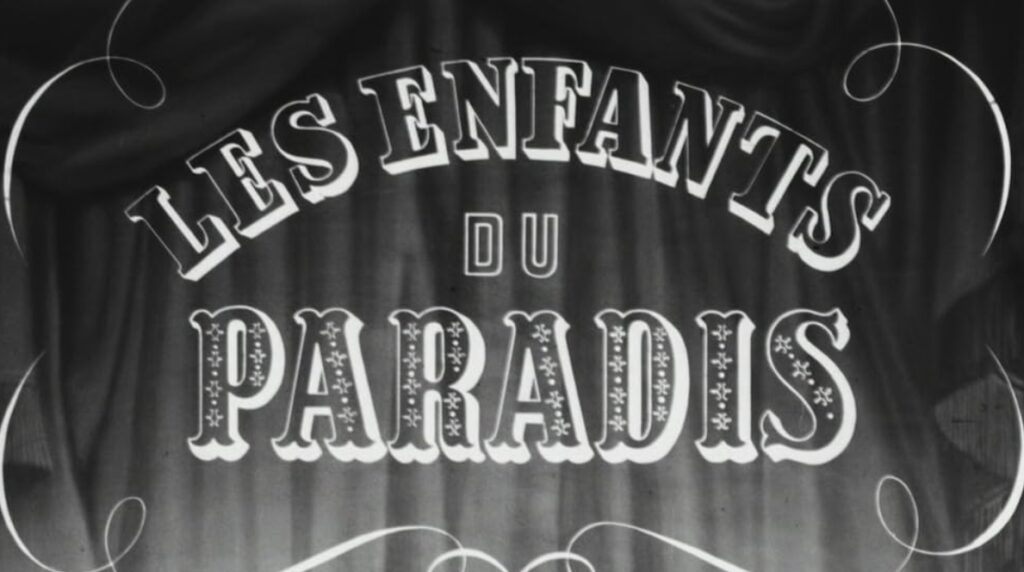
- Children of Paradise (Les Enfants du Paradis)
These films collectively define Carné’s legacy.
Port of Shadows (1938): Fog as Destiny
If Poetic Realism has a face, it is Jean Gabin in a trench coat, walking through fog in Port of Shadows.
In this film, Gabin plays Jean, a deserter drifting through Le Havre. He plans to escape to Venezuela — that recurring dream of elsewhere — but fate closes in through criminals, jealous rivals, and circumstance.
The visual language is immediately striking:
- Wet cobblestones reflecting weak light
- Studio-built docks shrouded in fog
- Faces emerging from shadow
The harbor is not simply a location; it is an emotional climate. The fog is history’s uncertainty. The dock is the threshold that will never be crossed.
Jean’s romance with Nelly (Michèle Morgan) is instantaneous yet fragile. They recognize love and its impossibility at the same moment. This dual awareness is the essence of Poetic Realism: love is most intense when already threatened.
Historically, Port of Shadows emerged during the late 1930s — a period of political instability in France, rising fascism in Europe, and growing dread. The film’s fatalism resonated deeply.
After France’s defeat in 1940, some critics accused films like this of fostering defeatism — an “aesthetic of surrender.” The claim is historically dubious and politically convenient. Art does not cause military collapse. But the accusation reveals how powerful Carné’s mood felt. The film seemed to capture the national anxiety so precisely that some mistook reflection for causation.
Le jour se lève (1939): Structure as Tragedy
If Port of Shadows establishes mood, Le jour se lève perfects structure.
The film opens with a gunshot. François (Jean Gabin again) has killed a man and barricaded himself in his room. Police surround the building. The ending is inevitable.
The narrative unfolds in flashbacks. We learn about his love affair, his jealousy, the manipulative antagonist. But crucially, we already know how it ends.
This structural decision transforms the viewer’s experience:
- Every joyful scene is already haunted
- Every kiss carries the weight of loss
- The present tense is fatal
The apartment becomes a vertical metaphor. François retreats upward, distancing himself from street life below. The physical architecture enacts psychological isolation.
The lighting — high contrast, chiaroscuro — intensifies the claustrophobia. Though grounded in working-class realism, the film’s shadows recall German Expressionism. But unlike Nosferatu or Metropolis, the horror is social, not supernatural.
The film was later remade in Hollywood as The Long Night (1947), but the remake softened the fatalism. Hollywood’s moral structure struggled to absorb French inevitability. Poetic Realism depends on doom that cannot be negotiated.
War, Occupation, and Allegory: The Night Visitors (1942)
When Germany occupied France in 1940, filmmaking did not stop. It transformed.
Direct social fatalism became politically dangerous. Carné and Prévert turned to allegory.
The Night Visitors is set in medieval times. The Devil sends emissaries to corrupt lovers in a castle. On the surface, it is fantasy. Beneath the surface, it is coded resistance.
The Devil is oppressive power. The castle is France. The lovers’ persistence symbolizes spiritual resilience.
The famous ending — in which the lovers are turned to stone but their hearts continue beating — resonated deeply with French audiences. Even under occupation, the heart remains alive.
Production itself was fraught. Some collaborators, including set designer Alexandre Trauner, were Jewish and worked in hiding. The act of making the film was an act of cultural survival.
Carné’s cinema here becomes quieter but no less defiant. The aesthetic remains lush, but the meaning shifts from fatal resignation to symbolic endurance.
Children of Paradise (1945): Monument of a Culture
If Carné had directed only Children of Paradise, his place in film history would be secure.
Set in 19th-century Paris’s theatrical world, the film centers on Garance, a free-spirited woman loved by four men:
- The mime Baptiste
- The actor Frédérick
- The criminal Lacenaire
- The aristocratic Count
Each represents a different mode of love — idealization, narcissism, intellectualism, possession.
Garance moves among them without surrendering autonomy. She becomes a symbol of freedom itself.
The scale of the production during Occupation was extraordinary. Despite shortages and surveillance, Carné constructed an elaborate recreation of the Boulevard du Crime. The film runs over three hours and unfolds like a theatrical epic.
Themes include:
- Performance versus authenticity
- Love as projection
- Art as refuge
- Freedom as elusive
Released after Liberation, the film was hailed as a masterpiece. It felt like a rebirth — proof that French cinema, and French identity, had survived.
Many critics consider it the greatest French film ever made. It is both culmination and farewell — the apex of Carné and Prévert’s collaboration.
Carné and Jean Gabin: The Face of Poetic Realism
Jean Gabin deserves special attention.
Gabin’s persona — weary, grounded, dignified — embodied Poetic Realism’s ethos. He was not romantic in a classical sense. He was human. He carried exhaustion like armor.
In Port of Shadows and Le jour se lève, Gabin becomes the face of structural fatalism. His characters do not rage against destiny theatrically. They endure.
Without Gabin, Carné’s early masterpieces would feel less anchored. His presence makes stylization believable.
Postwar Decline and the New Wave Critique
After the war, Carné’s partnership with Prévert dissolved. Carné continued directing, but the spark dimmed.
Meanwhile, a new generation — François Truffaut, Jean-Luc Godard — emerged. They criticized what they called “cinéma de papa,” accusing directors like Carné of excessive studio artificiality and literary dependency.
This critique must be contextualized. The New Wave needed a father to overthrow. Carné represented established prestige.
Yet the criticism oversimplified his achievement. Carné’s studio-bound style was not mere ornamentation. It was expressive architecture. His constructed worlds encoded social and emotional truth.
Even Truffaut later acknowledged admiration for Children of Paradise.
Carné’s later films lacked the same impact, but his earlier work remained foundational.
Carné’s Aesthetic: Architecture of Emotion
Across his major films, we see consistent elements:
1. Studio as Emotional Instrument
Carné embraced studio construction. Streets were built, perspectives altered, fog controlled. Reality was reshaped to match psychological states.
2. Light as Moral Texture
Chiaroscuro lighting does not merely create beauty; it divides moral space.
3. Fate as Social Condition
Characters are trapped not by myth but by class, jealousy, manipulation, or history.
4. Love as Recognition of Doom
Romance begins with awareness of fragility.
Influence and Legacy
Carné’s impact radiates outward:
- Film noir borrowed heavily from Poetic Realism’s shadows and fatalism.
- Postwar melodrama absorbed its emotional density.
- Directors like Wong Kar-wai echo its mood of missed connection and suspended longing.
More broadly, Carné demonstrated that cinema can be:
- Lyrical yet grounded
- Political yet indirect
- Stylized yet sincere
He proved that beauty does not negate realism; it can intensify it.
Reassessing Carné Today
Why return to Carné now?
Because we live, again, in uncertain times. His films capture the feeling of history pressing inward. They validate melancholy without glamorizing surrender.
They remind us that art can:
- Reflect anxiety
- Encode resistance
- Preserve dignity
Carné’s cinema does not offer solutions. It offers recognition.
Conclusion: The Heart Still Beats
Marcel Carné occupies a central place in French cinema not because he invented Poetic Realism, but because he perfected its language.
In collaboration with Prévert, he gave us fog that felt like destiny, rooms that felt like traps, and lovers who recognized the beauty of what they were about to lose.
Port of Shadows captures pre-war dread.
Le jour se lève refines fatal structure.
The Night Visitors transforms despair into allegory.
Children of Paradise immortalizes freedom through art.
If Poetic Realism is the art of beautiful doom, Carné is its master builder.
And like the stone lovers whose hearts continue to beat, his cinema remains alive — quiet, shadowed, and unforgettable.