
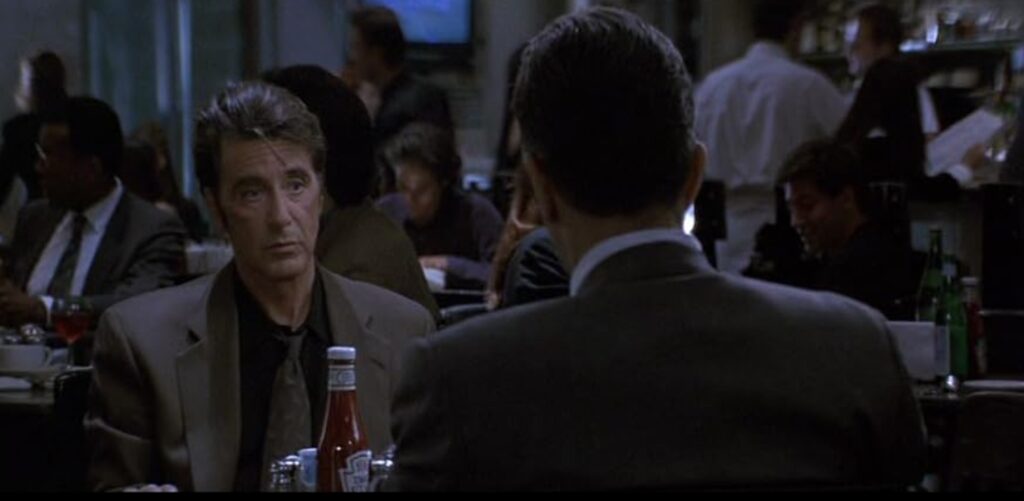
Watching Heat remains one of the most vivid cinematic experiences I’ve had. More than twenty years have passed, yet I still remember that moment with clarity. At the time, I may not have fully understood the mastery of Al Pacino and Robert De Niro, but I could sense the weight of their performances. What captivated me was not only the narrative, but the relationship at its core. Though positioned as opposites, the two men seemed to operate with the same code—precise, controlled, and unwavering. As the film moved toward its conclusion, I began to feel that Michael Mann was constructing something more than a conflict: a mirrored existence, where the hunter and the hunted are, in essence, the same man divided by circumstance. That interpretation stayed with me, eventually becoming the foundation of this piece.
Chicago-born director Michael Mann’s film Heat, which can justifiably be called his “masterpiece,” is long but absolutely essential viewing. It may well be one of the finest things ever to happen to cinema. The fact that it brings together two of the greatest living actors—arguably both in the top five—Robert De Niro and Al Pacino is, of course, the most crucial factor in its “masterpiece” status.
Yet the film goes far, far beyond a simple cops-and-robbers chase. Many organizations, magazines, and critics have described it as one of the leading productions in the history of the film industry. There are, naturally, other reasons why it is so highly regarded. One of them is the way it is supported by strong secondary characters. For example:
- A lonely woman who receives little attention from her complete workaholic husband (Police Lieutenant Vincent Hanna), who—reluctantly and almost out of spite—cheats on him, while also struggling to deal with her adolescent daughter from her first marriage.
- A teenage girl whose parents are divorced and who feels neglected by both of them, to the point of attempting suicide.
- A young woman living alone who falls for a man (Neil McCauley), only to later discover that he is a thief.
- A professional criminal who is unconditionally devoted to his gang leader (Neil McCauley), follows him no matter what, but cannot overcome his gambling and alcohol addictions—and is betrayed by the gang leader’s sister as a result.
- An ex-convict who returns to robbery immediately after being released from prison and is utterly loyal to his boss (Neil McCauley).
- A young man on parole who finds work in a diner but suffers under a troublesome employer, along with his girlfriend.
- A wife with one child who, neglected by her husband, cheats on him with a liquor salesman.
All the actors chosen to portray these characters—and the other supporting roles—are performers of considerable caliber:
Val Kilmer, Tom Sizemore, Natalie Portman, Ashley Judd, Jon Voight, Hank Azaria, and Danny Trejo.
There is no need to recount the entire film in detail; everything has already been written. Instead, let us focus on the ending—on the moments when De Niro and Pacino confront each other alone—and listen to the inner voices of these two main characters.
As they approach an unknown yet somehow inevitable end, both men prepare for the duel that is about to unfold. The policeman is determined to put yet another criminal behind bars. He is fiercely ambitious—yet cautious enough not to be defeated by his ambition. The thief, far from thinking about the woman he has just left in a corner of the hotel, does not even wish to recall how, just moments before reaching the plane that promised him freedom, he fell into the trap of his own revenge and pride.
Within seconds, both men heighten their focus to the utmost degree. There is no room for even the slightest mistake. The policeman seems slightly more daring—isn’t that how he has always been throughout his career? Always the one to step forward, fearless, reckless enough to turn his private life into a prison through sheer boldness, courage, and workaholism. So confident in his powerful sixth sense that he barely makes full use of cover. He is now a predator who has caught the scent of his prey.
The thief is more defensive, waiting for events to unfold from the other side. Who knows—perhaps those inner reckonings, the image of the curly-haired young woman he loves, on the verge of tears, have crossed his mind. But he is a professional; in such a critical moment, such thoughts can only flicker for seconds. He remains the same ruthless, capable criminal.
Then—an unexpected development that could unsettle both professionals, disrupt their focus, perhaps even alter their duel entirely: a plane is about to land. Suddenly, powerful lights flood the field, turning night into day. It is unsettling—“the darkness was better, but what can you do?” Plans are reassessed instantly, the situation recalculated, the final objective locked in once more. Both heroes regain their concentration. For them, this is child’s play—just a fleeting distraction. How many times have they faced situations like this before?
And yet both are gripped by a strange emotion, perhaps one they have never felt before:
“Why does it feel as if this is the end? Why do I feel as though I’m about to kill a colleague I deeply respect—perhaps even admire—almost like a brother? This is strange… but this is no time for such thoughts. First, I must do my duty. My priority is survival.”
The director gently brings the music back in. The policeman, as if reactivated, boldly leaves his cover and advances. “The end is near. There is only one last piece of cover—he can’t be anywhere else.”
The thief remains defensive. “Those footsteps are definitely his. Make your move!”
The policeman’s sixth sense and experience converge on a single point.
But no—another plane. And a plane means daylight again.
The thief’s inner reckoning becomes unstoppable:
“How can I, a man of rigid rules, fall in love? How can I be low enough to abandon the woman I love? How can I surrender to my pride when freedom was only minutes away? No—I no longer deserve to live. If I kill this policeman I admire, I won’t be able to live with the guilt.”
In a fraction of a second, he completely changes his strategy and steps out from his hiding place.
Now both are exposed. Whoever fires first will win. These are not men who miss.
For a moment, the blinding lights seem to distract the policeman—then the backlighting suddenly casts the target’s shadow at his feet.
The roar of the plane grows louder. The director cuts the music entirely. One shot—the beginning of the end. A second shot. Then a third. A fourth—was that a final insurance shot?
In the policeman’s eyes, first an unshakable stare:
“Hold on. It’s almost over. Don’t lose focus—he’s a complete professional. Yes, it’s over… but what are these feelings? I should be rejoicing right now.”
The thief, struck in lethal points by four bullets, collapses but is not yet dead. The plane’s noise fades. The policeman walks calmly toward him; the danger has passed.
A faint piano begins to play. As the policeman approaches, the music grows louder. He sees his fallen opponent more closely. There is no trace on his face or in his eyes of the usual victorious expression of a lawman who has taken down a great thief and gang leader.
The thief is dying, yet strangely calm and peaceful:
“I’ve paid for what I’ve done… You, great man… yes, you… deserve to live. To lose to someone like you is an honor for me. I’m glad you won, brother.”
The policeman is consumed by strange emotions:
“I wish the man I shot were like the other criminals I’ve killed. I wish I didn’t feel this… My brother, you know I had to do my duty. But I wish none of this had happened. I wish we could have been friends.”
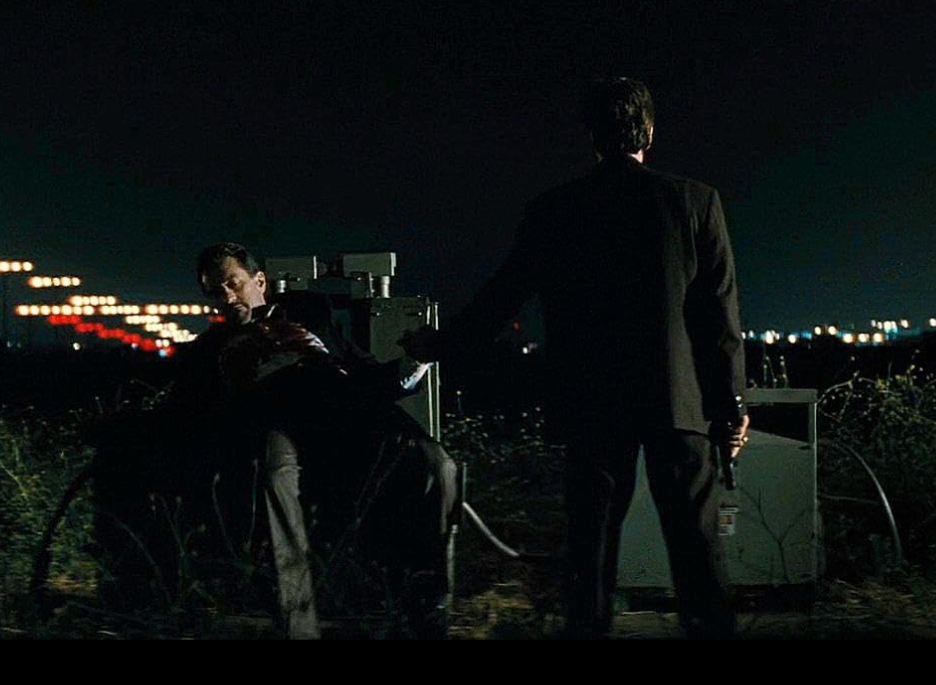
The music of Moby swells powerfully.
“How will I return to my old, routine life after you? You’ve taken a huge part of me with you. Nothing will ever be the same. Why did you have to cross my path? If only we had met differently… if only…”
The music continues. The “good” man—with many flaws—has won. The “bad” man—with many virtues—has lost.
And just as the plane had appeared moments before, a title now emerges on the screen: Michael Mann.