On Nobuhiko Obayashi’s Onomichi Trilogy — and the discovery of a filmmaker far stranger, and far gentler, than House ever let on
There is a scene in Nobuhiko Obayashi’s House — the 1977 film that, if you move in certain circles, needs no further introduction — where a piano eats a girl alive. Not metaphorically. The keys clamp shut over her fingers, the lid gulps her down, and the remaining characters carry on as though the house simply needed feeding. I watched it at some ungodly hour with a group of friends, and we all agreed: this was among the most deranged things we had ever seen committed to celluloid. We were right. And we were also, I now suspect, somewhat blinded by the derangement. Because for years afterward, whenever Obayashi’s name surfaced in conversation, my mind went straight back to that cannibal piano — and nowhere else.
That was the extent of my knowledge of Nobuhiko Obayashi (大林宣彦): House, the cannibal piano, and a vague awareness that he had died in 2020 at the age of eighty-two. A filmmaker, in my head, of brilliant, untranslatable weirdness. What I did not know — what I had never taken the trouble to find out — was that the same man spent much of the 1980s making some of Japan’s most beloved youth films: tender, nostalgic, formally adventurous, and rooted, almost obsessively, in a small port city on the Hiroshima coast called Onomichi (尾道). When I finally sat down with the three films that form his so-called Onomichi Trilogy — I Are You, You Am Me (転校生, Tenkosei, 1982), The Girl Who Leapt Through Time (時をかける少女, Toki o Kakeru Shōjo, 1983), and Lonely Heart (さびしんぼう, Sabishinbō, 1985) — I felt, more than once, like I had stumbled into the work of an entirely different director. Except that is not quite right either. The connection is there, once you learn where to look.
The Place Before the Films: Onomichi as a Character
Before there were characters, before there were plots, there was a place. Onomichi is a small port city wedged between the mountains of Hiroshima Prefecture and the Seto Inland Sea — a city of stone staircases climbing vertiginous hillsides, centuries-old Buddhist temples half-buried in cedar groves, and the distant percussion of ships passing through one of Japan’s most storied waterways. It is a city, in other words, that seems designed to remind you that you are passing through it. Boats come and go. Trains arrive and depart. The sea is always visible from almost everywhere, a shifting reminder of elsewhere.
Obayashi was born here in 1938, and the city entered his bloodstream early. His father, a physician, gave him an 8mm camera when he was eight years old — and Obayashi immediately began filming the streets, the staircases, the light on the water. He continued filming Onomichi throughout his adolescence, and later compiled the footage into a 1963 short film that he described as a glimpse of his “source landscape” (gentei no fūkei — 原点の風景). The phrase is revealing. This was not mere hometown sentiment. For Obayashi, Onomichi was less a setting than a grammar: a visual and emotional language that he kept returning to, across decades, as the substrate upon which his films were built.
The city had already been cinematically consecrated, of course. Yasujirō Ozu filmed parts of Tokyo Story (1953) here, and the city’s characteristic geography — its compressed verticality, its sense of time moving differently than in the metropolis — fed directly into Ozu’s meditation on mortality and distance. Obayashi knew this, and the awareness gives the Onomichi Trilogy a peculiar double weight. These films are in conversation with Ozu’s quiet masterpiece even as they push in the opposite direction: toward motion, toward the supernatural, toward adolescence rather than old age.
Before the Trilogy: The Road from the Avant-Garde to Kadokawa
What makes the Onomichi Trilogy genuinely surprising — once you know Obayashi’s full biography — is the distance it represents from where he started. In the 1960s, he was a committed avant-garde filmmaker, part of a loose collective called Film Independent (Japan Film Andepandan) alongside figures like Takahiko Iimura. His experimental shorts were screened at art galleries and universities; one of them, Tabeta Hito (The Person Who Is Eaten, 1963), won the Jury Award at the EXPRMNTL festival in Belgium. His work from this period has the restless, self-aware quality of someone who has absorbed Godard and Maya Deren and Andy Warhol and is trying to figure out what comes after all of them simultaneously.
Then came the television commercials. This seems, on the surface, like a capitulation — the experimental filmmaker seduced by corporate money. In practice, it was something stranger. Over the course of a decade, Obayashi directed roughly three thousand television advertisements, often featuring Western stars — Kirk Douglas, Catherine Deneuve, Charles Bronson — in surreal mini-narratives that owed more to his underground work than to conventional advertising logic. The commercials were, in essence, a laboratory: a way to refine technical trickery, experiment with format collisions and tonal whiplash, and do it all at speed and with budgets that no experimental cinema grant would ever provide.
When Toho approached him in the mid-1970s asking whether he had a film concept “similar to sharks attacking humans,” the result was House — a work that funneled all that accumulated weirdness into a single feature-length explosion. House is not, in retrospect, an anomaly in Obayashi’s career. It is the logical climax of a decade spent weaponizing the grammar of popular entertainment against itself.
What came next was a genuine pivot. Partnering with the Kadokawa studio throughout the 1980s, Obayashi directed a series of seishun eiga (青春映画) — youth films — that leaned into a newly emerging commercial formula: take a popular Kadokawa pop idol, set her in a story of first love and adolescent awakening, and shoot it with enough stylistic ambition to elevate the material above mere product. The films were enormously popular in Japan, and they represent the peak of Obayashi’s domestic cultural impact. Abroad, they were almost entirely unknown — eclipsed by the cult of House, which, unlike the idol films, had the kind of international distribution that cult cinema tends to attract.
Film One: I Are You, You Am Me (転校生, 1982)
The first film in the trilogy announces its intentions through its formal eclecticism almost immediately. Obayashi shoots in a deliberate mixture of 8mm, black-and-white, and color — oscillating between film stocks and aspect ratios with the freedom of someone who has nothing to prove and everything to play with. The story is, on paper, a gender-swap comedy: Kazuo and Kazumi, classmates, fall down a flight of Onomichi’s famously steep stone staircases and find themselves in each other’s bodies. What follows is their attempt to live out each other’s lives — at school, at home, in the social performances that Japanese adolescence demands of boys and girls respectively.
What the film actually does with this premise is something more thoughtful than the comedy suggests. The gender-swap is less a device for slapstick than for an anatomy of the invisible rules that structure daily life: how differently boys and girls move through identical spaces, how differently they are spoken to, touched, expected to perform. Obayashi’s humor here is never mean. It is observational with a kind of tender bewilderment — as though the film itself cannot quite believe how much it matters which body you’re in, and finds that disbelief both funny and heartbreaking.
The Onomichi geography is doing constant thematic work. The city’s verticality — its endless staircases, its steep hills — makes every journey through it feel like a negotiation with gravity, a constant up-and-down that mirrors the emotional instability of the characters. And then there is the port. Obayashi returns again and again to the water, to boats departing, to the horizon. One of the film’s most affecting threads involves an imminent departure — one of the kids must move away with his family — and the city’s whole apparatus of transit and transience becomes an extended visual metaphor for the impossibility of staying anywhere, or staying anyone. As one analysis puts it, the evanescence at the core of the film is reinforced through the setting’s imagery as a port town: boats and trains come and go, waves wash in and out, nothing is permanent.
This is recognizably the same director who made House, if you know where to look. The formal restlessness, the tonal instability, the willingness to let a sequence pivot without warning from comedy to genuine emotional devastation — these are Obayashi signatures. But the energy is different. House is aggressive; its strangeness is weaponized, designed to unsettle. Tenkosei is strange in a different register — wistful, digressive, sometimes clumsy in ways that feel deliberate. The composer, incidentally, is Joe Hisaishi — years before Nausicaä, in an early collaboration that gives the film a melodic warmth entirely at odds with the frenetic visual texture.
Film Two: The Girl Who Leapt Through Time (時をかける少女, 1983)
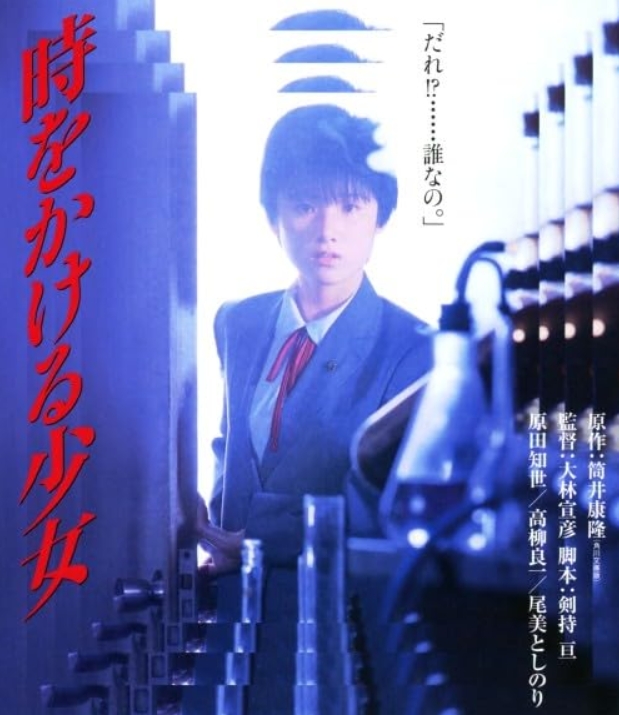
The second film is the trilogy’s most famous — at least by name. Yasutaka Tsutsui’s source novel, originally serialized in 1965, has been adapted into so many films, television series, and manga that it has become something close to a Japanese cultural institution. Most international audiences who know the title at all know Mamoru Hosoda’s luminous 2006 anime, which is a loose sequel rather than a direct adaptation. Obayashi’s version — released in Japan in July 1983 and a major box-office hit, the second-highest-grossing Japanese film of that year — was the first feature adaptation, and it remains the strangest.
Kazuko Yoshiyama (played by Tomoyo Harada, in her film debut) is a sixteen-year-old who, after an accident in her school chemistry lab, finds herself slipping through time. The novel’s mechanism — a lavender-scented chemical that grants the ability to time-leap — is retained, but Obayashi bends the story in directions Tsutsui apparently found surprising enough to respond with a parodic short story of his own. Where the novel focuses on the paradox of time loops, Obayashi’s film is really about something else: desire, and the way unrecognized desire structures our experience of time without our consent.
The formal choices here are more controlled than in Tenkosei, but the Obayashi fingerprints remain visible. He and his cinematographer deploy abrupt shifts between black-and-white and color, between standard and widescreen, in ways that track the protagonist’s disorientation without fully explaining it. The incident that triggers Kazuko’s first time-leap is filmed with the sudden angular menace of a horror scene — all metallic tones and sharp cuts — and then the film returns to its warm, school-drama register almost immediately, as though the intrusion of the uncanny were simply one more thing a teenager has to absorb and move on from.
Harada’s Kazuko has a particular quality of transparent interior life: you can see her feeling things before she has processed what she is feeling, which suits a film about a girl being buffeted by emotional forces she cannot name or locate. The love story at its heart — involving a mysterious time-traveler who has inserted himself into Kazuko’s most formative memories — works precisely because Harada makes the gap between conscious knowledge and unconscious longing feel physically present.
The film is suffused with Onomichi. Obayashi films the city with the careful attention of someone cataloguing something irreplaceable — and in a sense he was. The Japan of the early 1980s was changing at speed; the compact, low-rise, pedestrian world of the provincial port town was already becoming a kind of historical artifact. To watch these sequences now is to understand why the film triggered such intense nostalgia in its original audience, and why it continues to do so. The city is not background. It is a “source landscape” — a geography of feelings that the film does not explain so much as transmit.
Film Three: Lonely Heart (さびしんぼう, 1985)
The third film is the quietest, and in some ways the most personal. Hiroki is a bookish, photography-obsessed schoolboy who has developed a wordless fascination with a girl at his school — a sad-looking girl he photographs from a distance and whom he calls, privately, his “Lonely Heart” (sabishinbō). When a second girl appears — white-faced, mischievous, seemingly summoned from elsewhere — who also goes by the name Lonely Heart, the film begins its gentlest and most uncanny movement: a loop of time, memory, and resemblance that only fully reveals itself in the final act.
This was reportedly a favorite film of Akira Kurosawa’s — the story goes that he thought it so remarkable he urged his entire production staff to watch it. That anecdote tells you something about the film’s ambitions: it is not trying to be a crowd-pleaser, even though it was commercially successful. It is a film about the way that memory deforms and exalts the people we love, and the way that adolescent longing attaches itself to an image — a face in a viewfinder, a figure on a hillside — rather than to a person. Hiroki’s camera is both a way of possessing what he cannot approach and a confession of the distance that possession requires.
Shot on 16mm and permeated by Chopin’s Étude Op. 10, No. 3 — a piece whose particular bittersweet tristesse the film quotes and requotes until it becomes something close to a structural element — Sabishinbō is formally the most restrained of the three films, and emotionally the most devastating. Obayashi films Onomichi here with something approaching reverence. The famous stone staircases, the cliff-side temples, the light on the water: they appear not as picturesque backdrop but as the literal architecture of remembrance, the physical form that nostalgia takes in the body.
The film closes with a revelation I will not describe in detail here, except to say that it reframes everything that came before in a way that feels earned rather than cheap — a genuinely literary move in a medium that does not always make room for such things. I watched it twice in quick succession because the second viewing, knowing what the film knows all along, is a completely different experience from the first. That is a rare quality in any film, from any tradition.
What the Trilogy Is Really About
Taken together, the three films constitute something more coherent than the word “trilogy” — which usually implies a shared plot — might suggest. There are no recurring characters across the three films. The connection is one of sensibility, geography, and theme. Each film concerns a young person at a moment of threshold: between childhood and adulthood, between presence and absence, between staying and leaving. Each film uses Onomichi — its geography of departure and return, its port-town metabolism of arrival and farewell — as the spatial embodiment of that threshold state.
There is also a formal consistency. All three films treat the image as an unstable thing: images from different film stocks collide, black-and-white gives way to color without warning, the aspect ratio shifts, the past intrudes on the present through visual rather than narrative means. This is the inheritance of Obayashi’s avant-garde years, domesticated but not tamed. The experimental impulses that produced the cannibal piano in House are still present in the trilogy; they have simply found a different channel, one in which destabilization serves emotional rather than transgressive ends.
And then there is the anti-war dimension, which is easy to miss in films that appear, on the surface, to be about teenagers in love. Obayashi was born in Onomichi in 1938 — the year before the Second World War began — and he grew up in a city close enough to Hiroshima to feel its shadow. Many of his films contain anti-war themes, sometimes embedded so deeply in the metaphysics of the story that they are invisible on first viewing. In the Onomichi Trilogy, the elegies for youth and passing time carry within them an awareness, never stated but always felt, that entire generations of Japanese young people were consumed by a war they did not choose. The nostalgia in these films is not mere sentimentality. It is also grief.
Beyond the Cannibal Piano
I am aware that this essay has not resolved the central tension it began with: the distance between the director of House and the director of the Onomichi Trilogy. I am not sure that tension can be resolved, or that it should be. Obayashi was, by all accounts, a filmmaker who resisted reduction — who moved across genres and tones and formats across a sixty-year career with a restlessness that was partly artistic temperament and partly, I think, a refusal to be the thing anyone expected him to be.
What I can say, having spent time with the trilogy, is that it changed how I understand House. The cannibal piano no longer reads to me as mere gleeful derangement. It reads as the logical extreme of a sensibility that, in the Onomichi films, expresses itself through other means: a girl slipping out of time, a boy photographing a ghost he doesn’t yet know is a ghost, two teenagers waking up in each other’s bodies on a steep staircase in a city that has been filming itself, through its most devoted son, since he was eight years old with a camera.
Obayashi once described Onomichi as a geography of “magical youth” — a place to return to occasionally and reconnect with the innocent adventures of childhood, but not a place to stay forever. That push-pull between belonging and leaving is, in the end, what the trilogy is about. It is also, in some larger sense, what all good cinema about growing up is about. The Onomichi Trilogy earns its place in that tradition not because it is quiet — it is not, always — but because it knows, with the certainty of someone who has spent a lifetime looking at a place from the inside and the outside simultaneously, that what we call nostalgia is really just the shape of love in the past tense.