There is a dangerous question in film conversation: What was the best decade for cinema? Dangerous because it sounds as if cinema can be reduced to a competition between calendar pages. Dangerous because every decade has its own miracles, its own blind spots, its own films that arrive at exactly the right moment and become part of the way we understand life. And dangerous because once you answer, you immediately have to defend yourself against someone who thinks the 1930s were the real golden age, or that the 1940s had the greatest directors, or that the 1990s were the last time Hollywood still knew how to take a chance.
Still, I keep coming back to the 1970s.
Not because every film made between 1970 and 1979 was brilliant. Of course not. The decade produced plenty of trash, vanity projects, failed experiments, cheap imitations, and films that have aged badly. It also had exploitation pictures made quickly for money, star vehicles built around a single marketable idea, and a great deal of cinema that has vanished from public memory for good reasons. No decade is a museum of perfection.
But the 1970s may have offered the richest combination of freedom, danger, variety, and ambition that cinema has ever known. In the same ten-year stretch, filmmakers could make The Godfather, Jeanne Dielman, Stalker, Aguirre, the Wrath of God, The Texas Chain Saw Massacre, Network, Monty Python’s Life of Brian, Days of Heaven, The Ascent, Alien, and The Conversation. These are not just different films. They seem to come from different ideas of what a film is allowed to be.
A crime saga could become a national tragedy. A science-fiction film could become a meditation on grief. A horror film could feel like a documentary discovered in a ditch. A story about a housewife preparing dinner could become one of the most radical films ever made. A comedy could attack religion, empire, celebrity, and political fanaticism in the same breath. A studio picture could be enormous and intimate at the same time.
The 1970s did not choose between art cinema and popular cinema. At their best, they allowed the two to collide.
That is the main reason I think the decade has a serious claim to being cinema’s greatest. The 1970s were not simply a period with many good films. They were a period in which the meaning of “a good film” expanded. The decade made room for works that were commercially huge, formally strange, politically furious, spiritually searching, physically terrifying, and emotionally naked. It let filmmakers be personal without forcing them to abandon the audience.
A decade that did not trust easy answers
The 1970s began in the shadow of the 1960s, but they did not feel like a continuation of the 1960s’ optimism. The decade inherited the counterculture, the civil rights movement, the sexual revolution, and the suspicion of authority. It also inherited war, assassinations, political scandal, economic anxiety, social violence, and the sense that the official story could no longer be believed.
American cinema responded to that confusion with films that often seemed to ask whether institutions deserved our trust. The police might be corrupt. The government might be lying. The family might be a machine for passing down cruelty. The news might be selling fear. The hero might be a damaged person who mistakes obsession for virtue.
This was the period generally called New Hollywood. The movement began in the mid-1960s and continued into the early 1980s, but the 1970s were its central years. It represented a change in both filmmaking and subject matter: the old studio system gave way, at least for a while, to more director-driven production, frank depictions of sex and violence, anti-authoritarian attitudes, and stories shaped by the concerns of a younger generation. 1
The important point is not simply that young directors received opportunities. The important point is that the industry was uncertain enough to give them those opportunities. Hollywood had lost some of its old confidence. The grand studio spectacles of the 1960s had become expensive warnings. Television had changed the habits of audiences. The old censorship system had weakened. Younger viewers wanted films that did not speak to them like children.
The result was an extraordinary bargain. Studios wanted relevance and profit. Filmmakers wanted freedom. For a few years, those desires overlapped.
The BFI describes this period as a brief era in which stylistic experimentation, political engagement, adult themes, and the rise of the director as the key creative voice were tolerated by Hollywood in its attempt to reconnect with audiences. That tolerance was never unlimited. Directors fought with producers, stars, distributors, censors, and financiers. Many careers collapsed. Many films were cut, misunderstood, or buried. But compared with the increasingly cautious franchise culture that followed, the window feels almost unreal.
Imagine being a young filmmaker and being allowed to make Mean Streets, Badlands, The Last Picture Show, or Five Easy Pieces. Imagine being given a large budget after the success of The Godfather and using it to make The Conversation, a quiet, paranoid film about a surveillance expert who hears something he cannot emotionally survive. Imagine a studio allowing Apocalypse Now to become an insane, expensive, nightmarish journey into the heart of imperial violence.
The 1970s were full of bad decisions. Some of them became masterpieces.
Coppola’s impossible run
Francis Ford Coppola’s 1970s alone could support the claim that the decade was extraordinary. In roughly eight years, he directed The Godfather (1972), The Conversation (1974), The Godfather Part II (1974), and Apocalypse Now (1979). Each film is different enough to suggest a separate career.
The Godfather is often described as a gangster film, but that description is too small. It is a film about inheritance, family, power, assimilation, and the slow corruption of a person who believes he can remain outside the family business. It has the pleasures of a grand popular narrative—weddings, betrayals, guns, revenge, famous lines, unforgettable faces—but its real force comes from the sadness underneath. Michael Corleone does not simply become powerful. He loses the possibility of being innocent.
The film’s control is almost frightening. Coppola can move from a wedding full of noise and celebration to a dark restaurant where the air seems to leave the room. He can make a family dinner feel like a political summit and a baptism feel like a declaration of war. The film is rich, but it is never merely decorative. Every beautiful image has a moral weight.
Then came The Godfather Part II, a sequel that refuses to behave like a sequel. It expands the original while also contradicting its emotional temperature. The first film is about a man entering power. The second is about power hollowing a man out. Michael’s story is placed beside the story of his father, Vito, and the parallel is devastating. Vito builds a family. Michael protects an empire. Vito’s power is mixed with belonging; Michael’s power produces isolation.
Very few sequels have been willing to become so bleak. Part II does not reassure us that the family has survived. It asks what survival means when everyone has been sacrificed to the family’s continued existence.
Between those two films, Coppola made The Conversation, perhaps the most quietly devastating film of the decade. Harry Caul, played by Gene Hackman, records private conversations for a living. He insists that he only supplies information and does not take responsibility for what others do with it. But this professional distance collapses when he suspects that one of his recordings may lead to murder.
The film is not loud. It does not need to be. Its paranoia grows through sound: fragments, repetitions, interference, voices becoming clearer and less reliable at the same time. Harry is a man who believes privacy is a technical problem, only to discover that guilt is not something he can filter out. In a decade haunted by Watergate and government surveillance, The Conversation seemed to hear the future coming through a microphone.

on the set of “ApocalypseNow”
And then there is Apocalypse Now, one of the most famously troubled productions in film history. The story behind the film is almost too dramatic: weather disasters, illness, financial pressure, production delays, and a shoot that seemed determined to destroy everyone involved. Yet the finished film feels less like a report about a difficult production than a descent into a fever dream.
Coppola takes Joseph Conrad’s colonial nightmare and moves it into Vietnam, Cambodia, and the machinery of American power. Captain Willard travels upriver to find Colonel Kurtz, but the journey is not a simple mission. It is a movement away from the language of duty and toward the terrifying possibility that the madness is not an exception to the system. It is the system without its polite vocabulary.
The film contains images that have entered cultural memory: helicopters attacking to Wagner, napalm burning the jungle, the bridge that seems to exist only at night, Dennis Hopper’s manic photographer, Kurtz whispering in the darkness. Yet its most powerful effect is uncertainty. Are we watching a war story, a myth, a nightmare, or an American confession? The answer is yes.
Coppola’s run is not just impressive because the films are famous. It is impressive because each film reached for a different scale of experience. Family, surveillance, organized crime, war, empire, loneliness, and moral responsibility all became cinematic material.
Scorsese and the wounded American street
If Coppola looked at power from the inside, Martin Scorsese often looked at people who lived close to power but could not control their own lives. His 1970s films are dirty, funny, violent, religious, lonely, and alive with the feeling of streets that existed before the camera arrived.
Mean Streets (1973) feels like a film made out of memory, music, Catholic guilt, and neighborhood noise. Charlie wants to become respectable, but respectability is not an idea he can separate from the criminal world around him. Johnny Boy is reckless, funny, destructive, and impossible to abandon. Their friendship becomes a moral trap. Charlie’s desire to save Johnny may be mixed with his desire to save himself, but Scorsese does not turn that desire into a clean heroic gesture.
The film’s power comes from its unstable energy. The camera moves as if it has been pulled into the characters’ emotions. The soundtrack does not simply accompany the action; it seems to reveal what the characters cannot say. Scorsese understands that popular music can carry history, desire, and shame in a single song.
With Alice Doesn’t Live Here Anymore (1974), Scorsese made a film that is often overlooked when people talk about his greatest work. That neglect is unfair. The film follows a woman trying to rebuild her life after the death of her husband, and it gives Ellen Burstyn a role full of impatience, humor, anger, hope, and exhaustion. Alice is not presented as a symbol of liberation. She is a person trying to find a way to live without pretending that survival is glamorous.
Then came Taxi Driver (1976), one of the most influential films of the decade and one of the most dangerous. Travis Bickle is a Vietnam veteran who drives a taxi through a New York that he experiences as a sewer. He wants to cleanse it, but his idea of cleansing is inseparable from violence. The film does not invite us to celebrate his transformation. It traps us inside his sick imagination and makes us feel how easily loneliness can turn into political fantasy.
The film’s New York is real enough to smell, but Travis’s mind gives it a feverish glow. The city is not simply dirty. It has become a moral landscape inside him. Every passenger, prostitute, politician, and street corner is absorbed into his private mythology.
What makes Taxi Driver so difficult is that it does not allow a comfortable distance from Travis. We recognize his isolation before we recognize its danger. We understand the temptation to believe that the world’s complexity could be solved by a single violent act. Then the film forces us to see where that fantasy leads.
Scorsese’s cinema in the 1970s is full of people who want redemption but keep choosing punishment. His characters are not clean representatives of ideas. They are bodies in rooms, cars, bars, bedrooms, churches, and streets. They sweat. They lie. They make jokes at the wrong moment. They try to love people while damaging them.
That human mess is one of the reasons the decade still feels close. These films do not treat people as products of a plot. They let people be contradictory.
Tarkovsky and the mystery of being alive
The 1970s were not only a great decade for American cinema. Any argument for the decade must cross borders, because some of its most powerful films were made far from Hollywood.
Andrei Tarkovsky made three of his defining films in this decade: Solaris (1972), Mirror (1975), and Stalker (1979). The BFI notes that Tarkovsky made only seven features, partly because Soviet authorities repeatedly obstructed his work, and that his films rely on slow long takes, memory, spiritual crisis, and imagery that refuses to explain itself completely.
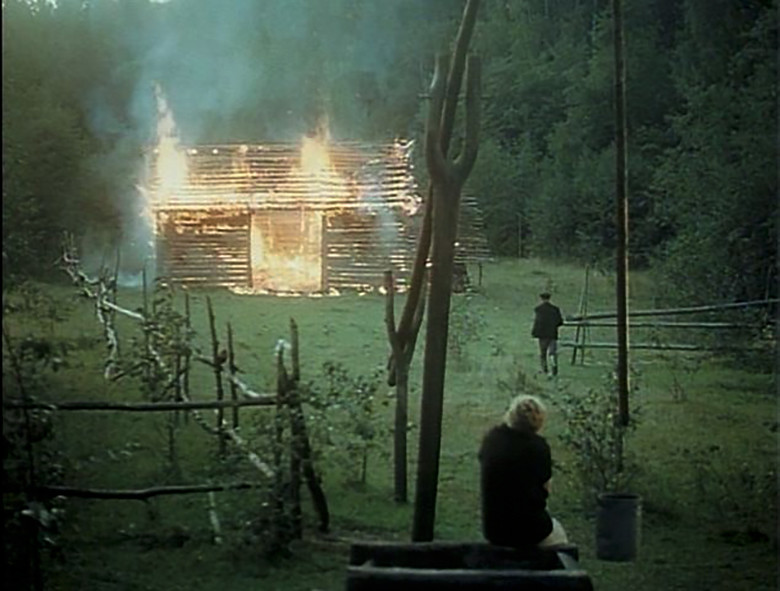
Solaris is often introduced as science fiction, but the label can mislead us. The film is not primarily interested in space travel, technology, or the mechanics of an alien world. Its real subject is grief. Kris Kelvin goes to a space station above the planet Solaris and encounters a physical presence shaped by his dead wife. The impossible visitor forces him to confront the part of his past he has never accepted.
The final movement of Solaris is controversial because it refuses the kind of conclusion many science-fiction stories promise. The question is not simply whether the planet is intelligent. The deeper question is whether human beings ever encounter anything outside themselves without turning it into a mirror of their own needs.
Mirror is even less interested in conventional plot. It moves through childhood, war, family, dreams, old houses, poems, and memory. It is personal without being confessional in the ordinary sense. Tarkovsky does not explain his past as a story with a beginning and an end. He lets memory arrive as it often does: in flashes, echoes, textures, and images that seem unrelated until they suddenly hurt.
There is a mother, a house, wind through a field, fire, rain, archival footage, a voice, and a feeling that time is not moving in a straight line. Mirror is one of the great films about the way a person carries several ages at once.
Then Stalker takes us into the Zone, an enclosed territory where a room is said to grant a person’s deepest desire. The Stalker leads a writer and a professor toward it, but the journey becomes less important than the fear of discovering what one truly wants. The film’s strange power comes from its patience. It does not rush to make its symbols useful.
Tarkovsky understood that cinema could make time physical. A shot of water, rust, grass, mud, or a passing train can become an event. The viewer is not just being told about a world; the viewer is made to remain inside it.
In most commercial filmmaking, time is something to manage. In Tarkovsky, time is something to experience. That difference matters. A decade that could produce both Star Wars and Stalker was not afraid of the full range of cinema.
The decade’s international richness
What becomes clear when these filmmakers are placed beside one another is how extraordinarily diverse the decade was. Ingmar Bergman’s best-known period may have been earlier, but the 1970s still gave us Cries and Whispers, Scenes from a Marriage, Face to Face, and Autumn Sonata. These films are not repetitions of his earlier work. They continue his examination of the body, faith, marriage, memory, illness, and the terrible difficulty of speaking honestly to another person.
Cries and Whispers turns a house into a chamber of pain. Its red interiors, intense close-ups, and silences make emotional suffering feel almost physical. Scenes from a Marriage watches a relationship change over time without reducing the couple to heroes and villains. The film understands that love can contain generosity, cruelty, habit, and fear in the same conversation.
François Truffaut’s The Wild Child and Day for Night show two different sides of his devotion to cinema. The Wild Child asks what education means when a child has grown up outside ordinary society. Day for Night is more playful and affectionate, but its affection is not blind. It shows filmmaking as a world of deadlines, accidents, ego, intimacy, and performance. It is a love letter to cinema that knows love letters can be embarrassing.
Luis Buñuel remained gloriously hostile to bourgeois comfort. The Discreet Charm of the Bourgeoisie turns dinner into an endlessly interrupted dream. The characters want to eat, but social ritual, political violence, dreams, and absurdity keep breaking through. The Phantom of Liberty links unrelated scenes and refuses the expectation that a film must behave like a tidy argument. That Obscure Object of Desire makes desire itself unstable by casting two actresses as the same woman. Buñuel was still making fun of people who believed they were respectable, rational, and in control.
Rainer Werner Fassbinder spent the 1970s working at a frightening speed. The Merchant of Four Seasons, Ali: Fear Eats the Soul, and Fox and His Friends examine love and social power with a directness that can feel cruel because the society around the characters is cruel. Fassbinder’s people often want tenderness, but the world teaches them to measure one another by money, class, nationality, sexuality, and usefulness.
Werner Herzog’s Aguirre, the Wrath of God is one of the decade’s great encounters between landscape and madness. The jungle is not a background. It is a force that makes ambition look ridiculous. Aguirre believes history will remember him, but the film keeps showing us a man becoming smaller inside a landscape that does not care about his dreams.
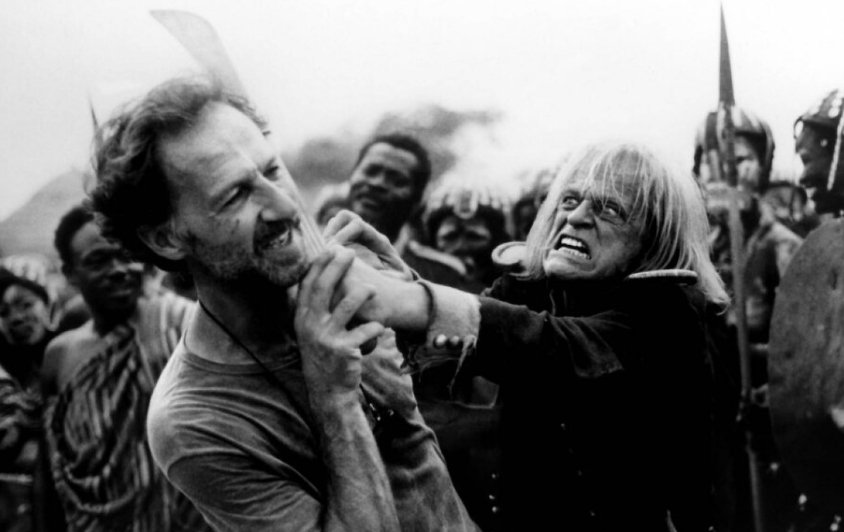
Aguirre, der Zorn Gottes (1972)
Bernardo Bertolucci’s The Conformist belongs to 1970 and turns political obedience into visual seduction. Its elegant compositions are not separate from its moral subject. The beauty is part of the trap. Theodoros Angelopoulos’s The Travelling Players moves through Greek history with a tragic sense of repetition. Larisa Shepitko’s The Ascent turns war into a spiritual test without making it simple. Akira Kurosawa’s Dersu Uzala studies friendship, nature, and the limits of human control.
Krzysztof Kieślowski’s Camera Buff is a beautiful film for anyone who has ever discovered that watching movies can change the way one sees real life. Its protagonist buys a camera to film his daughter, then becomes consumed by the act of filming. He begins with private memory and ends up facing public responsibility. The camera gives him a new language, but it also disrupts his family and his sense of himself.
Eric Rohmer’s Claire’s Knee and Love in the Afternoon show that the decade’s cinema could be delicate without being empty. Rohmer was interested in people who explain themselves too much and understand themselves too little. His films are full of conversation, but conversation does not necessarily lead to truth.
The decade also gave us films from filmmakers who did not fit easily into a single national story: The Fifth Seal from Zoltán Fábri, Vengeance Is Mine from Shōhei Imamura, The Conformist from Bertolucci, and The Red Circle from Jean-Pierre Melville. The 1970s did not feel like one cinema. It felt like cinema arguing with itself in several languages.
The American film that could do almost anything
The American 1970s are sometimes reduced to a small group of male directors. That group matters, but it is not the whole story. The decade’s great achievement was not only the rise of Coppola, Scorsese, Spielberg, Lucas, Altman, Friedkin, and others. It was also the variety of films made around them.
Sidney Lumet deserves special attention. Serpico (1973), Dog Day Afternoon (1975), and Network (1976) form a remarkable trio about institutions, performance, public attention, and the desperation produced by systems that pretend to be rational.
Serpico follows a police officer who refuses to accept corruption as normal. Dog Day Afternoon turns a bank robbery into an unstable public event in which the criminals, hostages, police, press, and crowd all begin performing for one another. Network is even more prophetic. It sees television transforming outrage into entertainment and the public sphere into a marketplace of emotions.
When Howard Beale shouts that he is mad as hell, the speech feels powerful because it is sincere. It also feels terrifying because sincerity can be packaged, repeated, and sold. The film knows that a system can absorb rebellion without becoming less powerful.
Robert Altman’s 1970s are equally remarkable. MASH (1970) uses comedy to expose the absurdity of war and hierarchy. McCabe & Mrs. Miller (1971) stains the western with rain, mud, loneliness, and economic calculation. The Long Goodbye (1973) takes the private eye story and makes its hero seem like a man who has wandered into the wrong decade. Altman’s films refuse to clean up life. They let people interrupt one another. They let several stories exist at once.
Altman could make a crowd feel like a living organism, but he could also make a single person’s confusion fill the screen. But Altman’s 1970s were much larger than these three films, but Nashville, California Split, 3 Women, and A Wedding could all join the conversation. The point is not that Altman had one style. The point is that he made uncertainty into a style.
Peter Bogdanovich brought an intense love of classic Hollywood into the new period. The Last Picture Show understands that the old movies were disappearing, but it does not treat the past as a sacred object. What’s Up, Doc? is a machine of comic timing. Paper Moon feels like a story from another period while carrying the emotional sharpness of the 1970s.
Hal Ashby’s Harold and Maude is another reason the decade remains beloved. It is strange, tender, morbid, and openhearted. Harold stages fake suicides; Maude treats life as something that must be used before it is gone. Their relationship should be impossible, but the film does not care about respectable expectations. It cares about the possibility that two damaged people might teach each other how to live.
Peter Weir’s Picnic at Hanging Rock uses mystery not as a puzzle to solve but as a wound that never closes. The film’s atmosphere is so precise that the missing girls seem to disappear from reality itself. In a different register, John Boorman’s Deliverance turns a trip into the wilderness into a confrontation with violence, masculinity, and the fantasy that civilization is something we carry inside us.
Terrence Malick’s Badlands and Days of Heaven show how a film can be lyrical without excusing its characters. Malick’s landscapes are beautiful, but beauty does not make the world kind. In Badlands, violence is filtered through youthful romantic fantasy. In Days of Heaven, the light seems to promise grace while the characters move toward loss.
Horror, science fiction, and the discovery that the audience was not safe
The 1970s were also one of the great decades for horror. Horror became a way to process political fear, family violence, economic anxiety, sexual danger, religious panic, and the feeling that ordinary spaces were no longer ordinary.
William Friedkin’s The Exorcist (1973) and The French Connection (1971) belong to different genres, but both are films of physical pressure. The Exorcist takes spiritual terror seriously without making it elegant. It is frightening because the crisis enters a family home, a child’s body, and the routines of medical and religious authority. The French Connection turns the city into a hard surface of pursuit, surveillance, and institutional aggression.
Friedkin’s Sorcerer (1977) is the darker, less appreciated cousin of his famous films. It is a story of men carrying unstable explosives through an impossible landscape, but it is also about people who have already lost the identities they once depended on. The film is punishing because its world offers no clean route back to innocence.
Tobe Hooper’s The Texas Chain Saw Massacre (1974) remains one of the decade’s most disturbing films. It is more accurate to call it a foundational modern slasher than to claim that it is the undisputed first slasher. Earlier films such as Psycho, Peeping Tom, and other proto-slasher works complicate that history. Still, Hooper’s film changed the emotional grammar of horror.
Its violence is often implied rather than shown, which makes the film feel worse, not safer. The washed-out colors, handheld camera work, rural isolation, false suggestion that the story is based on real events, and the exhausted performance of Marilyn Burns all work together to create a documentary-like nightmare. Britannica identifies the film as a 1974 Tobe Hooper and Kim Henkel production and notes its foundational role in modern horror and the slasher genre.
The film’s genius is that it does not let Leatherface become a glamorous monster. He is frightening, but the entire family is frightening. Violence is not the act of one supernatural villain. It is a social environment, a family tradition, an economy of meat, work, humiliation, and power.
John Carpenter’s Halloween (1978) takes a different path. It is cleaner, more controlled, and more formally precise. Carpenter turns the suburban street into a grid of empty windows, parked cars, and places where a figure may or may not be standing. Michael Myers is terrifying partly because the film refuses to make him psychologically legible. He is not a troubled character waiting for an explanation. He is a presence.
The importance of Halloween goes beyond its immediate influence. It showed that a small-budget independent film could reshape the mainstream. It proved that suspense could be built through framing, sound, repetition, and the patient movement of a camera rather than constant spectacle.
Ridley Scott’s Alien (1979) carried horror into space and made industrial design part of its terror. The spacecraft does not feel like a clean futuristic laboratory. It feels like a workplace. The crew are employees. The company sees them as replaceable. The alien is not simply an animal. It is a biological nightmare, an intrusion into the body, and a perfect expression of a system that values profit over life.
The Library of Congress selected Alien for the National Film Registry as a culturally, historically, or aesthetically significant film, describing it as an influential and spine-tingling science-fiction work. That recognition is deserved, but the film’s importance was already visible in the way it changed science fiction. After Alien, outer space could smell of machinery, sweat, oil, and blood.
George Lucas’s Star Wars began its cultural life in 1977, but Lucas’s 1970s were not limited to the space opera. American Graffiti (1973) is a tender and melancholy film about youth, cars, radio, and the last night before life changes. It shows Lucas’s interest in movement, sound, popular culture, and the way a group of friends can be together while already beginning to separate.
Steven Spielberg made Duel for television before directing Jaws (1975) and Close Encounters of the Third Kind (1977). Duel turns an ordinary road into a place of pure threat. Jaws makes a shark into a national nightmare but also gives us three men with different kinds of knowledge and courage. Close Encounters treats contact with extraterrestrial life as something mysterious, frightening, and spiritually overwhelming rather than merely militaristic.
Spielberg’s films also reveal something important about the changing relationship between Hollywood and its audience. Jaws helped establish the modern blockbuster model. PBS describes how the film combined wide release with prime-time television advertising, opening in hundreds of theaters and breaking box-office records. It also notes that The Godfather had already helped challenge the old practice of opening major films in only a few theaters before slowly expanding.
This is where the decade’s contradiction becomes visible. The 1970s created the conditions for daring director-driven films, but they also created the modern blockbuster system that would later make those films harder to finance. Jaws and Star Wars did not personally destroy cinema. That argument is too simple. But their success taught studios that a film could be treated as an event, a brand, a release strategy, and a repeatable commercial object.
The same decade that gave us The Conversation also taught Hollywood to sell a movie through a thirty-second television spot. The same decade that gave us Jeanne Dielman also showed studios the power of the sequel. Cinema became larger and more profitable, but some of its freedom began to narrow.
The radical quiet of Chantal Akerman
If someone wanted to argue that the 1970s were only a golden age for male directors, Chantal Akerman’s Jeanne Dielman, 23 quai du Commerce, 1080 Bruxelles would be enough to destroy that argument.
The film follows a woman through domestic routines: cooking, cleaning, shopping, caring for her son, and engaging in sex work. Akerman does not treat these actions as background information. She gives them time. A potato is peeled. A meal is prepared. A bed is made. A door is opened. The repetition becomes the story.
At first, this can feel almost unbearable. That is part of the point. Cinema has traditionally considered certain work worth watching and other work invisible. Akerman asks what happens when the invisible work becomes the formal center of the film.
The BFI notes that Jeanne Dielman was made in 1975 and topped the 2022 Sight and Sound critics’ poll, becoming the first film directed by a woman to take the number one position in the poll’s seventy-year history. It also describes the film’s feminist approach, fixed camera positions, extended duration, and attention to domestic routine.
The later poll result does not prove that the 1970s were the greatest decade. But it does reveal something important about the decade’s possibilities. Jeanne Dielman could exist because the period was willing, at least in some corners, to take formal risks that would have seemed commercially absurd. A three-and-a-half-hour film about a woman’s domestic labor should not have to wait decades to be recognized, but its eventual rise reminds us that cinema’s history is not only made by the films that dominate immediately.
The film is not “slow” because nothing happens. It is precise because everything happens. A small disruption becomes enormous because the film has taught us the rhythm of the ordinary. When the rhythm breaks, the break feels like an earthquake.
A decade of comedy, absurdity, and refusal
The 1970s could be violent and despairing, but it could also be gloriously stupid in the best possible way.
Monty Python and the Holy Grail (1975) treats medieval legend as a broken machine of bad logic, petty authority, absurd bureaucracy, and theatrical self-importance. Monty Python’s Life of Brian (1979) goes further by making political fanaticism and religious confusion the material of comedy. The humor is not empty. It understands that people can be sincere and ridiculous at the same time.
This matters because a decade is not great only when it is serious. Cinema becomes narrower when seriousness is confused with importance. The Pythons understood that absurdity can expose power more quickly than solemn speeches. A man who insists that he is not the Messiah may create a larger following precisely because everyone needs him to be something.
David Lynch’s Eraserhead (1977) is another kind of comic nightmare. It turns parenthood, sex, industrial space, and bodily anxiety into a black-and-white world of pressure and noise. The film refuses to tell us what its images mean, but it gives them such force that interpretation becomes secondary. You do not have to solve Eraserhead to feel its panic.
Hal Ashby’s Harold and Maude is funny because it takes death seriously. Robert Altman is funny because he allows people to speak past one another. Buñuel is funny because respectable society is already absurd before he adds a single impossible event. The 1970s knew that laughter and dread could occupy the same room.
The films that prove the decade was bigger than its canon
The decade’s filmography is generous, but even the most ambitious list cannot contain the 1970s. The argument becomes stronger when we recognize that the usual canon is only a map, not the territory.
There is A Woman Under the Influence and Opening Night, John Cassavetes films in which performance and emotion become impossible to separate. Cassavetes gives actors room to behave unpredictably, and the result is cinema that feels less like a polished account of life than life suddenly refusing to stay polished.
There is Network, which still understands the difference between being angry and having anger turned into a product. There is All the President’s Men, where research, uncertainty, phone calls, documents, and quiet persistence become sources of suspense. There is Five Easy Pieces, with Jack Nicholson’s character unable to belong either to his working-class present or to his privileged past. There is Patton, a performance-driven war film that makes charisma look both impressive and grotesque.
There is The Sting, a pleasure machine built from timing, deception, music, and friendship. There is Dirty Harry, a film that must be watched with some suspicion because its fantasy of order is tied to authoritarian violence. There is The Warriors, a stylized night journey through a New York of gangs, radio voices, uniforms, and urban myth. There is Mad Max, a rough, strange precursor to a worldwide action language that later films would copy, refine, and sometimes empty out.
There is Robert Benton’s Kramer vs. Kramer, Richard Attenborough’s A Bridge Too Far, the war spectacle Tora! Tora! Tora!, and Imamura’s Vengeance Is Mine. There is The Fifth Seal, The Ascent, Dersu Uzala, The Red Circle, and The Travelling Players. These films do not all belong together stylistically. That is precisely the point.
The decade was not one movement. It was a meeting place.
But was it really the best?
A fair argument must admit the objections.
The 1970s were not always inclusive. The most famous version of New Hollywood is overwhelmingly male and often overwhelmingly white. Women were underrepresented behind the camera, and many films that claimed to be rebellious still treated women as objects, victims, fantasies, or emotional support for male protagonists. A serious defense of the decade must not confuse artistic freedom with social equality.
Akerman and Shepitko are important reminders that the decade’s story cannot be reduced to its most famous male directors. The fact that Jeanne Dielman took decades to reach the top of the critical conversation is not proof that the old canon was healthy. It is evidence that the canon had blind spots.
The decade also had serious industrial costs. Many productions were brutal. Film crews worked under unsafe conditions. Directors could be destructive. Actors and collaborators were not always protected. The romance of the difficult masterpiece can hide the people who paid for it.
There is also the question of what “best” means. If it means the most consistently polished studio filmmaking, another decade may win. If it means the greatest musicals, perhaps the 1930s or 1950s. If it means the greatest concentration of silent-film invention, the 1920s. If it means animation, the answer might move again. If it means the most important films by women, Black filmmakers, Asian filmmakers, or filmmakers from particular national cinemas, the answer becomes more complicated than a single decade can handle.
The 1970s had their own limitations. But they also had a rare willingness to expose limitations rather than conceal them. Their films often looked at America and saw violence, vanity, racism, class power, political fraud, and emotional damage. They did not always know how to solve those problems. At least they did not pretend that a clean ending could solve them.
Why the films still feel alive
Many older films survive as historical objects. We respect them. We know where they belong in the story. We admire their craft. But the best films of the 1970s do not feel trapped in their historical moment.
The Godfather still feels like a film about families turning into institutions. The Conversation feels more relevant every time private life becomes data. Network understands outrage as entertainment. Taxi Driver understands the terrifying appeal of a lonely man who believes he has discovered the moral truth. Alien understands the worker’s vulnerability inside a corporate system. Jeanne Dielman still asks whose time and labor cinema considers worthy of attention.
Jaws remains thrilling because it understands fear, group behavior, money, and denial. Star Wars remains powerful because it takes old myths seriously enough to make them entertaining. Stalker remains mysterious because it does not confuse explanation with meaning. Aguirre remains frightening because ambition still believes the world exists to confirm it.
The films age, but they do not become harmless.
That may be the strongest test. A masterpiece should not merely sit behind glass. It should continue to create discomfort, pleasure, disagreement, desire, and discovery. The 1970s have an unusual supply of films that can still make viewers argue in the street after leaving the theater.
The decade as a conversation between opposites
What makes the 1970s special is not a single shared style. It is the conversation between opposites.
Coppola makes grand films about private wounds. Scorsese makes intimate films that reveal a city’s spiritual sickness. Tarkovsky slows cinema down until time becomes visible. Spielberg turns spectacle into emotion. Kubrick’s A Clockwork Orange and Barry Lyndon make style feel cold, exact, and morally unstable. Fellini’s Amarcord turns memory into a carnival of desire, embarrassment, politics, and family.
Bresson’s Four Nights of a Dreamer and The Devil, Probably strip performance and gesture down until the world feels spiritually exhausted. Cassavetes lets performance spill over the edges. Akerman imposes a rigorous frame on ordinary life. Altman opens the frame to a crowd. Lynch makes the world impossible. Rohmer makes ordinary conversation strange.
Buñuel attacks social respectability through absurdity. Bergman attacks emotional dishonesty through close-ups. Fassbinder attacks the power of social roles through melodrama. Malick searches for grace in landscapes where grace may not be available.
This is why the decade feels so large. It does not ask cinema to choose one identity. It permits the medium to be popular, personal, political, erotic, comic, brutal, mystical, and commercial, often in the same year and sometimes in the same film.
So, could the 1970s be cinema’s best decade?
Yes, they could. I would not claim that the question has an objective answer, but I would claim that the 1970s make the strongest case.
They gave us a cinema that was still large enough to dream and unstable enough to take risks. They gave directors room to make personal films, but they also gave audiences genre films that were not embarrassed by intelligence. They allowed Hollywood and international cinema to exist in a productive argument. They treated the past as something to learn from, not simply something to imitate. They made room for the future without fully knowing what the future would cost.
The decade’s filmmakers understood that a movie could be a machine for pleasure and a place of moral confusion. A film could give us a shark, a gangster family, a haunted space station, a woman cooking dinner, a group of comedians in medieval armor, a lonely cab driver, a surveillance microphone, a jungle expedition, or an alien in a corridor—and still be asking what it means to be human.
That is why I do not want to choose only ten films from the decade. The argument is not that a small list of masterpieces proves the 1970s were great. The argument is that the decade kept producing unexpected connections between films that should not have belonged in the same conversation.
The Godfather and Jeanne Dielman are both films about systems that organize private life. Taxi Driver and Stalker are both journeys into the mind of a person who believes a place will reveal the truth. Jaws and The Texas Chain Saw Massacre turn American landscapes into zones of danger, but one becomes a polished blockbuster and the other becomes a raw nightmare. Network and Star Wars both understand the power of spectacle, though one distrusts it and the other uses it to create wonder.
The 1970s could be the best decade because they refused to reduce cinema to one purpose. They allowed films to entertain without becoming empty, to experiment without becoming bloodless, to be political without becoming lectures, and to be personal without becoming private in the narrow sense.
The decade was not perfect. Its legends are too often male. Its industry was exploitative. Its freedom was temporary. Its blockbuster revolution helped produce the more controlled commercial landscape that followed. Some of its films are overrated, and many of its missing voices deserve to be restored to the conversation.
But the 1970s remain the decade in which cinema seemed most willing to gamble with its own identity.
And when I think about why I love movies, that is what I want from them. I want the feeling that the people who made them did not know exactly how far they could go. I want films that can be beautiful and frightening, funny and cruel, polished and broken, deeply personal and unexpectedly public. I want cinema to surprise me with the possibility that it can still become something else.
The 1970s did that more often than any other decade I can think of.
Maybe that is not proof that they were the best.
But it is more than enough reason to keep returning to them.