
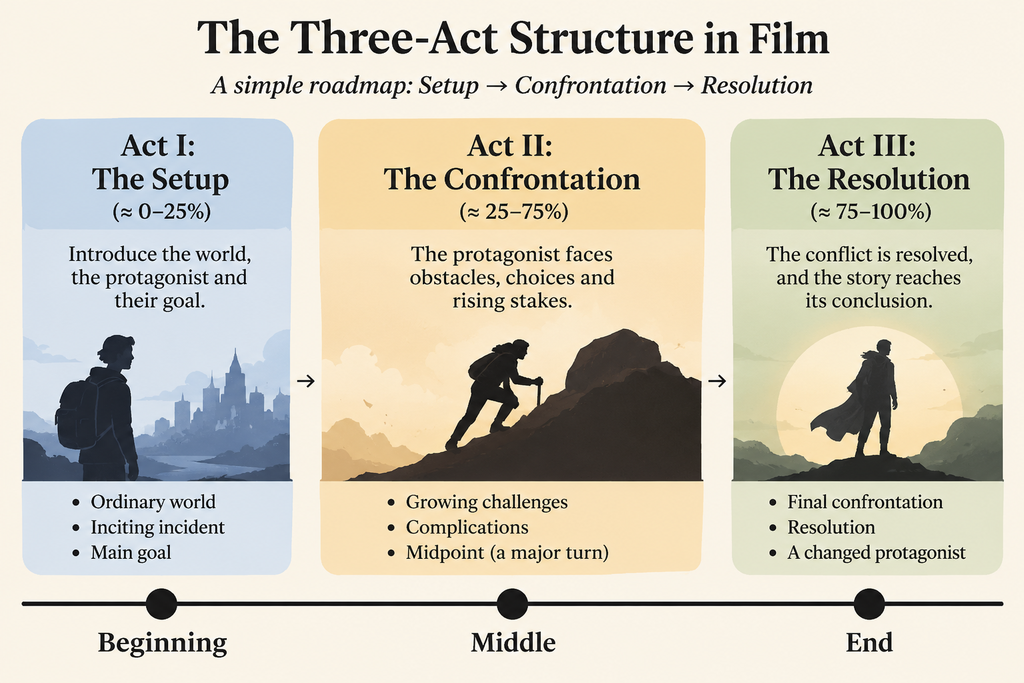
There is a familiar way to describe a film. Something happens. A character wants something. An obstacle appears. The situation becomes more complicated. The character is forced into a decisive confrontation. The ending reveals what has changed.
This is the basic movement usually associated with the three-act structure. It is one of the most influential storytelling models in modern cinema, and it remains especially visible in mainstream screenwriting, genre filmmaking, and the industrial culture of Hollywood. But it is not the only way a film can organize time, attention, conflict, or change.
Some films build their power through pursuit and escalation. Others build it through waiting. Some make a revelation feel like a door opening. Others make revelation less important than the sensation of remaining in a room, on a road, in a landscape, or inside a memory. In some films, a murder, a revolution, or a chase is the decisive event. In others, the decisive event is a woman forgetting to turn off a light, a man hearing an inexplicable sound, a family failing to visit a parent, or a group of villagers repeating a promise that will never become a future.
That difference is not a difference between structure and no structure. It is a difference between kinds of structure.
Slow cinema is especially useful for understanding this distinction. The term is contested and does not name a single international movement with a fixed manifesto. Scholars commonly associate it with long or conspicuously durational shots, reduced narrative progression, stillness, sparse action, and an emphasis on everyday or nonhuman time. Yet duration alone does not make a film “slow,” and slowness does not mean that a filmmaker has abandoned design. Jakob Boer’s work on film style and time distinguishes the experience of slowness from a simple lack of interest, while Emre Caglayan describes slow cinema as a tendency to weaken or defer narrative progression in favor of an extreme contemplative mood.
The more precise question is therefore not whether a film obeys or rejects the three-act structure. It is this:
What does a film treat as an event, and what kind of change does it believe an event can produce?
A Hollywood thriller may answer: a decision under pressure. A family drama by Yasujirō Ozu may answer: a social ritual whose emotional consequences arrive late. A film by Chantal Akerman may answer: a repeated domestic action whose smallest deviation exposes an entire system of gendered labor. Béla Tarr may answer: the continuation of an action after its meaning has begun to collapse.
This essay begins with the classical three-act model, then moves through films that use it with extraordinary precision. From there, it examines slow cinema and art-house filmmakers who preserve, bend, or replace classical dramatic progression. It also asks whether independent cinema is genuinely outside the three-act structure, and whether narrative form itself can carry political meaning.
1. What the three-act structure actually is
The three-act structure is often presented as a rigid formula with a first turning point at one precise page, a midpoint at another, and a climax near the end. That version belongs more to screenwriting pedagogy and commercial development culture than to the broad historical reality of cinema.
At its most useful, the three-act model is a way of describing changing relationships between a character, a situation, and a problem. It is not a demand that every story contain a likeable hero, a villain, a romantic subplot, a happy ending, or a perfectly explained conclusion.
Act One: A world is established and disturbed
The first act introduces a world and gives us a reason to understand its existing order. We learn something about the protagonist, the surrounding social environment, and the assumptions that make ordinary life appear stable. The act then introduces a disturbance.
This disturbance can be spectacular. A shark attacks a swimmer in Jaws. A princess’s message is hidden inside a droid in Star Wars. A family is pulled into a criminal conflict in The Godfather.
It can also be quiet. In Get Out, Chris’s visit to his girlfriend’s parents initially resembles an awkward social weekend. The disturbance is not one isolated event but a growing pattern in which apparently polite behavior begins to look coordinated. In Parasite, the Kim family’s entry into the Park household creates a new arrangement of class, labor, and space. The situation appears to offer opportunity, but it also creates the conditions for instability.
An act-one disturbance matters because it makes the old arrangement difficult to maintain. The protagonist may not yet understand what has happened, but the film has changed the available choices.
Act Two: The problem becomes more complicated
The second act is usually the longest section because it tests the premise of the film. The protagonist pursues an objective, but the pursuit produces new complications. What first seemed like a straightforward problem becomes social, moral, psychological, or existential.
In Chinatown, Jake Gittes begins with what appears to be an ordinary investigation. His expertise gives him confidence that a hidden truth can be uncovered and a case can be solved. The deeper he goes, however, the more the investigation reveals the corruption of family, water, land, power, and memory. The problem is no longer simply “Who is responsible?” It becomes a question of whether knowledge can protect anyone in a world organized by power.
In The Silence of the Lambs, Clarice Starling’s investigation has an external objective, but the film also makes her movement psychological. Her conversations with Hannibal Lecter are not merely information exchanges. They force her to confront memory, fear, vulnerability, and the social institutions that make her authority conditional.
The second act may contain a midpoint reversal, but not every film requires one in a mechanical sense. More broadly, the middle is where the film complicates its own initial understanding. The protagonist discovers that the original goal was incomplete, that the antagonist is not the only source of danger, or that victory may require becoming someone different.
Act Three: crisis, consequence, and resolution
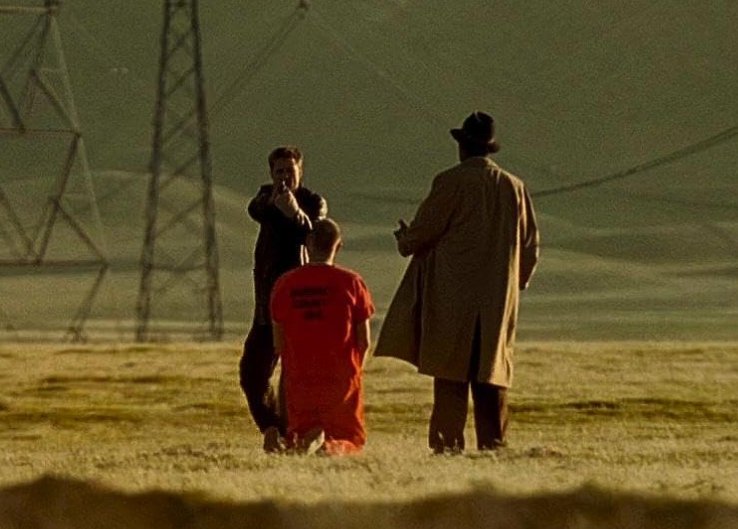
The third act brings the film’s central tensions to a point of consequence. This point may be triumphant, tragic, ambiguous, or deliberately unresolved.
Rocky does not need to win the championship for Rocky to achieve a resolution. The film’s emotional question concerns dignity, endurance, and the possibility of proving oneself. The climactic fight is decisive because Rocky goes the distance.
Michael Corleone’s victory at the end of The Godfather is also a transformation. He has protected his family and consolidated power, but he has become the figure he once claimed to be separate from. The final door closing on Kay is both a plot resolution and a moral revelation.
A resolution therefore does not mean that every mystery is explained. It means that the film has brought its principal tensions into a meaningful relation. No Country for Old Men is deliberately frustrating if judged by the expectation that a thriller must provide a conventional final confrontation. Its refusal of a satisfying showdown is part of its argument about chance, violence, age, and the failure of human beings to master the forces around them.
The three-act structure is best understood as a pattern of movement: from an established order, through disturbance and complication, toward consequence. The pattern can contain tragedy, political critique, absurdity, or ambiguity. It becomes a formula only when the pattern is confused with a set of mandatory ingredients.
2. Structure is not the same as formula
The distinction matters because criticism of “the three-act structure” often attacks a much narrower phenomenon: the industrial demand that every film produce the same kind of protagonist, rhythm, escalation, and emotional payoff.
A structure organizes relationships between events. A formula predicts the events themselves.
A film can have a three-act architecture without having a conventional hero. The Godfather is not morally simple. A Separation uses tight causal escalation but refuses to give the viewer a stable moral position. The Dark Knight turns its apparent superhero conflict into a crisis over whether ethical order can survive an opponent who refuses the rules of ordinary rationality.
Nor does three-act structure require a happy ending. Thelma & Louise moves toward a final act in which the protagonists reject the forms of legal and patriarchal containment available to them. The ending is tragic, but it is not structurally empty. Moonlight resolves its central movement through recognition and vulnerability rather than public achievement. Manchester by the Sea does not solve grief. It establishes what kind of life may be possible when grief remains.
This is why the phrase “three-act structure” should be used descriptively rather than as an accusation. The relevant question is whether a film’s movement feels mechanically imposed or organically connected to its subject, form, and ethical world.
3. Films that use classical structure with unusual intelligence
The classical model is not inherently shallow. Some films use clear dramatic architecture to produce moral, political, and formal complexity.
The Godfather: The transformation hidden inside the plot
The first act of Francis Ford Coppola’s The Godfather establishes Michael Corleone as a man who imagines that he can remain adjacent to his family without belonging to its criminal order. He is present at the wedding, but he tells Kay that his family is not his life.
The act-one disturbance is the attempted murder of Vito Corleone. The violence changes the family’s internal balance and makes Michael’s separation less sustainable. In the second act, Michael’s decisions draw him into the family’s world. He kills Sollozzo and McCluskey, goes into exile, and returns as someone whose relationship to power has changed.
The third act consolidates the transformation. Michael’s simultaneous participation in the baptism and orchestration of killings is a classical crosscutting climax, but the power of the sequence comes from the contrast between ritual language and organized violence. The structure is clear because the moral meaning is complex. Michael wins the plot while losing the identity he wanted to preserve.
Jaws: Suspense as controlled progression
Steven Spielberg’s Jaws is often treated as an exemplary commercial thriller, but its structure is also a study in how information changes dramatic pressure.
The first act introduces Amity Island, Chief Brody, the shark attack, and the institutional reluctance to acknowledge the threat. The second act expands the problem. The shark is not only a creature in the water; it becomes a political and economic problem. The mayor’s concern about tourism delays an adequate response. Brody’s fear of the water makes the external threat intersect with an internal vulnerability.
The final act reduces the story to a boat, a shark, and three men whose relationships have been shaped by the earlier sections. The structure feels inevitable because every previous choice has narrowed the available space. Suspense is not simply the question of whether the shark will appear. It is the pressure created by a sequence of decisions that make direct confrontation unavoidable.
A Separation: Classical causality without moral certainty
Asghar Farhadi’s A Separation is a useful counterexample to the assumption that art-house cinema must be formally loose. Its chain of cause and consequence is exceptionally tight. A domestic dispute produces a separation. The separation creates a new arrangement of care. A conflict between households becomes a legal and moral crisis.
Yet the film refuses the comfort of a single moral explanation. Each revelation changes the meaning of what came before. The audience is not given a stable villain or a final position from which to judge everyone else. Classical causality here produces uncertainty rather than clarity.
The film demonstrates that a strong plot does not have to simplify the world. It can make the world more difficult to judge.
Before Sunrise: time as the pressure of the third act
Richard Linklater’s Before Sunrise appears to be composed of walking and conversation. Jesse and Céline meet on a train, decide to spend a night together in Vienna, talk, flirt, argue, and become intimate. There is no conventional antagonist and no spectacular external crisis.
But the film has a precise architecture. The couple’s temporary arrangement creates a deadline. Every conversation deepens their connection while making the eventual separation more painful. The third act does not resolve their relationship through marriage or a declaration of permanent love. It turns the fact of limited time into the emotional climax.
This is still dramatic progression. The film simply makes intimacy, duration, and anticipated absence carry the weight that action carries in a thriller.
4. Slow cinema: Not the absence of structure, but a different experience of time
The label “slow cinema” became prominent in criticism in the twenty-first century, although many of the filmmakers associated with it began working decades earlier. It is useful as a critical term, but it should not be treated as a fixed genre or a membership category.
Slow cinema commonly involves long takes, reduced editing, stillness, sparse action, quiet observation, and a weakening of rapid causal progression. It may direct attention toward bodies, landscapes, domestic routines, labor, weather, architecture, memory, or nonhuman time. It may also make the viewer aware of the act of watching.
But the most important point is that slow cinema does not eliminate structure. It changes the location of structure.
In a conventional thriller, the structure may be carried by a chain of revelations. In slow cinema, it may be carried by repetition and deviation. It may be carried by the return of a space, a gesture, a sound, or a route. It may be carried by an alteration in the duration of an action. It may be carried by the accumulation of small observations that do not appear important until the film changes their context.
Emre Caglayan’s account of slow cinema emphasizes the mode’s extreme contemplative mood and reduced narrative progression, while also discussing filmmakers such as Béla Tarr, Tsai Ming-liang, and Nuri Bilge Ceylan through ideas of boredom, nostalgia, and absurdity. That reduced progression should not be mistaken for the elimination of form. The film may be less interested in asking “What happens next?” while becoming more interested in asking “How does this moment continue?”
This changes the spectator’s work. A fast plot encourages anticipation. A durational film may encourage comparison, attention, bodily awareness, and sensitivity to small variations. What some viewers experience as boredom may be a deliberate confrontation with the habits through which cinema normally keeps attention moving.
The term “boredom” must also be handled carefully. A film can be boring in the ordinary sense, and not every slow film transforms delay into insight. But philosophical accounts of boredom distinguish between simple disinterest and a more unsettling experience in which time itself becomes conspicuous. In that sense, boredom can be a reception effect or an aesthetic strategy, not a stable genre criterion.
5. Béla Tarr: when the three acts become a tango, a cycle, or a depletion
Béla Tarr is one of the clearest examples of a filmmaker who does not abolish structure but replaces forward dramatic progression with cycles, repetition, and attrition.
His films are often described as slow because of their long takes, patient camera movements, sparse dialogue, and attention to weather, bodies, architecture, and labor. Yet their formal organization is extremely precise.
Sátántangó: six steps forward, six steps back
The structure of Sátántangó is not simply long. It is explicitly cyclical. The film’s twelve chapters follow the logic of a tango: six steps forward and six steps back. The second half revisits events and perspectives from the first, producing chronological folds rather than a simple movement toward a new future. The film runs for approximately seven and a half hours, but its length is not an invitation to drift without design. It is a method for making social entrapment perceptible.
The villagers appear to be offered a chance of renewal when Irimiás returns. His promises of collective reorganization seem to provide the kind of act-two reversal that might lead to a final act of liberation. Instead, the promise reproduces dependence. Money is collected and redistributed through authority. Movement occurs, but the social pattern remains.
A conventional three-act reading might describe the film as communal collapse, false rescue, and dispersal. That reading is useful only if we immediately add that the apparent resolution is folded backward into the prior condition. The villagers do not move from one stable state to another. They circulate through hope, manipulation, exhaustion, and waiting.
The famous opening movement of cattle leaving a collapsing farm establishes this logic before the human characters speak. The animals move across the landscape, but their movement is not progress. It is displacement. Later, the villagers dance, drink, wait, and follow instructions. The film’s suspense is no longer primarily “What will happen?” It becomes “How long can this pattern continue, and what does continuation do to the people inside it?”
The answer is not only political. Tarr has resisted reducing the films to one historical allegory, even when money, authority, collective belief, and the collapse of institutions are clearly present. The social and the metaphysical coexist. A system may be changed, but the film does not promise that a new system will resolve the deeper conditions of human dependence.
Werckmeister Harmonies: catastrophe without meaningful restoration
Werckmeister Harmonies is shorter and more concentrated, but it also makes duration a political instrument. The film follows János Valuska, a mail carrier whose town is disturbed by the arrival of a circus carrying a stuffed whale and a demagogic figure known as the Prince. Criterion notes that the film contains only thirty-nine shots across nearly two and a half hours.
The film begins with János explaining a cosmic eclipse to a group of drinkers. The scene is not a conventional exposition sequence. It is an embodied model of order, darkness, and temporary return. The town’s later violence turns the metaphor into political reality.
The whale becomes a center of projection. The Prince’s rhetoric converts fear into a promise of cleanliness and order. A riot at the hospital is filmed through a long movement that forces the spectator to remain with the progression of collective violence rather than receiving it as a rapid montage of effects.
A classical third act would normally restore order or establish a new order with some explanatory clarity. Werckmeister Harmonies offers something more disturbing: the authoritarian restoration of order. The political settlement does not repair the town. It organizes its fear.
The film therefore contains a recognizable crisis but refuses the moral comfort of resolution. The final state is not the opposite of chaos. It is chaos disciplined into obedience.
The Turin Horse: six days of reverse creation
The Turin Horse reduces the narrative to a farmer, his daughter, a horse, a visiting neighbor, a well, potatoes, clothing, wind, and six days of increasingly diminished life. Tarr described the film as a kind of reverse creation: a world slowly losing the capacities that make ordinary existence possible.
Each day repeats the previous day’s actions. The daughter dresses her father. The father dresses himself. They haul water. They boil and eat potatoes. The horse refuses work and eventually refuses food. A visitor delivers a long monologue. A group of travelers arrives and leaves. The well dries. The light disappears.
This might seem to be the destruction of the three-act structure. It is more accurate to say that Tarr turns escalation into subtraction. In a classical drama, each act often adds information, danger, or possibility. In The Turin Horse, each repetition removes a capacity. The characters do not move toward a decisive confrontation. They move through a sequence of diminished options.
The smallest variation becomes enormous because the viewer has learned the routine. A refusal to perform a familiar gesture has the force of an event. The film’s form makes continuity itself dramatic.
Tarr has said that daily life is monotonous but that every day contains differences. He has also rejected the idea that only cuts and explicit actions constitute information. Looking at a face, a wall, a landscape, or rain can be a form of narrative information when the film has taught us how to attend. The result is an anti-resolution that is nevertheless meticulously structured.
Tarr does not ask whether a film can survive without plot. He asks how much plot a film needs before time, labor, and repetition become dramatic on their own.
6. Chantal Akerman: the three-act structure hidden inside domestic routine
If Tarr demonstrates how classical progression can be replaced by cycles and depletion, Chantal Akerman demonstrates how a recognizable dramatic scaffold can be preserved while the meaning of drama is radically changed.
Jeanne Dielman, 23 quai du Commerce, 1080 Bruxelles follows three days in the life of a widowed mother who cooks, shops, cleans, bathes, eats with her son, and receives male clients while he is away. The film lasts more than three hours and twenty minutes. Its long, frontal takes make domestic labor materially visible rather than compressing it into a few establishing shots.
Akerman explained that she wanted to give space to women’s daily gestures, which conventional cinematic hierarchies had treated as insignificant. The BFI has also emphasized her refusal of voyeuristic camera placement and fragmented coverage. The camera remains legible as a camera in a room rather than pretending to be an invisible consciousness moving freely through Jeanne’s body.
The result is a film that is almost classical in its progression and radically anti-classical in its allocation of attention.
A three-day dramatic architecture
The film’s three-day organization offers a striking structural parallel to the three-act model. The first day establishes Jeanne’s routine. The second day introduces minute disruptions. The third day brings the routine to a terminal rupture.
The second client’s visit is decisive. Jeanne forgets a corridor light, leaves the lid off a tureen, allows potatoes to burn, and begins to lose control of the timed sequence that organizes her life. These details might be invisible in a conventional film. In Akerman’s form, they become major plot information because the spectator has been taught the routine in full.
On the third day, Jeanne kills a client. The murder is shocking, but it is not presented as an isolated psychological eruption. It arrives after a system of timing, labor, money, sexual exchange, maternal responsibility, and self-control has begun to fail.
Akerman does not simply reverse the hierarchy between the ordinary and the dramatic. She shows that the hierarchy was always ideological. The domestic actions conventional cinema cuts away from are not outside drama. They are the material from which social pressure is made.
The film’s suspense comes from deviation. When the spectator notices a missing gesture, a delay, or a misplaced object, the object has become a narrative event. The viewer is no longer waiting for the next plot point. The viewer is measuring the health of a system.
Feminist form, not only feminist subject
It would be insufficient to call Jeanne Dielman feminist only because it depicts a woman’s life. Its feminism also lies in its mode of address. The film refuses to turn Jeanne’s body into a series of fragments for easy consumption. It refuses to provide psychological exposition that would make her actions immediately legible. It also refuses to make domestic labor picturesque.
At the same time, the film is not outside authorial control. Its apparent neutrality is carefully composed. The fixed camera, repeated framings, and exact durations produce a rigorous system. The viewer’s impatience becomes part of the experience: why should this action be shown for so long? Why does a potato matter? Why does a corridor light matter?
The answer is that time is political. The film makes visible the labor required to maintain an order that appears natural when cinema usually compresses it.
Akerman beyond Jeanne Dielman
Akerman’s earlier works show that this approach was not an accidental stylistic choice. Hotel Monterey observes a New York residential hotel through sustained attention to corridors, rooms, elevators, and changing light. News from Home combines letters from Akerman’s mother with long views of New York streets and subway spaces. The daughter is not presented as a conventional protagonist moving through a series of plot objectives. The emotional structure lies in the distance between familial address and anonymous urban space.
Je tu il elle is divided into three parts, but its dramatic movement is built from solitude, travel, exposure, and encounter rather than conventional causality. The tripartite form remains visible while the content of each section tests what narrative usually suppresses: waiting, eating, listening, sexual duration, and the body’s relation to an empty room.
Akerman is therefore an essential correction to the assumption that slow cinema simply abandons classical structure. She shows that the three-act model can remain underneath a radically different theory of what deserves screen time.
7. Abbas Kiarostami: Ethical movement without causal closure
Abbas Kiarostami’s films often appear open, incomplete, or casually assembled. Yet they are carefully organized around encounters, delays, omissions, and ethical reversals.
In Taste of Cherry, a man named Badii drives through the outskirts of Tehran looking for someone who will cover him with earth after he takes sleeping pills. He encounters a soldier, a seminarian, and an elderly taxidermist. The film withholds Badii’s backstory and does not offer a psychological explanation for his desire to die.
The structure is repetitive. Badii drives, stops, speaks, and drives again. Each encounter changes the moral and emotional pressure without producing a conventional plot revelation. The old man’s story about tasting cherries and choosing to live does not solve Badii’s crisis. It introduces another way of understanding experience.
After Badii lies in the ditch, the screen goes black. Rain is heard. The film then switches to grainy video footage showing soldiers, crew members, Kiarostami, and the apparently living actor who played Badii. The film does not explain whether the character died, survived, or whether the footage belongs outside the fiction.
This is not a random refusal of closure. It shifts the question from “What happened to Badii?” to “What kind of continuity does the viewer require?” The film makes the conventions of narrative reality visible by interrupting them.
Close-Up: The event that creates its own film
Close-Up begins from a real case in which Hossein Sabzian impersonated the filmmaker Mohsen Makhmalbaf before the Ahankhah family. Kiarostami filmed the trial, persuaded the real participants to reenact earlier events, filmed Sabzian’s release, and arranged a meeting with Makhmalbaf.
The film retains a recognizable movement from accusation to trial to release and possible reconciliation. Yet each stage is unstable because the film’s own presence changes the event. The participants play themselves. Some speeches are reconstructed. The trial is both a legal proceeding and a performance of social truth. The final motorcycle sequence contains damaged or manipulated sound that obscures the conversation between Sabzian and Makhmalbaf.
A conventional third act might explain the deception, pronounce judgment, and deliver reconciliation. Kiarostami gives us those elements while preventing them from becoming authoritative. The film does not tell us that one version of the event is the final truth. It asks how fiction, performance, shame, aspiration, and cinema have already entered the real.
The Wind Will Carry Us: The event that never arrives
In The Wind Will Carry Us, Behzad and his colleagues travel to a Kurdish village to document mourning rituals for an elderly woman. The woman does not die. The documentary assignment stalls.
The film’s apparent plot is therefore suspended. Behzad waits, communicates with unseen colleagues by telephone, shaves, does laundry, drives, observes villagers, and becomes increasingly entangled with the life he hoped to extract as material. Kiarostami deliberately leaves out connective pieces and asks viewers to make their own links.
The absent colleagues are structurally important because they exist through voices. The old woman’s condition is discussed but not converted into a dramatic spectacle. A digger encountered below a cemetery becomes more significant than the promised event. The film’s ethical movement is recognizable: Behzad’s professional impatience gradually becomes shame and self-questioning. But the film does not stage this movement as a decisive speech or a redemptive action.
Kiarostami’s films preserve dramatic trajectories while weakening the expectation that a trajectory must end in an answer. The plot becomes a situation. The situation becomes a relation. The relation becomes an ethical question.
8. Tsai Ming-liang: Spatial repetition and the drama of missed contact
Tsai Ming-liang’s cinema often replaces plot progression with spatial recurrence. Characters occupy the same apartments, streets, theaters, rooms, and beds, but they rarely achieve stable contact.
Tsai has said that when one shot will do, he does not use a second. He has described his scripts as resembling poetry and has expressed greater interest in locations, effects, daily life, and repetition than in conventional story structure.
This does not mean that nothing happens. It means that action is redistributed into bodies, surfaces, pauses, and failed encounters.
Vive L’Amour: A vacant apartment as a narrative system
In Vive L’Amour, a realtor, her lover, and Hsiao-kang separately occupy the same vacant apartment. They enter, hide, sleep, have sex, bathe, and wait without forming a conventional triangle.
The apartment is not merely a setting. It is the structure. The characters’ repeated occupation of the same spaces creates a drama of proximity without contact. The extended shot of the realtor crying makes aftermath and duration the climax. The film does not require a confession because the body’s continuation in the room has become the event.
Goodbye, Dragon Inn: cinema as a vanishing place
Goodbye, Dragon Inn takes place on the last night of an old cinema. A small audience watches King Hu’s Dragon Inn. The projectionist, ticket seller, visitors, and older actors move through corridors and rooms. The film’s apparent action is minimal, but its emotional structure is dense: cinema is being remembered at the moment it is disappearing.
Tsai has said that the film grew out of a theater encountered while making What Time Is It There? He leased the closing theater, wrote a one-page poetic outline, and shot only a few shots per day. He understood the project as memories of the theater becoming memories of cinema.
The result does not build toward a conventional public climax. Its central event is the recognition that contact may already have become memory. The long pauses allow the theater’s architecture to function as a character with a history that exceeds the people passing through it.
Tsai’s films are therefore not formless. They are horizontally structured. Desire moves across rooms and bodies rather than upward through escalating acts. Repetition creates emotional pressure without delivering the characters into a stable resolution.
9. Apichatpong Weerasethakul: when narrative changes ontological level
Apichatpong Weerasethakul also uses duration and repetition, but his films are less concerned with urban stagnation than with the coexistence of waking life, dreams, spirits, memory, illness, political history, and past lives.
His cinema does not always ask the viewer to decide which level is real. It allows several levels to remain active at once.
In Uncle Boonmee Who Can Recall His Past Lives, a dying man spends his final days with family and supernatural visitors, including a son who has returned in the form of a monkey ghost. Memories and past lives open into a cave and other temporal registers. The supernatural does not arrive as a violation of realism. It is folded into daily life.
In Cemetery of Splendour, volunteers care for soldiers with a mysterious sleeping illness in a school-hospital. Colored light tubes suggest synchronized dreams. A movie-theater sequence mirrors the sleepers’ altered state. Illness, military history, spirits, and national memory occupy the same space.
Apichatpong has said that ordinary dreams have a strange rather than spectacular logic and that cinema should activate the imagination rather than deliver a direct thesis. This is a different kind of narrative structure from Tarr’s cycle or Akerman’s routine. Apichatpong’s films bifurcate. They may begin with a recognizably social situation and then phase into another ontological register without announcing a clean transition.
Memoria organizes its movement around an inexplicable sonic bang heard by Jessica in Colombia. She tries to reproduce and locate the sound. The investigation begins like a mystery, but the mystery gradually becomes a sensory and temporal relation. The question is not simply who made the sound. It is how sound can carry memory across bodies, histories, and time.
Apichatpong’s films do not reject change. They reject the idea that change must be explained through a single causal chain. A person may be changed by a dream, a sound, a place, a past life, or a memory that cannot be assigned to one stable subject.
10. Ozu: classical premises, quiet crises
Yasujirō Ozu is not always classified as slow cinema in the same way as Tarr or Tsai, but his films are essential to any discussion of duration, ellipsis, routine, and alternative dramatic emphasis.
Ozu often begins with familiar classical premises. Parents visit grown children. A daughter faces pressure to marry. A family gathers. Someone returns home. A death changes the emotional climate.
What he does with these premises is unusual. Dramatic highlights are often omitted, delayed, or replaced by ordinary activities. The emotional consequences arrive through pauses, objects, transitional images, and conversations that appear to move sideways.
Tokyo Story: the family visit that cannot restore the family
In Tokyo Story, an elderly couple travels from Onomichi to visit their grown children in postwar Tokyo. The children are busy and inconvenienced. The parents are sent to a resort because the family cannot comfortably accommodate them. The daughter-in-law Noriko, who is not their biological child, offers the greatest emotional attention.
The film’s premise could support a conventional family melodrama. A confrontation might expose the children’s selfishness. A final reconciliation might restore unity. Ozu chooses another route. The failure of reciprocity is expressed through schedules, postponed visits, polite excuses, and the gradual realization that social duty can survive after emotional intimacy has eroded.
The death of the mother does not reunite the family. It produces further conversations, objects, and absences. The final image is not a triumphant return to order. It is the continuation of ordinary life after a person has disappeared.
Late Spring: marriage as social form and emotional loss
In Late Spring, Noriko lives contentedly with her widowed father. Relatives pressure her to marry. The father pretends that he may remarry so that Noriko will accept leaving home.
The film uses a familiar marriage plot, but the pressure does not come from a melodramatic villain. It comes through affection, social expectation, habit, and the fear of loneliness. The final act does not celebrate marriage as liberation. It registers the father’s loneliness after the decision has been made. His peeling of an apple becomes an image of time continuing after a social ritual has supposedly resolved the conflict.
Ozu preserves classical movement while changing its emotional scale. The decisive events are not scenes of public victory. They are acts of acceptance whose costs become visible only afterward.
11. Manoel de Oliveira: theatrical duration and ritual made visible
Manoel de Oliveira provides a useful comparison with Ozu. Both filmmakers can use social ritual, repetition, and understated conflict, but Oliveira often makes theatricality and literary speech more conspicuous.
His cinema frequently draws attention to frontal staging, extended dialogue, long takes, and the relation between theater and cinema. Rather than hiding the fact that people are performing social roles, he allows performance to remain visible.
In The Rite of Spring, villagers perform the Passion play in an outdoor setting. The event is both documentary record and inherited ritual. The film then breaks its apparent continuity with images of atomic explosions and war. Ritual does not provide a reassuring bridge between past and present. It becomes a way to ask whether inherited forms can contain modern violence.
In Gebo and the Shadow, domestic routine and poverty become an ethical pressure chamber. The household is organized around waiting, labor, family obligation, and hidden disappointment. The film retains the ingredients of a classical domestic conflict but stretches them until the act of waiting becomes more important than the arrival of a conventional revelation.
Ozu and Oliveira should not be treated as direct influences on each other without evidence. Their value in comparison lies in the different ways they make social form dramatic. Ozu tends toward quiet domestic understatement. Oliveira often exposes the theatrical and verbal nature of social ritual. Both demonstrate that an apparently uneventful scene can contain a complete structure of desire, obligation, and historical change.
12. Art-house cinema as a spectrum, not a binary
It is tempting to divide filmmakers into two groups: those who use the three-act structure and those who reject it. The films discussed above make that division impossible.
A more useful spectrum would look something like this:
•Preserving the macro-arc: Ryusuke Hamaguchi often retains cumulative dramatic progression while making listening, performance, and delayed knowledge the mechanisms of change.
•Bending the arc: Claire Denis preserves a beginning, an end, and underlying structural movement but removes explanatory links and replaces them with bodies, music, gesture, and ellipsis.
•Distributing the arc: Kelly Reichardt retains modest goal-and-obstacle patterns but makes labor, economic precarity, and process carry the dramatic weight.
•Expanding the social field: Jia Zhangke turns historical transformation, landscape, and collective change into the main event.
•Replacing linear progression: Antonioni and Tarkovsky often make perception, memory, absence, or discontinuity more important than causal advancement.
•Replacing plot with duration or recursion: Tarr, Akerman, Tsai, and Apichatpong create alternative architectures based on repetition, routine, spatial recurrence, or ontological coexistence.
Antonioni: The investigation that dissolves
In L’Avventura, Anna’s disappearance appears to establish a conventional mystery. Yet the investigation gradually loses its centrality. The characters’ alienation and emotional drift become more important than solving the disappearance. Harvard Film Archive describes Antonioni’s use of fractured spatial and temporal continuity, unanswered questions, omitted exposition, and endings that reframe the narrative.
The disappearance is not an abandoned plot in the careless sense. It is a structural decoy. The film begins by promising one kind of story and reveals that the promise itself belongs to a world incapable of stable meaning.
Tarkovsky: Memory as architecture
Mirror does not organize memory chronologically. Childhood, adulthood, dreams, poetry, archival history, and war footage coexist through association. Tarkovsky reportedly worked through more than twenty structural versions before the film acquired its inner connection.
The result is not a random collage. Its architecture is mnemonic. The viewer’s effort to connect images becomes the dramatic action. A classical film may ask whether the protagonist will achieve a goal. Mirror asks whether fragments of a life can be held together without being reduced to a single explanation.
Jia Zhangke: History as the main character
Jia Zhangke’s films often preserve loose trajectories while refusing to make individual success the measure of change. In Platform, young performers move through the changing political and cultural environment of China. In Still Life, separated spouses search for one another in a region transformed by the Three Gorges project.
Jia has described long takes as a way of respecting the viewer’s agency and has argued that contemporary reality may require a mixture of media and tonal registers. Documentary observation, fiction, pop spectacle, and surreal images can coexist because social reality itself is unstable.
The act structure is displaced into historical time. The protagonists do not simply overcome obstacles. They are carried by forces—economic, political, technological, geographic—that exceed personal intention.
Kelly Reichardt: Modest arcs and the drama of process
Kelly Reichardt’s Wendy and Lucy follows a woman seeking work and stability. First Cow follows two men trying to build a fragile economic scheme. These films have goals and obstacles, but the goals are modest and the obstacles systemic. There is no promise that individual ingenuity will overcome economic precarity.
Reichardt has spoken about her interest in chores and the forensic details of process, as well as her use of minimal plot. This is not an abandonment of narrative. It is a refusal to treat process as disposable material between important events.
In Certain Women, three linked stories replace a unified feature-length arc. The stories cross briefly, but they do not converge into a grand climax. A rancher returns to repetitive stable chores after an encounter that does not become a romance. The ending is continuation, not triumph.
Claire Denis: Ellipsis inside a strong skeleton
Claire Denis is especially useful because she has explicitly acknowledged the need for structure while resisting explanatory completeness. In interviews, she has described thinking in terms of a beginning and an end, then removing elements to create ellipses.
Beau Travail retains a tragic progression. Galoup serves in the French Foreign Legion. Sentain’s arrival produces rivalry. Galoup’s jealousy leads to violence, punishment, and exile. But the film tells this story through choreography, bodies, music, fragmented memory, and voiceover. Denis has explained that movement could express the ideas of the Legion more effectively than dialogue.
The film’s final nightclub dance is not a conventional explanatory resolution. It is a bodily release, a transformation of punishment into a moment of escape from the self. Denis has not rejected structure. She has moved the transitions from exposition into rhythm, gesture, and sensation.
Ryusuke Hamaguchi: The art-house film that still develops
Ryusuke Hamaguchi is a crucial counterexample to the idea that art-house cinema must be anti-plot. Drive My Car has an extended movement from marital betrayal and grief through a theater residency, car conversations, performance, disclosure, and a partial acceptance of loss.
Hamaguchi has said that he does not force dialogue to push the plot and that mystery should be preserved. The film’s structure is nested inside rehearsals of Chekhov’s Uncle Vanya, multilingual performance, and listening.
The result is slow in rhythm but cumulative in dramatic movement. The characters change because they listen, repeat lines, perform roles, and gradually permit another person to approach what they have hidden.
The film proves that duration and three-act progression are not opposites. A film can take its time and still build toward a recognizable emotional transformation.
13. Is independent cinema outside the three-act structure?
The answer is no, at least not by definition.
“Independent cinema” can refer to production outside major studios, alternative financing, festival and art-house circulation, director-controlled authorship, political independence, or low-budget methods. These categories overlap, but they are not identical. Independence describes a production or institutional condition more reliably than it describes narrative form.
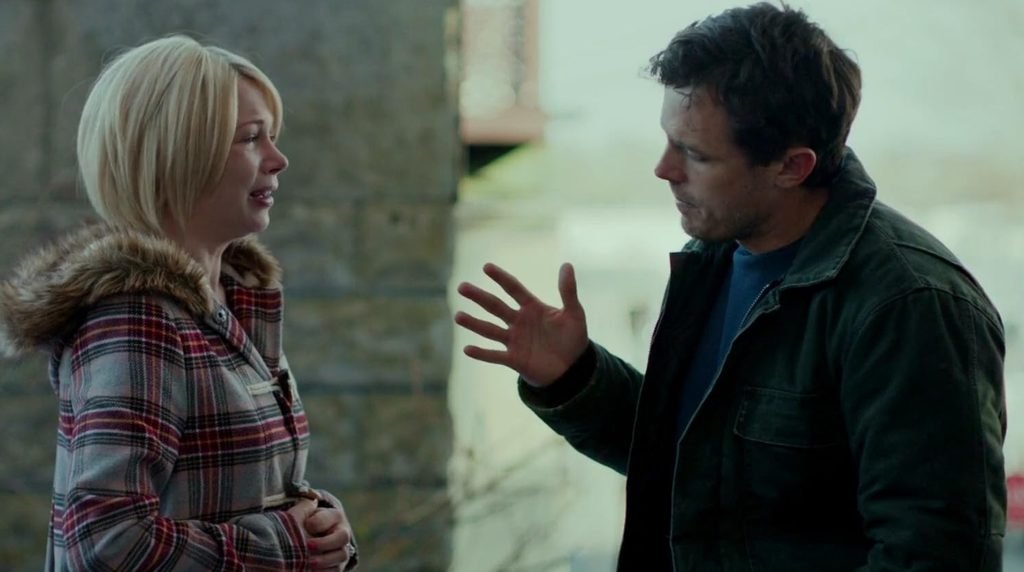
An independently produced film can use a highly recognizable dramatic arc. Moonlight, The Florida Project, Lady Bird, Winter’s Bone, Get Out, Whiplash, The Farewell, and Manchester by the Sea all differ in style and subject, but they organize experience through recognizable forms of setup, pressure, crisis, and consequence.
A studio film can also be formally radical. Large resources do not automatically produce conventional storytelling, just as small budgets do not automatically produce freedom from convention.
The confusion comes partly from the kinds of lives independent cinema often depicts. Independent filmmakers may focus on people whose lives do not fit the heroic goal-obstacle-victory pattern: the unemployed, the displaced, the elderly, migrants, domestic workers, children, people living with addiction, and communities affected by structural violence.
For these characters, survival may be the stake. Waiting may be the action. A modest act of care may be the climax. An unresolved economic condition may be more truthful than an inspirational victory.
But this does not make the films structureless. It means their structures are adapted to different forms of experience.
Wendy and Lucy has a goal: find work and maintain stability. The difficulty is that the goal is undermined by poverty, mobility, and institutional indifference. The film’s restraint does not remove causality. It makes causality social.
The Florida Project has a child’s perspective, but its structure is built around the repeated threat of eviction, the precarious economy of the motel, and the difference between childhood play and adult survival. The film does not need to convert poverty into a triumphant personal journey.
The Rider uses a recognizable movement of loss and adaptation, but its central conflict cannot be solved through determination alone. The protagonist’s body has changed. The film’s ethical question is not simply whether he will return to rodeo. It is whether he can imagine a self beyond the identity that injury has made impossible.
Independent cinema often appears less structured because it may refuse the requirement that every problem be personalized and solved. That refusal can be formally and politically valuable. It can also become a convention of its own. Slowness, ambiguity, and open endings are not automatically more profound than speed, clarity, or closure.
The relevant question is always whether a form is necessary for the experience the film wants to make available.
14. Narrative form and politics
The three-act structure is not politically neutral, although neither is an alternative form automatically progressive.
Classical goal-oriented stories often privilege individual agency. A protagonist acts, the world responds, obstacles are overcome, and the future becomes more legible. This can be emotionally powerful. It can also make structural problems appear solvable through individual will.
Poverty, colonialism, racism, bureaucracy, illness, displacement, and political violence do not always yield to a protagonist’s decisive action. A film that promises personal mastery over these forces may offer inspiration, but it may also misrepresent the scale of the problem.
Collective and politically engaged cinemas challenge this model by redistributing agency across groups, institutions, domestic routines, historical memory, and spectatorship.
Ousmane Sembène’s postcolonial cinema emerged in a context in which colonial authorities had restricted African film production. His films redirect cinema toward African autonomy and liberation, and works such as Xala, Emitaï, and Ceddo experiment with historical time and spatial cohesion.
The importance of Xala is not that it lacks a protagonist. It is that the protagonist’s condition exposes a collective system: elite corruption, gender hierarchy, neocolonial power, and political impotence. The film’s satire is more revealing than a redemptive individual plot would be because the problem is institutional.
The Battle of Algiers similarly organizes political agency around urban networks, insurgent populations, colonial policing, and reciprocal tactics rather than one heroic liberator. Ali La Pointe is a literal protagonist, but the movement is collective. The form raises a further ethical question: a carefully constructed film can make revolutionary violence appear historically inevitable, and political clarity can become another kind of authorial control.
Isaac Julien and the Sankofa collective provide another model. Their work brings documentary, drama, archive, theory, dance, and multiple time periods into contact. The Passion of Remembrance addresses Black feminist activism and Black queer cultural exchange. Its narrative agents are not reduced to one politically enlightened individual. Debate, memory, testimony, and collective conflict produce knowledge.
Chantal Akerman’s Jeanne Dielman makes another political intervention. The film does not show patriarchy as a villain who can be defeated in a climactic scene. It shows patriarchy as time, labor, routine, exhaustion, and the management of space. The politics are inseparable from the form.
Dziga Vertov’s Man with a Movie Camera offers a different kind of collective structure. Labor, machines, spectators, editing, and the city form a distributed protagonist. The film’s political promise is that montage can make social forces visible. Its risk is that the apparatus may claim to master the society it records.
Alternative structure is never innocent. A film can challenge the individual hero while replacing him with an equally totalizing authorial system. It can reject closure while making uncertainty a luxury available mainly to privileged spectators. It can turn marginal lives into beautiful atmospheres without giving those lives political agency.
The political question is therefore not “Does the film break the three-act structure?” It is “What relations of power does the film make visible, and what relations does its form conceal?”
15. Does every film have a structure?
At a certain point, the phrase “breaking structure” becomes misleading. Even a film without conventional plot organizes attention.
A film may be structured by:
•causality;
•duration;
•repetition;
•space;
•sound;
•color;
•memory;
•performance;
•historical association;
•a change in the viewer’s knowledge;
•or the gradual alteration of a routine.
Jeanne Dielman is structured by repetition and deviation. The Mirror is structured by memory and association. The Color of Pomegranates is structured by tableaux, iconography, and ritualized composition. Koyaanisqatsi is structured by rhythm, montage, music, and the escalation of visual patterns. The Tree of Life is structured by family memory, cosmic scale, grief, and spiritual association.
The question is not whether the structure exists. The question is what the film believes structure should do.
Should structure lead us toward an answer? Should it make us inhabit a duration? Should it produce a moral reversal? Should it show the persistence of a system that no individual can overcome? Should it make the viewer assemble a life out of fragments?
A film’s structure is its theory of experience.
16. A practical vocabulary for discussing films outside classical plot
It is useful to replace the vague phrase “this film breaks the rules” with more precise descriptions.
Temporal disruption
The film rearranges chronology while preserving or complicating causality.
Examples include Pulp Fiction, Memento, Rashomon, and The Godfather Part II.
Causal ambiguity
The film withholds explanations or refuses to confirm what occurred.
Examples include Burning, Mulholland Drive, The Headless Woman, and Caché.
Episodic construction
The film is composed of separate encounters or chapters rather than one continuous arc.
Examples include Holy Motors, Daughters of the Dust, and Certain Women.
Durational structure
Time, repetition, and variation carry the dramatic burden.
Examples include Jeanne Dielman, Paterson, The Turin Horse, and Goodbye, Dragon Inn.
Associative or poetic structure
Images, sounds, memories, and motifs organize the film more strongly than cause and effect.
Examples include Mirror, Sans Soleil, The Color of Pomegranates, and Uncle Boonmee Who Can Recall His Past Lives.
Spatial structure
The repeated occupation of places creates the relationships that a conventional plot would create through action.
Examples include Vive L’Amour, L’Avventura, In the Mood for Love, and The Passenger.
Essayistic structure
The film develops through argument, testimony, archival material, observation, and association rather than fictional escalation.
Examples include Close-Up, The Hour of the Furnaces, Nostalgia for the Light, and The Gleaners and I.
This vocabulary does not replace interpretation. It makes interpretation more precise.
17. The contemporary hybrid: Films that use both systems
Contemporary cinema is full of films that combine classical movement with formal experimentation.
Eternal Sunshine of the Spotless Mind rearranges chronology through memory but retains a recognizable emotional progression from intimacy to loss to renewed choice.
The Handmaiden divides its narrative into shifting sections that revise the viewer’s understanding of earlier events. Its structure is labyrinthine, but the reversals are also carefully engineered.
Everything Everywhere All at Once appears chaotic and multiversal, yet its emotional movement is clear: alienation, conflict, recognition, and reconnection.
The Zone of Interest refuses conventional access to its central violence. It builds horror through routine, sound, contrast, and what remains outside the frame.
Oppenheimer uses multiple temporal registers and perspectives, but its broad movement remains recognizable as rise, revelation, consequence, and historical collapse.
The Banshees of Inisherin begins with a simple rupture between friends and develops through repetition, escalation, absurdity, and the impossibility of returning to the prior social order. It has a plot, but it does not provide the reconciliation that a conventional comedy might promise.
These films suggest that the supposed opposition between “structured” and “experimental” cinema is increasingly unhelpful. The more interesting films often combine a strong macro-structure with local uncertainty, nonlinear presentation, open interpretation, or durational patience.
18. How to watch a slow or art-house film structurally
A viewer approaching a slow film does not need to choose between surrender and analysis. Both are useful.
First, notice the repeated actions. What does the film ask characters to do again and again? What changes when the action is repeated?
Second, observe the spaces. Does a room, road, apartment, theater, field, or landscape recur? Does the meaning of the space change because the viewer has learned its history?
Third, listen for sound that carries information beyond the image. Kiarostami’s unseen colleagues, the sound of a train or boat in Ozu, the sonic disturbance in Memoria, and the offscreen violence in The Zone of Interest all show that narrative can happen outside the frame.
Fourth, identify what the film withholds. Is a backstory omitted? Is a death unseen? Is a conversation inaudible? Is a promised event delayed until it becomes irrelevant? Withholding is not automatically depth, but it is often where a film declares its theory of knowledge.
Fifth, ask what counts as change. The protagonist may not make a decisive public choice. The change may be a shift in attention, a failure to repeat a routine, a new relation to a place, or the recognition that an expected future will not arrive.
Finally, distinguish your experience of boredom from the film’s formal use of duration. A film may fail for you. That is a legitimate response. But before concluding that nothing is happening, ask what kind of happening the film has chosen.
Conclusion: the three-act structure is a language, not a law
The three-act structure remains one of cinema’s most powerful narrative languages. It can organize suspense, transformation, moral consequence, and emotional release. It is not inherently commercial, simplistic, or opposed to art.
But its dominance has often been mistaken for universality.
Slow cinema shows that narrative progression can be delayed without being abolished. Béla Tarr turns acts into cycles and depletion. Chantal Akerman turns domestic routine into a precise architecture of rupture. Abbas Kiarostami preserves ethical movement while withholding causal certainty. Tsai Ming-liang replaces plot acceleration with spatial recurrence and missed contact. Apichatpong Weerasethakul allows dreams, spirits, memory, and waking life to occupy the same narrative plane. Ozu uses familiar family plots but makes omission, ritual, and afterlife more dramatic than confrontation. Oliveira makes theatrical duration and social performance visible.
Other filmmakers preserve more of the classical system. Claire Denis works with a strong skeleton while replacing explanation with bodies, music, and ellipsis. Kelly Reichardt makes modest goals and economic process carry the arc. Ryusuke Hamaguchi demonstrates that a slow rhythm can coexist with cumulative dramatic movement.
Independent cinema is not automatically outside the three-act structure. It is not a single aesthetic. It is a set of production, circulation, and authorship conditions that may create opportunities for alternative forms but does not guarantee them.
The best way to understand the relationship between classical narrative and its alternatives is not to ask which films obey the rules and which films break them. It is to ask what each film believes stories are for.
Some films use stories to drive a character toward a decision. Some use them to expose a system. Some use them to preserve a memory. Some use them to make us inhabit a body’s exhaustion or a room’s silence. Some use them to show that history does not move forward in the clean line promised by conventional plot.
The three acts are one way of arranging time. Cinema has many others.
The most important films are not necessarily those that obey or reject the three-act structure. They are the films that make us feel the structure of experience itself—whether that experience takes the form of pursuit, repetition, memory, waiting, catastrophe, ritual, or unresolved desire.