
There are many ways to tell the history of Hollywood. You can tell it through studios, through stars, through directors, or through the machinery that turns a finished film into a public event. But sometimes the most revealing story begins with a refusal.
In 1919, four of the most powerful people in American cinema decided that being famous was not enough. Charlie Chaplin, Mary Pickford, Douglas Fairbanks, and D.W. Griffith wanted control over the films they made, the money they earned, and the way those films reached audiences. They were not content to remain the most visible workers inside a system owned by other people. They wanted to build a company that belonged, at least in principle, to artists.
They called it United Artists.
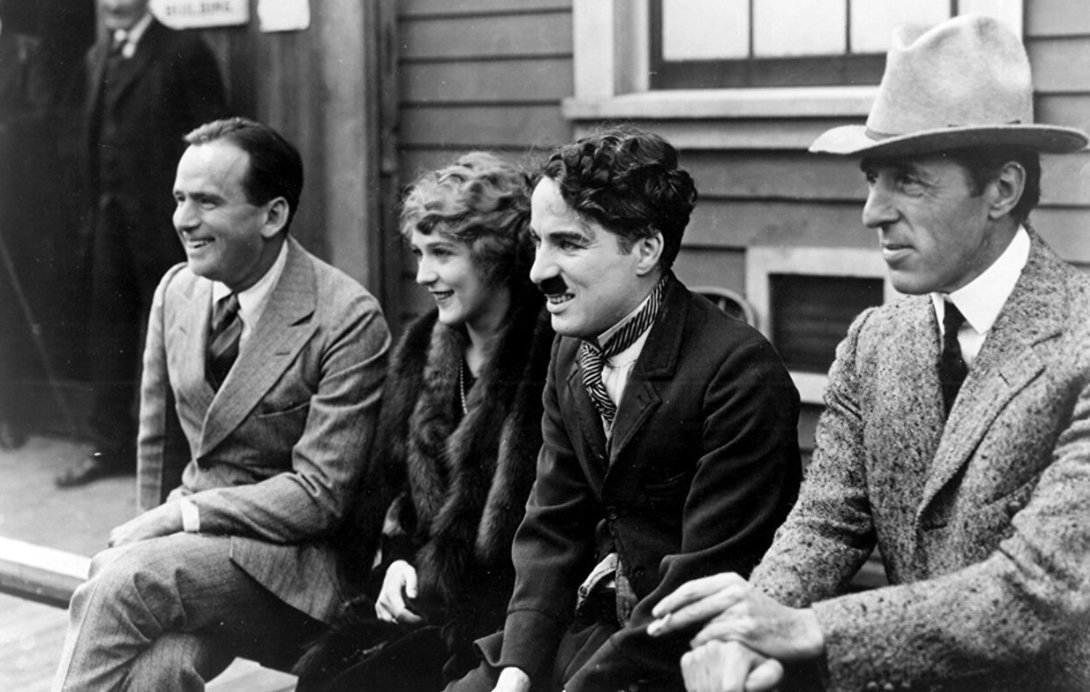
Douglas Fairbanks, Mary Pickford, Charlie Chaplin, D. W. Griffith
The name sounded almost idealistic. It suggested solidarity, independence, and a new relationship between celebrity and power. Yet United Artists was never a simple utopian experiment. It was a strange, contradictory, frequently brilliant company. It was founded as a rebellion against the studio system, but it still needed theaters, investors, executives, lawyers, and distribution networks. It wanted artistic freedom, but its founders were already wealthy stars with enormous bargaining power. It promised independence, but it could not escape the commercial logic of Hollywood.
That contradiction is exactly what makes United Artists so fascinating.
The company was not merely another studio. It was an argument about who should control cinema. Its history is the story of artists trying to own the machine that had made them famous—and discovering that owning the machine did not make the machine easy to operate.
For cinephiles, United Artists matters because its legacy can be felt whenever a filmmaker demands final cut, whenever an actor becomes a producer, whenever an independent company asks a major distributor to take a chance on an unusual film, and whenever a movie seems to have arrived from somewhere outside the usual factory system.
United Artists did not abolish Hollywood. It taught Hollywood that the people on the screen and behind the camera could become industrial forces in their own right.
I. Hollywood Before the Rebellion
To understand why United Artists was necessary, we have to return to the unstable Hollywood of the 1910s. The film industry was not yet the polished empire that later generations would imagine. Production companies were multiplying. Distributors were consolidating power. Exhibitors were trying to secure reliable access to popular films. Contracts were becoming more complicated, and the biggest stars were discovering that their popularity gave them leverage—but only if they learned how to use it.
The film business had three basic parts: production, distribution, and exhibition. A company made the movie, another organization might distribute it, and theaters showed it to the public. In practice, the boundaries were constantly shifting. The companies that controlled one part of the process wanted influence over the other two.
The emerging studio system depended on concentration. If a theater wanted the latest Mary Pickford picture, it might have to accept a package of other films from the same producing company. The famous star became the attraction, but the company controlled the contract, the production budget, the release schedule, and the relationship with exhibitors.
Pickford understood the imbalance immediately. She was not merely popular; she was a phenomenon. Audiences came to see her face, her body, her comic timing, and the particular emotional intimacy she created with the camera. But the structure of the industry treated her star power as something that belonged to the company that employed her.
Douglas Fairbanks understood the same thing from another direction. He was a star of athletic optimism, a performer whose physical energy seemed to turn the frame into a playground. Charlie Chaplin had perhaps an even more complicated relationship with the machinery of fame. His films depended on his control over performance, rhythm, editing, and tone. If someone else controlled the production conditions, Chaplin’s entire artistic identity was at risk.
D.W. Griffith brought a different kind of authority. He was a director whose name had become associated with the development of film grammar, cross-cutting, close-ups, parallel editing, and large-scale narrative construction. He also carried the contradictions of early Hollywood more visibly than anyone else. His artistic influence was immense, but his racial politics and the ideological violence of films such as The Birth of a Nation remain inseparable from his legacy.
These four men and women were not united by identical politics or identical artistic values. They were united by a business problem: the people whose names sold the films were not the people who fully controlled the films.
II. The Four Founders
The founding of United Artists on February 5, 1919, has the shape of a Hollywood myth. Four giants of the silent screen joined forces and announced that they would make and distribute films outside the control of the established producers.
The myth is attractive because it feels like a scene Hollywood would invent for itself: Chaplin with his cane, Fairbanks with his athletic confidence, Pickford with her business intelligence, and Griffith with his reputation as a cinematic pioneer. But beneath the glamour was a practical revolt against contracts, budgets, and the limits imposed by producing companies.
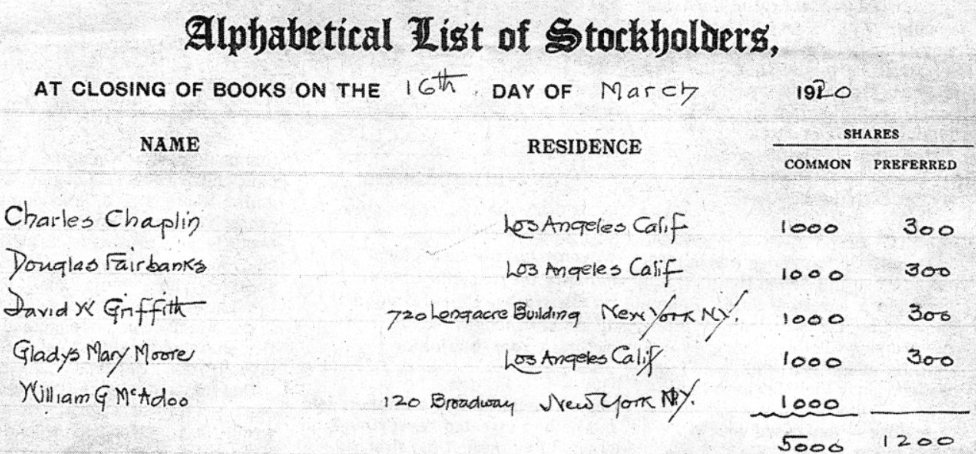
The immediate background was economic. Pickford, Fairbanks, and Chaplin believed that their popularity allowed them to earn more and to retain more control over their work. There were also fears that a merger among major distributors would reduce competition and make it harder for stars to negotiate. The Mary Pickford Foundation describes the new company as a rebellion against established producing and distributing arrangements, formed to protect the founders’ interests and to alter the balance among production, distribution, and exhibition.
The founders were not simply demanding artistic freedom in the abstract. They wanted the authority to decide what kind of films they would make, how much those films would cost, and how they would be released. In other words, they were asking for something that later filmmakers would call creative control, but they were seeking it before Hollywood had developed a stable language for it.
United Artists was unusual from the beginning because it was primarily a distribution organization for independently produced films. The company did not necessarily need to produce every film it released. It could act as the bridge between independent artists and the national theater network.
That model was both liberating and dangerous. A traditional studio could supervise production, maintain a regular flow of releases, and use the profits from one film to support another. United Artists depended on individual producers and stars to deliver films. If a production was delayed, the company might have nothing to release. If a film failed, there was no easy assembly line to compensate for it.
The company’s structure reflected the personalities of its founders. Each was accustomed to being a central figure. Each had a separate career, separate ambitions, and separate financial pressures. They were united in opposition to the old arrangement, but independence did not magically make them a harmonious ensemble.
That is one of the first great lessons of United Artists: freedom is easier to declare than to administer.
III. Mary Pickford and the Business of Being a Star
It is impossible to understand United Artists without understanding Mary Pickford. Her image is often reduced to the curls, the small frame, the youthful roles, and the sentimental aura of “America’s Sweetheart.” But behind that image was one of the sharpest business minds in early Hollywood.
Pickford knew that stardom was not simply a matter of being recognized. It was a form of economic power. Her audience created value, and she wanted a meaningful share of that value. More importantly, she wanted to shape the films that transformed her public image into a commercial product.
Her importance to United Artists was not decorative. She was one of the company’s central producers and decision-makers. The Library of Congress describes her as a major star with substantial business acumen and identifies Suds as one of her United Artists releases. The company gave her a platform to produce films that were closely connected to her own star persona while allowing her greater control over the conditions of production.
Pickford understood the tension between the performer and the brand. The audience wanted “Mary Pickford,” but that name could become a trap. If she remained forever a childlike heroine, the image that made her famous could eventually make her irrelevant. Her work at United Artists was therefore also an attempt to manage transition: to preserve her popularity while expanding her authority.
This is where the company’s history becomes more interesting than the familiar story of rebellious male auteurs. United Artists was founded by three men and one woman, but Pickford was not simply part of a quartet of celebrities. She was an executive, producer, negotiator, and long-term steward of the company.
She understood the value of controlling the story around the story. A film’s publicity, distribution, star image, and exhibition all affected how the audience interpreted the work. Artistic control did not stop when the camera stopped rolling.
The company could therefore be seen as an extension of Pickford’s larger argument: the star should not be separated from the business that makes stardom possible.
IV. Chaplin and the Luxury of Delay
If Pickford represented the business intelligence of United Artists, Chaplin represented its artistic patience.
Chaplin did not make films quickly. His work depended on experimentation, repetition, improvisation, and the slow refinement of movement. A gag was not finished because it had been written. It was finished when the timing, gesture, camera position, editing rhythm, and emotional effect all aligned.
That process was difficult to reconcile with a production system built around regular output. Chaplin needed time because he was not simply recording performances. He was discovering them.
United Artists gave him space to work in a way that larger companies might have found intolerably inefficient. The result included The Gold Rush in 1925, one of the great films of the silent era and one of Chaplin’s defining achievements. According to Britannica, the film was among the early successes associated with United Artists, alongside the work of other major performers and independent producers.
What makes The Gold Rush so important to the United Artists story is not only its brilliance. It demonstrates why an artist might want control over the entire production environment. The film moves between physical comedy, hunger, loneliness, fantasy, and romantic disappointment without treating those tones as separate departments. Its comedy can suddenly reveal desperation. Its sentiment can turn into a gag. Its famous dinner sequence is hilarious because it is also painful.
This kind of tonal flexibility is difficult to manufacture through committee. It depends on a filmmaker who is allowed to remain inside the material long enough to discover its contradictions.
Chaplin’s independence also came with risks. The more time and money he invested in a film, the more pressure the company carried. A conventional studio might have forced him to finish sooner, but it also had a larger infrastructure for absorbing delays. United Artists had to trust that Chaplin’s patience would eventually become a profitable event.
This tension would return throughout the company’s history. United Artists was attracted to difficult projects precisely because its identity depended on creative freedom. But difficult projects were also expensive, unpredictable, and vulnerable to delays.
The company’s greatest artistic achievements often emerged from the same freedom that made its finances unstable.
V. United Artists Was Not a Normal Studio
The easiest way to misunderstand United Artists is to imagine it as a conventional studio with a more glamorous founder list. It did not operate like Metro-Goldwyn-Mayer, Paramount, or Warner Bros. in the traditional sense.
A classic studio maintained a recognizable house style, a stable roster of contracted performers, standing sets, production departments, and a predictable release schedule. United Artists was closer to a financing and distribution network. It could release films made by independent producers and artists who retained more control over their projects.
This difference changed what a United Artists film could feel like. The company’s catalogue did not have one unified visual identity. There was no single “United Artists look” in the way people might talk about the polished MGM musical or the Warner Bros. gangster film.
Instead, the United Artists identity was based on a relationship with filmmakers. Its brand promised that the film might come from an unusual source, that the producer might have real authority, and that the company was willing to distribute work that did not fit a rigid house formula.
This made United Artists a kind of early home for the producer-as-auteur. The company’s importance was not only that it released famous films. It created conditions in which independent producers could approach a major distribution network without surrendering every decision to a studio executive.
But independence is never absolute. The company still needed money. It needed theaters. It needed publicity. It needed people who could negotiate contracts and manage risk. The anti-studio company still had to deal with the studio system’s infrastructure.
That contradiction gives United Artists its particular drama. It was not outside Hollywood. It was inside Hollywood, trying to redistribute power.
VI. The Company Learns to Survive
The 1920s brought prestige and important releases, but the business environment changed rapidly. Sound cinema arrived. Production costs grew. Audience expectations shifted. The original founders’ careers evolved, and not all of them remained equally involved.
The transition to sound challenged every company, but it was particularly complicated for an organization built around individual artists and independent production. Silent cinema had allowed performance, editing, and image to carry enormous expressive weight. Sound brought new technical demands, new studio investments, and new forms of control.
United Artists survived partly through relationships with producers such as Samuel Goldwyn, Howard Hughes, and Alexander Korda. These figures brought their own money, ambitions, and production structures. The company became less a single artistic collective and more a platform that various powerful producers could use.
That evolution was practical, but it also changed the meaning of the founding dream. United Artists had begun with a group of stars trying to protect themselves from producers. It increasingly became a distributor for producers with their own forms of power.
The company struggled financially during the 1940s. In 1951, the production studio was sold, and United Artists became primarily a financing and distribution facility.
At first glance, that might appear to be a defeat. The company that wanted to control production no longer functioned as a traditional production studio. But in another sense, the change clarified what United Artists had always been best at. It did not need to make every film itself. It needed to recognize films made elsewhere and help them reach an audience.
The company’s future would depend less on a permanent stable of stars and more on its ability to choose projects.
VII. The 1950s: Independence Becomes a Business Model
By the mid-1950s, the original founders had sold their shares, but United Artists was beginning a new chapter. The company released or distributed a remarkable series of films, including The African Queen, High Noon, Witness for the Prosecution, Some Like It Hot, The Apartment, The Magnificent Seven, and West Side Story.
The variety of these films reveals the company’s strength. There is no obvious single genre connecting them. Adventure, western, courtroom drama, comedy, musical, and social satire all appear within the same broad United Artists orbit.
What connects them is a sense of choice. These films do not feel like anonymous products created only to fill a release calendar. They are shaped by strong directors, writers, performers, and producers with distinct personalities.
High Noon is especially significant because its moral pressure is inseparable from its production history and political atmosphere. The film uses the western not as a simple celebration of heroic individualism but as a story about fear, abandonment, and social responsibility. Its clock-driven structure turns time into an ethical test. The town’s refusal to stand with the marshal becomes more disturbing than the approaching gunmen.
A film like this depends on a studio willing to release a work whose political anxieties are not entirely comfortable. Its power comes from the tension between genre expectation and moral uncertainty.
The African Queen demonstrates another United Artists strength: the ability to join recognizable stars and classical adventure with an unusual emotional texture. Humphrey Bogart and Katharine Hepburn are not simply filling archetypal roles. They are allowed to be ridiculous, irritated, frightened, stubborn, and unexpectedly tender.
Then there is Some Like It Hot, which plays with gender, desire, performance, and social disguise under the surface of a fast-moving comedy. The film’s brilliance lies partly in its ability to remain entertaining while quietly destabilizing the categories its characters are supposed to inhabit.
United Artists understood that a film could be commercially accessible without being artistically obedient.
VIII. The Foreign Film and the Independent Producer
Another important part of United Artists’ identity was its relationship with producers and filmmakers working outside the narrow center of American studio production.
This did not mean the company was free of Hollywood assumptions. It was still an American corporation operating in a commercial system. But its distribution model made room for projects that came from different production arrangements and different national contexts.
That openness mattered because postwar cinema was becoming increasingly international. American audiences were encountering films, stars, and styles that challenged the idea that Hollywood was the only center of cinematic invention. British producers, European directors, independent American producers, and genre filmmakers could all enter the same distribution conversation.
United Artists functioned as a translator between artistic ambition and commercial infrastructure. It took films that might not fit a conventional studio catalogue and gave them a path toward theaters.
The company’s relationship with independent producers also helped create a new understanding of authorship. The director mattered, but so did the producer who assembled the financing, negotiated the distribution, protected the schedule, and fought for the film’s existence.
In the mythology of cinema, independence is often attached to the director alone. United Artists reminds us that independent filmmaking is also a business practice. Somebody has to build the bridge between the idea and the audience.
IX. Bond, the Pink Panther, and the Art of the Franchise
The United Artists of the 1960s and 1970s was not only a home for serious dramas and prestige cinema. It was also a major force in popular entertainment, especially through the James Bond and Pink Panther series.
This creates another contradiction in the company’s story. United Artists is often remembered as a champion of artistic freedom, but its commercial survival depended heavily on recognizable properties. The Bond films offered spectacle, international locations, recurring characters, and an audience that could return from one installment to the next. The Pink Panther films offered a different kind of continuity: visual comedy, recurring characters, and the unpredictable energy of Peter Sellers.
Franchises are often treated as the opposite of artistic independence. Yet the Bond films also demonstrate how a stable commercial framework can give filmmakers room to experiment within genre. Different directors, performers, composers, production designers, and writers could leave their signatures on the series while maintaining a recognizable identity.
The franchise became a negotiation between repetition and variation. The audience wanted Bond, but it also wanted a new version of Bond. It wanted the familiar music, gadgets, villains, and danger, but it also wanted new locations, new tones, and new social anxieties.
The Pink Panther series reveals a similar tension. What begins as a caper structure can become a vehicle for physical comedy, improvisation, and performance excess. The narrative becomes an excuse for bodies to collide with architecture, etiquette, and social expectation.
United Artists understood a lesson that later Hollywood would make central: independence and commerce are not always enemies. Sometimes a franchise can finance experimentation. Sometimes a familiar character becomes a laboratory for style.
The danger, of course, is that the commercial structure eventually becomes more important than the experiment.
X. United Artists and the New Hollywood Moment
The connection between United Artists and New Hollywood is not that the company directly created the movement. The connection is institutional and philosophical.
By the late 1960s, the old studio system was weakening. Television had changed viewing habits. Younger audiences were skeptical of traditional Hollywood polish. The Production Code was being replaced by a ratings system. European art cinema and the French New Wave had demonstrated that commercial films could be formally restless, politically charged, and stylistically personal.
The industry needed new filmmakers, but it also needed companies willing to trust them.
United Artists was perfectly positioned for this moment because its identity had already been built around independent production and distribution. It could work with filmmakers who did not fit the old studio mold. It could support films with difficult subjects, uncertain heroes, unusual structures, and endings that did not deliver easy comfort.
The company became associated with landmark films such as Midnight Cowboy, One Flew Over the Cuckoo’s Nest, Rocky, and Annie Hall. History.com notes that United Artists films accumulated a remarkable sequence of Best Picture victories during this period.
Midnight Cowboy is an especially important United Artists film because it brought loneliness, prostitution, male vulnerability, urban decay, and sexual ambiguity into the center of American cinema. Its X rating did not prevent it from winning the Academy Award for Best Picture. The film’s power comes from its refusal to treat its characters as clean symbols. Joe Buck arrives in New York with a fantasy of himself and slowly discovers the city’s indifference. Ratso Rizzo turns survival into a performance of cynicism, but his vulnerability remains visible beneath it.
The film is neither a conventional studio melodrama nor a pure underground film. It occupies the unstable space that United Artists had spent decades developing: serious, commercial, adult, controversial, and built around strong creative voices.
One Flew Over the Cuckoo’s Nest uses an institution as its central metaphor, but its appeal is visceral. The film is about rules, punishment, conformity, rebellion, and the seduction of authority. Its characters are not simply representing social positions. They are bodies trapped in a system, each trying to preserve a sense of self.
Rocky appears more traditional, but its underdog structure contains the United Artists spirit in another form. It is a small personal story that became a major popular success. Rocky does not need to win the championship to achieve dignity. The film’s emotional victory arrives when he proves that he can remain present inside the fight.
Annie Hall turns romantic disappointment into a structure of memory, interruption, performance, and self-analysis. It is a star vehicle, a comedy, a New York film, and a formal experiment. Its protagonist speaks directly to the audience, rearranges time, and understands his own story while remaining trapped inside his habits.
These films made United Artists look like the ideal home for New Hollywood: a company capable of supporting artists who wanted to work inside popular cinema without surrendering complexity.
XI. The Producer as Auteur
United Artists also helped bring the producer into the public imagination as a creative figure.
The director is usually the name cinephiles follow, but the producer often determines whether the director gets to make the film at all. Producers arrange financing, negotiate with distributors, approve scripts, manage budgets, hire key collaborators, and protect the project from the many forces that can weaken it.
At United Artists, the producer-driven model became especially visible because the company did not rely on a single permanent production factory. It worked with individuals and independent companies. This could create space for strong producers with a clear artistic identity.
That model foreshadowed later independent cinema, where companies such as BBS and other producer-led ventures could make films that entered the major studio system without being entirely absorbed by it.
The United Artists story therefore complicates the idea of the auteur. A film can have a director with a recognizable vision and still depend on a producer who understands how to protect that vision. Creative authorship is often collective, even when the marketing gives one person the title.
The company’s most successful years were built on negotiations between artists, producers, and executives. The best results occurred when the business structure made room for disagreement without turning every disagreement into a surrender.
XII. The Cost of Independence: Heaven’s Gate
Every mythology needs a crisis, and for United Artists that crisis arrived with Heaven’s Gate.
Michael Cimino’s 1980 film became one of the most famous financial disasters in American film history. The production grew enormously in scale and cost. The finished film was associated with perfectionism, delays, reshooting, and an escalating budget. It was more than a commercial failure; it became a symbol of the moment when New Hollywood’s creative freedom seemed to turn into institutional self-destruction.
History.com describes the film as a devastating blow to United Artists. The production took years, went far over budget, and earned less than four million dollars at the U.S. box office.
The reaction was immediate and brutal. The film’s failure was used as evidence that directors had been given too much power. The studios, which had allowed a generation of filmmakers to operate with unusual freedom, began looking for stronger controls. The era of the director as a nearly independent creative authority was giving way to a more centralized, executive-driven model.
Yet Heaven’s Gate should not be reduced to a moral fable in which artistic ambition causes financial ruin. The movie’s production history involved industrial decisions, corporate expectations, changing budgets, and the difficulty of managing an enormous project. Its failure was not simply the result of one director’s personality.
Still, the symbolic power of the disaster is undeniable. United Artists had been founded on the belief that artists should control the conditions of filmmaking. Now the company appeared to have been damaged by the inability to impose limits on an artist-controlled production.
That is the tragic irony: the same independence that produced daring films could also expose a company to extraordinary risk.
After Heaven’s Gate, the industry changed. Studios became more cautious about large-scale creative autonomy. The blockbuster model grew stronger. High-concept projects with clear marketing hooks became increasingly attractive. The era of New Hollywood did not disappear overnight, but the balance of power moved back toward corporate control.
XIII. MGM, Corporate Ownership, and the Disappearance of the Name
In 1981, MGM bought United Artists. In 1983, the merged company became MGM/UA Entertainment.
The acquisition represented more than a corporate transaction. It symbolized the absorption of one of Hollywood’s great independence experiments back into the machinery of a major entertainment corporation.
United Artists continued to exist in different forms, but its original identity became increasingly difficult to separate from the owners and corporate structures that followed. The company had once been founded so artists could resist the control of large producing companies. Now its name was part of a larger corporate ecosystem.
That does not mean the brand became meaningless. Brand memory can outlive institutional reality. When audiences saw the United Artists logo, they could still associate it with Chaplin, Pickford, Bond, Midnight Cowboy, Rocky, and a long history of films that had arrived through an alternative route.
The name carried a promise even when the company’s structure had changed.
In later decades, United Artists was repositioned at different times as a producer of smaller films and as a revived label. But the original company could not simply be recreated by attaching the old name to a new corporate arrangement. The spirit of independence depends on actual control, not just historical branding.
That is another lesson of United Artists. A company can inherit a logo more easily than it can inherit a philosophy.
XIV. Why United Artists Still Matters
The most important legacy of United Artists is not a list of films, although the list is extraordinary. It is the idea that artists can challenge the structure through which their work reaches the public.
Before United Artists, stars were already powerful, but the company made their industrial power visible. It showed that performers and directors could organize, invest, produce, and distribute. It created a model in which the film’s makers could negotiate from a stronger position.
The company also helped normalize the idea that a major distributor could work with independent producers rather than making every film inside one closed system. That model now seems familiar, but it was once a radical alternative to the vertically integrated studio.
For modern cinephiles, the connection is easy to see. Whenever an actor receives a producer credit, whenever a director negotiates final cut, whenever an independent company brings a difficult film to a major audience, United Artists is somewhere in the background.
Its legacy is also visible in the tension between art and commerce. United Artists never solved that tension. It made the tension productive for a while.
It understood that audiences could embrace films that were politically uncomfortable, emotionally complicated, formally ambitious, or morally unresolved. It understood that independence did not require a film to be small, obscure, or anti-popular. A movie could be a personal statement and a mass entertainment. It could be an experiment and a franchise. It could be made by outsiders and still reach the center of the culture.
The company’s history is therefore not a simple triumph of artists over executives. It is a story of negotiation, compromise, ambition, failure, and reinvention.
Conclusion: The Company Behind the Unfinished Dream
United Artists began as a rebellion against the idea that the people who made movies should surrender their authority to the companies that financed and distributed them.
It was founded by stars who understood that popularity without control was a fragile kind of power. Pickford brought business intelligence. Chaplin brought artistic patience. Fairbanks brought charisma and entrepreneurial confidence. Griffith brought directorial prestige, along with the complicated legacy of an artist whose influence cannot be separated from the harmful ideas present in some of his work.
Together, they built something that was never entirely stable but was historically unforgettable.
United Artists did not become a perfect artists’ republic. It struggled with money, production delays, corporate ownership, and the contradictions of independence. It sometimes supported films that changed the language of American cinema, and it sometimes made decisions shaped by the same commercial pressures it had originally resisted.
But that is precisely why its story remains alive.
The company’s greatest achievement was not escaping Hollywood. It was forcing Hollywood to make room for a different kind of power. It demonstrated that a distributor could be more than a gatekeeper, that a star could be more than an employee, and that a film could carry the personality of the people who made it without becoming economically invisible.
When we watch The Gold Rush, High Noon, Some Like It Hot, Midnight Cowboy, One Flew Over the Cuckoo’s Nest, Rocky, or Annie Hall, we are not watching one unified United Artists style. We are watching a history of choices—some careful, some reckless, some commercially brilliant, some artistically difficult.
That is the true United Artists tradition: not a formula, but a wager.
The wager is that audiences will follow artists into unfamiliar territory if the film gives them something alive to hold on to. The wager is that independence can exist inside a commercial system, even if it never exists there without conflict. The wager is that the people who make cinema should have a voice in deciding what cinema becomes.
Every time that wager is made, United Artists is still present.