Introduction
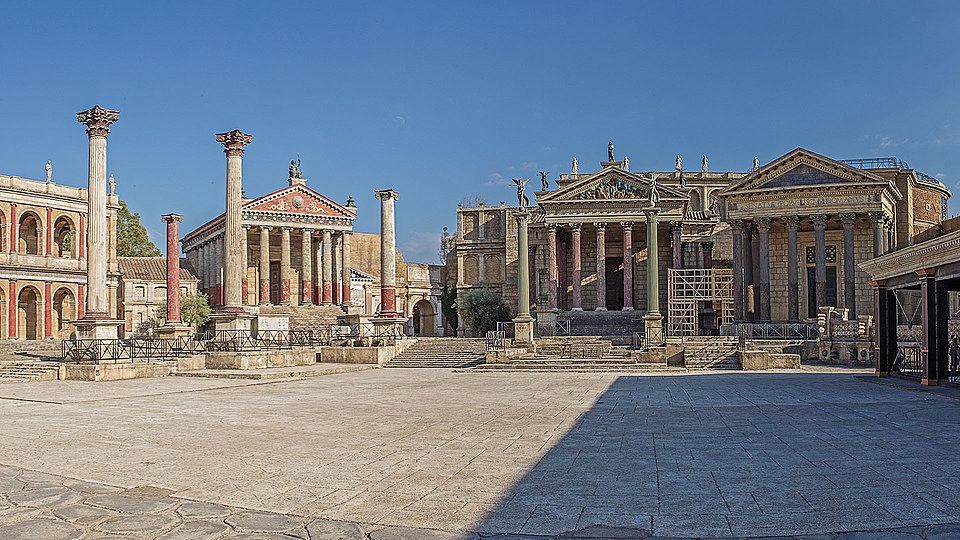
Cinecittà, often referred to as the “Hollywood on the Tiber,” is not merely a film studio complex. Since its founding in 1937, it has stood as a symbol of Italian creativity, European cinematic ambition, and international cultural exchange. Situated on the southeastern outskirts of Rome, Cinecittà has witnessed the rise of Italian Fascist propaganda films, the golden age of Neorealism, the glamour of international co-productions, and the modern challenges of digital cinema.
For nearly nine decades, Cinecittà has been the beating heart of Italy’s film industry while also functioning as a crossroads for global cinema. From Federico Fellini’s dreamscapes to monumental epics like Ben-Hur and Cleopatra, from Neorealism’s intimate portraits to today’s streaming-era productions, Cinecittà’s story reflects both the history of film and the broader history of 20th- and 21st-century Europe.
This article provides a comprehensive exploration of Cinecittà: its origins, development, cultural significance, artistic legacy, decline and rebirth, and its place in contemporary world cinema.
Foundations: Cinecittà and Fascist Cinema
Cinecittà was inaugurated on April 28, 1937, under Benito Mussolini’s Fascist regime. Its establishment was part of a larger cultural project: to use cinema as an instrument of propaganda and national pride. The slogan at its opening was explicit: “Il cinema è l’arma più forte” (“Cinema is the strongest weapon”).
The regime invested heavily in cinema as a tool for shaping public opinion and constructing a modern Italian identity. Before Cinecittà, Italian cinema had been fragmented and underfunded, struggling to compete with Hollywood’s dominance. The studios’ creation consolidated production under state oversight, giving birth to a centralized, modern filmmaking infrastructure.
The early productions at Cinecittà were heavily controlled by the regime and consisted of historical epics, propagandistic dramas, and escapist comedies. Films such as Scipione l’Africano (1937) exemplified the Fascist vision: monumental, patriotic, and aimed at fostering collective pride.
Yet, ironically, the same infrastructure designed for propaganda laid the foundation for one of the most humanistic and critical cinematic movements in history: Italian Neorealism.
War and Transformation
World War II disrupted Cinecittà’s development. During the German occupation of Rome in 1943–44, the studios were used as barracks and later as a refugee camp for displaced persons. The once-proud “Dream Factory” became a symbol of Italy’s collapse into war and poverty.
After the war, Cinecittà’s facilities were damaged and resources scarce, forcing filmmakers out of the studios and onto the streets. Ironically, this necessity became the seed of Italian Neorealism, as directors such as Roberto Rossellini (Rome, Open City, 1945), Vittorio De Sica (Bicycle Thieves, 1948), and Luchino Visconti (Ossessione, 1943) began shooting with non-professional actors in real locations, reflecting the harsh realities of postwar life.
Although these films were not typically produced within Cinecittà’s walls, the studio’s presence remained crucial, eventually serving as a site of editing, distribution, and later, a return to more structured productions.
The Postwar Golden Age: Hollywood on the Tiber
By the late 1940s and into the 1950s, Cinecittà re-emerged as a cosmopolitan hub. The Italian government encouraged international co-productions, and Cinecittà’s facilities became attractive to Hollywood studios seeking cheaper labor and authentic European settings.
This era earned Cinecittà the nickname “Hollywood on the Tiber.” Monumental films such as:
- Quo Vadis (1951)
- Ben-Hur (1959)
- Cleopatra (1963)
- Roman Holiday (1953, partially shot in Rome but tied to Cinecittà’s presence)
brought international stars and massive budgets to Rome. Elizabeth Taylor, Richard Burton, Charlton Heston, and Audrey Hepburn walked the sets and streets of Cinecittà, transforming Rome into a glamorous nexus of celebrity culture.
The influx of American money not only revived the Italian film industry but also enabled local auteurs to gain visibility. Fellini, Antonioni, and Visconti thrived in this climate, using Cinecittà both as a physical space for their productions and as a symbolic stage upon which they commented on modernity, memory, and spectacle.
Fellini’s Cinecittà
No filmmaker is more closely associated with Cinecittà than Federico Fellini. For Fellini, the studio was not just a workplace but a psychological and artistic playground. His most celebrated films, including La Dolce Vita (1960), 8½ (1963), and Amarcord (1973), were constructed within the controlled dreamworld of Cinecittà.
Fellini turned the studio’s artificiality into an asset. He embraced its constructed nature, building elaborate sets that reflected his characters’ inner lives. Cinecittà became, under Fellini, a theater of memory and imagination, where realism and fantasy coexisted.
The famous Trevi Fountain sequence in La Dolce Vita, although shot on location, resonates with the artificial grandeur of Cinecittà’s sound stages. Similarly, 8½’s surreal film-within-a-film sequences reveal Fellini’s deep engagement with Cinecittà as a space where cinema reflects upon itself.
Thus, while Neorealism thrived in the streets of Rome, Fellini reclaimed Cinecittà for cinematic dreamscapes, expanding its role in world cinema.
Cinecittà and Italian Neorealism
Though Cinecittà is most closely associated with monumental epics and Fellini’s imaginative spectacles, its indirect role in Italian Neorealism is crucial.
- Technical infrastructure: Even when Neorealist films were shot on location, post-production often occurred at Cinecittà.
- Institutional support: After the war, the Italian government used Cinecittà as part of its strategy to rebuild national culture, offering a base for filmmakers to gain equipment and distribution networks.
- Contrast with artifice: Cinecittà’s studios, once the site of Fascist escapism, stood in symbolic opposition to Neorealism’s gritty authenticity, highlighting the movement’s radical break with the past.
By the 1950s, however, Neorealism’s influence began to wane, and Cinecittà shifted back toward large-scale productions and auteur-driven artistry.
The European Auteur Tradition
Cinecittà’s history cannot be reduced to Hollywood spectacles alone. It also served as a base for Europe’s most ambitious auteurs.
- Luchino Visconti: His operatic style and historical epics (The Leopard, 1963) relied on Cinecittà’s ability to recreate lavish interiors and period details.
- Michelangelo Antonioni: Though known for location shooting, Antonioni used Cinecittà for controlled sequences in films like L’Avventura (1960).
- Pier Paolo Pasolini: Films like Medea (1969) and Salò, or the 120 Days of Sodom (1975) used Cinecittà for sets that bridged realism with allegory.
Thus, Cinecittà nurtured not only international blockbusters but also the intellectual backbone of European art cinema.
Decline in the Late 20th Century
From the 1970s onward, Cinecittà experienced a decline. Several factors contributed:
- Collapse of the studio system: Italian cinema lost its dominance as television and new media eroded box office numbers.
- Economic crises: Italy’s broader financial difficulties impacted film subsidies.
- Changing tastes: Hollywood shifted toward blockbusters like Jaws and Star Wars, marginalizing international co-productions.
Cinecittà survived largely through television production and occasional international projects, but its grandeur diminished.
Revival and the Modern Era
The 21st century has witnessed a renaissance for Cinecittà. Major investments, modernization of facilities, and collaborations with international streaming platforms have revitalized its global standing.
Recent high-profile productions shot at Cinecittà include:
- Gangs of New York (2002, directed by Martin Scorsese)
- The Passion of the Christ (2004, Mel Gibson)
- Rome (2005–2007, HBO series)
- The Young Pope (2016, Paolo Sorrentino)
Streaming giants like Netflix and Disney have turned to Cinecittà for both historical authenticity and cost-effective production facilities. This reaffirms its role not just as a relic of the past but as a living, adaptive hub of global cinema.
Cinecittà as Cultural Memory
Beyond its industrial role, Cinecittà functions as a museum of cinema history. Guided tours allow visitors to see Fellini’s sets, historical costumes, and archives of Italian cinema. It is both a workplace and a site of cultural pilgrimage, attracting cinephiles, scholars, and tourists alike.
The preservation of Cinecittà ensures that Italian cinema’s legacy remains tangible. It is not just a studio, but an archive of Europe’s cinematic imagination.
Cinecittà’s Global Legacy
Cinecittà’s influence is vast:
- On Hollywood: It demonstrated that European studios could rival American production values.
- On auteurs: It offered a space where filmmakers could combine artistry with industrial resources.
- On identity: Cinecittà symbolizes the duality of Italian cinema—between realism and spectacle, intimacy and grandeur, politics and fantasy.
Conclusion: Cinecittà as Europe’s Dream Factory
Cinecittà is more than a collection of soundstages; it is a living testament to the evolution of cinema itself. Born as a tool of propaganda, it transformed into the home of Neorealism, the playground of Fellini, the site of Hollywood epics, and now, a modern production hub.
For nearly 90 years, Cinecittà has embodied the tensions of European cinema: between art and commerce, national identity and international collaboration, realism and fantasy. Its survival and renewal demonstrate cinema’s enduring power to adapt, reinvent, and inspire.
As long as stories are told on screen, Cinecittà will remain not only Italy’s cinematic heart but also one of the great cultural landmarks of global film history.
Related topics:
White Telephone Films: Fascist-Era Italian Cinema and Its Glamorous Escapism
Italian Neorealism: Cinema’s Revolutionary Movement
The Impact of Italian Neorealism on Indie Cinema
Federico Fellini: Maestro of Dreams and Reality
Roberto Rossellini: The Unconventional Architect of Modern Cinema and the Truth of the Lens
Michelangelo Antonioni: Alienation, Modernity, and the Language of Cinema
Vittorio De Sica: Master of Neorealism and Humanist Cinema