The sword that carved a genre — and the arm that made it possible
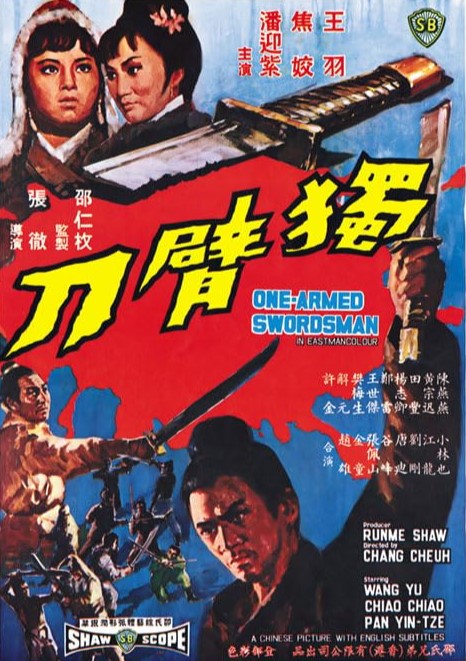
There is a moment in Chang Cheh’s The One-Armed Swordsman (1967) that most first-time viewers don’t see coming. The film has been building patiently — perhaps too patiently by modern standards — for nearly 25 minutes when the master’s daughter, in a fit of jealous rage, draws her blade and slashes off Fang Kang’s right arm in a single clean stroke. It’s abrupt, it’s nasty, and in 1967, it was absolutely shocking. Hong Kong cinema hadn’t seen anything quite like it, and neither, frankly, had much of the world.
That severed arm set off a chain of events — both within the story and within the history of Chinese-language cinema — that is still being felt today.
The World Before the Cut: Shaw Brothers and the Wuxia Tradition
To understand why The One-Armed Swordsman landed so hard in 1967, you first need a feel for what wuxia actually is and what it was doing before Chang Cheh got his hands on it.
Wuxia (武俠) translates, roughly, as “martial chivalry” — it’s a compound of wu (martial, military) and xia (chivalrous hero). As a storytelling tradition, it is ancient. Its roots run through Tang Dynasty prose, through Song and Yuan dynasty novels, and most definitively through the 14th century Water Margin, which established the template of outlaws with a moral code operating in a shadowy parallel world called the jianghu — literally “rivers and lakes.” The jianghu is a universe unto itself: a landscape of wandering swordsmen, rival martial arts schools, corrupt officials, and remote inns where fortunes are settled with blades rather than law. Honor, loyalty, vengeance, and the weight of unpayable debts drive everything in it.
By the time cinema arrived, wuxia had already been adapted from page to screen as early as 1928, with the silent serial The Burning of the Red Lotus Temple. But it was in Hong Kong, after the Communist Revolution sealed off mainland China in 1949, that the genre truly made its new home. Hong Kong became the de facto capital of Chinese-language popular cinema, and the jianghu was one of its most reliable territories.
Shaw Brothers Studio was the empire that housed all of this. Founded in Shanghai in 1925 by the Shaw family — with Run Run Shaw eventually steering the ship — the studio relocated operations to Hong Kong and built Movietown at Clearwater Bay, which opened in 1961 as the largest privately owned film studio in the world. Forty-six acres, fifteen sound stages, over a thousand full-time employees working in shifts around the clock. Run Run Shaw ran it like a miniature Hollywood, signing actors and directors to exclusive contracts, controlling production, distribution, and exhibition all at once. The scale was staggering. As film historian Law Kar noted in his essay “The Origin and Development of Shaw’s Colour Wuxia Century,” there was a deliberate effort to bring Hong Kong martial arts films in line with both Hollywood production values and the kinetic energy of Japanese period films like those of Akira Kurosawa.
The wuxia films Shaw Brothers was making in the early 1960s were dominated by female heroines and a certain balletic, opera-inflected style of choreography. Women warriors — characters played by Cheng Pei-pei and others — were genuine box office draws. The plots were honorable in an almost old-fashioned sense. Action was staged with static cameras and theatrical precision. It worked, it sold tickets, but it was starting to feel a little anachronistic by mid-decade. Something was about to shift.
Chang Cheh and the Arrival of Yanggang
Chang Cheh (張徹) had been working at Shaw Brothers as a screenwriter before he started directing — he produced more than 20 scripts between 1962 and 1967, learning the machinery of genre from the inside. He was not a Hong Kong native; he came from Zhejiang Province, had studied politics at National Central University in Chongqing, and worked as a film critic before moving into the industry. He was also, by his own account, deeply impatient with the prevailing mood of Hong Kong martial arts cinema.
The films he admired were Japanese — Kurosawa, Hideo Gosha — and Western: Sergio Leone, Sam Peckinpah. What drew him to those directors was their celebration of an explicitly male sensibility in extremis. Men under pressure, men in pain, men choosing to die for something rather than negotiate away their integrity. Chang had a term for what he was after: yanggang (陽剛), meaning masculine toughness, vitality, fighting spirit. He saw the female-dominated wuxia of the early 1960s as — in his own rather blunt phrase — too “effeminate,” and he intended to correct the imbalance.
His vehicle for this was Fang Kang, and his chosen star was Jimmy Wang Yu.
Wang Yu (王羽) was a former Shotokan karate practitioner who had appeared in minor Shaw Brothers productions before The One-Armed Swordsman. He was not, by any conventional measure, a charismatic leading man. His face is more interesting than handsome — heavy brows, a certain stillness that reads as either inner strength or limited range depending on your patience. Chang Cheh correctly read it as the former. The character of Fang Kang, the son of a servant who sacrifices his life for his master, grows up resented and eventually mutilated by the master’s own daughter, is one of class resentment and masculine shame turned inward before exploding outward. Wang Yu’s controlled performance suits this exactly.
The screenplay, co-written with the prolific Ni Kuang (倪匡) — who would go on to write scripts for nearly half of Shaw Brothers’ major productions over the next two decades — follows Fang Kang from school life to exile to recovery. After losing his arm, he retreats to a small farm, falls in with a peasant woman named Xiao Man, and begins teaching himself a new fighting style based on a torn, incomplete manual. The half-manual becomes a symbol of adaptation: conventional swordsmanship is built for two arms, so a one-armed practitioner is forced to develop something new, something the enemy can’t anticipate. When the villainous clans come bearing their specialized weapons — weapons designed to trap and neutralize standard sword technique — Fang Kang’s improvised one-armed style is the only thing that can defeat them.
The metaphor is rich and intentional. The story hit Hong Kong audiences at a particular cultural moment: the mid-1960s, when the colony was experiencing social tensions, a generation of young men caught between traditional Chinese identity and modern colonial life, between obligation and self-determination. Fang Kang’s trajectory — cast out, mutilated, forced to rebuild himself from nothing — carried real weight. He doesn’t restore himself to what he was. He becomes something different.
Released on July 26, 1967, The One-Armed Swordsman became the first Hong Kong film in history to gross over HK$1 million at the local box office. This was a seismic event. The South China Morning Post’s film historian Richard James Havis has described it as a film that “launched the new wave of wuxia films which modernized the genre in the late 1960s.” Chang Cheh earned the lasting nickname “the One Million Dollar Director,” and Wang Yu was suddenly a superstar. At the 2005 Hong Kong Film Awards poll of the 100 best Chinese-language films, The One-Armed Swordsman placed 15th. The Taipei Golden Horse Film Festival’s 2011 industry survey — 122 voters including scholars, directors, and programmers — ranked it 73rd on its list of the 100 greatest Chinese-language films.
The action choreography was handled by Lau Kar-leung (劉家良) and Tong Gaai (唐佳), who would become two of the most influential figures in Hong Kong martial arts filmmaking over the following decade. Lau in particular was a genuine martial artist from a family with deep Hung Gar roots, and his work here grounds the fights in a physicality that the more theatrical wuxia of the previous era had lacked. Not magic swordsmanship — something that looks like it might actually work, if imperfectly and bloodily.
Part Two: Return of the One-Armed Swordsman (1969) — The Machine Accelerates
Two years later, commercial logic demanded a sequel. The interesting thing about Return of the One-Armed Swordsman (獨臂刀王) is how honestly Chang Cheh acknowledges the terms of the sequel game and then plays it with tremendous skill.
The setup is textbook, almost cheerfully so. Fang Kang has retired to farm life with Xiao Man (Lisa Chiao Chiao returns in the role, as does the first film’s chemistry between the leads). He wants nothing more to do with the jianghu. The Eight Sword Kings — eight tournament champions, each with a specialized and frankly somewhat theatrical fighting style — have seized control of the martial arts world, capturing or killing rival school masters and coercing junior students into their orbit. Word reaches the farm. Fang Kang is pulled back in.
Where the first film takes its time — building character, earning its dramatic payoffs — Return essentially opens the tap immediately. The first half-hour is devoted to establishing the problem; after that, the film is almost non-stop swordplay and gore. The choreography, again by Lau Kar-leung and Tang Chia, reaches for a kind of controlled chaos: mobs of fighters, blood pumped from palm squibs soaking the white costumes that Chang Cheh dressed his heroes in (a stark visual choice — white against red, throughout the film), acrobatic deaths and the peculiar Shaw Brothers convention of mortally wounded fighters carrying on for another five minutes of furious combat before finally collapsing.
The Eight Sword Kings themselves represent the film at its most knowingly absurd and entertaining. Each master has a distinct and often bizarre speciality — a woman who produces an almost inexhaustible supply of knives from under her robes, a swordsman with extended reach, others with weapons specifically designed to counter conventional technique. It is, in the best sense, pulp filmmaking — the logic is that of an escalating game rather than psychological realism. And at this particular game, Chang Cheh was expert.
What the film retains from its predecessor is the central emotional note: Fang Kang’s reluctance. He is not a hero who enjoys the violence. Every time he’s forced back into it, there’s a cost. The ending, set against celebrations that he cannot fully share, is quietly rueful. Return is often described by Hong Kong film enthusiasts as the Mad Max 2 to the original Mad Max — a fair comparison, since it does roughly what George Miller did with his sequel: leaner story, vastly expanded action, the same protagonist pushed further than he was before.
Ti Lung appears in a small early role here — sharp-eyed viewers will notice him — and his presence is a small piece of continuity that points toward what’s coming.
Part Three: The New One-Armed Swordsman (1971) — The Reboot Before Anyone Called It That
By 1971, the relationship between Chang Cheh and Jimmy Wang Yu had deteriorated. Wang Yu left Shaw Brothers — an acrimonious departure that would lead to bitter contractual disputes and eventually to Wang Yu’s career at rival productions, where he made One-Armed Boxer (1972) and the gloriously deranged Master of the Flying Guillotine (1976). With his star gone, Chang Cheh faced a choice: end the franchise or transform it.
He chose transformation. The New One-Armed Swordsman (新獨臂刀) retains the amputee premise and the basic emotional architecture — shame, withdrawal, forced return, revenge — but builds a completely new story around a completely new character, played by David Chiang (姜大衛).
Chiang’s Lei Li is a very different kind of one-armed swordsman from Fang Kang. Where Wang Yu’s performance was all compression and controlled fury, Chiang is lighter, more expressive, almost mercurial. He was, by 1971, the hottest young actor at Shaw Brothers alongside Ti Lung, and the two were frequently cast together by Chang Cheh in a mode that film critics — then and now — have described with varying degrees of directness as depicting a deep, almost romantic brotherhood. The New One-Armed Swordsman is perhaps the most explicit example of this dynamic. Ti Lung plays Feng Chun-Chieh, a two-sword fighter who befriends the embittered, arm-less Lei Li, refuses to leave him to his shame, and becomes the emotional catalyst for his eventual return to the jianghu.
The circumstances of Lei Li’s amputation are notably different from Fang Kang’s. Where Fang’s was an accident of jealousy, Lei Li severs his own arm deliberately — as an act of penance after losing a duel. This is a more extreme, more specifically wuxia-inflected decision, rooted in the tradition of the xia warrior for whom reputation and honor are worth more than physical wholeness. The villain, Lung I-Chih (played by Ku Feng, one of Shaw Brothers’ most reliably menacing character actors), uses a three-section staff — an interconnected weapon that cannot be beaten by conventional swordsmanship. The formula demands a weapon to defeat the weapon, and here it comes in the form of three swords thrown and caught in sequence, a spectacularly cinematic solution that gives the film’s climax its particular visual logic.
The review site Senses of Cinema described The New One-Armed Swordsman as “Chang Cheh at his peak,” and it’s not a hyperbolic claim. The film grossed HK$1,596,530 domestically, and sold over 564,000 tickets in France alone upon its 1973 release — remarkable penetration for a Chinese-language film in the European market at that moment. Guo Tinghong won the Best Editing award at the 9th Taiwan Golden Horse Awards for his work on the film.
What Chang Cheh achieved with the third entry is something technically difficult: he made a reboot that honors the franchise’s emotional DNA without being bound by its narrative continuity. The one-armed swordsman, in his hands, had become a type rather than a character — a template for a particular kind of masculine suffering and reconstitution that transcended any individual story.
What the Trilogy Actually Did to Hong Kong Cinema
The combined impact of these three films is easier to trace than it might seem from a distance. In the immediate term, they established Chang Cheh as the dominant force in Hong Kong action cinema for the next decade — he would go on to direct nearly 100 films, often at a rate of five or six a year, working with successive generations of actors and cementing the yanggang aesthetic as Shaw Brothers’ signature. His influence on John Woo — who worked as his assistant director on films including Boxer from Shantung (1972) and The Water Margin (1972) — is the most direct line between the One-Armed Swordsman era and the “heroic bloodshed” films of the 1980s that made Hong Kong cinema internationally famous: the balletic gun violence, the male friendships tested to the point of death, the operatic sense of loyalty and sacrifice. Woo has consistently cited Chang Cheh as his primary filmmaking inspiration.
Quentin Tarantino famously dedicated Kill Bill: Volume 2 (2004) to Chang Cheh. The debt is everywhere in that film: the dismemberment, the female warrior, the revenge plot that burns across years, the weaponry treated as almost fetishistic objects of identity. Zhang Yimou, whose Hero (2002) helped spark the international art-house wuxia boom of the early 2000s, grew up watching Shaw Brothers films. The conversation is long and ongoing.
More immediately, the trilogy’s influence on subsequent Shaw Brothers productions was total. Every amputee hero, every retirement-out-of-retirement plot, every eight-villain tournament structure, every white-clad hero drenched in crimson — these became stock genre elements because Chang Cheh made them work so effectively here. The jianghu of the trilogy, built on Clearwater Bay sound stages dressed to evoke dynastic China, set a visual template that Shaw Brothers recycled and refined throughout the 1970s.
The wuxia genre itself — previously the province of female-centered, more supernatural adventure — was permanently altered. After 1967, the male anti-hero with a specific physical or social wound became the dominant protagonist type. The fighting styles became more grounded, more specific, less like opera and more like brutality. The blood — which had so alarmed contemporary Western critics, who dismissed these films as “violent trash” — became an index of consequence, a way of making the audience feel the stakes.
Legacy and Why It Still Holds Up
Watching the trilogy today requires a certain calibration of expectations, which is the case with any popular cinema from six decades ago. The pacing of the original is deliberate by modern standards; the melodrama is occasionally very melodramatic. But the films reward patience.
The fight choreography, supervised by Lau Kar-leung across the trilogy, has an integrity that a lot of later martial arts cinema lost in the rush toward wirework and digital enhancement. These fighters look like they’re actually hitting things and being hit. The injuries feel real because they’re presented with an almost clinical matter-of-factness.
David Chiang’s performance in The New One-Armed Swordsman is genuinely impressive — a slow-burn of suppressed shame and grief that gains power the more you know the conventions he’s working against. And there’s a formal intelligence to how Chang Cheh stages his climaxes: bodies piling up, the hero taking wounds that should stop him but don’t quite yet, the violence escalating past the point of plausibility into something closer to myth.
In 2025, Arrow Video included a 4K restoration of the original One-Armed Swordsman in their Shawscope Volume Three collection, alongside scholarly commentary on its cultural significance — a belated but appropriate canonization for a film that Hong Kong’s own critics and industry had recognized for decades.
The one-armed swordsman — whether he’s called Fang Kang or Lei Li, whether he’s played by Wang Yu or David Chiang — is ultimately a figure about what survives mutilation. Not wholeness restored, but something new forged from what’s left. That’s a durable idea, which is why the image endures. The arm is gone. The sword remains.