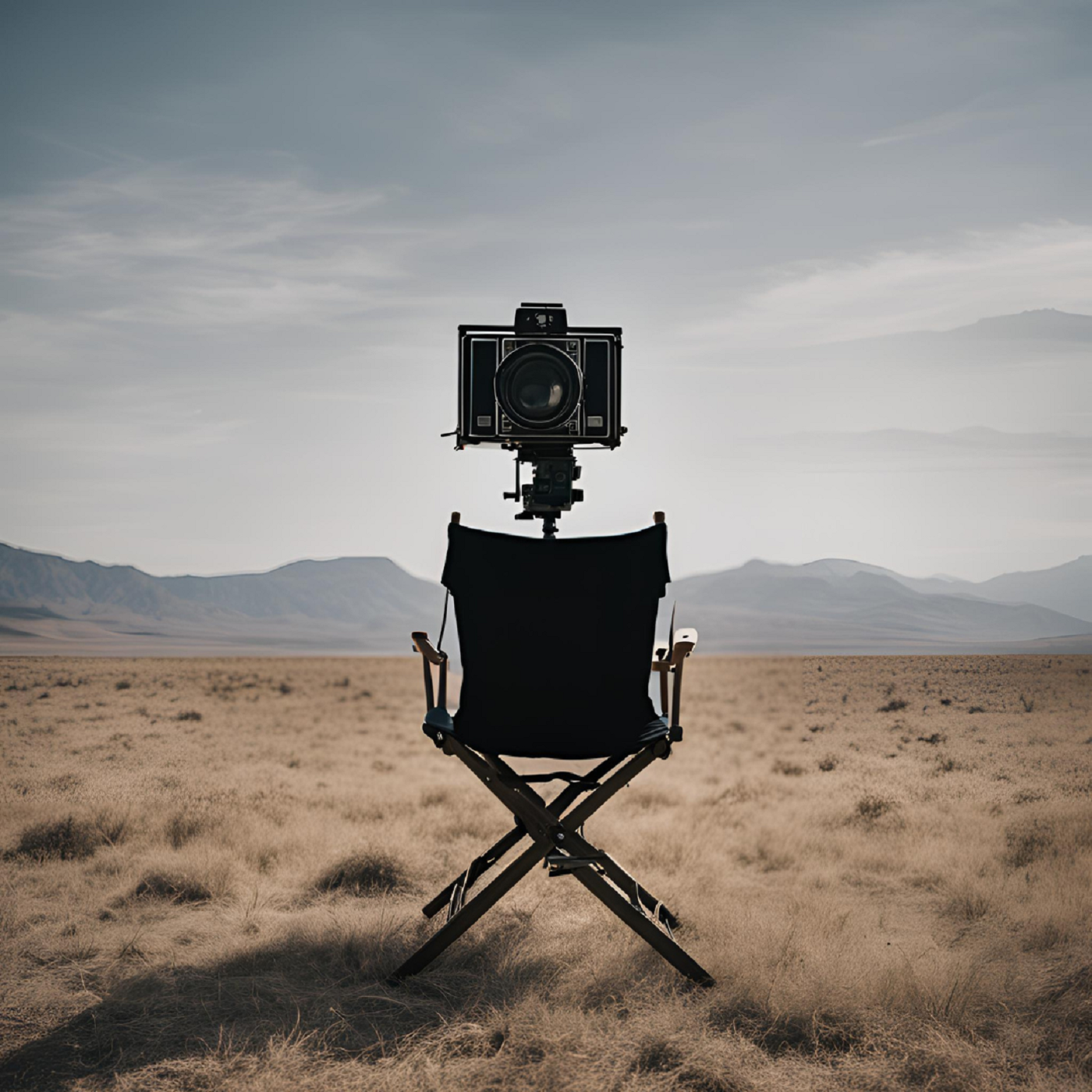
There is a particular thrill in watching Battleship Potemkin for the first time and realizing, somewhere around the Odessa Steps, that you are not watching a story so much as watching an argument. The images do not simply follow one another; they collide, they accumulate, they build toward a conclusion the way a proof builds toward a theorem. That sensation — of cinema as construction rather than depiction — is not an accident of style. It is the residue of a specific, short-lived, and extraordinarily ambitious moment in Russian art: Constructivism, the aesthetic philosophy that grew out of the Bolshevik Revolution and, for roughly fifteen years, tried to reinvent not just what art looked like but what art was for. To understand Soviet cinema’s golden age, you have to understand that it was never really a national cinema in the ordinary sense. It was a laboratory experiment conducted in the ruins of an empire, and Constructivism supplied both its toolkit and its ideology.
The Philosophy: Art as Production, Not Representation
Constructivism emerged in Russia in the years immediately following 1917, as painters, sculptors, architects, and theorists confronted a strange new problem: what does art look like after the bourgeois world that produced easel painting and psychological portraiture has, in theory, been abolished? Figures like Vladimir Tatlin, Alexander Rodchenko, Varvara Stepanova, and the Stenberg brothers arrived at a radical answer. Art should stop pretending to be a window onto reality and admit what it actually is — an assembled object made of real materials, built according to real structural principles, with a real social function. Tatlin’s famous (and never completed) Monument to the Third International, a spiraling iron tower meant to house the offices of the Comintern, is the movement’s founding gesture: not a sculpture of the revolution, but a piece of revolutionary engineering in its own right.
This was a deliberate rejection of everything Constructivists associated with the old regime — illusionism, ornament, the cult of the solitary genius, art as a luxury commodity for private contemplation. In its place they proposed the artist as engineer, someone who organizes material into functional, socially useful forms. The Russian word they used, faktura, describes this attention to the physical, tactile properties of a material — wood, steel, glass, celluloid — and how that material’s own nature should shape the form built from it. Alongside it sat tektonika, the logic of construction itself: the visible, honest relationship between a structure’s parts and the load-bearing purpose they serve. Nothing hidden, nothing decorative, nothing that pretends to be something it isn’t. It is worth sitting with how genuinely strange and exciting this was at the time. An entire generation of artists convinced themselves that abolishing illusion was itself a revolutionary act, that a poster, a chair, or a film reel could be as ideologically consequential as a speech in the Duma.
It’s important not to flatten this into mere political sloganeering, though the politics were sincere and inseparable from the aesthetics. Constructivists genuinely believed that a new kind of society required a new kind of visual and material culture — one built from first principles rather than inherited from Tsarist or European bourgeois tradition. Art, in their formulation, had to justify itself through utility: posters that organized public opinion, furniture that organized domestic labor, typography that organized information, and — crucially — film that organized perception itself. This is the philosophical soil out of which Soviet cinema’s most radical formal experiments grew.
The Components: Building Blocks of a New Visual Language
If you strip Constructivism down to its working vocabulary, a few recurring components show up across every medium it touched, including film:
Geometric abstraction and dynamism. Diagonal lines, sharp angles, and asymmetry replace the static, centered compositions of academic art. Movement — implied or literal — becomes a structural principle rather than a decorative flourish.
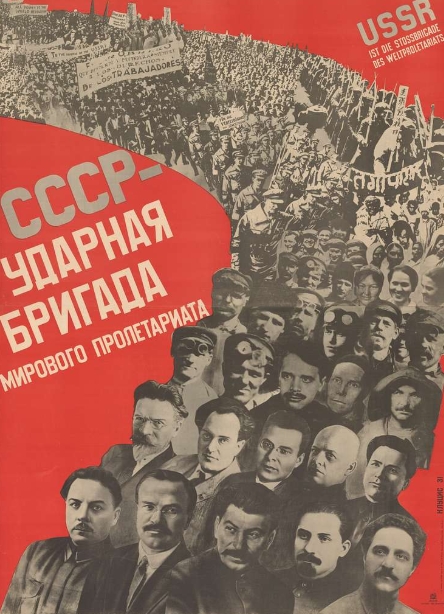
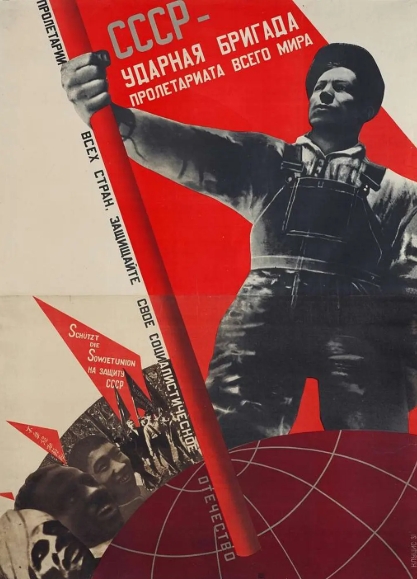
Photomontage and assemblage. Rather than painting an image from nothing, the Constructivist artist assembles one from existing fragments — photographs, printed text, found materials — cut apart and reorganized into new meaning. Rodchenko’s photomontages and book covers are the clearest bridge between graphic Constructivism and the montage cinema that would follow.
Industrial materials and honesty of construction. Steel, glass, and machine-tooled surfaces replace marble and oil paint. The seams show. The joints are visible. Nothing is varnished into false unity.
Utilitarian purpose. Every object justifies its existence through use — propaganda, education, organization of labor — rather than contemplation.
Collective rather than individual authorship. Design collectives, workshops (like the VKhUTEMAS, Moscow’s state art and technical school, essentially the Soviet Bauhaus), and production brigades replace the romantic solitary artist.
Transpose these five principles onto celluloid and you get, almost point for point, the working method of the great Soviet directors of the 1920s. Film was, for the Constructivists and their fellow travelers, the ideal medium precisely because it was mechanical, reproducible, collectively made, and built out of discrete, physical fragments — strips of film that had to be literally cut and joined together. No other art form made the Constructivist metaphor of “construction” so unmetaphorical. A film really was assembled, shot by shot, on an editing table, out of raw material.
Constructivism Meets Film: The Birth of Montage Theory
The crucial transmission point between Constructivist theory and cinematic practice was Lev Kuleshov and his workshop at the State Film School in Moscow, founded in the early 1920s under conditions of near-total material scarcity — a fact that matters more than it might seem. There was almost no raw film stock in the young Soviet state; the civil war and the collapse of the old distribution networks had left Kuleshov‘s students with scraps of old footage and, often, no camera at all. Out of necessity, Kuleshov’s workshop became a theoretical laboratory rather than a production house. Students rehearsed “films without film,” acting out camera movements and edits on paper and on stage, developing theories of montage before they had the material means to shoot anything.
It was here that Kuleshov ran the experiment that gives film students their first taste of Soviet montage theory today: he intercut a single, expressionless shot of the actor Ivan Mozzhukhin with three different follow-up shots — a bowl of soup, a dead woman in a coffin, a child playing — and audiences swore the actor’s face displayed hunger, grief, and tenderness in turn, even though the shot of the face never changed. The conclusion Kuleshov drew from this was pure Constructivism transposed to psychology: meaning does not reside inside a single shot any more than structural integrity resides in a single beam. Meaning is constructed, produced by the relationship between fragments, assembled in the mind of the viewer the way an engineer assembles a bridge from girders. This is the essential pivot. Soviet montage theory took the Constructivist insistence that form is built, not found, and applied it to the fundamental unit of cinematic meaning itself — the cut.
From Kuleshov’s workshop emerged the filmmakers who would define Soviet cinema’s golden decade, and though they disagreed fiercely with one another about the specifics, all of them treated the film image the way a Constructivist sculptor treated steel: as raw material to be honestly, functionally, and dynamically assembled.
The Filmmakers Who Built Soviet Cinema
Sergei Eisenstein is the name most people know, and rightly so, though it’s worth resisting the temptation to treat him as a solitary genius in the old bourgeois mold he himself despised. Eisenstein trained originally as an engineer and came to film through revolutionary theater, where he developed his concept of “montage of attractions” — the idea that a work of art should be built from discrete, calculated shocks to the audience’s nervous system, arranged not to tell a smooth story but to produce a specific ideological effect, the way an electrical circuit is arranged to produce a specific current. By the time he made Strike (1925) and Battleship Potemkin (1925), he had refined this into a full theory of “dialectical montage” — shots as thesis and antithesis, colliding to produce a synthesis in the viewer’s mind that exists nowhere in the individual images themselves. The Odessa Steps sequence remains the textbook demonstration: no single shot contains the massacre; the massacre exists only in the collision between shots, precisely engineered for maximum emotional and political voltage. Later, with October (1927) and Ivan the Terrible (1944–46), Eisenstein pushed toward “intellectual montage,” attempting to build entire abstract arguments — not just emotions — purely out of visual juxtaposition.
Dziga Vertov approached the same Constructivist premises from an almost opposite temperament. Where Eisenstein was a dialectician staging collisions, Vertov was closer to a Constructivist engineer building an entirely new sensory apparatus. His concept of the “Kino-Eye” proposed that the camera was superior to the human eye precisely because it was a machine, unburdened by psychology, capable of seeing truth that human perception, clouded by bourgeois habit, could not. His newsreel series Kino-Pravda (“Film-Truth”) and above all Man with a Movie Camera (1929) are perhaps the purest cinematic expressions of Constructivist principle ever made: a film with no actors, no sets, no script, and — famously — a film that shows you its own construction, including the editor Elizaveta Svilova physically splicing the footage together on the editing table. It is a film about a city, about a cameraman, and, insistently, about itself as a manufactured object. You cannot watch it without becoming aware of the seams, which is exactly the point — honesty of construction, faktura, made literal.
Vsevolod Pudovkin, also a product of Kuleshov’s workshop, developed a theory of montage as “linkage” rather than Eisenstein’s “collision” — building meaning through the smooth accumulation of associated images rather than through shock and contradiction. His trilogy of Mother (1926), The End of St. Petersburg (1927), and Storm Over Asia (1928) applied this more legible, emotionally driven style to explicitly revolutionary narratives, and arguably did more than Eisenstein’s work to popularize Soviet montage technique among ordinary audiences, both at home and abroad.
Around these three central figures worked a wider constellation of filmmakers who deserve to be named. Grigori Kozintsev and Leonid Trauberg, founders of the FEKS group (the Factory of the Eccentric Actor) in Petrograd, brought a more circus-inflected, deliberately jarring aesthetic to their early work, treating actors themselves as Constructivist material to be manipulated with the same mechanical precision as editing. Alexander Dovzhenko, working out of Ukraine, occupied a more lyrical, poetic register — his masterpiece Earth (1930) is less interested in montage-as-argument than in montage-as-meditation on cycles of life, death, and land — but he too emerged from and was shaped by the same revolutionary insistence that cinematic form had to be actively built rather than passively inherited from theatrical or literary tradition. Esfir Shub, a pioneering editor and director, developed the “compilation film,” constructing new historical narratives entirely out of found archival footage — a documentary extension of the photomontage principle, assembling meaning from pre-existing fragments rather than newly shot material.
Constructivism’s presence in Soviet cinema was never confined to editing theory alone. It also shaped the look of the films directly, through production design. Set designers trained in or influenced by the Constructivist movement built the angular, skeletal, industrial sets that populate films like Aelita (1924, directed by Yakov Protazanov, with sets by Alexandra Exter and Isaac Rabinovich) — a science-fiction film whose Martian city is rendered in pure Constructivist geometry, all sharp planes and mechanical costume design. And outside the films themselves, the poster art that sold Soviet cinema to the public — above all the work of the Stenberg brothers, Georgii and Vladimir — translated montage principles into still graphic form: fragmented photographic elements, violent diagonals, and bold sans-serif typography assembled into images that were themselves miniature exercises in cinematic construction.
Impact and Legacy: The Afterlife of a Revolutionary Idea
The Soviet montage cinema of the 1920s did not last, at least not in its purest form. By the early 1930s, the political climate under Stalin had turned decisively against formal experimentation. Socialist Realism was declared the only acceptable artistic doctrine in 1934, and it demanded the opposite of everything Constructivism stood for: accessible, emotionally direct, heroic narrative realism rather than fragmented, intellectually demanding montage. Eisenstein himself was repeatedly forced to defend, revise, and in some cases shelve his work; Vertov’s radical documentary experiments became professionally unviable; the VKhUTEMAS was shut down. Constructivism, in effect, was a revolutionary aesthetic that outlived the revolutionary openness that had produced it by barely a decade.
And yet its influence on world cinema was already irreversible by the time it was suppressed at home. Soviet montage theory crossed borders almost immediately — Eisenstein lectured and worked briefly in Western Europe and the United States, and Battleship Potemkin became required viewing for an entire generation of international filmmakers and theorists. The basic grammar of editing that most narrative cinema still relies on — the idea that meaning is produced through the relationship between shots, not simply contained within them — owes an enormous, often unacknowledged debt to what Kuleshov, Eisenstein, Pudovkin, and Vertov worked out in conditions of extraordinary material poverty in the 1920s. You can trace direct lines from Soviet montage theory through French and Latin American political cinema of the 1960s (Jean-Luc Godard and the Dziga Vertov Group took their name from Vertov quite deliberately), through the essay-film tradition, through documentary compilation filmmaking, and into the basic toolkit taught in every introductory film editing class today, whether or not the students realize where the ideas came from.
There is also a quieter, more melancholy legacy, one that any serious cinephile has to sit with honestly. Constructivism’s insistence on collective authorship, mechanical honesty, and utilitarian purpose was bound up, inseparably, with a political project that would go on to produce immense human suffering under Stalinism — the very system that ultimately crushed the movement’s own freedom to experiment. The artists who built this aesthetic largely believed, with real sincerity, that they were constructing the visual language of human liberation. Watching Man with a Movie Camera or Potemkin today means holding two things at once: genuine admiration for a body of formal invention that changed cinema permanently, and clear-eyed awareness of the historical machinery that both enabled and eventually destroyed it.
What remains, undiminished, is the core intellectual gesture: the idea that a film is not a window but a construction, that meaning is manufactured rather than simply captured, and that the cut — the humble splice between one strip of celluloid and the next — can carry as much ideological and emotional weight as anything filmed in front of the camera. That idea was forged in a very specific place and time: a collapsing empire, a starved film industry improvising with scraps of stock, and a generation of artists who genuinely believed that if they could just build things honestly enough, out of the right material, arranged according to the right structural logic, they could build a new world along with them. Cinema, more than any other art form born of that revolutionary decade, is still living inside the structure they built.