
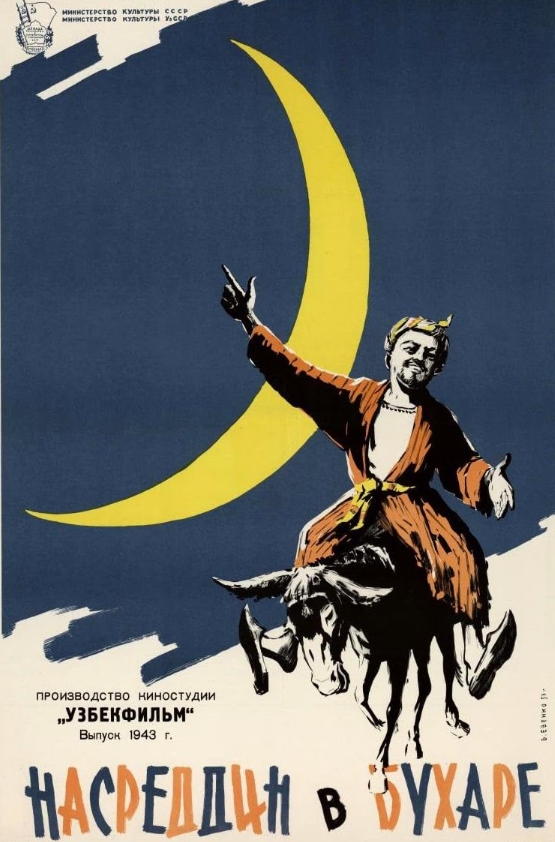
In Akshehir, a small Anatolian town in the province of Konya, there is a grave. It belongs — officially, ceremonially, and according to Turkish national tradition — to a man named Nasreddin Hodja: a 13th-century sage, cleric, wit, and wanderer who is buried there still, or so the story goes. Every July, the town holds an international festival in his honor. Tourists pose beside his statue. Schoolchildren recite his jokes. The Turkish state considers the matter settled: Nasreddin Hodja is Turkish, his donkey is Turkish, and his tomb is Turkish, and has been since the Seljuk Sultanate of Rum ruled these lands in the age of Rumi and the Crusades.
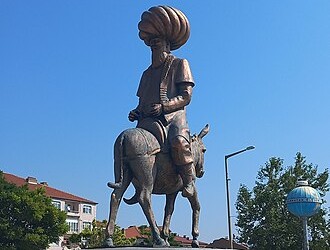
Now travel eastward, roughly three thousand kilometers, to Tashkent, the capital of Soviet Uzbekistan, in the summer of 1943. The city is crowded, chaotic, and alive with an energy it has never known before — the entire apparatus of Soviet filmmaking has been evacuated here from Moscow and Leningrad to escape the Nazi advance. In the studios of the renamed Tashkent Film Studio, a veteran Russian director named Yakov Protazanov is completing what will turn out to be the last film of his life. On screen, a lean, quick-eyed young man in a modest turban and worn robe rides a donkey through the gates of Bukhara, outwitting a moneylender, humiliating an emir, and liberating the poor. He too is called Nasreddin.
The two Nasreddins barely resemble each other. The Turkish one is elderly, portly, bearded, dignified — a man of learning and standing, whose enormous turban alone seems to outweigh his donkey. The Soviet one is young, mobile, subversive, and explicitly on the side of the working poor against every form of traditional authority. One is a monument; the other is a weapon. Understanding the distance between them — how it was manufactured, why, and to what end — is the subject of this article.
A Character Who Belongs to Everywhere
Before turning to what the Soviets did to Nasreddin, it is worth establishing what he was before they got to him — because the ease with which Soviet ideology recruited this figure depended entirely on his fundamental ambiguity.
Nasreddin Hodja is not simply a Turkish character who happened to spread abroad. He is, in the most precise scholarly sense, a “composite figure” — what folklorist Ulrich Marzolph has called a focal point to which countless humorous and satirical stories from across the Muslim world were gradually attributed over centuries. His Arabic predecessor, known as Juha, appears in sources predating any Turkish version of the tale and was already a fixture of Islamic comic tradition under the Umayyad Caliphate. In Iran and Afghanistan, he lives on as Mulla Nasreddin. In the Balkans, his arrival followed the Ottoman armies as they moved into Europe. In Azerbaijan, Kazakhstan, and across Central Asia, he roamed as Khoja Nasreddin or Qojanasyr, a free spirit outside social convention — no family mentioned, no fixed address, an eternal wanderer on a donkey bound by neither class nor ethnic boundaries.
Turkey’s claim to him rests on the historical and archaeological record: most serious scholars place his birth in Hortu Village in present-day Eskishehir Province in the early 13th century, and his death around 1284 or 1285 in Akshehir, near the Seljuk capital Konya, in the same era and broad region as Jalaladdin Rumi. This claim is genuine and has weight. But it has never prevented others from doing what states, empires, and ideologies always do with beloved folk figures: claiming them, reshaping them, and pointing them in whatever direction serves the moment.
The Ottomans had done this before the Soviets. In the folklore that circulated under Ottoman rule, Nasreddin frequently appears winning verbal duels against Amir Timur — the Central Asian conqueror who had famously destroyed an Ottoman army and captured Sultan Bayezid I at the Battle of Ankara in 1402. For generations of Ottoman subjects, the image of Nasreddin besting Timur in a battle of wits offered something no military history could: symbolic revenge, delivered through laughter. This was not organic folk tradition; it was ideology wearing the costume of folklore. The Soviets recognized the pattern and improved upon it dramatically.
The earliest written sources complicate both the Turkish and Soviet claims in revealing ways. The oldest manuscript containing Nasreddin stories, titled Hikayat-i Kitab-i Nasreddin Hoca, dates from after 1571 — more than two centuries after his supposed death. In those earliest texts he is a far more disreputable figure than in any later tradition: a rascal who openly flouts religious prescriptions, a transgressor of taboos, something closer to a vulgar trickster than a sage. The wise, warm, philosophically inclined Nasreddin who charmed both Ottoman and Soviet audiences was a later construction, produced by precisely the same kind of ideological domestication the Soviets would later perfect. The Ottomans had already “socialized” him — given him a wife and children — before the Russians ever heard of him.
This long history of reinvention is not incidental to the Soviet story. It is the context that makes the Soviet reinvention comprehensible. Nasreddin had always been whatever the age needed him to be.
The Pre-Soviet Template: Molla Nasreddin Magazine and the Azerbaijani Laboratory
The Bolsheviks did not arrive in Central Asia and the Caucasus with Nasreddin already in hand. They found him, partly made-over, in the Azerbaijani satirical press — and what they found there showed them what could be done.
In 1906, in the city of Tiflis (modern Tbilisi), an Azerbaijani writer named Jalil Mammadguluzadeh founded a satirical weekly magazine and gave it a name that was a provocation in itself: Molla Nasreddin. The magazine combined essays, poetry, mock telegrams, and cartoons — the cartoons, comprising roughly half the content, were drawn in a style reminiscent of a Caucasian Honoré Daumier. Its targets were the hypocrisy of the Muslim clergy, the corruption of local elites, the colonial policies of Russia and European powers, and the perceived backwardness of Muslim societies in relation to modernity. It argued loudly for women’s rights and educational reform.
The impact was immediate and volcanic. Within a month of the inaugural issue, mullahs in the Muslim-majority regions of the Caucasus and Persia were declaring that the magazine should not enter any Muslim household, and if it did, should be seized with tongs and discarded as filth. Clerics in Tabriz denounced it as a deception against Islam. Members of the editorial team faced harassment, office attacks, and multiple threats. Mammadguluzadeh himself was at various times forced to flee protesters outraged by the magazine’s contents.
But the magazine’s distribution only grew. By its own account, within a month of launch more than 15,000 copies were circulating between Khorasan and Tehran, Isfahan, Tabriz, and the villages of the Caucasus. It ran — with interruptions — until 1931, published in Tbilisi, Tabriz, and finally Baku under Soviet rule. The decision to continue under Bolshevik authority was itself telling: the Soviets recognized a useful instrument when they saw one. The magazine’s anti-clericalism was impeccable; its format was accessible to readers across multiple languages; and it had already done the work of attaching Nasreddin’s name to modernizing, secularizing critique.
What the Azerbaijani magazine had accomplished, in essence, was to perform a surgical operation on the character: it kept the wit, the irreverence, the anti-authority energy, and stripped away the Sufi spirituality, the Islamic learning, and the complex religious identity that the title “Molla” technically implied. The Soviets would deepen this operation to the point of rendering all religious content invisible.
Leonid Solovyov and the Colonizer’s Gaze
The true architect of Soviet cinematic Nasreddin was not a Central Asian. He was a Russian writer named Leonid Vasilyevich Solovyov, and the story of his relationship to Nasreddin contains within it the entire paradox of Soviet cultural policy toward the East: genuine love combined with structural condescension, sincere enthusiasm combined with imperial appropriation.
Solovyov was born in 1906 in Tripoli, Lebanon, where his parents worked for the Imperial Orthodox Palestine Society — itself a fascinating genealogy for a future Soviet writer. In 1921, his family relocated to Kokand in the Fergana Valley of Uzbekistan. He spent his formative years there, worked for regional newspapers, and traveled extensively through the region studying local folklore. He enrolled in the literary and screenwriting program at the Institute of Cinematography in Moscow in 1930, graduating in 1932.
His immersion in Uzbek life gave his work an authenticity of detail and atmosphere. But scholars who have examined his prose carefully note that his perspective was never anything other than orientalist in the technical sense: his Central Asia is exotic, colorful, sensuous, and fundamentally other — a land viewed from the outside, through the eyes of someone for whom its strangeness is part of its appeal. His Bukhara is a backdrop of minarets and bazaars, of intrigue and fragrance, not a living society encountered on its own terms.
When Solovyov published Disturber of the Peace in 1939, the first part of what would become his two-volume Tale of Hodja Nasreddin, the book was a sensation. His Nasreddin returned to Bukhara after a long exile to find his city in the grip of a corrupt emir, a rapacious moneylender, and a servile clergy — the feudal trinity that Soviet ideology had identified as the enemy of the Eastern poor. Armed with nothing but his wit and his donkey, this Nasreddin proceeded to dismantle the established order through trickery, impersonation, and inspired chaos. The novel’s popularity was genuine; its ideological function was transparent.
What Solovyov had done was take a figure whose traditional role was philosophical — the wise fool who exposed the gap between appearance and reality, between pretension and truth — and give him a political mission. His Nasreddin did not merely expose folly; he fought class injustice. He was not a wandering sage; he was an activist. As one passage in the 1946 film adaptation makes the transformation unmistakable: when a poor man rescued from debt offers Nasreddin a share of his earnings, Nasreddin replies with pointed irony: “If all masters shared their profits with their workers, what would become of this world? Would emir tolerate such disorder?” This is not folk wisdom; it is a Communist Party pamphlet delivered in costume.
There is an opinion among some scholars that through the image of Nasreddin, Solovyov was covertly criticizing Stalinist power, using the emir as a stand-in for Stalin. The evidence does not support this reading. In both the novel and the films it inspired, the “disturbed peace” is emphatically the peace of the emir and his court, not the peace of the Soviet state. Solovyov reinforced the positions of Soviet ideology rather than subverting them, employing satire that was easily legible to a broad audience and packaged in orientalist imagery that made the East appear as a land that had been, and perhaps still was, in need of rescue.
The bitter irony arrived in 1946, when Solovyov — the man who had given Soviet culture its most beloved Eastern trickster — was arrested and accused of conspiring to commit acts of terrorism against the Soviet state. He was sent to the labor camps, where he remained until 1954. It was in those camps that he wrote The Enchanted Prince, the second volume of the Nasreddin saga. The man imprisoned by the system he had served wrote his most enduring work in its prisons. His Nasreddin, meanwhile, continued to ride freely across the screens of the empire.
The Films: A Journey Through Soviet Screens
Nasreddin in Bukhara (1943)
The first Soviet Nasreddin film arrived in August 1943, at one of the darkest moments of the war, released from a studio that had become — by force of historical circumstance — the most active production center in the Soviet Union. Uzbekfilm’s wartime role was far from incidental. With Russian studios displaced to Tashkent, the city became a crossroads where the Soviet cinematic establishment met Central Asia face to face, often for the first time. Evacuated Russian directors, cinematographers, and actors worked alongside Uzbek colleagues, in conditions of urgency and improvisation.
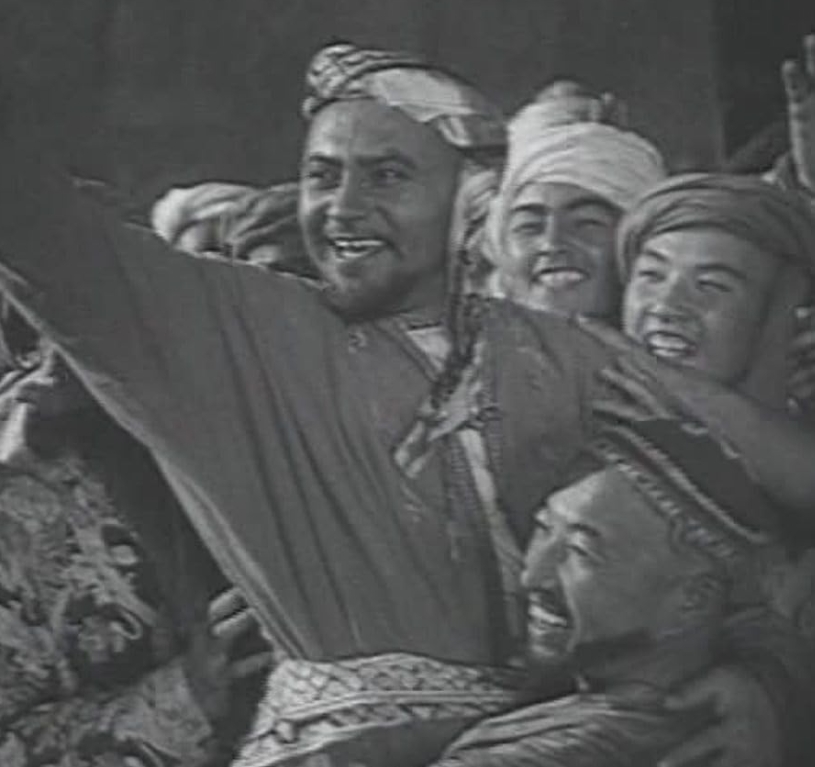
Yakov Protazanov, one of the founding fathers of Russian cinema — his career stretched back to 1907, and he had directed both the silent science-fiction classic Aelita (1924) and major comedies of the 1930s — brought to Nasreddin a light, almost theatrical touch that distinguished the film from heavier Soviet productions of the period. Lev Sverdlin played the lead: a Russian actor performing a Central Asian folk hero in Russian for a nationwide Soviet audience, a casting decision that speaks volumes about who this film was actually made for.
The plot follows Solovyov’s novel closely. Nasreddin arrives in Bukhara on his donkey, falls in love with the potter’s daughter Gyuldjan (called “little toad” with affection), rescues her from the moneylender Jafar, infiltrates the Emir’s court disguised as a wise man from Damascus, tricks the Emir into releasing political prisoners through an elaborate astrological deception, and finally liberates Gyuldjan from the harem before escaping into the desert. Every scene drives a wedge between the corrupt power structure and the sympathetic poor. Every joke is at the expense of authority.
The film’s wartime function extended beyond simple entertainment. Nasreddin appeared simultaneously in Uzbek-language Red Army newspapers, depicted skewering Hitler and the Nazi leadership with the same wit he deployed against emirs and moneylenders. This deployment was deliberate: Soviet cultural planners understood that Nasreddin could serve as a cultural mediator — introducing the Soviet East to the Russian-speaking audiences who had been evacuated there, while simultaneously reaching out to Muslim populations across the broader region in a language of shared folk tradition rather than explicit propaganda.
The Adventures of Nasreddin (1947)
The immediate sequel, directed by Nabi Ganiev — one of the major Uzbek Soviet directors and a central figure in establishing Uzbekistan’s national cinema — marked a significant shift. This time, the lead was played by Razzak Khamraev, a celebrated Uzbek actor whose age, bearing, and physicality were far closer to the traditional Central Asian image of Khoja Nasreddin than the Russian Sverdlin’s had been. Critics noted the improvement: Khamraev’s Nasreddin felt as though he belonged to the landscape rather than being superimposed upon it.
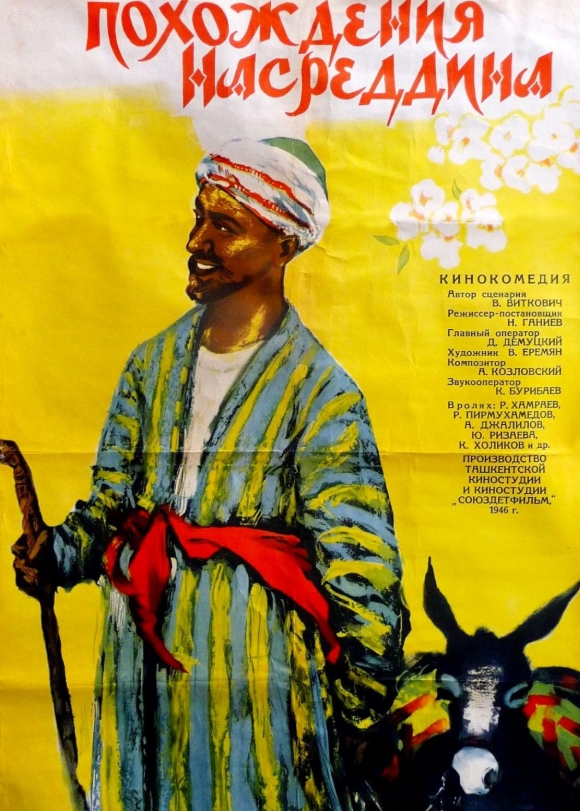
But the ideological intensification was considerable. The 1946 film pressed more heavily on the class-struggle dimension, the dialogues sharpening the political edge to the point where the character’s “proto-socialist” orientation was unmistakable. Religious authority was presented not as an incidental element of the setting but as a direct partner in oppression. The scene in which Nasreddin all but articulates Marxist economic theory — if masters shared profits with workers, what would the emir say? — demonstrates how thoroughly the traditional Sufi wanderer had been transformed into a revolutionary agitator. The name “Hodja,” which in Central Asian tradition signified both a religious title and an indicator of high social and spiritual standing, had been fully emptied of its original content and repurposed as a mark of affectionate familiarity.
Nasreddin in Khujand, or The Enchanted Prince (1959)
Based on Solovyov’s second novel — the one written in the labor camps — the 1959 Tajikfilm production directed by Amo Bek-Nazarov and Erazm Karamyan shifted registers again. Here the political didacticism softened somewhat, and the fairy-tale dimension expanded: the film leaned into the visual and narrative vocabulary of One Thousand and One Nights, with Eastern exoticism pushed into the foreground. Nasreddin appeared as a middle-aged man helping young lovers, wise and kind rather than politically pointed. The film was made during the Khrushchev Thaw, a period when the hard ideological edges of Stalinist culture were being sanded down, and that relative relaxation shows in the film’s more playful, less doctrinaire tone.
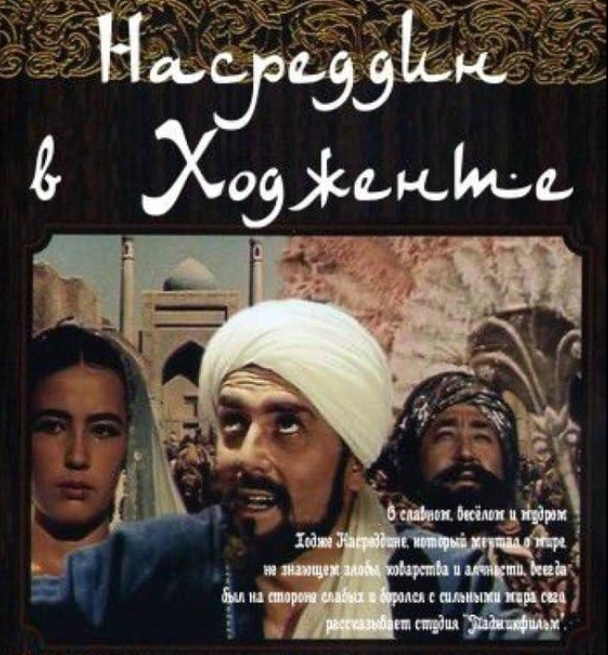
The Tajik Republic’s claim to Nasreddin here is notable. The character was being distributed not just across time but across geography — from Uzbekistan to Tajikistan — as if his ambiguity made him equally available to any Soviet republic that needed a local folk hero in approved socialist form.
The Twelve Graves of Khoja Nasreddin (1966–1967)
This film marks the most striking and subversive entry in the Soviet Nasreddin canon. Directed by Klementiy Mints and produced at Tajikfilm, it performed a conceptual move none of its predecessors had attempted: it brought Nasreddin out of his medieval setting and placed him in contemporary Soviet Dushanbe. Breaking the frame of the historical fairy tale, the film confronted the folkloric character with modern Soviet reality — and the encounter produced something melancholic, satirical, and philosophically sharp.
The premise — a medieval wise man bewildered and outraged by contemporary absurdities — allowed the film to be a critique of the present that could not easily be punished as such, since it wore the costume of folklore. The celebrated comedian Arkady Raikin praised the lead actor Bashir Safarogly’s performance as that of a “southern Chaplin” — and the Chaplin comparison is illuminating. Chaplin too was a trickster figure who used comedy to expose the brutalities of systems more powerful than any individual. The Nasreddin of The Twelve Graves (12 mogil Khodzhi Nasreddina) had quietly slipped his ideological leash and was using the freedom he had been given — to mock emirs and clerics — to mock the present as well.
This is the paradox that runs through the entire Soviet Nasreddin project: by recruiting a trickster, the state introduced into its own cultural machinery a figure whose defining characteristic is that he cannot finally be controlled. The trickster tricks everyone, including those who think they have domesticated him.
Later Films: The Taste of Halva (1975) and Look More Cheerfully (1982)
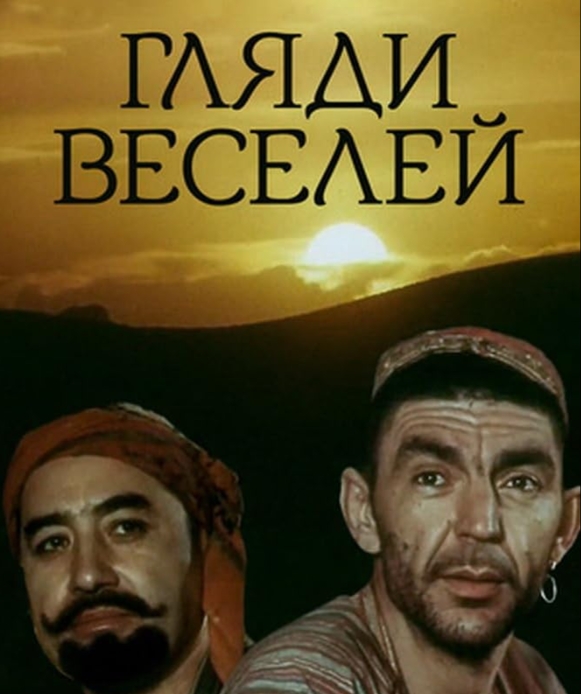
Pavel Arsenov’s 1975 musical fairy tale The Taste of Halva (Vkus khalvy) took the unprecedented step of narrating Nasreddin’s youth and formative years — the Soviet franchise had by now expanded to the point of requiring a prequel. By 1975, Nasreddin had become so thoroughly established as a Soviet cultural property that it was possible to imagine his entire biography. Marat Aripov’s three-part television film Look More Cheerfully (Glyadi veseley) (1982, Tajikfilm), in which Aripov himself played Nasreddin, represented the character’s full integration into the Soviet television landscape. Tajikfilm, as scholars have noted, functioned during these decades as something of a fairy-tale factory, producing not only Nasreddin films but an entire cycle of Eastern fantasias — harem intrigues, cunning viziers, beautiful princesses, and poor young men who triumph through wit.
The Mechanics of Transformation: What Soviet Cinema Did to Nasreddin
Across four decades of production, Soviet Nasreddin films accomplished a systematic transformation of their source material. The changes were structural, not merely cosmetic.
Secularization was the foundational operation. In the original Central Asian folklore tradition, the honorific “Hodja” indicated both social and spiritual standing, including the completion of the hajj. The name Nasreddin itself — Nasr al-Din — means “defender of the faith.” In Soviet literary and cinematic representations, these religious and spiritual layers were completely erased. What remained was a character who looked vaguely Eastern, wore vaguely Islamic dress, and lived in a vaguely medieval Muslim city — but whose interiority contained no religion at all. He had been hallowed out of his faith and refilled with class consciousness.
Class realignment followed from secularization. The traditional Nasreddin was a free-floating social type, unbound by class allegiance, equally likely to mock the rich, the poor, the learned, and the stupid. Soviet cinema gave him a fixed social identity: he was always of the poor, always against the rich, always on the right side of the Marxist social diagram. This made him far less interesting as a folk figure — the traditional Nasreddin’s comedy often came precisely from his refusal to take sides — but made him enormously useful as a vehicle for political education.
Orientalist framing structured the visual world of the films. Central Asian cities became exotic backdrops rather than lived environments: the minarets, bazaars, and gardens of Bukhara and Samarkand were rendered in a mode of aesthetic fascination that owed as much to European orientalist painting as to documentary observation. The people who inhabited these spaces were simplified into types — the corrupt moneylender, the pompous emir, the hypocritical cleric, the suffering poor — whose relationships were legible according to Soviet ideological categories even if their clothing was medieval Islamic. The “East” in these films was not a place where real, complex human beings lived. It was a stage set illustrating a lesson.
De-Turkification was among the most politically significant operations. By relocating Nasreddin to Bukhara, Khujand, and Dushanbe — and by presenting him as Uzbek, Tajik, or ambiguously “Central Asian” — Soviet cinema systematically severed his connection to Anatolia and the Ottoman-Turkish tradition. The 1943 film’s plot device of having the Turkish Sultan claim (falsely) to have beheaded Nasreddin is revelatory: Turkey becomes one of the villains, a rival power whose claims over the character are dismissed as lies, while Soviet Central Asia implicitly lays claim to his authentic legacy. The territorial dispute about a folk hero mirrored broader Soviet geopolitical interests in undermining Turkish nationalism and projecting Soviet influence among the Turkic peoples of the Middle East.
Russification of authorship completed the picture. The foundational literary text was by a Russian writer (Solovyov). The foundational film was directed by a Russian director (Protazanov) and starred a Russian actor (Sverdlin) performing in Russian. The character who was supposed to represent the folk tradition of Central Asia was, in his Soviet incarnation, largely a product of the Russian imagination about Central Asia. This was not incidental; it was structural. Soviet nationality policy promoted the “friendship of peoples” while ensuring that the ideological content of the resulting cultural productions flowed, at least initially, from the center to the periphery.
The Political Logic: Why Nasreddin?
The Soviet cultural system could have produced anti-feudal, anti-clerical films set in Central Asia without using Nasreddin. It chose Nasreddin for reasons that go beyond the obvious — that he was popular, funny, and available.
The first reason was the need to avoid the crudity of direct anti-Islamic propaganda. The anti-religious campaigns of the 1920s and 1930s had involved frontal attacks on Islamic practice — mosque closures, arrests of clergy, bans on religious education. These campaigns generated resistance, resentment, and sometimes violence. What the Nasreddin films offered was something the campaigns could not: an anti-clerical message delivered from within the tradition, through a figure that Muslim populations already loved. When Nasreddin mocked the mullah, it was — or could be presented as — a continuation of a native satirical tradition rather than a Russian imposition. The distinction was largely fictitious, given how thoroughly the character had been transformed. But it was a useful fiction.
The second reason was the wartime imperative. In 1943, with the Soviet Union fighting for survival, Stalin needed to mobilize every available resource, including the loyalties of the Muslim populations of the Caucasus and Central Asia, whose enthusiasm for the war could not be taken for granted. Nasreddin in Bukhara offered a cinematic argument: look, here is your own tradition, preserved and celebrated under Soviet rule. The implication was that the Soviet system protected and honored the cultures of its peoples — even as it systematically reshaped those cultures in its own image.
The third reason was exportability. Soviet cultural diplomacy during the Cold War was intensely interested in projecting influence into the decolonizing world — the newly independent nations of Asia and Africa, many of them with Muslim-majority populations. A Soviet Nasreddin film, showing a folk hero of the Muslim world celebrated and produced within the socialist system, could be screened in Egypt, Indonesia, or Turkey as evidence that socialism and Eastern culture were compatible, even mutually reinforcing. The argument was directed outward as much as inward.
The Trickster Tricks His Masters
There is a final, fitting irony in the story of Soviet Nasreddin. The trickster, by his very nature, is uncontrollable. Every ideology that recruits him discovers, eventually, that he has his own agenda.
The films of the 1960s and 1970s show this dynamic clearly. As the Stalinist certainties of the early Cold War gave way to the ambiguities of the Thaw and the Brezhnev years, Soviet Nasreddin began to change his function. He had been introduced as a weapon against feudalism and religion; he began to serve as a mirror held up to Soviet reality. The Twelve Graves of Khoja Nasreddin is the clearest example: a medieval folk hero transported to modern Soviet Dushanbe, bewildered by bureaucratic absurdity and social hypocrisy, offering through his very anachronism a critique of the present that would have been impossible to make directly. The film’s comparison of Nasreddin’s performance to a “southern Chaplin” is precisely right — Chaplin’s tramp, like Nasreddin’s fool, was always simultaneously inside and outside the system he inhabited, loving and mocking it in the same breath.
The Slavic literary scholar who has written most extensively on Nasreddin’s appearances in Russian and other Slavic literatures notes that what makes the character valuable to writers operating under censorship is exactly his ambiguity: his “foolish wisdom” creates a space of indeterminacy that state censors find difficult to police. You cannot easily punish a film for mocking an emir, when the official ideology encourages the mockery of emirs. But the emirs on screen can look uncomfortably like the officials in the audience.
This was the ultimate failure — and ultimate success — of the Soviet Nasreddin project. The state recruited a trickster and was surprised when he tricked it. The character designed to tell Central Asian Muslims that their own tradition endorsed socialism ended up telling Soviet audiences that their own tradition endorsed dissent. The weapon became a mirror.
The Question of Ownership, Revisited
When we return to the question with which we began — who owns Nasreddin? — the answer that emerges from this history is both simple and unsatisfying.
Turkey owns him in the sense that the best historical evidence places his origins in Anatolian soil, and in the sense that the Turkish folk tradition has preserved a Nasreddin of genuine depth and complexity — the large-turbaned elder whose comedy is inseparable from his learning and piety, not a sanitized proto-Communist but a full human being with contradictions intact.
Soviet cinema owned a different Nasreddin — a figure of its own invention, assembled from genuine folklore elements, a Russian novelist’s imagination, and the requirements of socialist cultural policy. This Nasreddin was, in a strict sense, a fabrication. But fabrications can have real power. The Soviet Nasreddin films were genuinely popular across the republics where they were shown. Audiences in Tashkent and Dushanbe and Baku laughed at the same jokes their grandparents had laughed at in oral tradition, even if the institutional apparatus that produced those jokes had different intentions than the storytellers of the past.
And then there is Nasreddin himself — the composite figure, the focal point, the trickster who has never belonged to any single tradition and has always belonged to all of them. In the end, the Soviet experiment with Nasreddin illustrates something he himself might have said: that the powerful always believe they are using the fool, and the fool always knows better.