Most viewers have experienced a moment in Martin Scorsese’s Goodfellas that few can fully articulate: Henry Hill walks through the back entrance of the Copacabana nightclub with his date Karen, and the camera follows him — not from a fixed angle, not with a cut, but in continuous, gliding pursuit. The camera doesn’t explain anything. It doesn’t editorialize. And yet you feel, with complete physical certainty, what it is like to be Henry Hill: to move through a world that parts for you, that bends around your presence, that treats you as the centre of gravity. That feeling isn’t in the dialogue. It isn’t in the performances alone. It is in the camera movement.
This is what makes camera movement one of the most powerful and most underappreciated tools in all of cinema. When we talk about a great film, we tend to talk about story, character, performance, score. But the camera — the way it moves, the speed at which it turns, the distance it keeps from its subjects — is constantly narrating alongside all of these things. Sometimes quietly. Sometimes deafeningly. Always with purpose, when the filmmaker is doing their job.
What follows is a thorough examination of the fundamental camera movements in cinema: where they came from, what they communicate, and which filmmakers have used them most brilliantly. This isn’t a technical manual. It is an invitation to watch films differently — to see not just what the camera is looking at, but to understand why it is moving the way it is.
Before the Camera Moved: A Brief History
To understand why camera movement matters, it helps to understand what cinema looked like before it moved at all.
The earliest motion pictures, shot in the 1890s by the Lumière Brothers and their contemporaries, were entirely static. The camera was placed on a fixed platform, pointed at its subject, and left there. This was partly a technological limitation — the cameras of the era were heavy, cumbersome machines with no mechanism for fluid rotation — and partly a conceptual one. Early filmmakers were still absorbing the idea that pictures could move at all. The idea of moving the camera as well seemed almost beside the point.
But filmmakers are, by nature, restless. In the early years, because most motion picture tripods had fixed camera mounts, panning and tilting were extremely rare before 1900, when more camera operators began using rotating tripod heads. Panning was initially established as a cinematic device after the turn of the century, first appearing in documentary films that contained a slow pan providing an extended view of a single location.
In 1903, tracking shots — also known as dolly or trucking shots — began to appear in narrative films. These shots required the camera to sit on a dolly, a small platform secured on wheels or tracks, which when rolled could move in and out, beside subjects, or even around them.
From there, the evolution accelerated. In the 1920s, filmmakers experimented with other ways to mobilize cameras, such as strapping them to themselves or to moving objects on set. Because of the heavy weight of 35mm cameras during the first half of the 20th century, truly handheld work was rare. But as cameras became lighter and more mobile, the camera could go virtually anywhere — handheld, on cranes, even from the air.
By the 1970s, camera operator Garrett Brown had invented the Steadicam, which provided smooth movement without the inconvenience of tracks, unlocking a new dimension of possibilities. And today, digital technology and CGI have extended the language further still, allowing camera movements that would have been physically impossible in any previous era.
But what is remarkable is that the fundamental vocabulary of camera movement — the pan, the tilt, the dolly, the trucking shot, the pedestal, the whip pan, the arc, the dolly zoom — was essentially established in the first half of the twentieth century and remains as relevant, as expressive, and as powerful today as it ever was.
Let us go through each one.
The Pan: Cinema’s Simplest Gesture
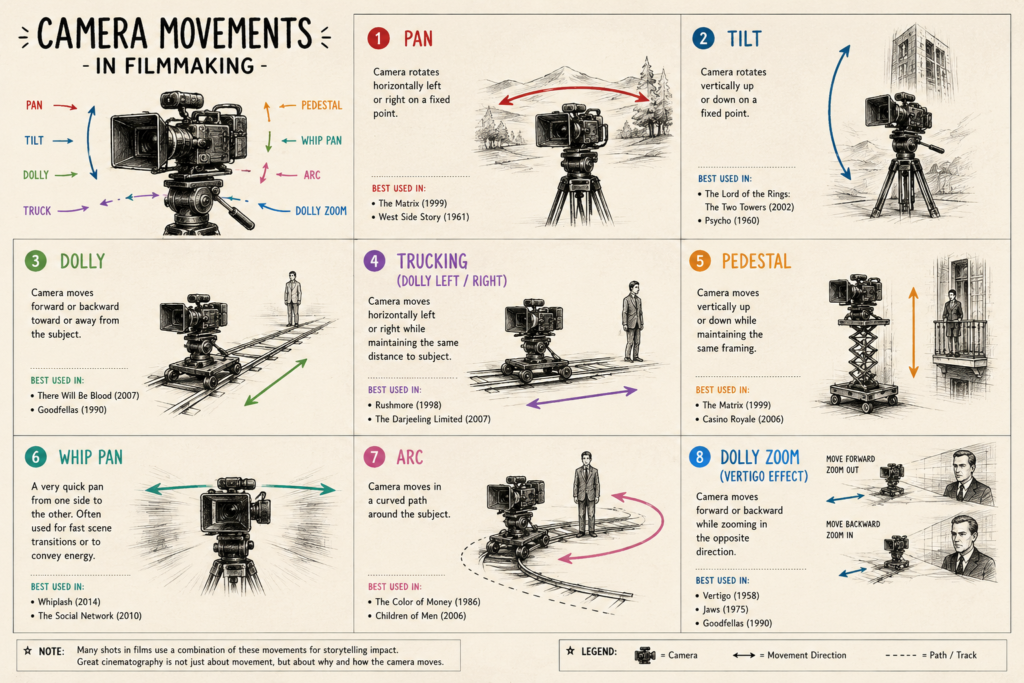
The pan is camera movement at its most elemental. A camera pan is horizontal movement in which the camera moves right to left or vice versa from a central axis. Taken from the word “panorama,” the physical position of the camera itself does not move. Instead, panning refers to the swiveling left or right from a fixed location. This differs from dolly shots in which the mounting system itself moves.
Think of it like turning your head. You remain standing in the same spot. You simply look left, then right. The pan does exactly this — it follows the natural sweep of human attention across horizontal space.
One of the earliest examples of a narrative pan occurs in The Great Train Robbery (1903), when the camera moves to the left to follow the bandits as they flee the train. It is a modest shot by contemporary standards — a utilitarian tracking of action — but it marks the beginning of something enormous: the understanding that the camera does not have to be a passive observer. It can chase, follow, pursue.
In its most basic form, the pan serves informational purposes. It connects two people in conversation. It follows a character across a space. It sweeps across a landscape to establish geography. But in the hands of a genuine filmmaker, the pan carries far more weight than mere information delivery.
Consider how Wes Anderson uses the pan — often combined with tracking — as a kind of comic and architectural punctuation. His pans are perfectly horizontal, often 90 or 180 degrees, executed at a consistent speed that becomes a visual signature. In The Grand Budapest Hotel, Anderson frequently uses pan shots to explore a setting and make things seem just a little more ridiculous. The pan in Anderson’s world isn’t just movement; it’s a statement about the precision, the control, and the slightly absurd formality of the universe he has constructed. When the camera pans in a Wes Anderson film, it does so like a well-trained butler crossing a lobby. The movement itself carries a tone.
The Coen Brothers offer a different application entirely. In the opening of No Country for Old Men, a series of wide, slow pans across the West Texas landscape communicate something the dialogue never says outright: this is a place of indifferent, almost geological scale. Human activity — violence, pursuit, ambition — will play out against a backdrop so vast it barely registers it. The pan, in those opening minutes, isn’t following anyone. It is contemplating emptiness.
Alfred Hitchcock used the pan throughout Vertigo to heighten his protagonist’s sense of disorientation — the camera turning as Scottie’s gaze turns, making the rooftops and staircases feel vertiginous, participatory, inescapable. The pan there is POV made visceral.
What connects all of these uses is the pan’s fundamental mimicry of human attention. Because it approximates the way we actually scan our environment, it can be used to guide audience attention almost invisibly, or, when deliberately exaggerated or slowed, to call attention to the act of looking itself.
The Tilt: Reading the Vertical World
Where the pan sweeps horizontally, the tilt moves vertically. The camera, still fixed in place, rotates upward or downward — revealing the height of a building, the stature of a character, the scope of a vista above or below.
A tilt shot moves the camera up or down, often to establish a sense of scale or dominance. Tilts enable filmmakers to capture the verticality of a film in moments of awe and spectacle.
The tilt has been part of cinema’s vocabulary almost as long as the pan. As camera technology improved, filmmakers began experimenting with panning and tilting movements to expand the visual scope of their shots. Tilting shots could reveal vertical elements or emphasize power dynamics. Tilts were often used in conjunction with pans to follow characters in motion.
The storytelling implications of tilt direction are intuitive and worth stating explicitly: tilting upward typically suggests scale, power, aspiration, or the overwhelming weight of something larger than the character. Tilting downward can imply vulnerability, the gulf below a character, or revelation of what lies beneath. A camera that tilts up to find a towering figure looking down is a camera that is telling you, without a word of dialogue, where power resides in this scene.
Some of the most frequent tilting movements capture a character on a ledge or show the bottom of a building and tilt upward for an establishing shot that sets up context and location. The Star Wars films use this repeatedly, opening with downward tilts into the vastness of space that immediately establish the cosmic scale of the drama about to unfold.
Steven Spielberg is perhaps the contemporary master of the tilt as emotional device. In Jurassic Park, he uses the tilt when introducing the dinosaurs. The camera tilt perfectly captures the emotions of the film’s characters while eliciting awe in the audience. Spielberg is known for his dynamic camera movement, and this scene is a perfect example of how a tilt-up can produce a profound emotional response. We see the humans first, then the camera tilts up and up and up until the brachiosaurus fills the frame, and in that moment the audience experiences, in real time, the same overwhelming wonder the characters are supposed to feel.
Christopher Nolan uses the tilt in Inception to convey the verticality of dream-world architecture — cities folding upward, buildings rising impossibly overhead. The tilt there becomes a grammar for the impossible.
One important distinction worth making: the tilt is sometimes confused with the pedestal move, which we will discuss shortly. The key difference is position. In a tilt, the camera remains in the same physical location and simply pivots its angle upward or downward. In a pedestal, the camera itself moves up or down through space. This distinction matters significantly for what each shot can reveal.
The Dolly: Moving Through Space
The dolly shot changed cinema fundamentally. It introduced depth — not just horizontal breadth — into the vocabulary of camera movement, and with it a new kind of cinematic intimacy and physical presence.
A tracking shot (also known as a dolly or trucking shot) propels the camera through space parallel to the ground. It can travel forward, backward, from side to side, diagonally, or in a circle. Whereas a pan or a tilt reveals what one might see when standing still and rotating one’s head, a track provides the impression of actually advancing into space.
This distinction — between looking and moving — is the essential point. A pan turns your gaze. A dolly moves your body. The emotional effect of the two is categorically different. A pan shot observes. A dolly shot participates.
The dolly must also be carefully distinguished from the zoom, a confusion that remains common even among frequent filmgoers. When you zoom, the camera stays still and the focal length of the lens changes, effectively magnifying the image. When you dolly, the entire camera physically moves through space. The result is that a zoom maintains a flat, two-dimensional relationship between foreground and background — they compress together — while a dolly preserves, and in fact emphasizes, the three-dimensional depth of the scene. The world around the subject remains spatially coherent. This is why dolly shots feel physically real in a way that zooms, especially obvious ones, frequently do not.
Paul Thomas Anderson’s There Will Be Blood contains one of cinema’s most controlled and purposeful dolly shots. In the film’s early sequences, the camera moves slowly toward Daniel Plainview as he works alone in barren, ancient earth — the dolly’s forward progress not triumphant but relentless, mirroring the character’s own grinding, unstoppable will. The camera doesn’t rush. It simply advances, as Plainview advances, toward everything he wants and everything he will become.
The dolly is also central to building tension in genre cinema. A slow push-in on a character’s face communicates psychological pressure in a way a cut to close-up does not — because the cut is instantaneous, while the dolly is felt as a process, as something closing in, something coming. Hitchcock understood this; Spielberg understood it; Scorsese has used it throughout his career.
The Trucking Shot: Keeping Pace With the World
The trucking shot — sometimes listed as a variant of the tracking or dolly shot, but distinct enough to merit separate attention — involves the camera moving laterally, side to side, while maintaining a consistent distance from and scale of its subject.
Rather than moving toward or away from the subject, the camera travels with it, keeping pace like a companion running alongside. The result is a sustained study of a person or object in motion — you travel through the environment together, and the world scrolls past you both equally.
This creates a particular kind of intimacy. Because the scale is maintained and the movement is shared, you inhabit the same velocity as the subject. You are not watching them from the outside; you are, in a sense, beside them.
No filmmaker has made more dedicated use of the trucking shot than Wes Anderson. In Rushmore, in The Royal Tenenbaums, in The Darjeeling Limited, and across his entire filmography, Anderson employs lateral camera movement with almost obsessive precision. His trucking shots tend to be perfectly horizontal, executed at a consistent pace matched exactly to the movement of the character. The effect is both warmly humanistic — the camera never abandons its subject, never outpaces them — and subtly stylized, because no one actually moves through the world at quite such a calibrated, elegant pace. Anderson’s trucking shots are affectionate fictions of orderly progress through a chaotic world.
The opening sequence of The Darjeeling Limited is one of the most beautiful applications of the technique: the camera travels with each character onto the train, keeping pace with them as they run, maintaining that perfect visual companionship, until the film’s central tensions and relationships are established — not through exposition, but through the shared physical experience of movement. Anderson’s trucking shots aren’t just elegant; they carry an emotional argument about connection.
But the trucking shot is also used effectively in far more kinetic contexts. Action sequences use lateral camera movement to keep a running figure in frame while allowing the audience to read the environment around them — the obstacles, the pursuers, the geography of danger.
The Pedestal: Rising and Falling Through Space
The pedestal — also called the boom shot by some practitioners — involves the camera moving vertically through space. Not tilting its angle up or down, but physically rising or descending.
This is the crucial distinction from the tilt. The fundamental difference between a boom shot (pedestal) and a tilt up or down is that tilting means we only change the camera’s vertical direction or viewpoint, but the camera itself remains physically in the same place. Whereas a boom shot combines both a change in camera direction and a physical movement of the camera up or down.
Consider a building. If you want to show the building from bottom to top, you have two options. With a tilt, the camera stays at ground level and angles its gaze upward — you see the building grow from the base up, but the camera’s relationship to the ground floor remains fixed. With a pedestal, the camera actually rises along with the building — it ascends, floor by floor, so that what you see changes not just in angle but in physical context. You are no longer at the bottom looking up. You are rising.
The pedestal is therefore most useful when the spatial journey itself matters — when the revelation isn’t just what’s at the top, but the experience of getting there. Action films with vertical set pieces — chases up staircases, escapes up buildings, anything with height as an active narrative element — use pedestal movements to make the audience feel the ascent or descent rather than simply observe it.
The Matrix offers a instructive example of pedestal and tilt working in combination. In one memorable sequence, the camera begins with a tilt — angling upward to read a space — and then transitions into a pedestal, the camera itself rising to continue revealing the environment. The combination of the two movements in sequence clarifies, perhaps more vividly than any diagram, the difference between looking up and actually going up.
The Whip Pan: Speed as Language
The whip pan is the regular pan taken to its logical extreme. Rather than turning the camera smoothly and deliberately from one point to another, the whip pan turns it so fast that the intervening frames blur into indistinction — a streak of motion that lands, suddenly, on a new subject or scene.
A whip pan shot is an intentional camera rotation on the x-axis so fast that it creates a blurring effect. It draws the audience’s attention from one point of interest in a scene to the next with rapid precision. A whip pan can be done on a tripod, dolly, gimbal, or even handheld.
This blurring is the point. The whip pan doesn’t want you to see the space between its two endpoints. It wants to obliterate that space — to make the transition feel abrupt, urgent, electric. The world between A and B doesn’t matter. What matters is the arrival.
This makes it enormously useful as a transition device. When edited so that one whip pan blurs outward and a second shot begins with a matching blur that resolves, the result is a seamless, energetic scene change that carries the kinetic force of the previous moment directly into the next. This technique — the whip pan match cut — has been used memorably in films like Scott Pilgrim vs. the World, where Edgar Wright uses it to create a hyper-stylized visual language that mirrors the energy of video games and comic books. Paul Thomas Anderson, Edgar Wright, Damien Chazelle, Wes Anderson, Sam Raimi, Peter Jackson, and Quentin Tarantino have all relied on the effectiveness of a good whip pan.
But it is in Damien Chazelle’s Whiplash that the whip pan finds perhaps its most thematically resonant modern application. In Whiplash, the camera moves rapidly back and forth between music instructor Terence Fletcher and drummer Andrew Neiman using whip pans. By using a whip pan rather than simply cutting back and forth, director Chazelle illustrates how in sync the characters have become while also making the scene feel as frenetic as jazz. The whip pan there isn’t just about speed — it’s about the tethering of two people in a relationship of terrible intensity. The blur between them is not separation; it is the electrical current that runs between student and teacher.
Quentin Tarantino uses the whip pan with a different kind of pleasure — as both an action device and, at times, a comedic one. In Kill Bill: Volume 1, whip pans are used during combat sequences to amplify the ballistic energy of each strike, each throw, each sudden movement. The camera doesn’t observe the fight; it participates in it, lurching with the violence.
The danger of the whip pan, used carelessly, is that it exhausts and disorients the audience without earning that disorientation. Used too frequently, it becomes noise. The filmmakers who do it best — Chazelle, Wright, Tarantino — understand that the whip pan is a form of punctuation. It must follow a sentence worth punctuating.
The Arc Shot: Orbiting the Centre of the Story
The arc shot — sometimes called an orbit shot — is among the most visually striking movements in cinema. The camera moves in a circular or semicircular path around its subject, orbiting them while keeping them at the centre of the frame.
An arc shot circularly follows a central subject — in other words, the camera goes around the subject, often in a semicircle or a full circle, dramatically emphasizing the central object or character.
The arc communicates something that no other camera movement can replicate: the sense that the subject is the axis around which the world rotates. When the camera orbits a person, the background revolves behind them — we see their surroundings from every angle, and in doing so we understand their spatial relationship to the world with an almost sculptural completeness. The person is the fixed point. Everything else is in motion around them.
This is why the arc shot is so often used at moments of climactic tension or revelation — the moment a villain reveals their plan, the moment a hero commits to their action, the moment two characters become definitively, irreversibly entangled. The orbiting camera announces: this is the centre. This is what everything revolves around.
Martin Scorsese’s The Color of Money contains a masterclass use of the arc. As Tom Cruise’s character works the pool table, the camera orbits both Cruise and the table itself simultaneously — circling without cutting, keeping the continuous arc running so that we see the table, then Cruise, then the table again, all in one unbroken movement. The most iconic arc shots of recent movie history are probably those from The Matrix trilogy, where they are used in many fighting and shooting scenes, often combined with the “bullet time” technique.
The arc in The Matrix pushed the technique into new technical territory. By combining camera movement with arrays of still cameras triggered in sequence, the Wachowski siblings crafted the ability to “freeze” an action while the arc continued — the now-legendary bullet-time effect. The arc shot there is not merely a cinematographic choice; it is the visual argument that Neo has become something beyond human, something around whom time itself bends.
The arc is also used to communicate psychological states. In horror and thriller contexts, an orbiting camera can suggest that a character is being circled — watched, hunted, surrounded. The movement that in other contexts communicates centrality and power can, with different music and a different pace, communicate paranoia and entrapment.
The Dolly Zoom: Cinema’s Most Unsettling Invention
And then there is the dolly zoom — perhaps the most technically demanding, most emotionally precise, and most imitated camera technique in the history of the medium.
A dolly zoom is an in-camera effect that appears to undermine normal visual perception. The effect is achieved by zooming a zoom lens to adjust the angle of view while the camera dollies — moves — toward or away from the subject in such a way as to keep the subject the same size in the frame throughout.
The result is something that the brain registers before the eyes fully process: the subject stays the same size, but the background warps — either rushing toward the viewer as the camera pulls back and zooms in, or retreating away as the camera moves forward and zooms out. The world distorts around the fixed subject. Perspective becomes unstable. The physical relationship between foreground and background, which we rely on to make sense of three-dimensional space, becomes untrustworthy.
The Vertigo Effect, also known as the “dolly zoom” or “zolly” shot, is a cinematographic technique that creates a disorienting and unsettling visual experience by simultaneously zooming in with a camera lens while the camera is physically dolly-tracked backward — or vice versa.
The effect was first created by Irmin Roberts, a Paramount second-unit cameraman, who devised the method for Alfred Hitchcock‘s film Vertigo. Interestingly, the concept for the effect was initially conceived by Hitchcock during the filming of Rebecca in 1940, but at that time he was unable to achieve it technically. Determined to bring his vision to life, Hitchcock revisited the idea years later in Vertigo, where he wanted to visually represent the sensation of vertigo — the dizzying feeling of fear and confusion associated with heights — that the protagonist Scottie Ferguson, played by James Stewart, experiences throughout the film. The effect perfectly encapsulated the character’s psychological state and became one of the most iconic shots in cinema history.
Vertigo went on to become not just one of Hitchcock’s best films but one of the most acclaimed films ever made — and the dolly zoom became its visual signature, so inextricably linked to the film that the technique bears its name.
Since Vertigo, the dolly zoom has been used across virtually every genre of cinema, though almost always in service of its original function: to communicate psychological disturbance, fear, or a sudden and destabilizing change in a character’s perception of their situation.
Steven Spielberg used it to devastating effect in Jaws, when Chief Brody spots a shark attack from the beach and the world suddenly seems to collapse away from him — the background rushing back as the camera advances, amplifying the horror of what he’s seeing. The effect communicates, in a single visual gesture, the dissociation of shock: the world goes wrong, perception fails, certainty dissolves.
Scorsese deployed it in Goodfellas when Henry Hill begins to understand the true danger of his situation — the dolly zoom there communicating paranoia, the sense that familiar surroundings have become hostile, that the ground beneath his world is no longer stable.
The dolly zoom shot is often referred to by different nicknames, including the vertigo shot, the zolly shot, the Hitchcock zoom, and the contra zoom. Each name captures a slightly different aspect of the technique — the zolly emphasizing its dual mechanical components, the Hitchcock zoom honoring its inventor, the contra zoom highlighting the oppositional relationship between camera movement and lens adjustment.
What makes the dolly zoom so uniquely powerful is that it doesn’t just show disorientation — it creates it. The viewer doesn’t intellectually understand that a character is disturbed; the viewer feels disturbed alongside them, because the visual grammar of the shot has made the world literally unstable. It is cinema operating at its highest register: not describing an emotion but engineering its experience.
The Static Camera: When Not Moving Is a Choice
Any examination of camera movement would be incomplete without acknowledging what might be its most profound option: stillness.
When a filmmaker chooses not to move the camera, that choice is as deliberate and as meaningful as any of the movements described above. A static camera holds a frame and demands that the drama come to it — that action, emotion, and revelation unfold within a fixed composition. This places an enormous burden on performance, staging, and editing, but it creates a different kind of authority. The world does not move for a static camera. The characters must contend with it.
In the early years of cinema — the 1890s and 1900s — most films were shot using static cameras due to technological limitations and the influence of theater staging. Filmmakers relied on careful composition, staging, and editing to create visual interest and narrative progression within a fixed frame. But what began as a limitation became, in the hands of certain filmmakers, an aesthetic philosophy.
Thomas Vinterberg shot Festen (1998) entirely with a handheld camera — not a stabilized, choreographed camera, but a camera held by a human operator who moved as human operators move, imperfectly, reactively, with the slight unsteadiness of someone genuinely present in the room. The result is a film that feels like documentary rather than fiction, like witnessed truth rather than constructed narrative. The camera’s relative stillness and mobility are not stylistic choices in any decorative sense; they are arguments about the nature of what we are watching.
The static camera is also the baseline against which all camera movement means anything. Movement signifies because stillness is the norm. When a camera that has been still begins to move, or when a film that has been kinetically mobile suddenly locks down into stillness, the change is felt immediately and viscerally. The grammar works both ways.
Combining Movements: The Full Vocabulary at Work
In practice, of course, these movements are rarely used in pure isolation. The most sophisticated filmmaking typically involves multiple movements within a single shot — a tilt that becomes a pedestal, an arc that incorporates a dolly, a trucking shot that ends in a whip pan transition. The vocabulary becomes a syntax, and the syntax allows for an expressive complexity that approaches, at its best, something like poetry.
Consider the opening shot of Touch of Evil (1958), in which Orson Welles sets a bomb in the trunk of a car and the camera follows that bomb — through a crane shot, a pan, a tilt, a trucking shot — across several city blocks and three minutes of screen time, until the bomb detonates. Every element of the scene’s geography, the players, the stakes is established in that single unbroken take, through the orchestrated combination of every movement type available. It is not a demonstration of technique for its own sake; it is technique serving an argument about surveillance, about the bomb as the organizing principle of the scene’s world, about the indifferent machinery of fate moving through a crowded city.
The introduction of dolly tracks and crane arms in the 1920s and 1930s allowed for more complex and fluid camera movements, expanding the cinematic vocabulary. Dolly shots could create a sense of depth and perspective, while crane shots could capture sweeping, high-angle views. Each new technological development didn’t replace the old vocabulary — it extended it, added new combinations and possibilities.
Why Camera Movement Matters
There is a temptation, when discussing technique, to treat it as separate from art — as the mechanical underpinning of something more elevated. This is a mistake. Camera movement is not the scaffolding of cinema; it is part of the structure itself.
When a dolly zoom distorts the world around a frightened character, the audience feels fear, not just comprehension of it. When an arc shot orbits a character at the moment of their decisive choice, the audience feels the weight of that choice, not just its narrative significance. When a whip pan cuts between two musicians locked in furious dialogue, the audience feels the electrical current between them.
The best camera operators and directors understand something that is easy to state and difficult to practice: every movement must be earned. A camera that moves without cause is a camera that draws attention to itself at the expense of the story. But a camera that moves with complete and invisible purpose — with a movement so exactly right for the moment that you feel the emotion before you register the technique — is a camera that has turned mechanical physics into something close to feeling.
Cinema is, at its core, a language. Camera movement is its grammar. And like all grammar, it works best when you feel it rather than see it — when the rules are so internalized by the filmmaker that the audience never has to think about them at all, only experience what they make possible.
The next time you watch a film, watch the camera. Notice when it moves, how it moves, and when it chooses to hold still. Notice when the world seems to rush away from a character, when the camera keeps perfect pace with someone running, when it orbits a table like a satellite. Notice what you feel in those moments.
You will find that you feel quite a lot!